


"The market is eager for a rate cut in December," said Goldman Sachs traders: sentiment is low, but many clients believe "if Bitcoin stops falling, US stocks will still have momentum by the end of the year."

Goldman Sachs stated that multiple technical indicators show the market is in a dangerous zone, and the market is calling for the Federal Reserve to cut interest rates in December. However, some positive factors are emerging, concerns about economic growth may be overstated, and liquidity conditions are expected to improve... Many of Goldman Sachs' clients view high-beta assets like Bitcoin as risk appetite indicators, believing that if Bitcoin's performance improves, a year-end rebound may restart
Despite the S&P 500 index only retreating a few percentage points from its historical high, market trading sentiment has plummeted. Goldman Sachs' chief trader Brian Garrett stated that although there was a 100 basis point rebound on Friday, it was seen as one of the "most failed" rebounds in recent years, with the atmosphere on the trading floor resembling that of a market crash.
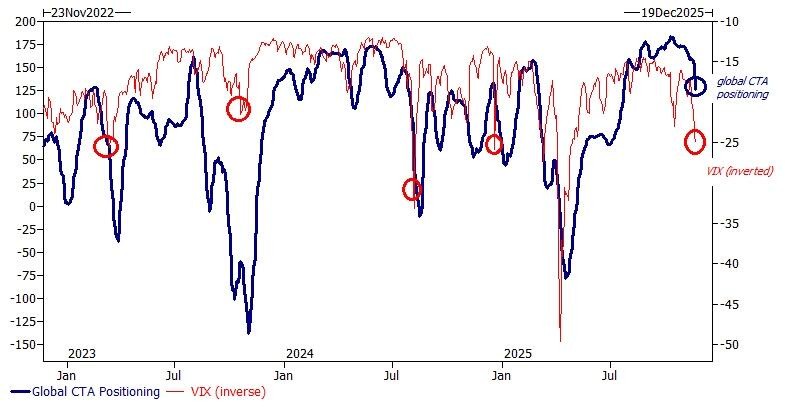
Multiple technical indicators from Goldman Sachs show that the market is in a dangerous zone: liquidity is being exhausted as volatility rises, the Gamma value of the S&P 500 has turned negative, defensive sector rotation has intensified, systemic trading thresholds have been breached, and volatility indicators are flashing panic signals. The market is calling for the Federal Reserve to cut interest rates in December.
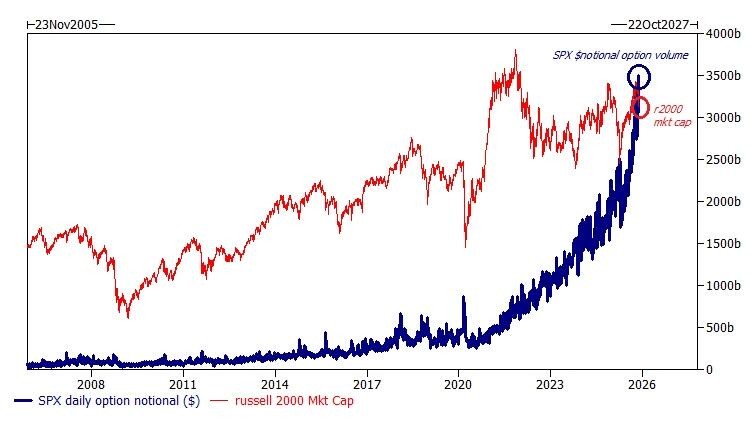
This sentiment split is evident in the data. The average daily trading range of the Nasdaq 100 index is close to 3%, the S&P 500 index exceeds 2%, while the average daily trading volume of S&P 500 options has reached a historic high of $3.5 trillion, surpassing the total market value of the entire Russell 2000 index.
Nevertheless, some positive factors are emerging. Goldman Sachs pointed out that concerns about economic growth may be overstated, liquidity conditions are expected to improve, and the AI productivity theme is gaining more attention in client conversations. Many clients view high-beta assets like Bitcoin as indicators of risk appetite, believing that if Bitcoin's performance improves, a year-end rebound may restart.
Capital Flow: Accelerating Defensive Rotation
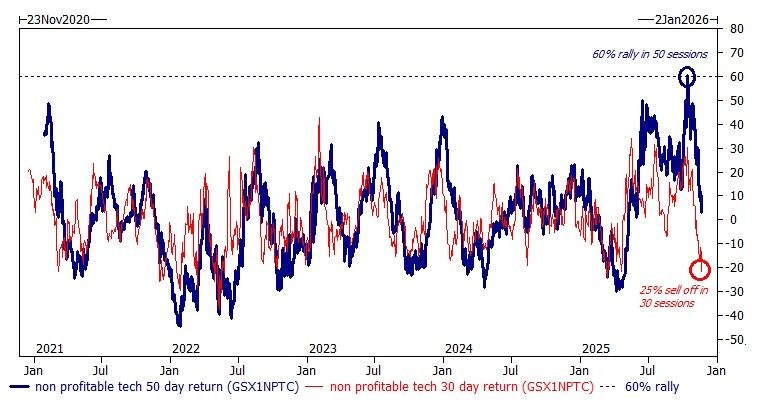
U.S. stocks have faced buying pressure for the third consecutive week, but investors continue to shift their allocations towards the upper end of the defensive chain, buying healthcare and durable consumer goods sectors while selling off "unprofitable" sectors. Notably, unprofitable tech stocks surged 65% over the two months from August to October, but have plummeted 25% in the past month, with investors increasing their short positions.
Goldman Sachs' research team analyzed the holdings data of institutions managing trillions of dollars in assets, showing that hedge funds and mutual funds are consistently overweight in the healthcare sector, while the sector that is consistently underweight is information technology—this consensus is quite rare.
Data from prime brokerage books indicate that total exposure has reached high levels, with investors continuing to adjust their allocations along the defensive sector chain. The thematic strategy team summarized: "Clients have been in a buying strike, and the uncertainty of key themes has led to a more defensive posture, with capital flows leaning towards AI sector sell-offs and momentum hedging."
Systematic Selling Pressure: Just Beginning
The S&P 500 index finally broke below a short-term threshold this week, having tested that level twice before. Currently, the S&P 500 index shows negative momentum compared to the Russell 2000 and Nasdaq 100 indices, and is expected to face large-scale stock supply: if it remains flat for a week, it will bring $50 billion in selling pressure, and if it remains flat for a month, it will result in $62 billion in selling pressure—this means that selling pressure is highly front-loaded.
Goldman Sachs' futures strategy team stated: "We have just broken through this level, so technically, the selling has just begun. In the upcoming trading sessions, the scale of selling and forecasted scale may increase significantly." The team likened the current situation to "the first half of the first inning, with two outs, but the visiting team has the bases loaded"—it has only been 4 days since breaking the short-term threshold Negative Gamma values do not help stabilize the market. Goldman Sachs' Gamma calculation shows a negative $2 billion as of Friday, and it will not turn positive at any recent point.
Derivatives Market: Panic Signals Emerge
Multiple stock volatility indicators have issued warnings. The "volatility pressure" index closed at 9.5 points (out of 10) on Friday. Top-level liquidity has evaporated, and the VIX implied volatility surged after Nvidia's earnings report.
The average daily trading range of the Nasdaq 100 index is nearing 3%, while the average daily trading range of the S&P 500 index exceeds 2%. These ranges are far from calm levels, and implied volatility needs these ranges to narrow significantly to decline—although this is an excellent time for intraday Gamma hedgers.
It is worth noting that the average daily trading volume of S&P 500 options has now reached $3.5 trillion, setting a historical high, officially surpassing the total market capitalization of the Russell 2000 index (the market capitalization of 2,000 companies compared to the nominal daily trading volume of S&P 500 options).
Positive Factors Begin to Emerge
Despite the gloomy market sentiment, Goldman Sachs points out several potential positive factors: concerns about economic growth may be overstated, clarity in Federal Reserve policy, liquidity support, high levels of uncertainty have been priced in, and AI productivity gains may extend to non-tech sectors.
As of November 17, the Atlanta Fed's latest forecast for third-quarter GDP is 4.1%, which is quite high—especially against the backdrop of a classic head-and-shoulders pattern in the cyclical/defensive sector ratio. Although several cyclical sectors, such as regional banks, transportation, chemicals, low-income consumers, and small businesses, are performing poorly, Goldman Sachs' clients believe that growth in the first half of 2026 should benefit from tax legislation, and the tax revenue situation for middle-income consumers will be favorable, making this divergence noteworthy.
Liquidity conditions are expected to improve. Over the past month or so, Treasury repo rates have risen and become more volatile, with reserves dropping to the lowest level in this cycle. This prompted the Federal Reserve to announce at its October meeting that quantitative tightening would end this month. These pressures have been more persistent than the Fed expected, so it is anticipated that the Fed may begin purchasing Treasuries in the new year to expand its balance sheet. As the Treasury's cash balance declines and reserves are rebuilt, conditions may slightly ease in the coming week.
The theme of AI productivity is gaining more attention in client conversations. If companies improve productivity and generate more revenue through the use of AI, this will benefit the non-tech sector of the S&P 500, but it has not yet been reflected in stock prices. If this becomes a reality in the coming years, its value will surpass the normal valuation premium. This remains a focal point of debate Goldman Sachs believes that the sell-off since mid-October has mainly focused on high beta factors and popular themes such as quantum computing, Bitcoin-sensitive stocks, rare earths, and strategic national investments. Many clients view these as future risk appetite indicators, believing that if Bitcoin's performance improves, a year-end rebound may restart
