


Morgan Stanley: 2/3 of large-cap stocks have nearly retraced 10%, the adjustment in US stocks is "nearing its end"

Morgan Stanley believes that although the risks related to the Federal Reserve's monetary policy may persist in the short term, the significant adjustment in the U.S. stock market is nearing its end rather than just beginning. The recent adjustment provides investors with a good opportunity to position themselves for 2026. Analysts maintain their bullish stance for the next 12 months, with a focus on recommending consumer goods, healthcare, financials, industrials, and small-cap stocks
Morgan Stanley believes that the short-term volatility in the U.S. stock market caused by the Federal Reserve's monetary policy and liquidity tightening provides an opportunity for bulls to increase their positions.
According to a report from Morgan Stanley's Michael J. Wilson research team on November 24, although the S&P 500 index has only retraced 5%, two-thirds of the top 1,000 companies by market capitalization have retraced more than 10%, indicating that the internal adjustment of the market has been relatively sufficient.
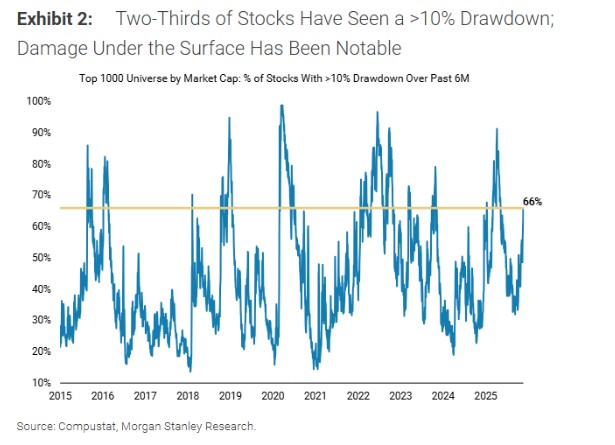 (Two-thirds of stocks have experienced declines of over 10%)
The report points out that momentum stocks in the U.S. peaked on October 15, when the Treasury General Account (TGA) significantly increased due to the government shutdown. The S&P 500 index peaked on October 29, the day of the Federal Reserve meeting, when Powell stated that a rate cut in December was "far from a done deal."
Morgan Stanley believes that although risks related to monetary policy may persist in the short term, the significant adjustment in the U.S. stock market is nearing its end. Analysts maintain a bullish stance on the U.S. stock market for the next 12 months, with a focus on recommending consumer goods, healthcare, financials, industrials, and small-cap stocks.
Index "Calm," Individual Stocks "Bleeding"
Morgan Stanley points out that the recent U.S. stock market appears calm on the surface, with the S&P 500 index experiencing a limited pullback of about 5%. However, the situation beneath the surface is starkly different.
Data shows that among the top 1,000 large companies by market capitalization, as many as two-thirds (66%) of stocks have experienced a deep pullback of over 10%. This divergence stems from two main factors:
- First, high-momentum stocks are more sensitive to liquidity tightening, having peaked after the U.S. Treasury General Account (TGA) began to significantly rise on October 15;
- Second, high-quality indices represented by the S&P 500 and Nasdaq 100 reacted more violently to the hawkish signals conveyed by the Federal Reserve during the Federal Open Market Committee (FOMC) meeting on October 29.
(The standard index fell on the day of the October Federal Reserve meeting, but liquidity had already begun to tighten significantly beforehand)
The report suggests that this widespread and deep adjustment of individual stocks is a positive sign, indicating that the market correction has entered its later stage.
Analysts even believe that the final phase of this adjustment may involve a "catch-up" decline of the previously leading large technology stocks. At the same time, this monetary policy-driven adjustment provides a "good opportunity" for investors optimistic about a mid-term recovery to increase their positions.
Federal Reserve's Direction a Mystery, Short-term Volatility May Intensify
The core uncertainty in the short-term market trend lies in the Federal Reserve's policy path The research report analyzed various "alternative" labor market data as of the end of October, finding that multiple indicators show signs of weakness, but not an accelerating trend.
ADP employment data, U.S. Challenger job cut announcements, unemployment expectations from the University of Michigan consumer confidence survey, implied unemployment rate from the Chicago Fed model, WARN layoff notices, and the number of continuing unemployment claims all indicate a further slowdown in the labor market.
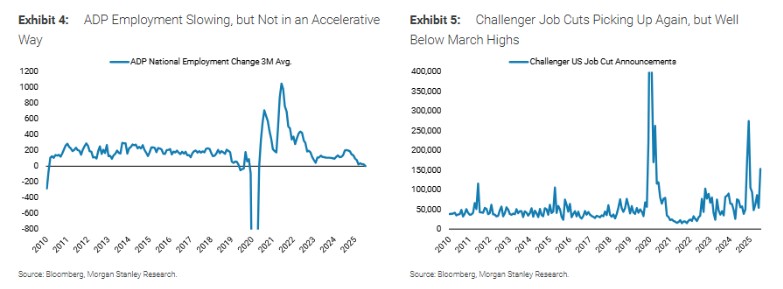 (Left image: ADP employment data growth slows but does not show an accelerating trend; right image: Challenger report shows layoffs intensifying again but the extent is still far below the peak level in March)
Previously, due to the U.S. government shutdown, the official September employment data was delayed, showing that the number of new jobs exceeded expectations, but the unemployment rate unexpectedly rose to 4.4%, exacerbating market confusion.
More critically, the official employment data for November will be released on December 16, later than the FOMC meeting on December 10. This means that the Federal Reserve will not be able to reference the latest labor market conditions when making its decision on whether to cut interest rates in December.
This information vacuum may lead to continued market price fluctuations in the short term. However, Morgan Stanley pointed out that the short-term weakness in the stock market or financing market may actually increase the probability of the Federal Reserve "taking preemptive action," thereby strengthening the structural bullish outlook in the medium term.
Liquidity Constraints Are Easing
Morgan Stanley noted that high-momentum stocks and speculative growth stocks in the U.S. stock market are more sensitive to liquidity constraints.
When bank reserves decline, TGA account balances rise, and the Federal Reserve has not yet announced the end of quantitative tightening (QT), the market faces short-term pressure. The widening SOFR-OIS spread reflects the recent tight financing conditions, which coincides with the rise in TGA.
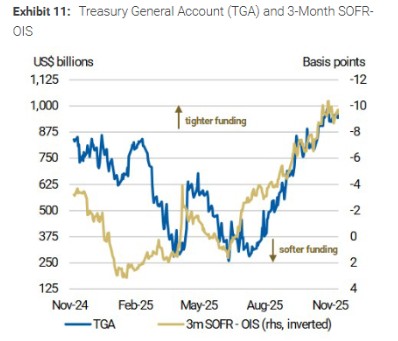 (The TGA account and 3-month SOFR-OIS rate trends are highly correlated)
However, as liquidity conditions improve, these pressures are expected to ease.
The research report predicts that with the end of the U.S. government shutdown, TGA account balances will see a significant decline in the coming weeks, followed by a rebound to about $850 billion by year-end, which should boost liquidity conditions in the short term.
Additionally, the Federal Reserve will end balance sheet reduction on December 1, which will also help boost market liquidity to some extent.
Morgan Stanley believes that the key observation indicator is whether the asset classes most sensitive to liquidity in the next two weeks (high beta and speculative growth stocks, cryptocurrencies, gold) can achieve sustained relief.
2026 Outlook: Standing Opposite the Market
Morgan Stanley's latest 2026 outlook report contains several views that contradict market consensus First, the institution believes that the market is in the "early cycle," while the market consensus considers it to be in the "late cycle."
Second, there is an optimistic expectation for the earnings growth of companies related to the Nasdaq index. The research report forecasts a 17% growth in earnings per share by 2026, while the bottom-up consensus among sell-side analysts is 14%, and the buy-side consensus is even lower than 14%.
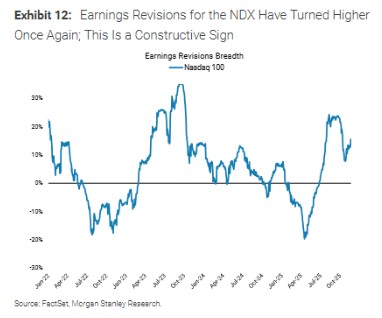 (The earnings forecast adjustments for Nasdaq index-related companies have increased.)
The most controversial aspect may be the institution's upgrade of small-cap stocks and non-essential consumer goods to an overweight rating.
Morgan Stanley's strategy team stated that after being underweight on the consumer goods sector for most of the past 3-4 years, they are now optimistic about the sector's performance in the early cycle context.
The research report emphasizes that the release of pent-up demand, the shift in consumption from services to goods, declining interest rates, strong household balance sheets, and extremely depressed market sentiment/positions all indicate that this sector will outperform the market.
In fact, during the recent decline in U.S. stocks, non-essential consumer goods, financials, industrials, and small-cap stocks have performed well relative to the S&P 500 index.
Morgan Stanley is Confident About 2026
The research report emphasizes that even during the pullback in U.S. stocks, the support from company fundamentals remains strong. This round of decline is merely a "policy and liquidity-driven adjustment," rather than strong evidence of a fundamental collapse.
Due to strong fundamentals, the breadth of earnings revisions for the Nasdaq 100 index increased last week.
Data shows that the net profit expectations for the major indices over the next 12 months are all on an upward trend, with small-cap stocks showing the strongest growth momentum, consistent with Morgan Stanley's positive view on small-cap stocks.
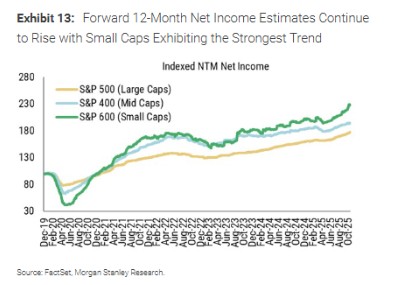 (The net profit forecast values for 12 months later continue to rise, with small-cap stocks showing the strongest growth momentum.)
Morgan Stanley expresses confidence in a bullish stance on U.S. stocks over the next 12 months, advising investors to view any further short-term weakness as an opportunity to increase long positions, especially in their preferred sectors.
