

Gemini 3, is it "cursed" out by Sergey Brin?

Under the impact of ChatGPT, Google launched the conversational AI Bard, but the results were unsatisfactory. Google founder Sergey Brin returned and personally wrote code, promoting the merger of Google Brain and DeepMind into Google DeepMind. Brin had internal disputes over the prohibition of using Gemini for coding, which was ultimately resolved with the support of Sundar Pichai
When ChatGPT burst onto the scene at the end of 2022, the entire tech industry was caught off guard by this sudden wave of conversational AI.
At that time, Google, a giant that had been deeply involved in AI for over a decade, appeared particularly silent. It had a solid technological foundation but did not immediately present a matching product in response.
In no time, it was labeled by outsiders as "slow to react" and "losing its advantage."
To cope with the impact brought by ChatGPT, Google hurriedly launched the conversational AI Bard, but Bard's debut not only failed to turn the tide but also sparked a new round of skepticism due to inaccurate answers and unstable experiences.
On the other hand, OpenAI was continuously rolling out blockbuster products one after another.
Faced with the overwhelming competitive pressure, Google co-founder Sergey Brin returned in "founder mode" and even wrote code himself. Internally, Google began a major integration, merging Google Brain with DeepMind to form Google DeepMind.
In fact, Brin's return largely saved Google.
Gemini's Code Writing Ban Leads to a Heated Argument
In a recent interview, Brin revealed an interesting incident.
His exact words were:
"I recently had quite a heated argument within the company because we had a list of tools that could be used for coding and those that couldn't.
And Gemini was surprisingly on the banned list.
The reason was that Gemini had to remain pure and couldn't be used... for a bunch of particularly strange reasons that I couldn't understand at all.
Clearly, Gemini's coding capabilities are excellent, yet for some inexplicable reason, someone added it to the internal website's blacklist.
So I had a fierce argument with them. After a shocking bureaucratic process, I finally resolved the issue.
I even told Sundar Pichai about it, and he was very supportive of me. Because I really couldn't deal with those people anymore; this matter had to be handled by Pichai.
I was extremely frustrated.
So can you imagine that feeling? In a company, the people you didn't personally hire form a bureaucratic system, and then you, as the founder, have to go back and fight against it; it's really a very bizarre experience."
Brin's complaints laid bare the peculiar situation at Google, with thickening processes, increasing rules, inaccurate product positioning, and severe bureaucracy.
Imagine if Brin hadn't returned; Gemini might still be on the banned list for coding, reduced to an AI that could only chat, tell jokes, and answer trivia.
Now, everyone is going wild using Gemini to write code, which is one of Gemini's standout features.
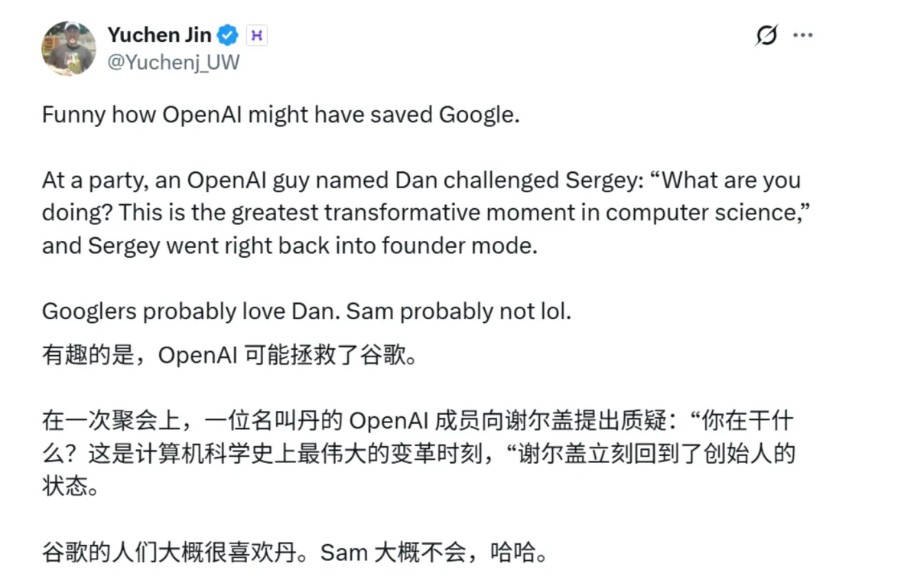
In fact, Brin's return can also be attributed to a person from OpenAI named Dan. In 2019, Brin had already begun to step back, stating that he wanted to do other things, like sitting in a café or reading physics books However, at a gathering, a person named Dan questioned Brin: What are you doing now? This is the most transformative moment in the history of computer science! You are part of computer science itself.
This statement hit Brin like a slap on the forehead, and he realized he needed to do something. At that time, Google happened to be in an awkward phase, lagging behind others, and just like that, Brin's founder mode was fully activated, returning to the front lines.
Upon his return, Brin didn't waste a moment. We can sense this from his previous interviews. "I've basically been working every day recently. To be honest, I felt a bit uneasy not going to the office today, which was also why I hesitated a bit about whether to come. But I'm glad I ultimately did.
As a computer scientist, I've never seen anything as exciting as the development of AI in recent years. It's truly astonishing.
What has happened in the past decade has completely exceeded imagination. As a computer scientist, I now feel like I'm shocked by new breakthroughs almost every month. You must also be using various AI tools, and every month there's some brand new capability emerging. And I'm probably twice as shocked as the average person: Wow, computers can actually do this? So, for me, returning to technical work is because I don't want to miss this era."
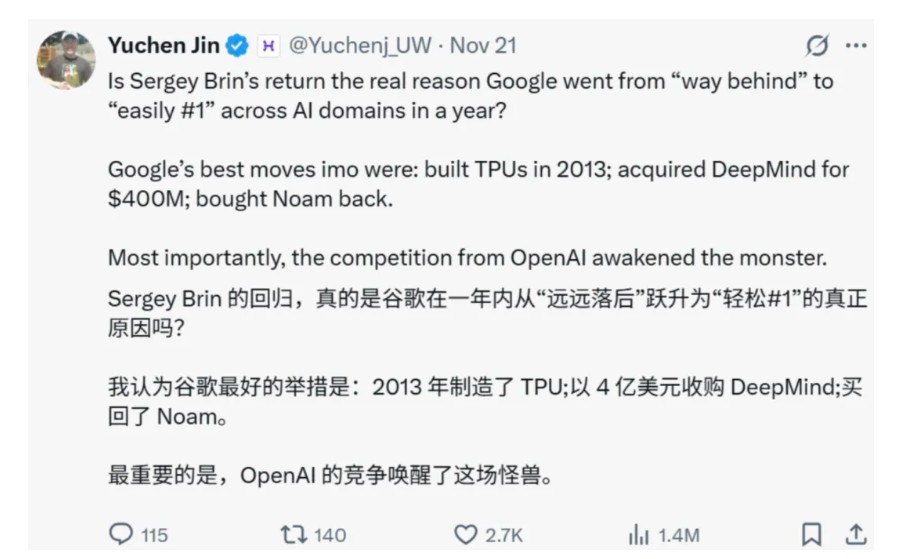
Some have also pointed out that Google has gone from being far behind in the AI field to easily taking the lead in just one year, and the real reasons go beyond Sergey Brin's return. There are also Google's strategic moves in key areas:
Building TPU since 2013;
Acquiring DeepMind for $400 million;
Bringing Noam (Shazeer) back.
But the most important point is: competition from OpenAI has awakened this sleeping giant.
In any case, last week, with the consecutive launch of Gemini 3, Nano, and Banana Pro, Google's throne in the AI field can be said to be firmly established.
Altman reveals Google's resurgence brings "short-term pressure," OpenAI aims to double down on Shallotpeat in response
From the reactions of competitors, we can also see how successful Google's strong return has been.
According to reports, recently OpenAI CEO Sam Altman told employees in a memo that Google's recent progress in the AI field—especially the Gemini 3 project—could bring short-term pressure to OpenAI. This rare "frankness" undoubtedly sends a signal that with Gemini 3 making a strong comeback, Google's long-standing "invincible" position is beginning to shake, making things tougher for OpenAI On one hand, the influence of Anthropic Claude in the coding model space has been giving OpenAI a "headache" for quite some time, and now Google Gemini 3 is catching up, even surpassing OpenAI in key areas. OpenAI, which originally held the banner as the technological leader moving towards AGI, has been significantly impacted, and the situation has reversed in an instant.
On the other hand, corresponding to the technological stagnation, OpenAI is also facing enormous expectations for computing costs, which has raised concerns among investors. Currently, OpenAI's market valuation is as high as $500 billion, never before so high, but its revenue is only $13 billion, with an expected loss of $7 billion by 2028. Additionally, OpenAI is continuously pouring hundreds of billions of dollars into infrastructure... The huge gap between the "crazy inflated" market value and the "modest" actual profitability undoubtedly puts it on the edge of danger.
In contrast, the established tech giants are much more "steady." Google owns YouTube, Search, Gmail, Maps, and the Android system, along with billions of users, creating a mature ecosystem accumulated over many years that brings diversified revenue sources. Data shows that Google's annual revenue exceeds $300 billion, primarily from advertising and cloud services, allowing its AI layout to be more of a strategic investment, giving it the confidence to conduct various "money-burning" experiments and investments without worrying about short-term profits.
This strong funding, proprietary hardware, and decades of data processing experience are undoubtedly difficult for startups to replicate, even for OpenAI.
Of course, OpenAI is not discouraged by this. Sam Altman still believes that OpenAI will maintain its lead in the long term. He emphasized in a memo, "I don't want this memo to seem negative — our company is currently doing exceptionally well... and I expect this situation to continue." To this end, he revealed the upcoming response strategy, which centers on developing a new model codenamed Shallotpeat, specifically aimed at improving and addressing the identified pre-training flaws.
Additionally, OpenAI plans to focus on the automation of AI research itself, which is a meta-method aimed at significantly shortening the new model development cycle. This is not just about efficiency optimization but attempts to fundamentally change the competitive landscape: if AI systems can accelerate their own evolution, it may weaken the structural advantages of existing participants with vast resources.
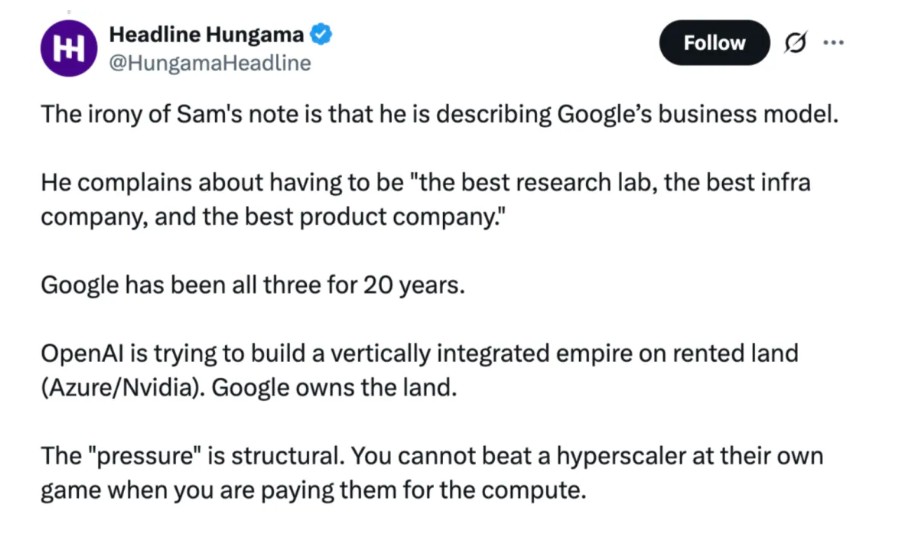
In the end, Sam Altman stated, "We have to do so many tricky things at the same time — build the best research lab, the best AI infrastructure company, and the best AI platform/product company — this is indeed very tricky, but this is our destiny. And I won't go to any other company for a position change."
Interestingly, after Sam Altman's memo was reported, some netizens "sharply commented" on his vision for OpenAI's future: he said OpenAI must become "the best research lab, the best infrastructure company, and the best product company," but isn't that just Google's business model? Google has been a combination of these three for the past 20 years...
Risk Warning and Disclaimer
The market has risks, and investment requires caution. This article does not constitute personal investment advice and does not take into account the specific investment goals, financial situation, or needs of individual users. Users should consider whether any opinions, views, or conclusions in this article are suitable for their specific circumstances. Investment based on this is at one's own risk
