
Nuclear power revival + supply concentration, has uranium reached the starting point of a decade-long bull market?
 I'm LongbridgeAI, I can summarize articles.
UBS believes that the global nuclear energy revival is driving uranium demand into a long-term growth channel, with expectations that demand will increase by over 50% by 2035. The supply side is highly concentrated, and major producers are adopting a "value-first" strategy, leading the market to enter a continuously expanding structural shortage after 2030. Once utilities sign long-term contracts on a large scale, it could trigger a stepwise increase in uranium prices, initiating a decade-long bull market cycle
Under the global energy transition and decarbonization wave, a "nuclear renaissance" is brewing.
According to the news from the Wind Trading Desk, a report titled "Uranium 101: Fueling the Nuclear Renaissance" released by UBS on November 24 shows that uranium, a key fuel for nuclear energy, is at a critical turning point in its market. A structural demand wave driven by the "nuclear renaissance" is colliding with a highly concentrated and supply-constrained supply pattern, laying the foundation for a decade-long bull market cycle for uranium prices.
As the global demand for low-carbon, high-base-load electricity continues to grow, nuclear energy is returning to the center stage of energy policies in various countries. Marked by the declaration at the COP28 climate conference to "double nuclear power generation capacity by 2050," the strong momentum of global nuclear power deployment is fundamentally changing the long-term demand outlook for uranium. UBS predicts that global uranium consumption will increase by more than 50% by 2035.
At the same time, supply-side bottlenecks are becoming increasingly prominent. Global uranium mine supply is highly concentrated in a few countries and producers, and these industry giants are adopting a "value over volume" strategy, unwilling to release idle capacity until long-term contract prices reach their incentive levels. This supply discipline, combined with insufficient investment in new projects and risks of development delays, severely limits supply elasticity.
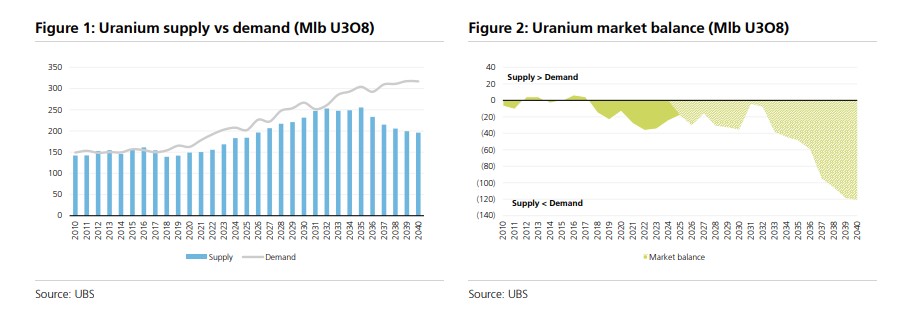
UBS believes that this means the uranium market will enter a state of persistent supply shortage starting in 2025, with the gap significantly widening after 2030. Although utility companies are currently slow to sign long-term procurement contracts, this demand "can be delayed but cannot be avoided." UBS predicts that once contract signing accelerates, the market will witness a structural step-up increase in uranium prices.
Super Cycle Consensus: Geopolitical Risks and Policy Restructuring
The subsequent trend of the uranium market has formed a general consensus on Wall Street. An article from Wall Street Insight noted that Barclays further pointed out in its latest research report that the combination of geopolitical risks and the "nuclear super cycle" is the core driving force behind this multi-year bull market.
-
The "Sword of Damocles" of Geopolitics: Barclays' analysis shows that the vulnerability of the uranium supply chain lies not only in upstream minerals (with Kazakhstan accounting for nearly 40%) but also in the midstream processing stage. About 40% of the global uranium conversion and enrichment capacity is controlled by Russia, meaning that Western countries are heavily reliant on geopolitical adversaries for critical nuclear fuel segments. The United States, as the world's largest nuclear power consumer (accounting for over 25%), produces less than 1% of the global total, creating a significant supply-demand mismatch that makes its energy security exceptionally fragile.
-
Policy-Driven Supply Chain Restructuring: In the face of supply risks, policy shifts in Europe and the United States have significantly accelerated. In the U.S., with uranium designated as a strategically important mineral and the signing of related executive orders, the aim is to "rebuild domestic control over the uranium fuel cycle"; the EU's "Roadmap to Completely Eliminate Dependence on Russian Energy" has also been put on the agenda. These policies have directly stimulated the market's reassessment of supply chain restructuring opportunities, as evidenced by the soaring stock prices of related companies like Cameco and Centrus Energy, reflecting investors' recognition of this logic
-
Long-term Demand Surge: Barclays cites predictions from the World Nuclear Association, indicating that driven by a nuclear energy supercycle, global uranium demand is expected to surge from 175 million pounds in 2024 to 391 million pounds in 2040, an increase of 124%. Bloomberg Intelligence models further predict that the global uranium market could enter a supply deficit as early as 2032.
Revival of Demand: The Rise of the East and New Technological Waves
A UBS report analyzes that the demand outlook for uranium is almost entirely anchored to the pace of global nuclear power development. Over the past decade, the annual growth rate of uranium demand has only been 1-2%, but in the next decade, this figure is expected to accelerate significantly. The report forecasts that from 2025 to 2030, the global uranium demand will have a compound annual growth rate (CAGR) of 3.6%, further accelerating to 4.9% from 2030 to 2035.
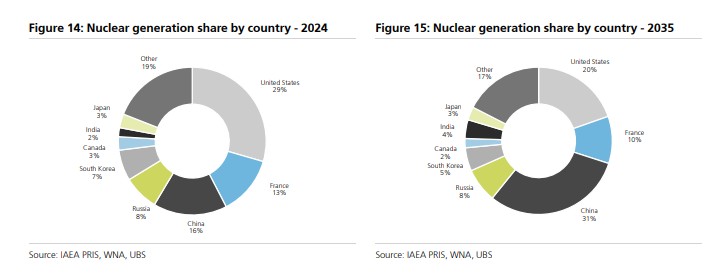
The geographical landscape of demand is undergoing profound changes. Although Western countries such as the United States and France are still the main contributors to nuclear power generation, the future growth engine will clearly shift to the East. The report predicts that by 2035, China and India alone will contribute about three-quarters of the global demand growth over the next decade, with their share of global nuclear power generation doubling from the current approximately 18% to 35%.
In addition, emerging technologies represented by small modular reactors (SMRs) are opening up new possibilities for uranium demand. Although large-scale commercial deployment of SMRs may not occur until the 2030s, they show great potential in meeting the stable power demands of high-energy industries such as artificial intelligence data centers, which not only brings new customer groups to the uranium market but also strengthens the long-term narrative of a "nuclear renaissance."
Supply Dilemma: Oligopoly and Insufficient Investment
In stark contrast to the booming demand side, the global uranium supply faces structural challenges. The report emphasizes that the global uranium supply side is characterized by high concentration and limitations, providing a solid foundation for price increases.
-
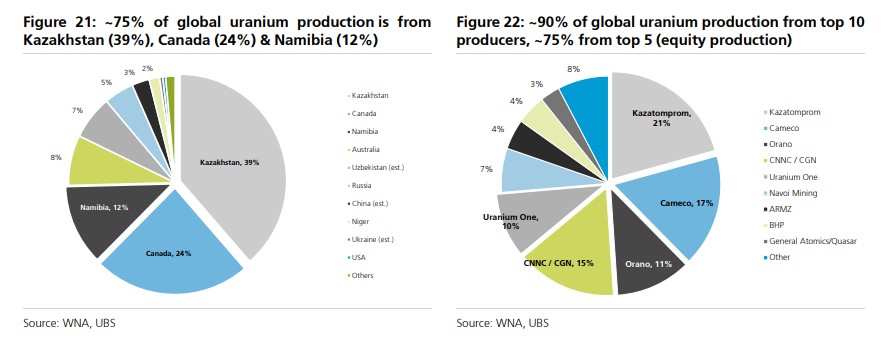
Geographical and Corporate Concentration: In 2024, approximately 75% of global uranium production will come from Kazakhstan (39%), Canada (24%), and Namibia (12%). Meanwhile, the top five producers (such as Kazakhstan's national atomic company Kazatomprom and Canada's Cameco) control about 75% of global output.
-
"Value First" Supply Discipline: Over the past decade, major producers have shifted from pursuing output and market share to a strategy of "value over volume." They maintain market balance through proactive production cuts and placing mines in maintenance mode. The report clearly states that these giants have little incentive to restart idle capacity or invest in new projects without seeing sustainable long-term contracts and sufficiently high prices
-
Limited Supply Growth and Risks: According to a report by UBS, the average annual compound growth rate of mine supply from 2025 to 2035 is expected to be around 4%, with the period from 2025 to 2030 primarily relying on the restart of existing capacities (CAGR 6%), while the period from 2030 to 2035 will depend on the commissioning of new projects (CAGR 2%). However, project development faces strict regulations, engineering challenges, and financing difficulties, leading to significant downside risks in supply forecasts.
-
Shrinkage of Secondary Supply: Historical secondary supplies, such as government inventories and the reuse of concentrated tailings, are depleting, and are expected to decline at an annual rate of about 3% over the next decade, failing to compensate for the shortfall in primary mineral supply.
Increasing Supply-Demand Imbalance: A Continuously Expanding Market Gap
When strong demand growth meets constrained supply, market imbalance becomes an inevitable result.
The core model of the report indicates that the uranium market will remain in a state of shortage between 2025 and 2029, albeit a mild shortage. However, as we enter the 2030s, demand growth is expected to significantly outpace supply growth, leading the market into a "persistent and continuously expanding deficit."
This situation arises from the market's "contract cycle dilemma": power companies delay signing long-term contracts due to uncertainties in downstream processes (such as the concentration stage), while producers are unwilling to increase production due to the lack of long-term contracts. Breaking this deadlock will be a decisive moment for the market's direction.
Market Dynamics: Slow Contracts and Volatile Spot Prices
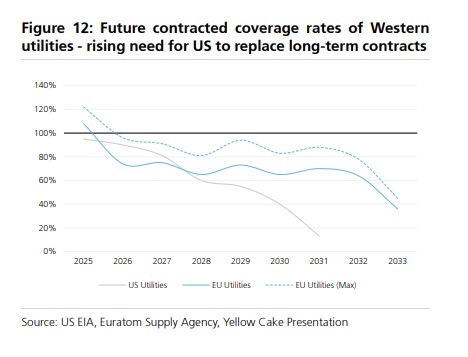
The current uranium market is caught in a "contract stalemate": on one hand, utility companies hesitate to sign long-term procurement agreements due to uncertainties in the downstream nuclear fuel cycle; on the other hand, producers are unwilling to commit to new supplies until they see sustainable long-term orders.
However, this wait-and-see attitude cannot last. According to data from industry consulting firm UxC, about two-thirds of global utility companies' uranium demand (approximately 3 billion pounds) has not yet been secured through long-term contracts over the next twenty years. This indicates that a large-scale inventory replenishment cycle will eventually arrive. UBS analysts believe that while utility companies can delay their demand, it cannot ultimately be avoided.
In this context, a divergence in prices between the spot market and the long-term market has emerged. Spot prices are highly volatile, reflecting more the buying and selling behavior of financial institutions (such as the Sprott Physical Uranium Trust) and market sentiment, rather than the real supply-demand fundamentals. These financial entities reduce the tradable inventory in the market by purchasing and holding physical uranium, thereby amplifying price fluctuations. In contrast, the long-term contract prices that can incentivize new mine investments are key to determining the future direction of the market
The above wonderful content comes from [ZhuiFeng Trading Platform](https://mp.weixin.qq.com/s/uua05g5qk-N2J7h91pyqxQ).
For more detailed interpretations, including real-time interpretations, frontline research, and other content, please join the【 [ZhuiFeng Trading Platform ▪ Annual Membership](https://wallstreetcn.com/shop/item/1000309)】
[](https://wallstreetcn.com/shop/item/1000309)