


Where has the AI "bubble" reached?

The discussion on the AI bubble needs to clarify several issues: the term "bubble" is neutral, and it is necessary to confirm the stage rather than deny the bubble. Judging a bubble depends on the degree of price deviation from value and whether investment exceeds demand and capability. Currently, the internal demand for AI has realized cost reduction, while external demand awaits breakthroughs, and the intensity of investment is less than half of that during the tech bubble. The primary market in the capital market is hot, while the secondary market valuations are high. The AI bubble has triggered a decline in global tech stocks, and attention should be paid to fluctuations in valuation expectations and long-term investment value
Key Points
How to correctly discuss bubbles? First, a bubble is a neutral term, and there is no need to have a preconceived negative impression. Second, if it ultimately ends in a bubble, one should not exit too early; therefore, it is not about denying the bubble but confirming which stage one is in. Third, the discussion of bubbles is a dynamic process of future expectations. Fourth, it is important to distinguish between the capital market and the bubble in the industry itself.
How to effectively judge a bubble? A bubble, in terms of the primary and secondary markets, mainly looks at the degree of price deviation from value; in terms of the industry itself, it is necessary to see whether investment has exceeded demand (endogenous and exogenous) and capacity (sources of funds and leverage levels). Accelerated investment is not a bubble; it is when it far exceeds demand and capacity that it becomes one; sustained increases, high valuations, and concentration of leading companies do not equate to a bubble; exceeding value is what constitutes a bubble.
1️⃣ How large is the demand for AI? Endogenous cost reduction has been realized, while exogenous demand still needs to break through; the contribution to the economy is far greater than during the internet era, approaching 1996-1997.
2️⃣ Is AI investment excessive? The investment intensity is less than half of that during the internet era, similar to 1997-1998, and the financing capability is also better than at that time.
3️⃣ Is there a bubble in the capital market? The heat of the primary market is close to that of 1999, the valuation of the secondary market is close to that of 1998, and monetary policy and inflation are more similar to 1998.
From the three dimensions of demand, capacity, and pricing, the current situation is more similar to 1996-1998. What does this mean? 1) High valuation expectations will lead to volatility. 2) The long-term industrial trend is still present, so there is still investment value. 3) However, the structure will trend towards differentiation.
Main Text
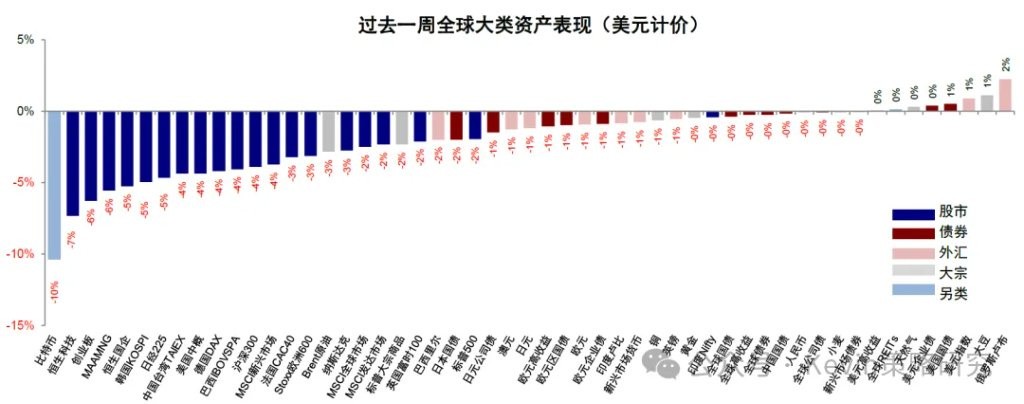
Recently, the AI bubble has resurfaced and seems to be intensifying, becoming one of the main culprits behind the significant declines in AI-related growth styles in the U.S., A-share, and Hong Kong markets, as well as overall risk assets. In the past week, concerns about the AI bubble have led to declines in global tech stocks, with the Hang Seng Tech (-7%), ChiNext (-6%), and the "Seven Sisters" of U.S. stocks (-6%) leading the drop in dollar terms.
Chart: In the past week, among global major asset performances, Bitcoin, Hang Seng Tech, ChiNext, and the "Seven Sisters" of U.S. stocks led the decline.
Source: Bloomberg, FactSet, CICC Research Department
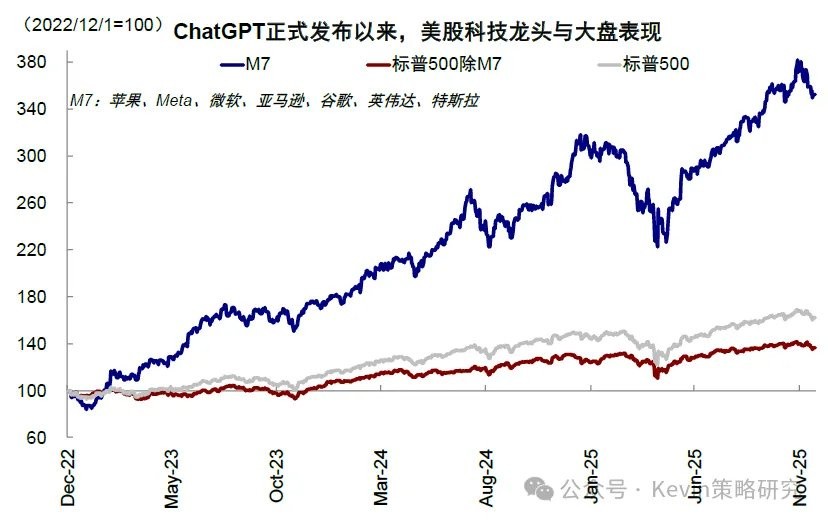
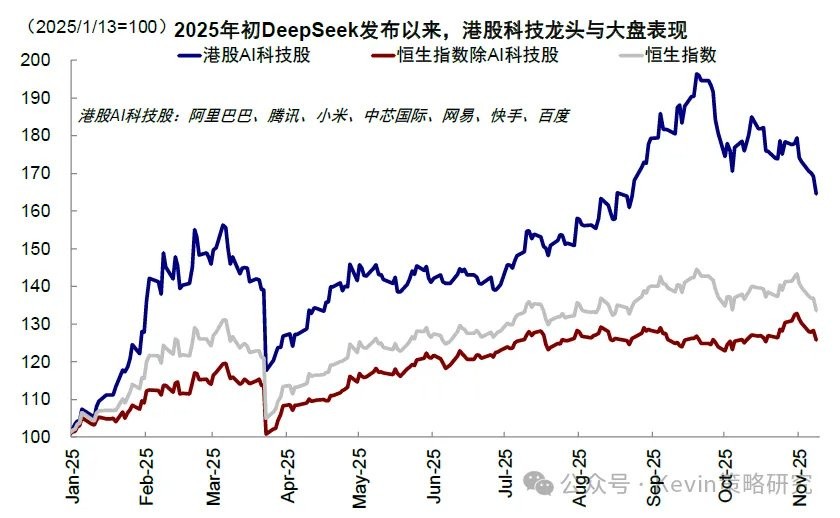
At the same time, the U.S. government shutdown, tight liquidity in the repurchase market, and cooling expectations for Federal Reserve interest rate cuts, along with weakening domestic data, have all contributed to suppressing risk appetite. However, concerns about the AI bubble are the core issue, as this is one of the main economic directions in the current markets of China and the U.S. For example, since the release of ChatGPT at the end of 2022, the "Seven Sisters" of U.S. stocks have risen by a maximum of 283%, significantly outperforming the S&P 500 index, which, after excluding M7, has risen by 69% during the same period; the Chinese market is similar, with the "Ten Giants" of Chinese tech rising by a maximum of 81% since the release of DeepSeek in early 2025, significantly outperforming the Hang Seng Index, which, after excluding the "Ten Giants," has risen by 19%, with annualized performance even exceeding M7 at one point It can be seen that whether in market performance or credit cycles, the AI trend is interconnected; when one thrives, all thrive, and when one suffers, all suffer (2026 Outlook: Following the Direction of Credit Expansion).
Chart: The "Seven Sisters" of the US stock market rose by a maximum of 283%, significantly outperforming the S&P 500 index, which, after excluding M7, rose by 69% during the same period.
Source: Bloomberg, FactSet, CICC Research Department
Chart: Since the beginning of 2025, China's "Ten Giants" in technology have risen by a maximum of 81%, outperforming the Hang Seng Index, which, after excluding the "Ten Giants," rose by 19%.
Source: Wind, FactSet, CICC Research Department
How to Properly Discuss Bubbles? It’s Not About Denying Bubbles, But About Confirming the Stage; Distinguishing Between the Secondary Market and the Industry Itself
Before specifically discussing whether AI is a bubble, we believe it is necessary to clarify a few issues first, which will help make the subsequent discussion more targeted.
► First, bubble is a neutral term. A bubble is not necessarily a bad thing; to some extent, investment impulses have driven industry development. Therefore, there is no need to have a negative impression of bubbles from the outset.
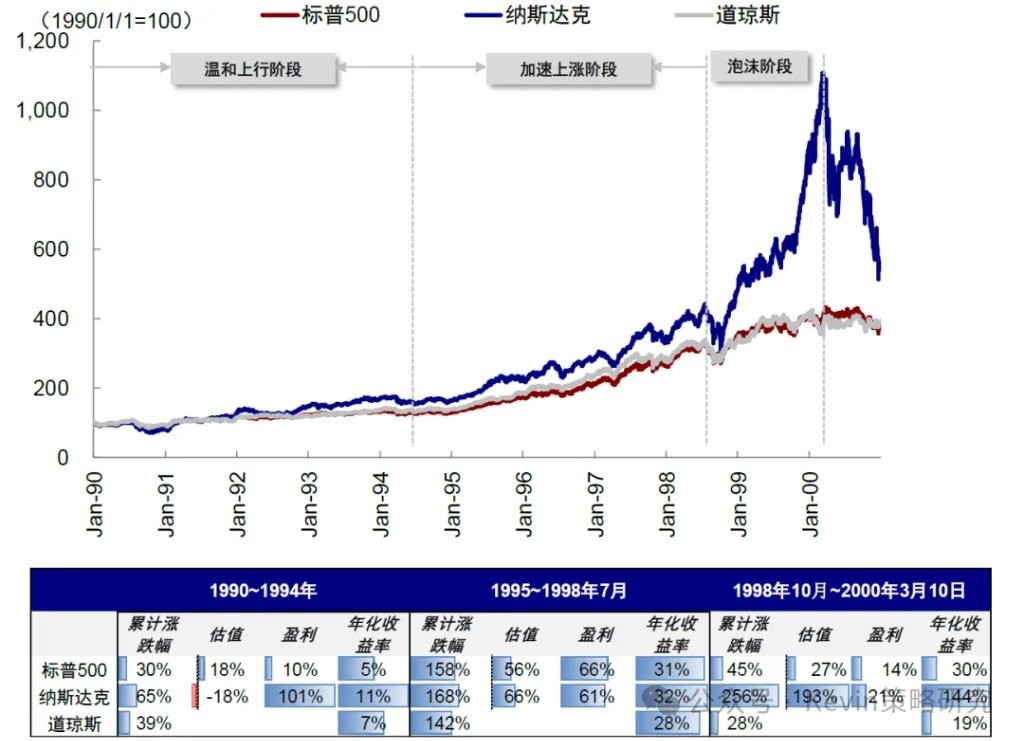
► Second, if any industry trend ultimately ends in a bubble, one should not exit too early during the bubble formation stage. Taking the bubble formation period from October 1998 to March 2000 as an example, profits declined sharply while valuations expanded rapidly, driving the Nasdaq index to rise by 256% over 15 months, with an annualized return of 144%, equivalent to 4.5 times the rapid rise period from 1995 to 1998 (annualized return of 32%). Therefore, the key to the discussion is not to deny the bubble, but to confirm which stage we are currently in.
Chart: The market began to gradually enter the "irrational exuberance" phase starting in 1995, and this further intensified after 1998.
Source: Bloomberg, CICC Research Department
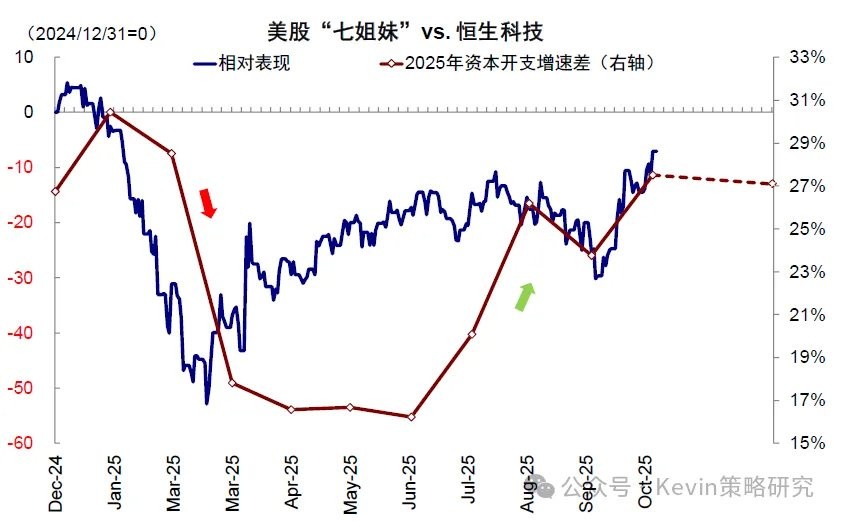
► Third, the discussion of bubbles is a dynamic process involving future expectations, but this is precisely where market divergences occur. For example, the current market expects OpenAI's IPO valuation to be $1 trillion [1], compared to its current annual revenue of $20 billion [2], resulting in a P/S ratio as high as 50 times. However, if its revenue doubles next year, the P/S valuation would quickly drop to 25 times, which would be much more "reasonable." ► Fourth, it is important to distinguish between capital market bubbles and the bubbles within the industry itself. The bubbles in the secondary market and those in the industry are related but should be appropriately differentiated. If the focus is more on the secondary market, then adjustments and digestion of stock prices can bring better allocation opportunities. For example, at the beginning of the year, the rise of DeepSeek led to a nearly 20% significant correction in the "Seven Sisters of US Stocks," but with the valuation correction and the disproof of concerns, reallocation opportunities emerged. Conversely, if the industry trend has been disproven, even if the valuation bubble is digested, it is not worth increasing positions.
Chart: The rise of DeepSeek led to a nearly 20% significant correction in the "Seven Sisters of US Stocks."
Source: FactSet, CICC Research Department
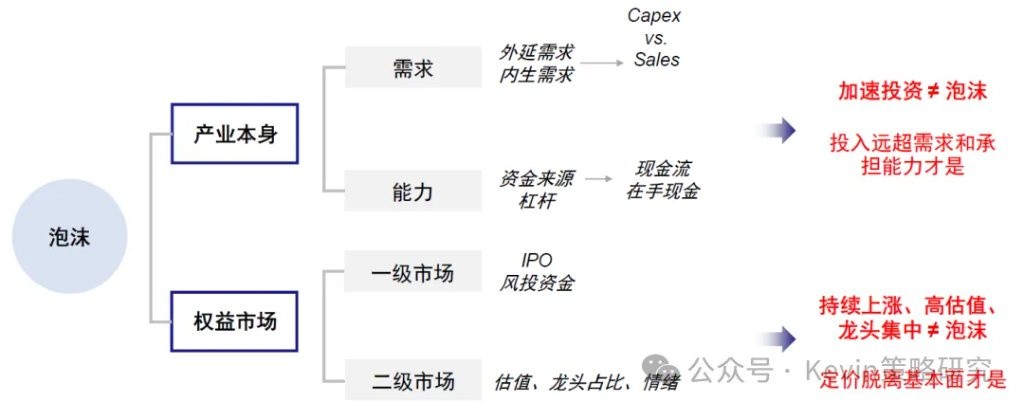
How to effectively judge a bubble? Accelerated investment is not a bubble; far exceeding demand and capability is; continuous rise, high valuation, and concentration of leading companies do not equate to a bubble; exceeding value is.
A bubble, from the perspectives of the primary and secondary markets, mainly looks at the degree of price deviation from value; from the perspective of the industry itself, it examines whether investment has already exceeded demand and capability. This is also the main framework and basis for discussing whether AI is a bubble in this article. Specifically,
Chart: From the perspectives of the primary and secondary markets, it mainly looks at the degree of price deviation from value; from the perspective of the industry itself, it examines whether investment has already exceeded demand and capability.
Source: CICC Research Department
► For the industry itself, the core issue is whether investment matches demand and capability. 1) How to view AI demand? The demand created by AI can be divided into two levels: external disruptive innovation and endogenous cost reduction and efficiency improvement of existing systems. Although the external demand brought by the application of AI technology may have a time lag, the endogenous part of cost reduction and efficiency improvement has already begun to show results; 2) Does investment match demand? This can be observed by looking at the current investment intensity (capex vs. sales) and comparing it with the intensity during the 2000 internet bubble; 3) Does investment match capability? This can be measured by the source of investment funds (operating cash flow or debt financing) and the level of leverage. Therefore, accelerated investment does not equal a bubble; investing far beyond demand and one's own capacity is a bubble.
► For the equity market, continuous rise, high valuation, or concentration of leading companies do not equate to a bubble; only when pricing deviates from fundamental support is it a bubble. Compared to the internet bubble period, this round of primary and secondary markets is more rational, with primary market funds focusing more on high-quality leading companies. The valuations of the "Seven Sisters of US Stocks" in the secondary market are also far lower than the "bubble" levels during the internet period, not to mention that profit resilience is also stronger. In addition, the rising concentration of leading companies is not equivalent to a bubble, but rather a normal industrial structural phenomenon that occurs against the backdrop of accelerated technological evolution Q1. How large is the demand for AI? Internal cost reduction has already been realized, while external demand still needs to break through; its contribution to the economy is far greater than during the internet bubble period, approaching that of 1996-1997.
The size of AI demand and its future potential are fundamental issues in discussing the bubble. This can be analyzed from two perspectives: 1) the internal demand for cost reduction and efficiency improvement, which is progressing faster and has already been realized; 2) the external demand from new application scenarios, which has yet to make breakthrough progress. This is also the fundamental reason why M7 has consistently faced a valuation ceiling of 35 times since the end of 2022, and why discussions of a bubble occasionally resurface.
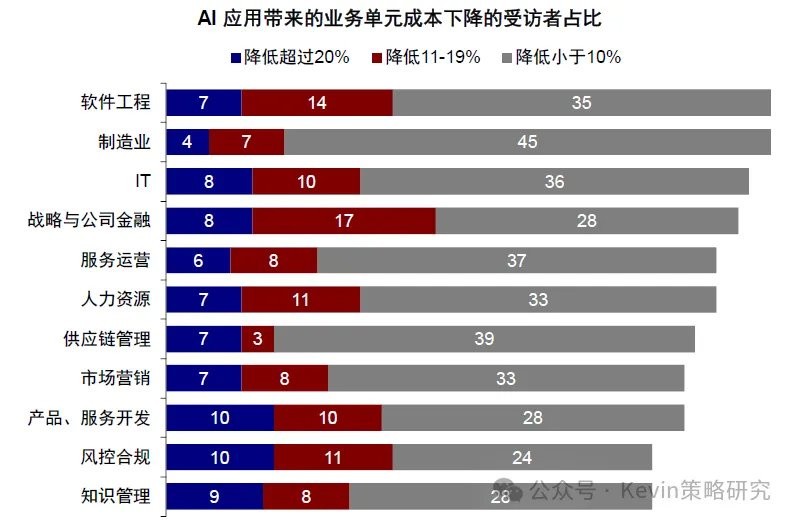
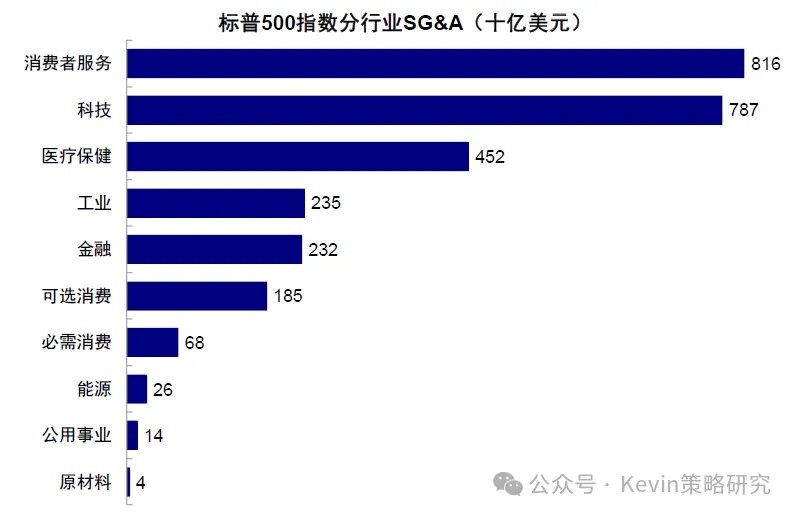
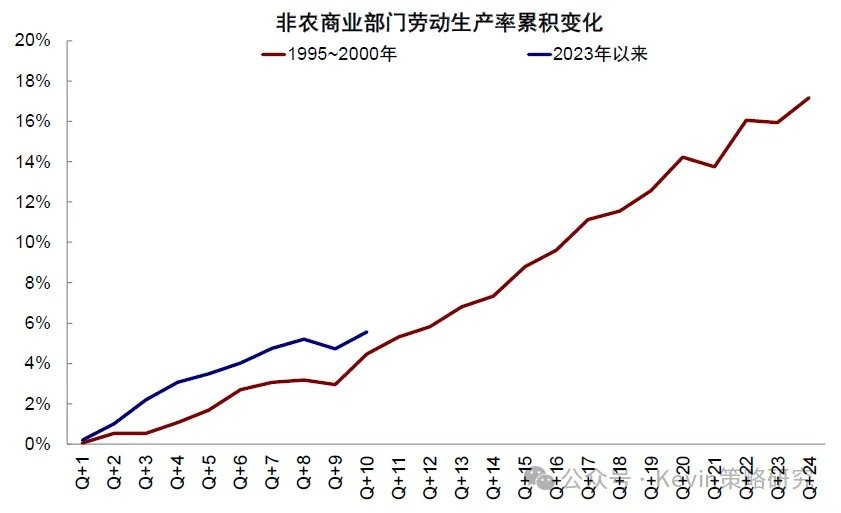
► Internal cost reduction and efficiency improvement: AI applications have already begun to bring significant cost savings. A McKinsey survey shows that respondents indicated that current use of AI can reduce costs by 9-11%. If we roughly consider this from the perspective of the S&P 500, the total scale of SG&A is about $3 trillion, which means it could save about $300 billion a year, equivalent to 15 times OpenAI's annualized revenue of $20 billion [3]. The speed of labor productivity improvement is even faster. Since 2023, labor productivity in the non-farm business sector has increased by 5.6%, a pace quicker than during the internet revolution from 1995 to 2000, approaching the level at the end of 1997.
Chart: McKinsey survey shows that AI applications average a 9-11% reduction in costs
Source: McKinsey, CICC Research Department
Chart: The total scale of SG&A in the S&P 500 is about $3 trillion; if reduced by an average of 9-11%, it would be about $300 billion
Source: FactSet, CICC Research Department
Chart: Labor productivity in the non-farm business sector has increased by 5.6%, faster than during the internet revolution from 1995 to 2000
Source: Haver, CICC Research Department
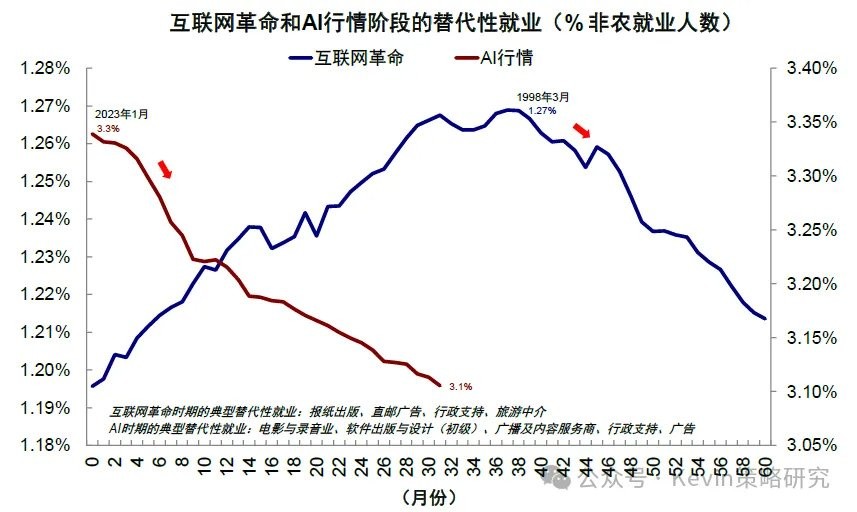
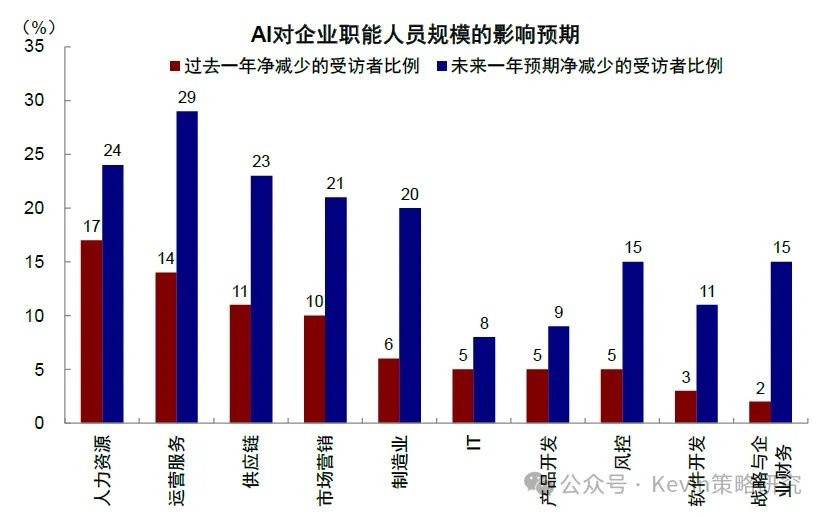
Of course, one "collateral damage" of efficiency improvement may lead to a reduction in some jobs. The popularization of personal computers and the internet from 1995 to 2000 significantly replaced traditional publishing, manual data entry, and other procedural jobs. The launch of Windows 98 further exacerbated the substitution effect, with the proportion of employment in significantly affected industries such as administrative support and newspaper publishing reaching 1.27% in March 1998, then continuously declining to 1.21% The substitution effect of AI technology on employment is faster and broader. AI technology not only affects traditional repetitive job positions but also extends to entry-level positions in content generation such as software development, broadcasting, film and recording, and advertising. The proportion of affected employment has continued to decline from 3.3% starting in 2023 to 3.1% by August 2025. According to the latest survey by McKinsey [4], the proportion of respondents expecting AI to continue exacerbating the net reduction of corporate functional personnel in the coming year is increasing, with the percentage in industries such as human resources, operations services, and supply chain rising to over 20%.
Chart: The proportion of employment affected by AI has continued to decline from 3.3% starting in 2023 to 3.1% by August 2025.
Source: Haver, CICC Research Department
Chart: The proportion of respondents expecting AI to continue leading to a net reduction in the scale of corporate functional personnel in the coming year is increasing.
Source: McKinsey, CICC Research Department
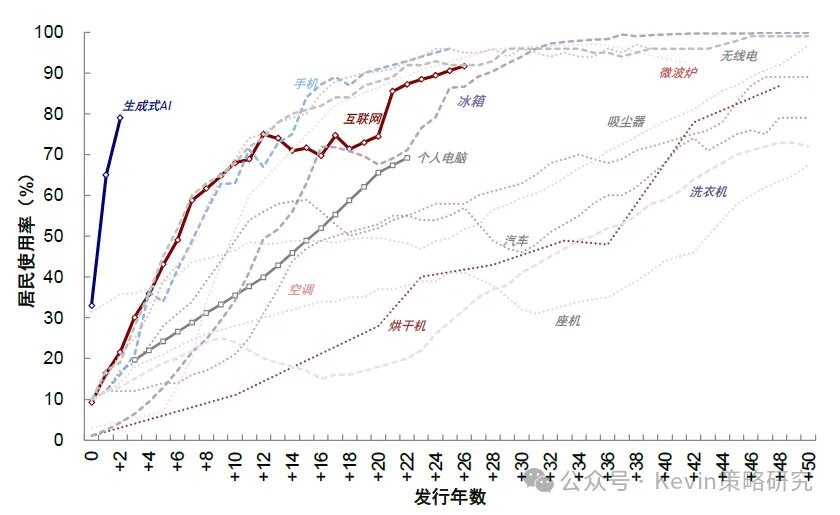
► Demand for external innovation: This is key to whether AI applications can break through to a broader range, and it is also the biggest divergence in the market. One of the prerequisites for new technology to be converted into demand depends on the speed and depth of its adoption. The adoption rate of generative AI technology has risen to 79% since the release of ChatGPT, a speed that far exceeds the 22 years and 12 years it took for personal computers and internet technology to reach this level, indicating that there is currently a significant level of familiarity and "grassroots support" for AI, which may allow for breakthroughs. Besides the information technology industry (29%), industries such as professional technical services (24%) and corporate management (21%) lead in the proportion of companies using AI technology, while the usage rate in accommodation, catering, and transportation and warehousing is less than 1%. However, in the expected survey for the next six months, the usage rate is expected to increase across almost all industries, with significant increases in financial insurance (8.2ppt), professional technical services (7ppt), real estate (5.8ppt), and medical and social services (4.2ppt), among others. The key moving forward may depend more on the penetration level in non-technology and professional technical fields such as the service industry.
Chart: The adoption rate of generative AI technology has risen to 79%, a speed that far exceeds that of previous personal computers and internet technology.
Source: McKinsey, Our World in Data, CICC Research Department Chart: In the expected outlook for the next 6 months, financial insurance, professional technical services, real estate, and medical social services lead in growth.
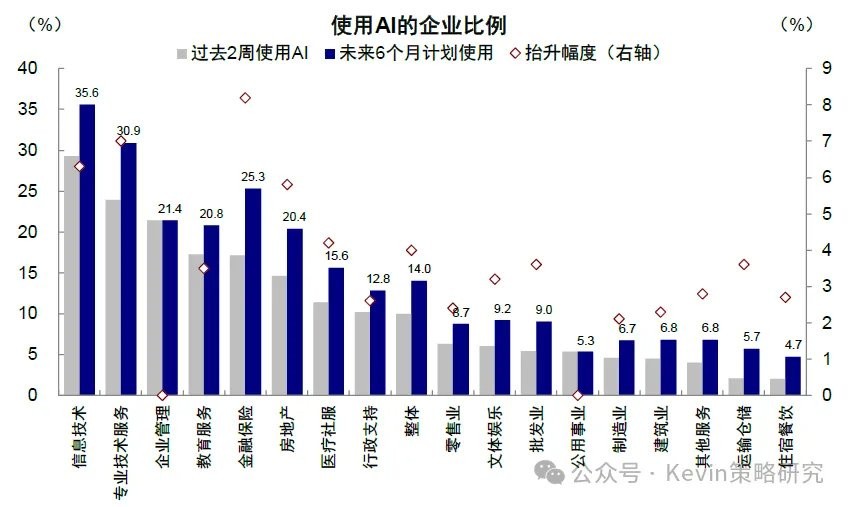
Source: Haver, CICC Research Department
From the results, AI leaders have at least begun to achieve considerable revenue scale and are still accelerating. The revenue growth rate of the "Seven Sisters" of U.S. stocks has continued to rise from 14.5% in the third quarter of 2023, with expectations to rise to 17% in the first quarter of 2026 before slightly retreating to 15-16%. From the perspective of growth rate and trend, it superficially resembles 1997. However, against the backdrop of continuously rising capital expenditures, whether the strong revenue growth can further open up space is the market's focus and point of divergence, and it is also the reason why valuations have always faced a ceiling.
Chart: Accelerated expansion of capital expenditures from 1996 to 1997, while revenue growth of leading stocks significantly declined, reflecting the disconnection between demand and investment.
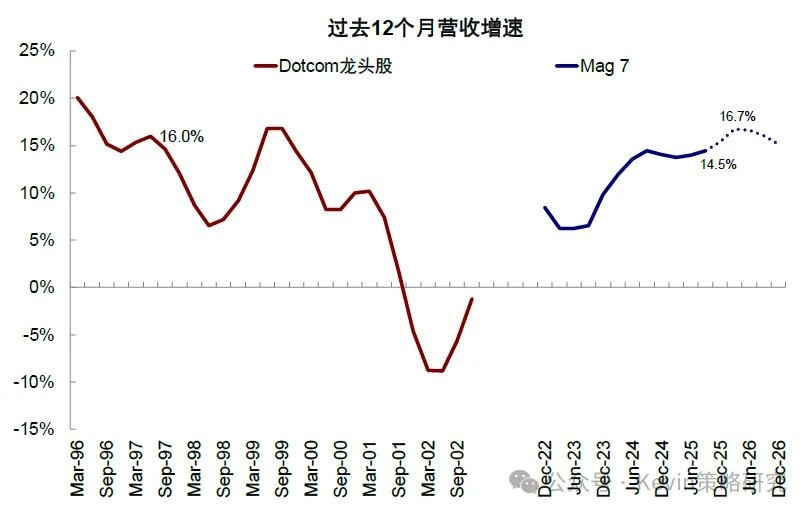
Source: FactSet, CICC Research Department
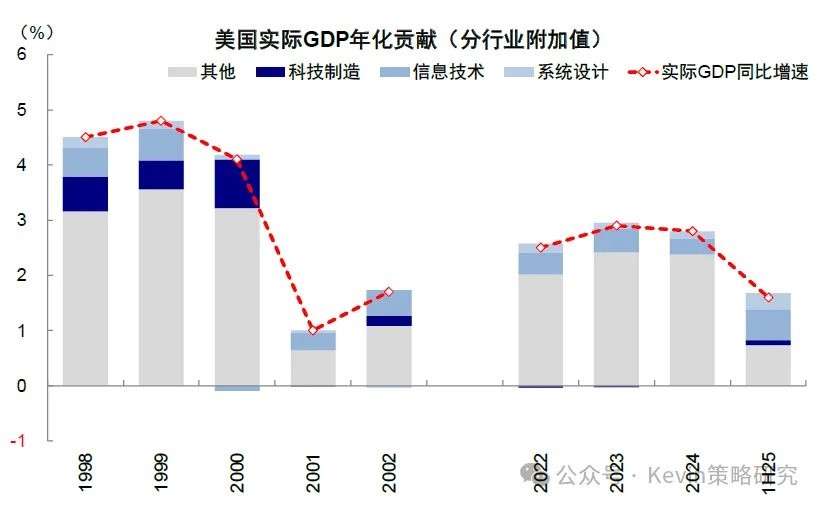
Compared to the internet bubble of 2000, AI's driving effect on the economy is even stronger. 1) From the GDP expenditure approach, in the first half of 2025, the actual GDP annualized quarter-on-quarter average growth of 1.6% saw technology investment contributing 0.9ppt, close to the 1.1ppt contribution from private consumption. However, since computer equipment investment includes a large amount of imports, measuring growth contribution solely from the investment dimension may lead to "overestimation." Therefore, we introduce the industry value-added (GVA) metric under the production approach to observe the actual value created by the technology industry within the United States. 2) From the GDP production approach, in the first half of 2025, the technology industry contributed approximately 0.95ppt to the overall growth of 1.6%, accounting for nearly 59%, higher than the 20-30% during the internet revolution. At the same time, the growth contribution in this round mainly comes from the information technology and system design industries, differing from the development pattern dominated by technology manufacturing during the internet revolution.
Chart: Technology investment contributed 0.9ppt to the actual GDP annualized quarter-on-quarter average growth of 1.6% in the first half of 2025.
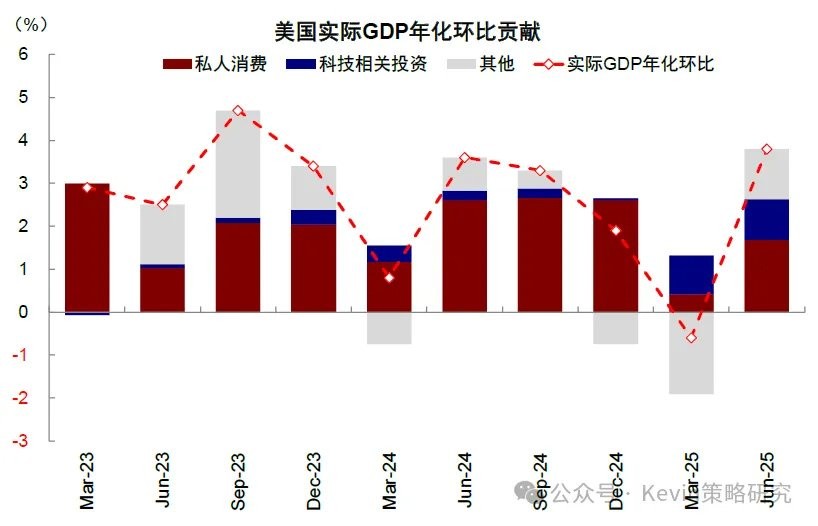
Source: Haver, CICC Research Department
Chart: High correlation between investment in computer equipment and imports.
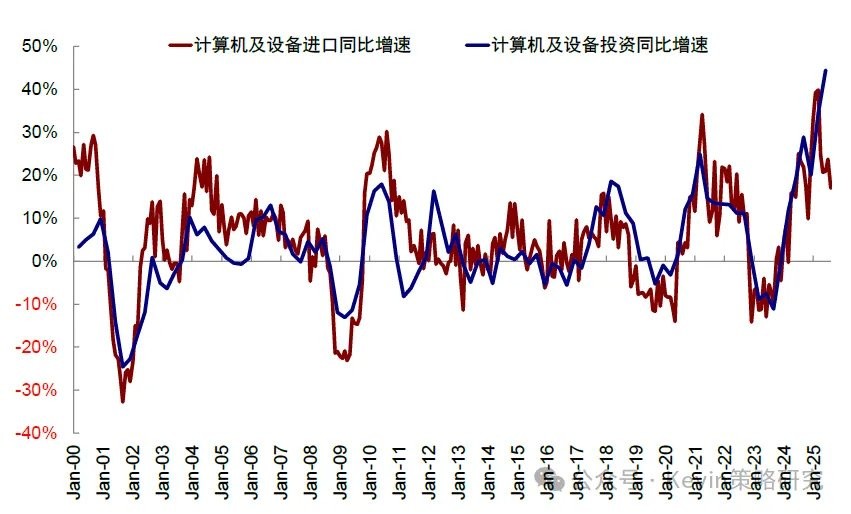 Source: Haver, China International Capital Corporation Research Department
Chart: In the first half of 2025, the contribution of the technology industry to growth is close to 59%, contributing 0.95ppt of the 1.6% growth.
Source: Haver, China International Capital Corporation Research Department
Overall, the demand for AI has already shown effects in terms of endogenous cost reduction and efficiency improvement, while external demand still needs breakthroughs and is more critical. Currently, corporate revenue is still accelerating, and its pull on the economy is much stronger than during the internet bubble. In terms of growth rate and the extent of productivity improvement, current demand is similar to that of 1996-1997, but external demand may still require further breakthroughs.
Q2. Is AI investment excessive? The investment intensity is less than half of that during the internet bubble, similar to 1997-1998, and the financing capacity is also better than at that time.
According to the framework discussed above, whether investment is excessive depends on two factors: first, whether it matches demand, and second, whether it is allocated according to capacity, i.e., whether the financing structure and leverage are healthy and reasonable. Specifically,
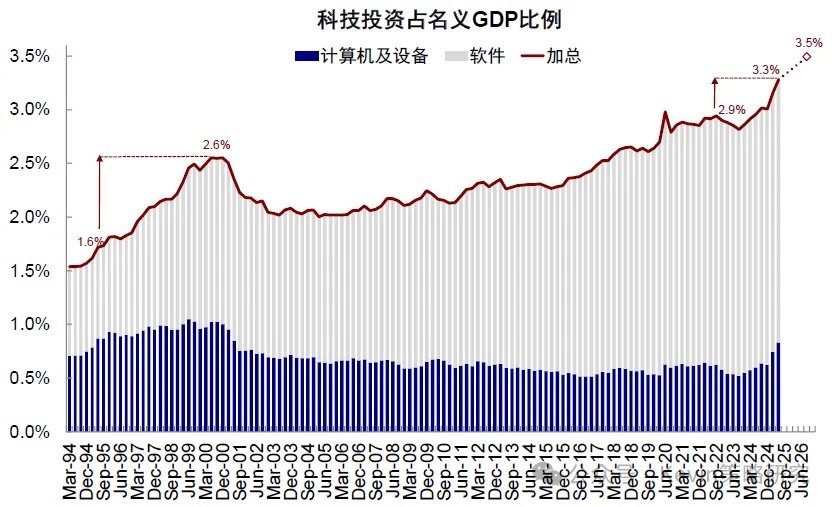
► Compared to demand, the scale of investment at the macro level is still in its early stages, with the proportion of GDP increasing by less than half of that during the internet revolution. The year-on-year growth rate of technology investment (computer equipment and software investment) accelerated from 6% at the beginning of 2023 to 16% in the second quarter of 2025, but the proportion of nominal GDP has only increased by 0.4ppt since 2023 (from 2.9% to 3.3%), which is less than half of the increase (1ppt) during the 1995-2000 internet revolution. Even considering that the proportion of technology investment in GDP is expected to rise to 3.5% in 2026, the current increase of 0.6ppt is still lower than the level during the internet revolution. Structurally, the proportion of computer equipment in nominal GDP has increased by 0.25ppt, with little difference; the proportion of software investment has increased by 0.13ppt this time, far lower than the 0.7ppt during the internet revolution.
Chart: The proportion of technology investment in nominal GDP has increased by 0.4ppt since 2023, while during the internet revolution it increased by 1ppt.
Source: Haver, China International Capital Corporation Research Department
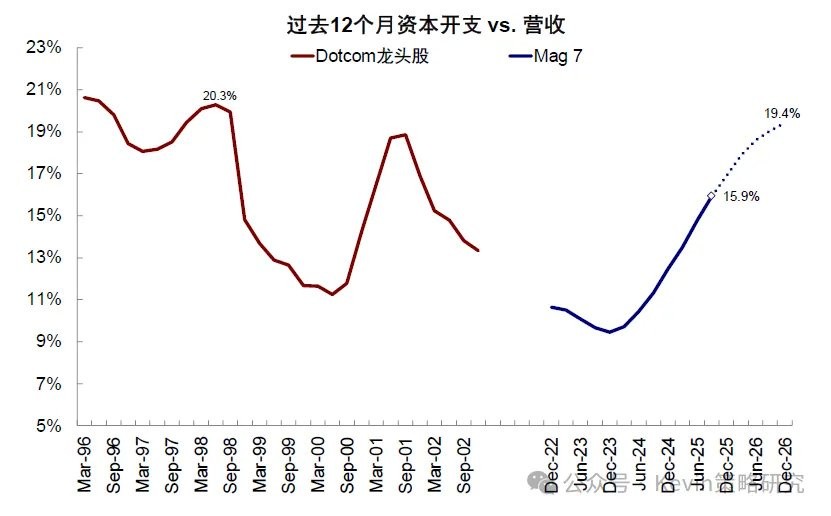
At the corporate level, the AI investment intensity of leading companies is still relatively reasonable, not reaching the peak of a bubble, and is more similar to the levels of 1997-1998. If we measure investment intensity relative to demand using capex vs. sales, during this round of AI market, the "seven sisters" of U.S. stocks have increased from about 9% in Q4 2023 to about 15.9% in Q3 2025, which is lower than the peak of about 20% in 1998. Looking ahead, according to FactSet consensus expectations, this indicator is expected to further rise to 19% in 2026, and investment intensity will further strengthen However, it is important to note that 1) the current market consensus on the demand side may not include the long-term potential increment brought about by an "exogenous" demand explosion (such as the large-scale new demand generated by popular AI applications), while in 1998, new exogenous demand had already formed; 2) in addition to the apparent water level, the duration of high investment intensity is also another important measure, based on the experience of the Internet revolution; 3) even when focusing on endogenous demand, leading companies still have the potential for revenue to exceed expectations.
Chart: The ratio of capital expenditure to revenue over the past 12 months is 16%, with market expectations continuing to rise to 19% by the end of 2026.
Source: FactSet, CICC Research Department
► In terms of comparative ability, the current financing structure is also different from the Dotcom 5 during the Internet revolution, being more reliant on external debt financing, while this round of Mag7 relies more on endogenous cash flow, with a low dependence on debt financing.
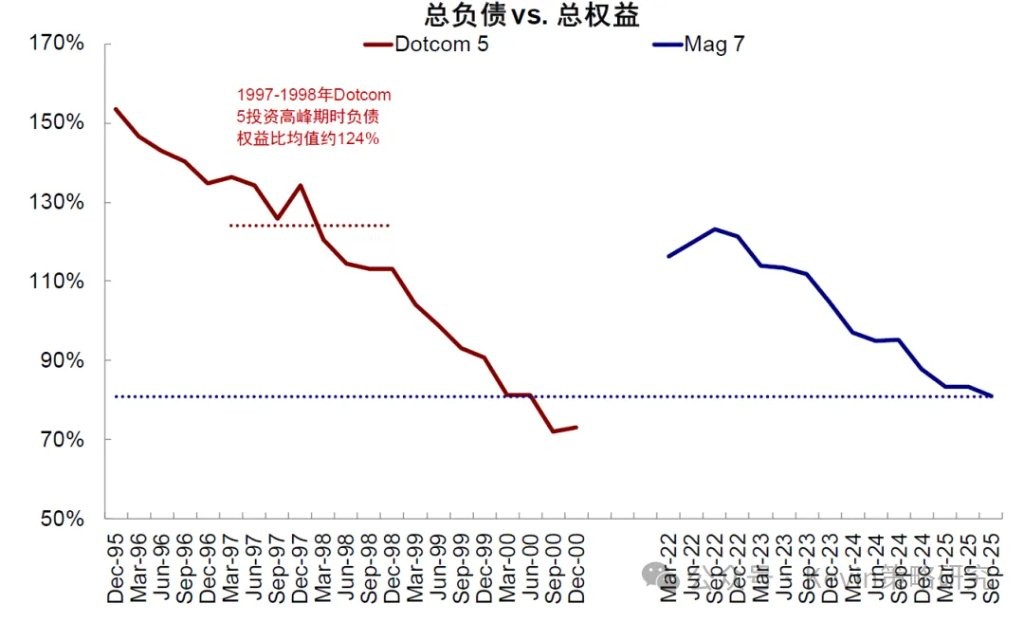
From the perspective of existing stock, observing the level of leverage, the implications of relying on debt financing when "debt is high" are quite different from initiating debt financing when the leverage ratio is relatively healthy. Currently, the debt-to-equity ratio of Mag 7 (approximately 81% in 3Q25) is significantly lower than the investment peak level of Dotcom 5 (around 1997-1998) (average about 124%). Although there are signs that some companies may begin to initiate debt financing to invest in AI, a lower initial leverage level may still indicate that their dependence on debt is relatively lower than during the Internet bubble period.
Chart: Currently, the debt-to-equity ratio of Mag7 is lower than the peak level of Capex for leading companies during the Internet revolution.
Source: FactSet, CICC Research Department
From the perspective of cash flow, by dissecting the cash flow statement, it is found that during the Internet revolution, the capital expenditure of Dotcom 5 had a strong reliance on debt financing. 1) At that time, the rhythm of capital expenditure (capex vs. OCF) for Dotcom 5 was highly correlated with debt financing (debt financing cash flow vs. OCF), and the rhythm of capital expenditure lagged behind that of debt financing, indicating the connection between the two; 2) The intensity of dividends and buybacks (vs. OCF) was relatively stable at that time, and leading companies overall maintained a certain level of shareholder returns.
Chart: During the Internet revolution, the marginal changes in bond financing cash flow had a strong correlation with the marginal changes in capital expenditure.
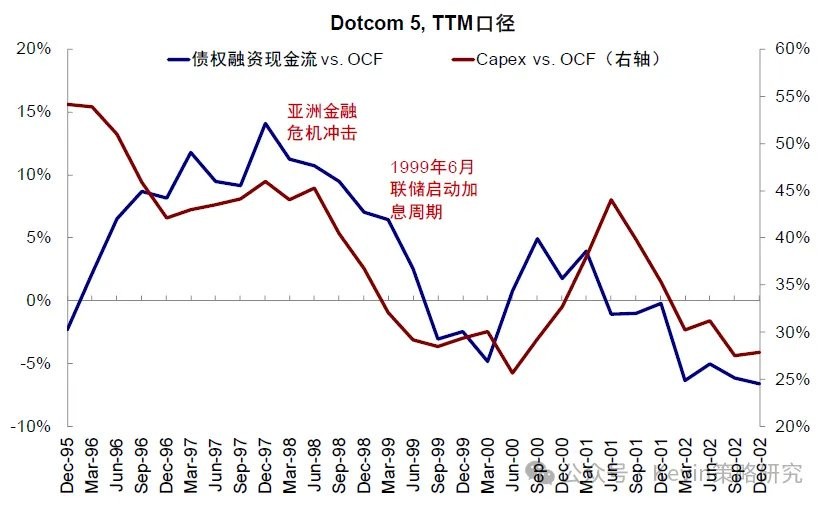 Source: Factset, CICC Research Department
Chart: During the Internet revolution, leading companies' capital expenditures relied heavily on debt financing
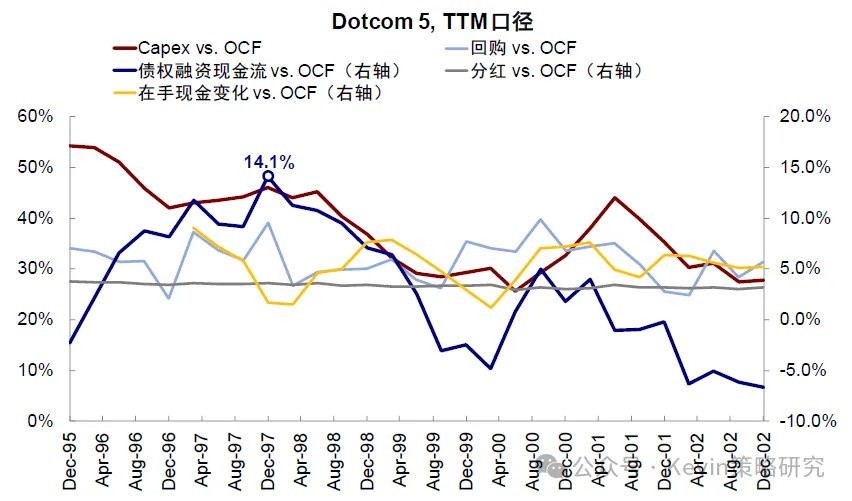
Source: Factset, CICC Research Department
In the current AI market, the capital expenditure sources of the Mag 7 are relatively diversified. 1) Currently, the correlation between the capital expenditures of the Mag 7 and the pace of debt financing is poor, and debt financing does not have a significant marginal impact on capital expenditures; 2) The proportion of debt financing cash flow to OCF is near zero, while the peak proportion of debt financing cash flow for the Dotcom 5 during the Internet revolution was about 14.1%; 3) Other cash flows of the Mag 7 (such as buybacks) are showing signs of contraction.
Chart: So far, there is no significant correlation between the marginal changes in cash flow from bond financing and capital expenditures for the Mag 7 in this round of market
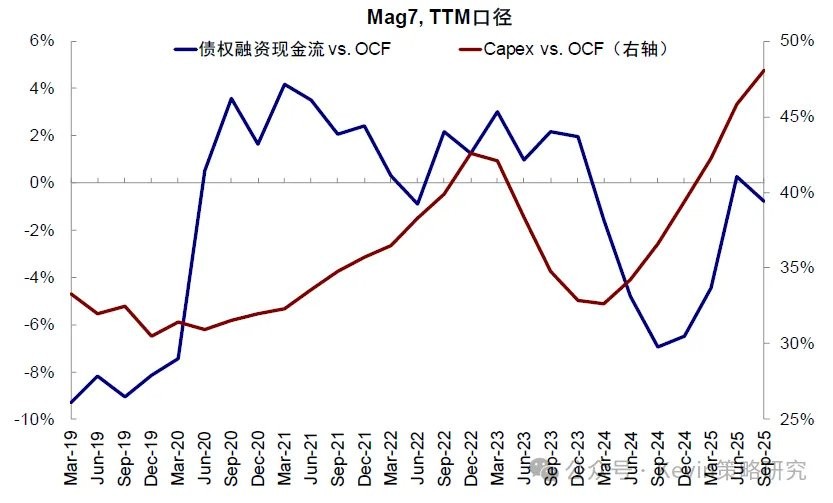
Source: Factset, CICC Research Department
Chart: In the current AI market, the financing sources for capital expenditures of leading companies rely more on endogenous cash flow
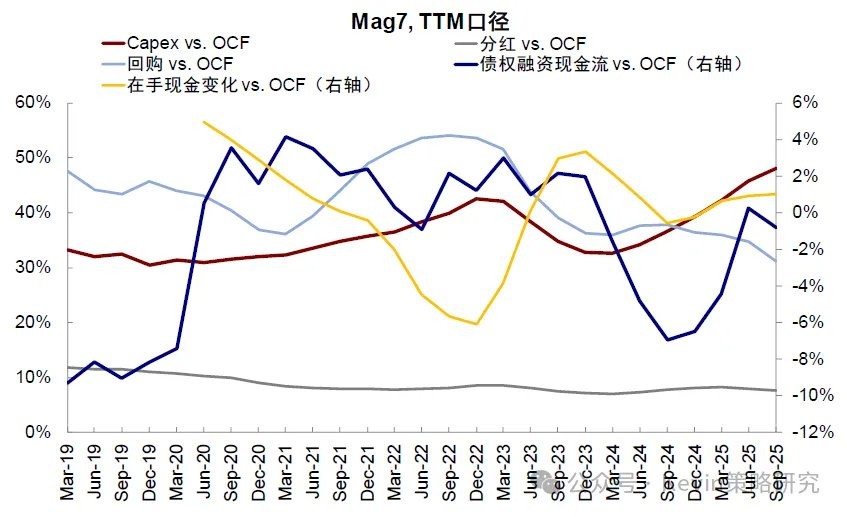
Source: Factset, CICC Research Department
In summary, the scale of investment may still be in its early stages, with a matching degree to demand equivalent to the level during the Internet bubble of 1997-1998, but the investment capacity and reliance on debt are far lower than at that time. Therefore, an "indirect signal" to determine whether it is heading towards a bubble is that more companies, especially outsiders, are entering this industry with more money, even through borrowing.
Q3. Is there a bubble in the capital market? The heat level of the primary market is close to 1999, while the secondary market valuation and monetary policy are close to 1998
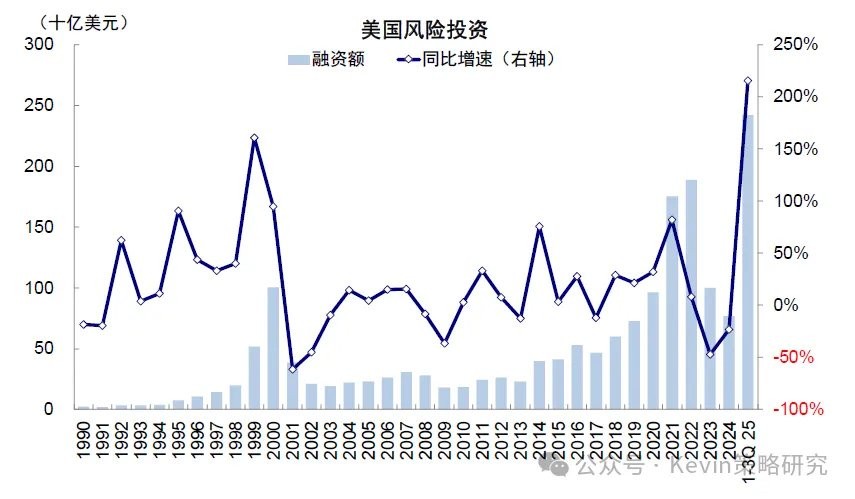
The primary market is approaching the heat level of 1999 but has not yet reached the bubble peak of 2000. From the perspective of U.S. venture capital scale, the peak of the Internet bubble in 2000 saw venture capital reach $100 billion, a fourfold increase compared to 1998. Although the current primary market has not yet reached the heat level of the bubble peak, according to KPMG statistics, U.S. venture capital in the first three quarters of 2025 is expected to reach $240 billion, a 1.4-fold increase compared to the financing scale during the rise of the AI industry in 2023, already approaching the level of 1999.
Chart: U.S. venture capital in the first three quarters of 2025 has increased 1.4 times compared to the financing scale during the rise of the AI industry in 2023
Source: FactSet, CICC Research Department
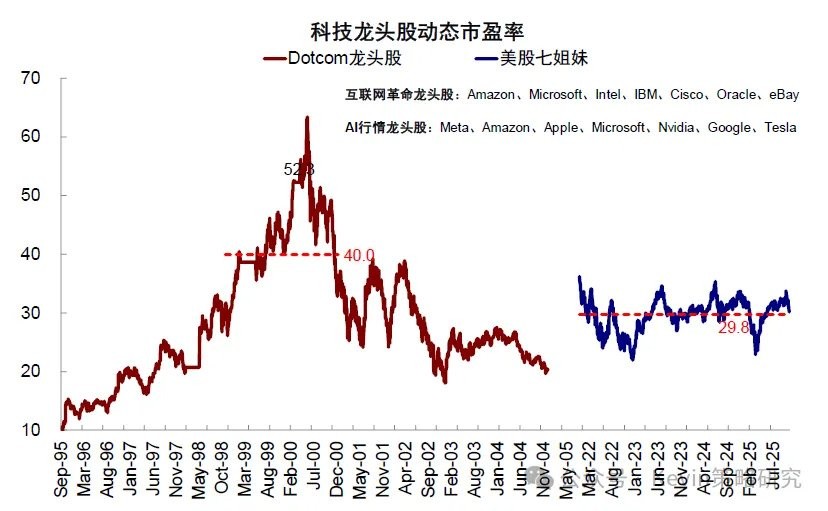
The secondary market valuation is close to the end of 1998 levels. The dynamic price-to-earnings ratio of the "Seven Sisters" of U.S. stocks climbed to around 33 times at the end of October, approaching the peak of 35 times in July 2024, but still significantly lower than the "irrational" 60 times during the "internet bubble." Recently, with the adjustment of U.S. stocks, the dynamic price-to-earnings ratio of the "Seven Sisters" has fallen back to around 28 times, similar to the level in November 1998.
Chart: The dynamic price-to-earnings ratio of the "Seven Sisters" of U.S. stocks has fallen back to around 28 times, similar to the level in November 1998.
Source: FactSet, CICC Research Department
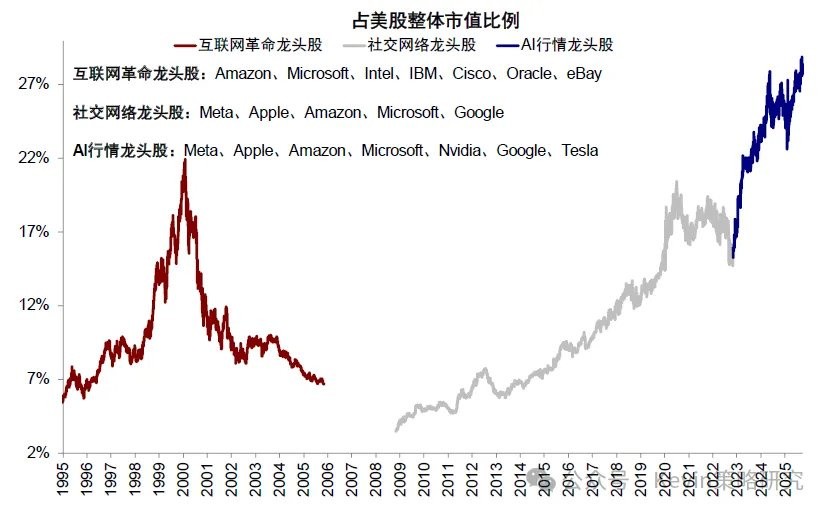
The concentration of top companies has further strengthened, with the market capitalization of leading technology companies accounting for 29% of U.S. stocks. The market capitalization share of the "Seven Sisters" has risen again to a peak of 29%, higher than the 22% during the internet bubble. However, this indicator is not comparable; the current technological paths and development models mean that only leading companies have the capability to achieve breakthroughs in models, revenue, and demand.
Chart: The current market capitalization of leading technology stocks accounts for 28% of the overall market capitalization of U.S. stocks, higher than the 22% during the internet bubble.
Source: Bloomberg, CICC Research Department
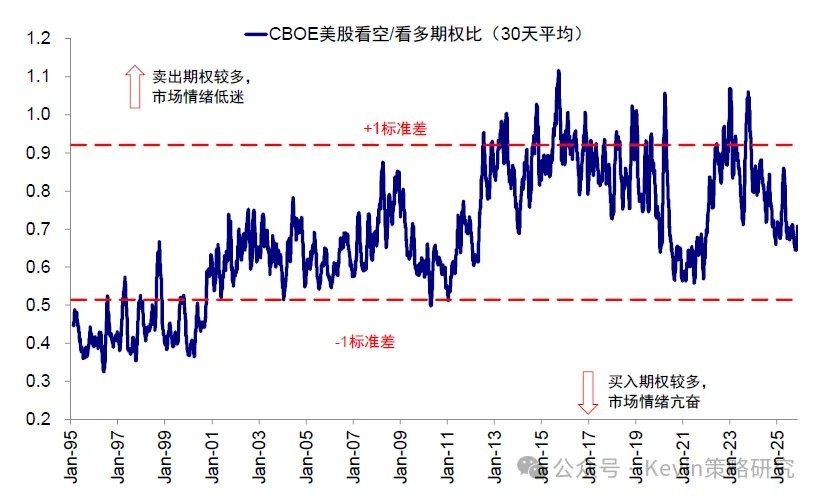
Investor sentiment has not yet reached the exuberant levels of the bubble period, and the bearish/bullish options have not fallen back to the extreme levels of 1998-2000. The AAII individual investor sentiment has also significantly cooled, with the current net bullish ratio continuing to decline to -5%, a significant difference from the 46% in January 2000. However, leverage levels have reached an all-time high, which may amplify short-term volatility. The implied leverage level of the margin balance tracked by FINRA rose to 1.85 before the bubble burst in March 2000, while the latest data as of the end of October 2025 shows that the implied leverage level has surpassed 3. The CBOE open interest in bullish options has also reached a new high of 370 million contracts, but the bullish/bearish ratio of 1.3 is still distant from the 1.8 times in 2000.
Chart: The current bearish/bullish ratio is also continuing to decline, but has not yet fallen back to the extreme levels of 1998-2000.
 Source: Bloomberg, CICC Research Department
Chart: As of November 20, 2025, the net bullish ratio of AAII individual investors has fallen to around -5%
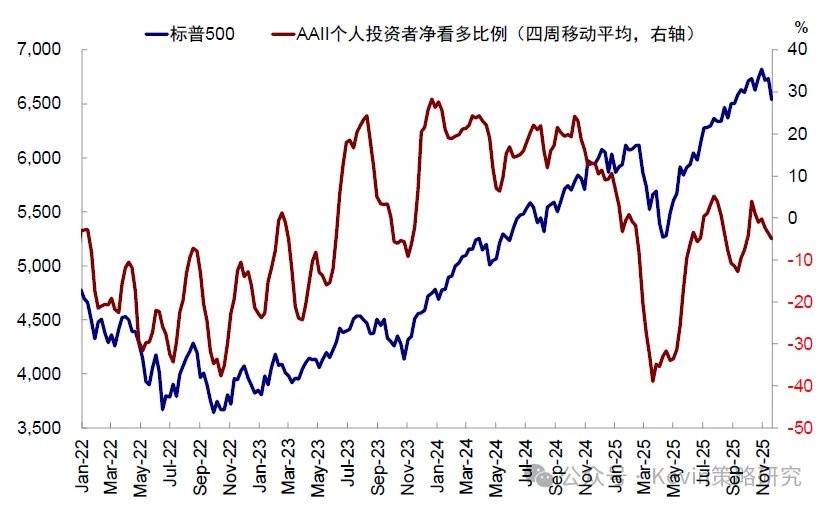
Source: Bloomberg, CICC Research Department
Chart: The implied leverage level of margin balances reported by FINRA has exceeded 3 as of the end of October 2025
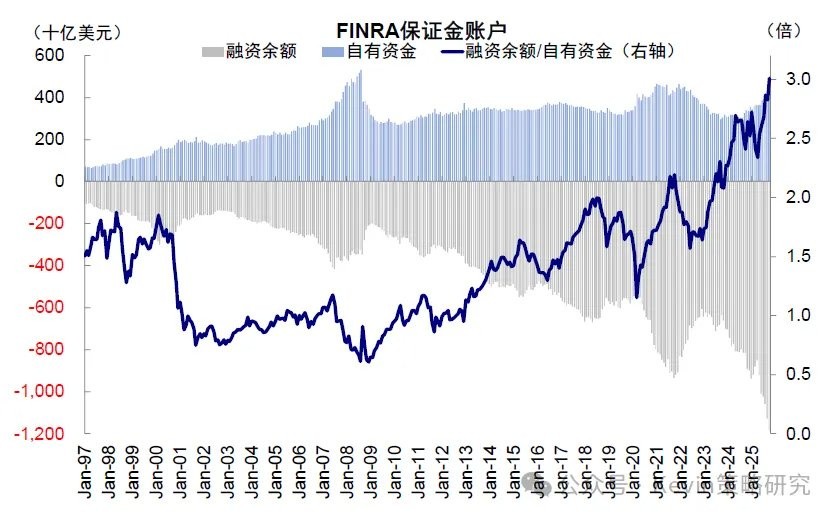
Source: Haver, CICC Research Department
Chart: The volume of CBOE open bullish options has also reached a new high of 370 million contracts
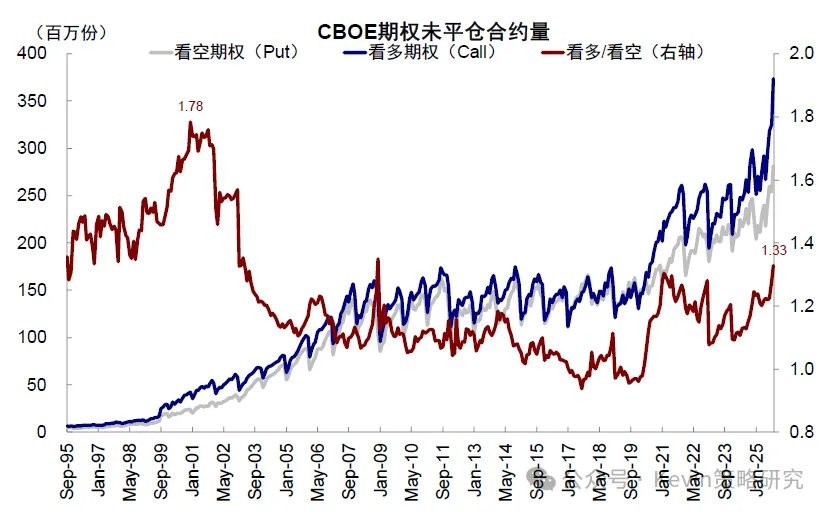
Source: Haver, CICC Research Department
The monetary policy environment is more accommodative, and inflation pressure is not significant. During the Internet revolution, the Federal Reserve shifted to an accommodative monetary policy in 1995, and after a slight rate hike in March 1997, it cut rates three times in a row in 1998. However, in June 1999, the Federal Reserve began raising rates to combat inflation, cumulatively increasing rates 6 times by a total of 175 basis points until May 2000. In contrast, in this round, after pausing rate cuts at the end of 2024, the Federal Reserve restarted rate cuts in September 2025, with still 3 rate cut opportunities under the baseline scenario. Regarding inflation, the transmission speed of tariffs to inflation is far slower than previously feared by the market (see "Who Ultimately Bears the Cost of Tariffs?"), and we estimate that the year-on-year U.S. CPI may fall from 3.1% to 3.0% in the first quarter of next year, while core CPI remains at 3.3%. Therefore, both the policy and inflation environments are closer to those of 1998, especially since the Federal Reserve has stopped balance sheet reduction and may even restart balance sheet expansion, which will further provide liquidity.
Chart: The Federal Reserve began tightening monetary policy in 1994, but subsequently shifted to an accommodative stance, cutting rates again in 1998
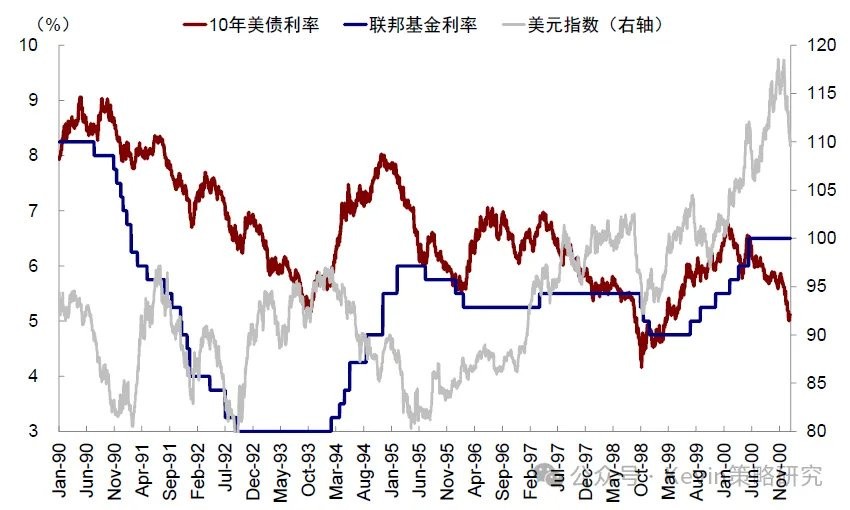
Source: Bloomberg, CICC Research Department
Chart: The U.S. natural interest rate is around 1.1%, and the real interest rate is close to 1.8%. Three rate cuts could resolve the 70 basis point gap between the two
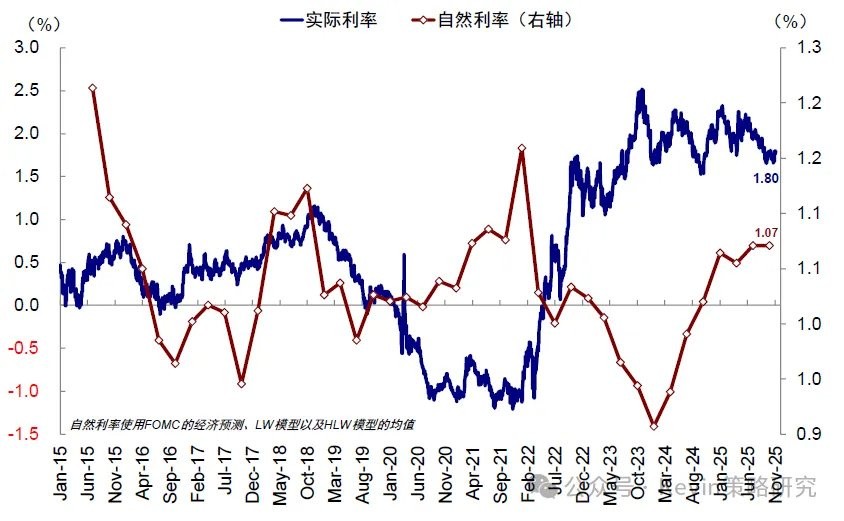 Source: Bloomberg, Federal Reserve, China International Capital Corporation Research Department
Chart: In the first quarter of next year, the U.S. CPI year-on-year may fall from 3.1% to 3.0%, while core CPI year-on-year remains at 3.3%
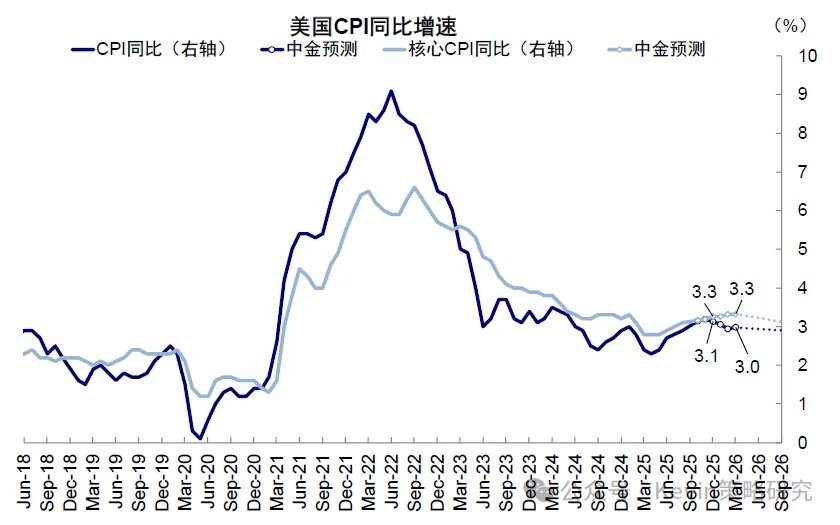
Source: Haver, China International Capital Corporation Research Department
Chart: CME interest rate expectations currently imply 4 more rate cuts in this round
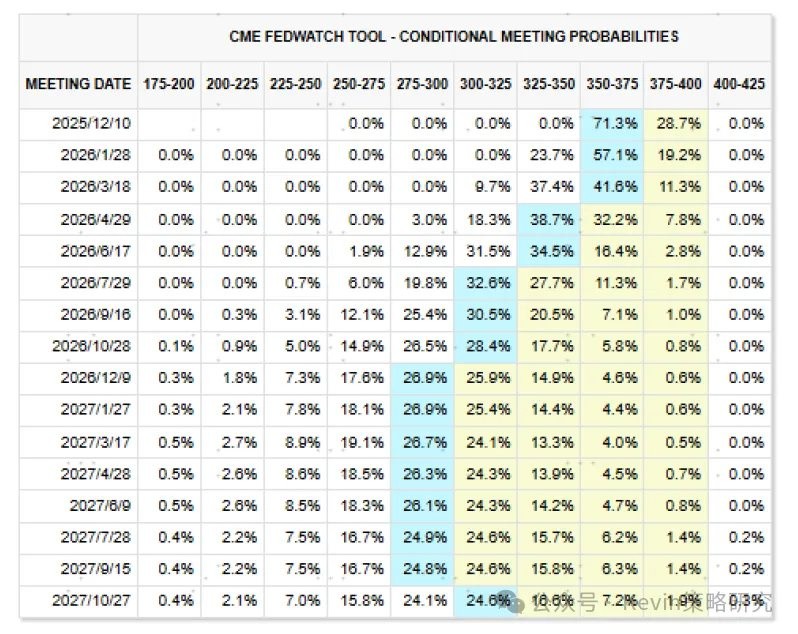
Source: CME, China International Capital Corporation Research Department
In summary, the primary market is approaching the heated level of 1999; the secondary market's pricing of AI is more rational than during the internet bubble period, with valuations close to the end of 1998. Monetary policy and inflation are also closer to the macro environment of 1998.
Chart: U.S. inflation is similar to the situation in 1998
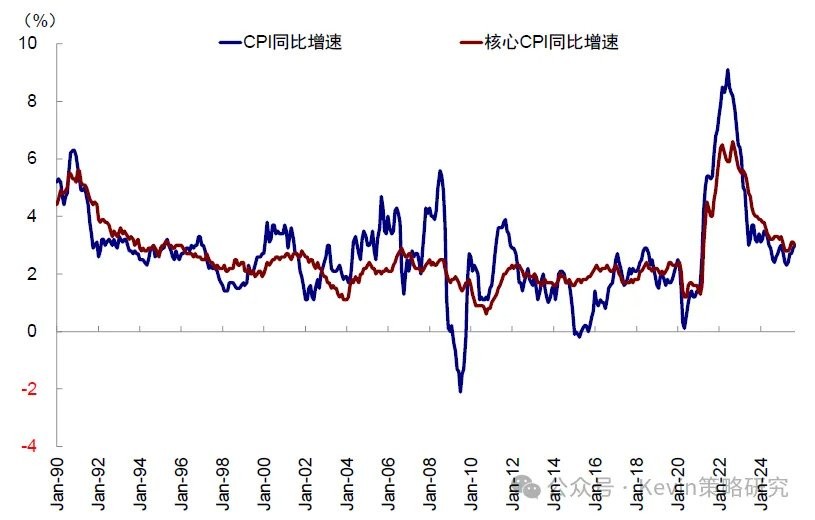
Source: Haver, China International Capital Corporation Research Department
Outlook: Static expectations are high, but it may be too early to talk about bubbles; short-term volatility is expected, but long-term investment value remains, with structural differentiation likely
From the current perspectives of demand, financing capacity, and market pricing: 1) Demand is close to that of 1996-1997, with endogenous cost reduction and efficiency improvements already realized, while external demand still needs to break through; revenue and productivity growth rates are similar to those of 1996-1997. 2) Investment is close to that of 1997-1998, with scale still in its early stages, but financing dependence is far lower than at that time. 3) Primary market pricing is close to 1999, while secondary market valuations and policy environment are close to 1998. Overall, we judge that the current market may be more in line with the situation of 1996-1998.
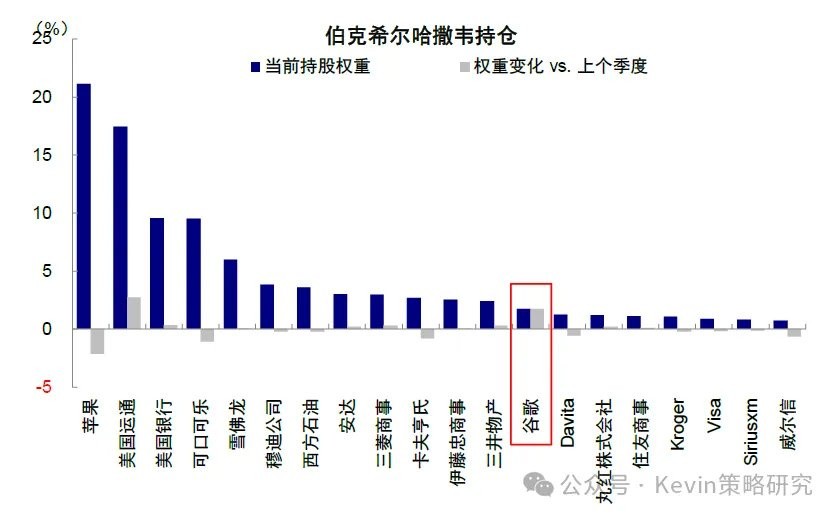
What does this mean? 1) High valuations and high expectations will lead to volatility. Since 2023, the valuations of the "seven sisters" of U.S. stocks have remained around a relatively high level of 30 times, but each time they approach 35 times, it raises market concerns about bubbles, leading to corrections. This also indicates that there is a "ceiling" on valuations; to break through further, substantial breakthroughs in technology applications must drive more demand realization. 2) Long-term industrial trends are still present, so there is still investment value. The improvements in productivity and the expansion of application scope indicate that AI technology still holds potential; short-term volatility in the secondary market does not affect the investment value of the real industry. 3) However, the structure will trend towards differentiation. In this process, there will also be differentiated performances among the leaders; those companies that can deeply integrate leading models with diverse business scenarios to form scalable commercial closed loops will have greater opportunities to benefit For example, Google is accelerating the integration of AI with traditional businesses, and its potential value has attracted the attention of value-oriented funds. Berkshire Hathaway established a position in Google for the first time in the third quarter, making it one of its top twenty holdings.
Chart: Berkshire Hathaway established a position in Google for the first time in the third quarter, making it one of its top twenty holdings.
Source: FactSet, CICC Research Department
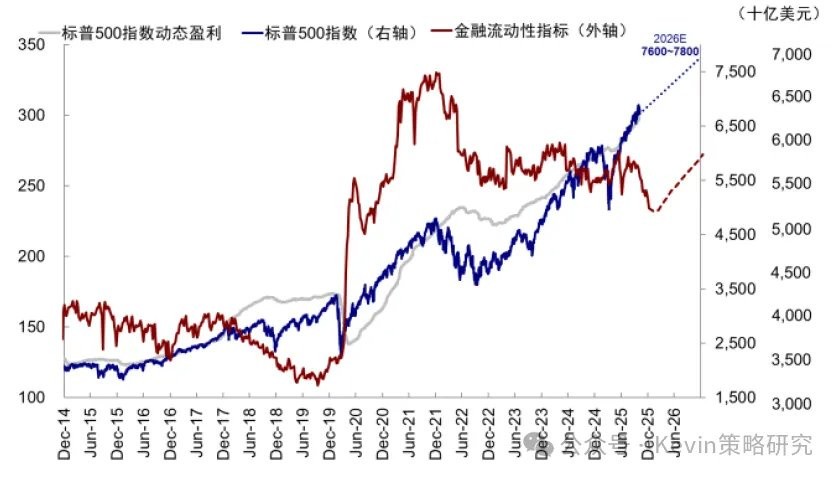
For the overall U.S. stock market, under the baseline scenario, we judge that the logic of fundamental recovery supports the rise of U.S. stocks, and short-term fluctuations do not change the long-term trend ("2026 Outlook: Following the Direction of Credit Expansion"). The credit cycle is moving towards recovery or even overheating, which helps to push U.S. stock earnings to continue to be revised upward, potentially continuing to drive U.S. stocks higher. In addition, financial liquidity has historically had a good correlation with U.S. stocks. Under the baseline scenario for 2026, the Federal Reserve will stop balance sheet reduction and may even start expanding the balance sheet, and the expansion of financial liquidity will also have a positive effect on U.S. stocks. We predict that by the end of 2026, the S&P 500 index may be between 7600 and 7800, with an increase potential of 13% to 16%.
Chart: We predict that by the end of 2026, the S&P 500 index may be between 7600 and 7800, with an increase potential of 13% to 16%.
Risk Warning and Disclaimer
The market has risks, and investment requires caution. This article does not constitute personal investment advice and does not take into account the specific investment goals, financial situation, or needs of individual users. Users should consider whether any opinions, views, or conclusions in this article are suitable for their specific circumstances. Investing based on this is at your own risk
