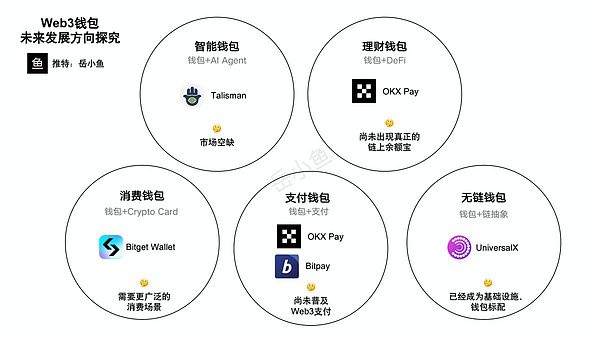

Five key development directions for Web3 wallets

The article outlines five key development directions for Web3 wallets: integration with AI agents, DeFi, crypto cards, Web3 payments, and chain abstraction. The most promising is the combination of wallets and AI agents, with examples like Coinbase Wallet, Bitget Wallet, and Talisman Wallet leading innovations. The potential for smart wallets to revolutionize the industry is highlighted, akin to an "Apple moment."
Author: Yue Xiaoyu; Source: X, @yuexiaoyu111
The future form of Web3 wallets has 5 key development directions:
1️⃣ Wallet + AI Agent = Smart Wallet
Deeply integrate AI Agents into the wallet to achieve intelligence.
Many wallets are making various attempts, but it is still in a state of market gap.
2️⃣ Wallet + DeFi = Financial Wallet
It needs to be able to automatically generate interest on the balance, truly realizing an on-chain Yu'ebao (Alipay's money market fund).
OKX Pay has made a good attempt: deposit and use stablecoins, and the balance automatically earns interest, just like Yu'ebao (Alipay's money market fund). 3️⃣ Wallet + Crypto Card = Consumer Wallet The carrier is a U-card; top up with stablecoins and you can use it for everyday spending. Currently, Bitget Wallet is the best example, not only having a built-in U-card but also offering a shopping mall service, providing various usage scenarios. MetaMask has also done something similar, launching its own U-card, focusing heavily on the travel sector. 4️⃣ Wallet + Web3 Payment = Payment Wallet Stablecoin payment penetration is already very high. However, the current market mainly focuses on B2B payments, i.e., payments between businesses. C-end payments are still not widespread; BitPay, which entered the market very early, has relatively extensive merchant resources. 5️⃣ Wallet + Chain Abstraction = Chainless Wallet Wallets are still too complex; ordinary users need to understand many concepts to truly use them. For example, they need to understand private keys, Gas, cross-chain, etc. Particle Network, a chain abstraction service provider, has already become industry infrastructure. Of these five major directions, the most promising is the combination of wallets and AI agents. After reviewing the market, I found that there aren't many wallets that incorporate AI. They can be roughly divided into three categories: One category, represented by Coinbase Wallet, focuses on building standards, offering an open platform, AI toolkit, and the x402 payment protocol; another category, represented by Bitget Wallet, focuses on integrating AI services, leveraging AI capabilities for token analysis, trading signals, and more; and the third category, represented by Talisman Wallet, focuses on system reform, building a new generation of AI-native wallets. I studied Talisman Wallet's strategy: It primarily uses a built-in AI Agent to optimize and automate user decisions, including trading and DeFi operations. Talisman's AI service was developed in collaboration with Rizzo, a partnership facilitated primarily by the DNA Fund. Talisman itself is a multi-chain wallet, mainly providing product direction, user experience, and wallet integration; Team Rizzo is an AI Agent development team responsible for building and maintaining subnet infrastructure. There's some buzz in the community, perhaps due to the upcoming TGE. However, in the long run, it all comes down to the product itself. With the addition of AI capabilities, is it possible for existing wallets to leap into the era of smart wallets? This is certainly something to look forward to, and hopefully, the wallet industry will see its "Apple moment"!