


Has the DAT myth come to an end? What's next for Bitcoin Treasury?

Galaxy Research highlights the challenges faced by Bitcoin Treasury companies as their equity premiums, once high, have now fallen below the net asset value of their Bitcoin holdings. This shift has led to significant underperformance of Bitcoin treasury stocks compared to Bitcoin itself, with many holdings showing unrealized losses. The October deleveraging event exacerbated liquidity issues, raising concerns about potential Bitcoin sales by these companies. The analysis focuses on companies like MicroStrategy and Metaplanet, emphasizing the reversal of the previous growth cycle.
Author: Will Owens, Research Analyst, Galaxy Digital; Translator: Jinse Finance xiaozou
In July, Galaxy Research pointed out that the effectiveness of the Digital Asset Treasury Company (DAT) model depends on the maintenance of the company's equity premium. At that time, these stocks were trading at a high premium relative to the net asset value (NAV) of their underlying Bitcoin (or other cryptocurrencies), and this premium was supported by a value-added cycle between price, issuance, and asset accumulation.
The Bitcoin Treasury model is essentially a liquidity derivative. It only works when the company's stock trades at a premium relative to its Bitcoin NAV. Once these premiums disappear, the entire growth flywheel reverses.
The core warning from Galaxy Research's July report on Bitcoin treasury companies and the broader DAT report was that this reflexive cycle stalls once the premium narrows and stock issuance shifts from value creation to dilution. This scenario has now materialized. Bitcoin has fallen from its October high of around $126,000 to a low of around $80,000 (it has since rebounded to around $92,000 at the time of writing), severely impacting trading in high-beta treasury assets. The macroeconomic backdrop has increasingly shifted to a risk-averse mode: inflows into cryptocurrency exchange-traded funds (ETFs) have slowed, and speculative fervor in the public markets has diminished. As Galaxy Research noted in October, the deleveraging event on October 11th triggered a significant forced sell-off, clearing leverage from the system and leading to a significant deterioration in liquidity conditions heading into the fourth quarter. The impact of this market shift has been particularly pronounced for treasury companies whose stocks had previously served as leveraged cryptocurrency trading instruments. Financial engineering, which once amplified upward returns, is now also exacerbating downside risks. Note: This report only discusses Bitcoin DAT. Companies investing in ETH or SOL can generate returns through staking or DeFi lending in addition to capital appreciation, and therefore require separate analysis. Key Points: DAT companies' equity valuations, which were significantly higher than their net asset value during the summer, have now fallen and are currently generally lower than the value of their underlying assets. Bitcoin treasury stocks have fallen sharply from their 2025 highs, significantly underperforming Bitcoin itself. Most Bitcoin treasury companies' Bitcoin holdings are currently showing unrealized losses. Galaxy Research's July prediction that "premium contraction will break this reflexive cycle" has been validated. The high beta of DAT stocks relative to BTC amplifies gains during uptrends, but the premium collapses during downtrends, with new issuances eroding value. I. Analysis Methodology In this article, we use market capitalization rather than the more traditional enterprise value to calculate the premium of equity relative to Bitcoin's net asset value (NAV). Enterprise value is the standard method for evaluating operating businesses, but Bitcoin Treasury companies primarily operate as asset holding vehicles, and their valuation is driven by exposure per Bitcoin rather than cash flow. Therefore, market capitalization provides a more direct and economically meaningful reference point for comparing equity value with Bitcoin's NAV. Premiums or discounts derived from enterprise value-based calculations (typically used to calculate NAV multiples, or mNAV) may differ. This analysis focuses on four companies: MicroStrategy (MSTR), Metaplanet (3350.T), Semler Scientific (SMLR), and Nakamoto (NAKA), as they each represent different types of Bitcoin treasury companies. MicroStrategy is the world's largest corporate Bitcoin holder, attracting the most market attention and boasting the longest historical record. Metaplanet is the most active and transparent company in accumulating Bitcoin. Semler Scientific entered the market relatively early, launching its Bitcoin purchase program last year. Nakamoto helps to observe how new entrants are accumulating Bitcoin later in this cycle. II. Current Status The deleveraging event on October 11th marked a turning point. The forced liquidation of centralized and on-chain perpetual contract positions led to a sharp decrease in open contracts, tightening liquidity in the crypto market. With weakened risk appetite and a deep deterioration in the spot market, this deleveraging wave quickly spread throughout the entire crypto market. Galaxy Research's analysis of this event can be found in "A Comprehensive Analysis of the Largest Flash Crash in Crypto History". For DATs (Digital Asset Treasury Companies), the feedback loop directly manifests as: Bitcoin price decline; Net asset value per Bitcoin decreases; The premium of equity relative to net asset value shrinks; The ability to increase value through issuing new shares weakens. The mechanism that previously supported companies issuing new shares at prices above net asset value and purchasing Bitcoin has now been completely reversed. As stock prices fall below net asset value, investors are beginning to question whether some companies will ultimately need to sell their Bitcoin. The chart below shows the price pullback of four Bitcoin treasury companies: MicroStrategy (MSTR), Metaplanet (3350.T), Semler Scientific (SMLR), and Kindly MD, which merged with Nakamoto Holdings and now trades under the ticker symbol NAKA. The massive pullback across the board is alarming, with NAKA's stock price falling by over 98%. This price movement is quite similar to the crashes commonly seen in the Meme coin market.
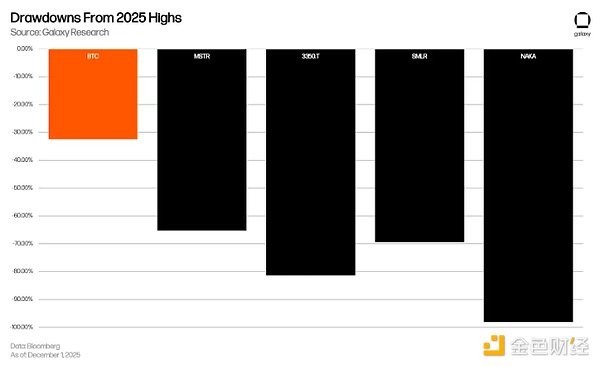
Equally noteworthy is that these pullbacks are particularly extreme compared to Bitcoin's own decline. Bitcoin has fallen approximately 30% from its high. In the volatile crypto market, such volatility is common. But as Galaxy Research pointed out in the summer, these treasury companies are essentially leveraged investment vehicles for Bitcoin exposure. When the underlying asset BTC falls by x%, investors should expect the Bitcoin treasury company's stock price to fall by x+y%.
Equity Premium Relative to Bitcoin Net Asset Value
Since July, the equity premium relative to net asset value (NAV) has contracted significantly, whereas at that time the premium was significantly high.
In this section, we use the current market capitalization (number of shares outstanding × share price) relative to Bitcoin's NAV to calculate the equity premium.
The following chart shows the market capitalization premium relative to Bitcoin's NAV for MicroStrategy (MSTR), Metaplanet (3350.T), and Semler Scientific (SMLR) since the beginning of 2025. The continued narrowing of the premium for these three companies clearly indicates that once Bitcoin weakens and risk appetite diminishes, the issuance premium quickly dissipates.
NAKA is not included in this chart because the company only began accumulating the majority of its Bitcoin holdings in August, making early data incomparable to other companies.
The chart below compares the premium level at the time the July report was released, when Metaplanet's stock price was 236% of its Bitcoin Net Asset Value (NAV). This is the updated chart (we've again replaced ALTBG with NAKA).

III. What's Next?
The initial phase of Bitcoin Treasury investment appears to have ended. This pattern didn't mysteriously fail; rather, it triggered the natural boundary conditions pointed out in Galaxy Research's July report. When the stock price trades near or below Bitcoin's net asset value, issuing new shares transforms from a growth engine into value erosion. This is precisely the reality currently facing the market.
Looking ahead, depending on the health of each company's balance sheet and its financing capabilities, the following three reasonable scenarios may occur (and may occur simultaneously in different companies): ****Continued Narrowing of Premiums (Base Scenario)** As long as the crypto market remains weak, most DAT will likely trade at par or a negative premium. In this scenario:** The core indicator determining whether an issuance is for added value or dilution—BTC holdings per share—will stagnate or decline; DAT stocks will exhibit a leveraged decline relative to spot BTC, rather than upward momentum. Investors should not expect a repeat of the "stock beta > BTC beta" scenario seen in early 2025, unless risk appetite fully recovers and BTC reaches new highs. **Selective Survival and Industry Consolidation** This pullback is a stress test for balance sheets. The least flexible companies include: Companies that issued the most shares at the peak of the premium; companies that bought the most Bitcoin at the cycle's high; and companies that used their Bitcoin holdings as collateral for debt. The persistent discount, coupled with substantial unrealized losses, is likely to trigger real solvency and governance pressures. Potential restructuring is expected, and stronger players (including MicroStrategy) will be well-positioned to acquire weaker companies at a discount or eliminate them outright based on their financial strength. In other words, treasury companies are about to enter a phase of natural selection. MicroStrategy's recent announcement of a $1.44 billion cash reserve is an example of this trend. For years, MicroStrategy relied almost entirely on its Bitcoin reserves and capital market funding to manage liquidity. However, with the changing issuance environment, the company has now built a substantial dollar reserve (raised through immediate equity sales) to cover at least 12 months of dividend and interest payment obligations. This move marks a significant evolution in the DAT model. The micro-strategy is signaling to the market that it is prepared for periods of narrowing premiums and weak Bitcoin prices. Beyond pure Bitcoin accumulation, liquidity management is increasingly becoming a strategic focus. The Next Cycle of DAT Choices In principle, the treasury firm investment model has not died out. If (or when) Bitcoin eventually reaches new highs, some of these firms will likely regain a moderate equity premium and restart the issuance flywheel. But the bar is clearly higher now. Boards and management teams will be judged on how they handle this first real stress test: Did they over-issue at price highs? Did they retain flexibility? How will they handle market downturns? Are their shareholders willing to participate again? The key is that these firms are no longer simply “Bitcoin leveraged bullish tools,” but rather path-dependent tools—their returns are highly dependent on issuance strategies and entry timing. It's worth reiterating a passage from Galaxy Research's July report: "The DAT (Digital Attraction, Telecommunications, and Acquisition) business model is vulnerable to premium collapses, regulatory changes, and capital market volatility. Companies overly reliant on PIPE financing or with excessive leverage may experience sharp drawdowns under unfavorable market conditions."
