


The US-Russia meeting failed to reach an agreement, and the unclear geopolitical outlook led to fluctuations in oil prices

The US-Russia meeting failed to reach an agreement, and the unclear geopolitical situation led to fluctuations in oil prices. The average WTI price was $58.87 per barrel, an increase of 0.58% from the previous week. OPEC+ maintained its policy of suspending production increases to support oil prices, while the Russia-Ukraine situation and tensions in Venezuela also affected oil prices. The US-Russia talks did not produce a solution to the Ukraine issue, and investors' wait-and-see attitude put pressure on oil prices
Introduction
This week (11.27-12.3), international crude oil prices showed an overall range-bound trend, with weekly average prices fluctuating. The WTI average price was $58.87 per barrel, an increase of $0.34 per barrel, or 0.58%, compared to the previous week. Factors supporting oil prices during the week included OPEC+ maintaining its pause on production increases and the lack of an agreement from high-level meetings between the U.S. and Russia. Factors putting pressure on oil prices included investors taking a wait-and-see attitude towards the Russia-Ukraine situation and a decrease in U.S. crude oil inventories.
Review of the Crude Oil Futures Market This Week
This week (11.27-12.3), crude oil showed an overall range-bound trend, with weekly average prices fluctuating.
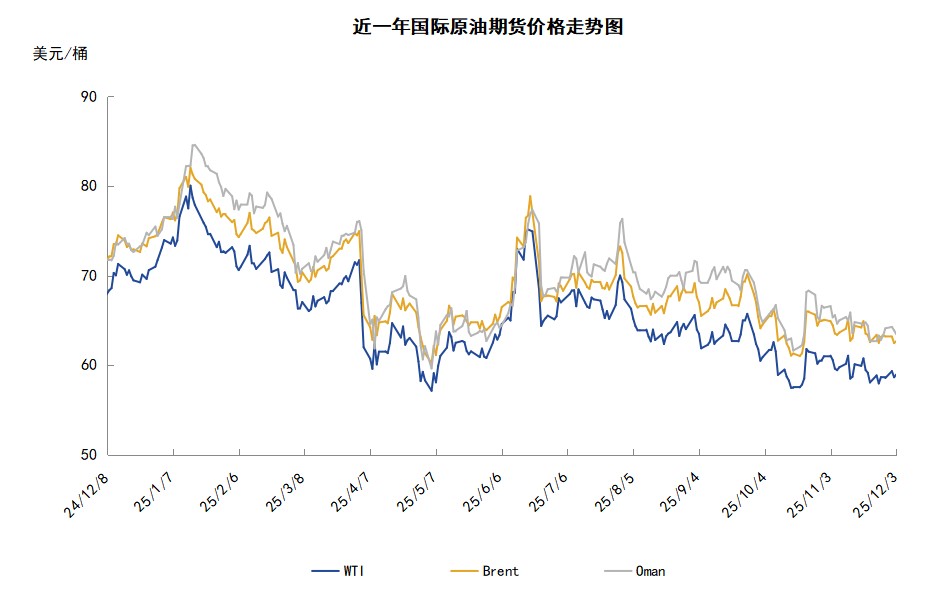
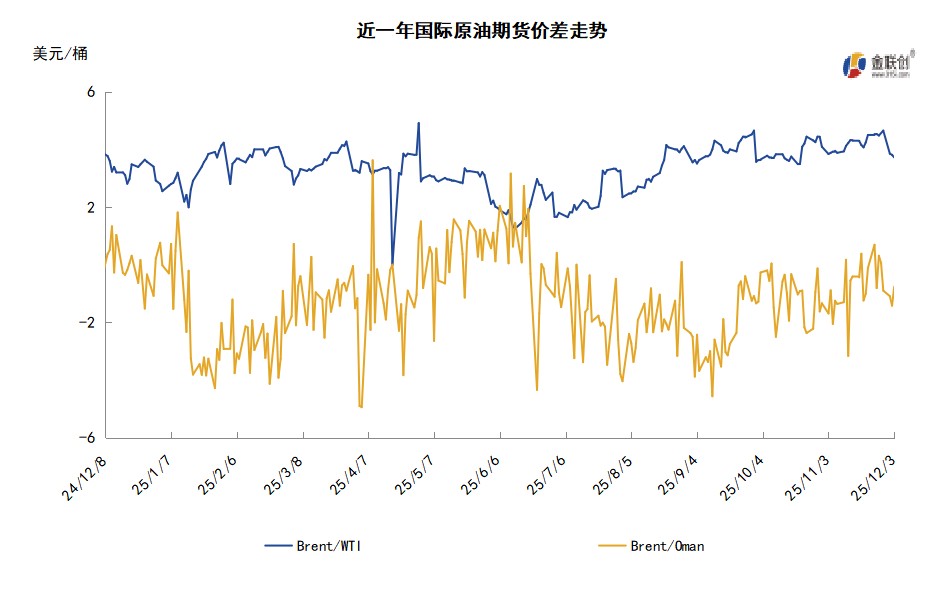

During the week, in terms of supply, the OPEC+8 countries maintained their pause on production increases, which supported oil prices. The Organization of the Petroleum Exporting Countries (OPEC) issued a statement that the eight major oil-producing countries of OPEC+ decided to maintain the production plan established in early November and to pause production increases in the first quarter of 2026. In terms of geopolitical situation, the expectation of reduced supply of Russian oil due to force majeure was favorable for oil prices. On the 29th, the Caspian Pipeline Consortium's mooring facilities in Novorossiysk were attacked by unmanned boats, leading to the suspension of loading and other production operations, and tankers were urgently evacuated. Additionally, sources in Ukraine revealed that an explosion occurred on the section of the "Friendship" oil pipeline from Taganrog to Lipetsk due to an attack. Besides the Russia-Ukraine situation, the tense geopolitical situation in Venezuela also supported oil prices. U.S. President Trump stated on social media that the airspace over and around Venezuela "is considered fully closed." Subsequently, Venezuela filed a complaint with the International Civil Aviation Organization regarding Trump's remarks, accusing the U.S. of "violating sovereignty."
On the other hand, investors' wait-and-see attitude towards the Russia-Ukraine geopolitical situation and the Ukraine peace agreement put pressure on oil prices. Russian President Putin met with U.S. President Trump's envoy, Vitkov, at the Kremlin, with the Russian side stating that the talks were constructive, very beneficial, and content-rich. The discussions included territorial issues; however, the U.S. and Russia agreed not to disclose the substance of the talks, and no compromise solution to the Ukraine issue was reached. The Russian side indicated that the U.S. and Russia would maintain contact at the presidential assistant level. The possibility of a meeting between Putin and Trump would depend on the progress made in the mediation process regarding the Ukraine issue. In terms of inventory, EIA data showed that as of the week ending November 28, U.S. crude oil inventories, including strategic reserves, increased by 824,000 barrels to 839.177 million barrels, while U.S. commercial crude oil inventories increased by 574,000 barrels to 427.503 million barrels
This Week's Crude Oil Spot Market Review
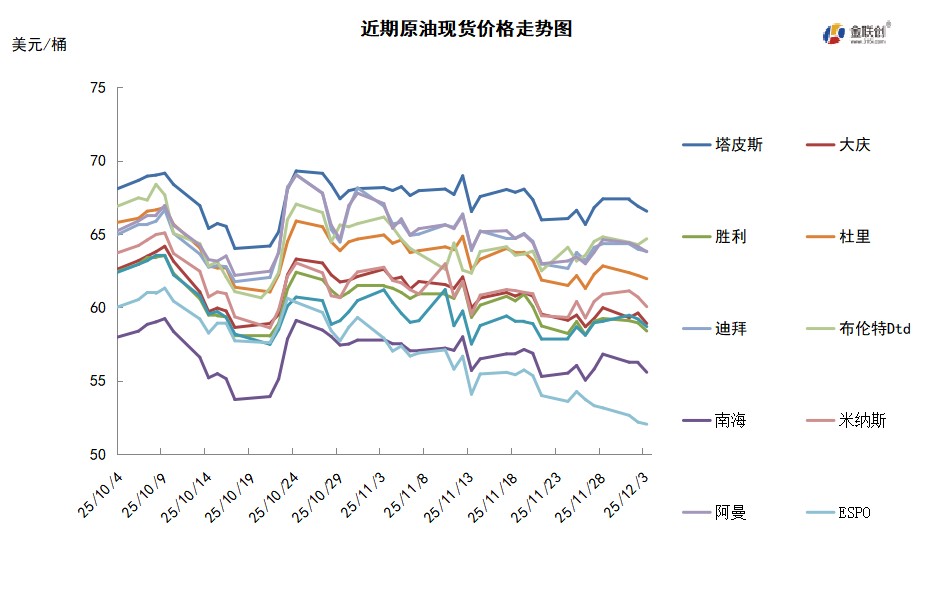
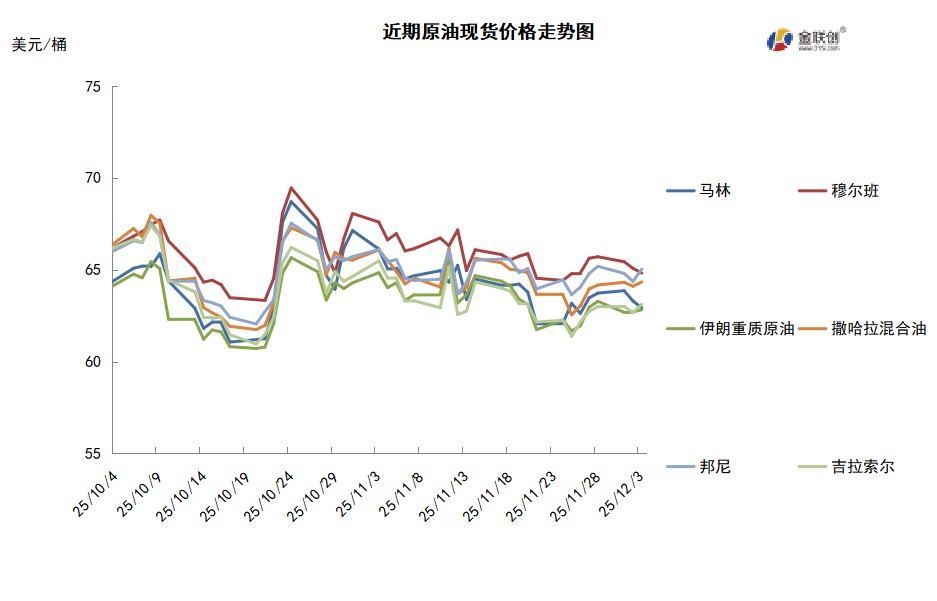
This week, the average spot price of international crude oil fluctuated. In the Middle East crude oil market, traders shifted their attention to the new round of official crude oil prices announced by Middle Eastern oil-producing countries and the supply situation for shipments in February. Sources indicate that Saudi Arabia is expected to lower the official crude oil price for January for Asian buyers to its lowest level in five years. The official price for Arab Light crude oil in January may drop by $0.30-$0.40 per barrel, to a premium of $0.60-$0.70 per barrel over the Oman/Dubai average, marking the second consecutive month of decline and the lowest level since January 2021. The spot price differential for Abu Dhabi's Upper Zakum crude oil for January shipments has risen, as expectations for the supply and demand fundamentals of medium/heavy crude oil are set to improve. Additionally, the spot price differential for El Sharara crude oil for February shipments has also increased, as expectations suggest that the oversupply situation in February will ease. In the Asia-Pacific crude oil spot market, trade sources reported that Indian Oil Corporation has placed orders to purchase Russian crude oil from non-sanctioned entities, and Bharat Petroleum Corporation is also negotiating imports of Russian crude oil. Following new sanctions imposed by the U.S. on Russian oil producers in October, Indian refiners had paused purchases of Russian crude oil, prompting them to turn to the Middle East and other markets for alternative crude oil. However, the decline in Indian imports of Russian crude oil may only be temporary, as Russia plans to increase supplies to India. Furthermore, the market is also paying attention to the purchase tenders for shipments arriving in February from Indonesia's national oil company and the supply and demand situation for Ichthys condensate in February. Many market participants believe that the supply of Ichthys condensate for February shipments will be lower than in January. The trading price of Ichthys condensate shipped after November has consistently exceeded market expectations, and some end-users appear to have restricted their spot purchases of Ichthys condensate. INPEX has sold two cargoes of Ichthys condensate for January shipments at around $5 per barrel above the spot price of Brent through private negotiations.
Supply and Demand Factors
This week, on the supply side, OPEC+ decided at its oil production meeting on November 30 to maintain oil production levels unchanged for the first quarter of 2026. Nearly half of the global oil supply increase in 2025 is expected to come from OPEC+, reflecting the organization's efforts to increase production targets to gain market share. Crude oil supply continues to benefit from significant improvements in production efficiency, and although the number of active oil drilling rigs has decreased, crude oil production has not declined correspondingly. Additionally, U.S. domestic crude oil production has not slowed down; instead, it continues to set historical peaks, which may lead to further downward risks for oil prices in the coming months On the demand side, since the beginning of this year, the recovery pace of global economic energy demand has been uneven, and the demand fluctuations in Asian countries and other emerging markets have further weakened the upward momentum of crude oil prices. Against a backdrop of weak supply and demand on both sides, any expectations of increased supply related to peace progress will be amplified by the market, thereby suppressing price rebounds. Currently, it is the off-season for oil consumption, and the market is continuously weighing the supply and demand outlook. Due to the uncertainty of Trump's trade war, the global economic situation in 2026 remains unknown, which suppresses the growth of oil consumption.
U.S. Inventory Changes
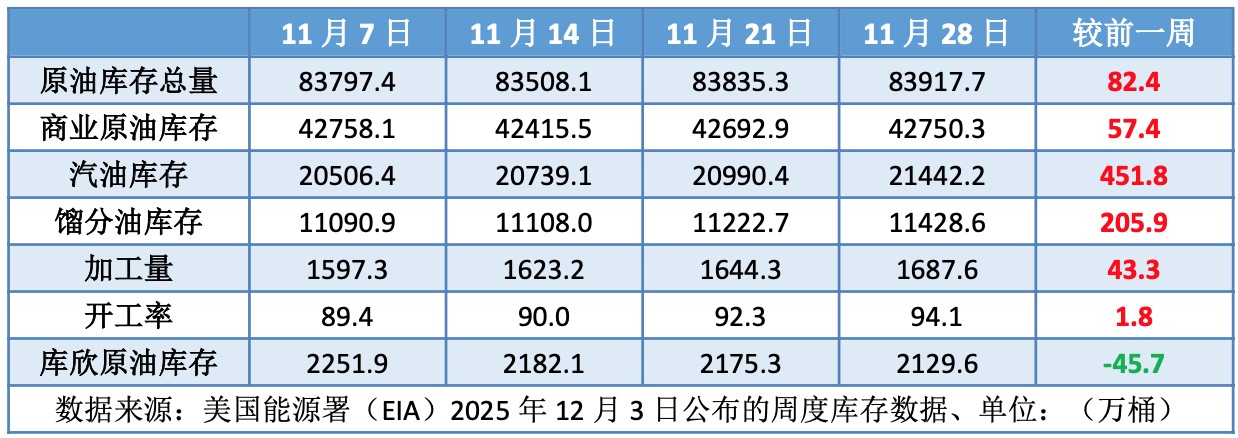
Last week, U.S. crude oil inventories unexpectedly increased, while gasoline and distillate inventories also exceeded expectations. According to data from the U.S. Energy Information Administration, as of the week ending November 28, crude oil inventories were 0.98% higher than the same period last year; 3% lower than the same period over the past five years; gasoline inventories were 0.08% lower than the same period last year; 2% lower than the same period over the past five years; distillate inventories were 3.23% lower than the same period last year; and 7% lower than the same period over the past five years. Last week, U.S. crude oil imports averaged 5.981 million barrels per day, a decrease of 456,000 barrels from the previous week, while refined oil daily imports averaged 175.7 thousand barrels, an increase of 57,000 barrels from the previous week.
Fund Positioning
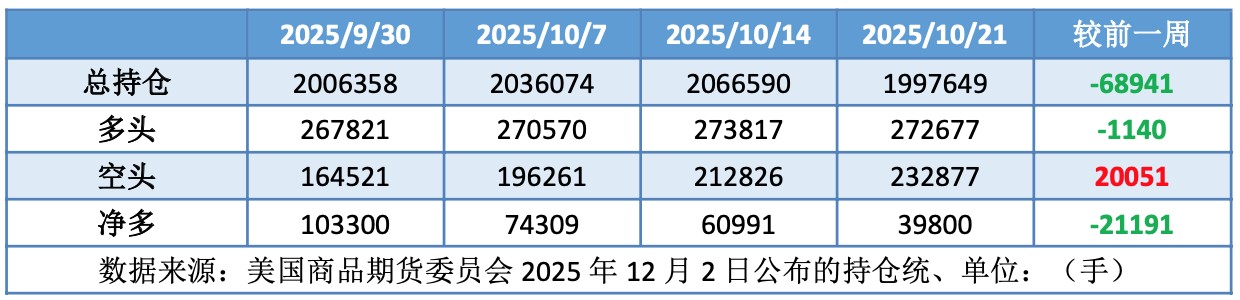
Speculators held a net long position in light crude oil futures on the New York Mercantile Exchange that decreased by 34.7%. According to the latest statistics from the U.S. Commodity Futures Trading Commission, as of the week ending October 21, the open interest in crude oil futures on the New York Mercantile Exchange was 1,997,649 contracts, a decrease of 68,941 contracts. Large speculators held a net long position of 39,800 contracts in crude oil futures on the New York Mercantile Exchange, a decrease of 21,191 contracts from the previous week. Among them, long positions totaled 272,677 contracts, a decrease of 1,140 contracts from the previous week; short positions totaled 232,877 contracts, an increase of 20,051 contracts.
Market Outlook for Next Week
From a technical perspective, international crude oil prices are generally showing a range-bound fluctuation trend. The main factors supporting oil prices during the week include: first, OPEC+8 countries maintaining a pause in production increase policies; second, high-level meetings between the U.S. and Russia failing to achieve substantial progress on Russia-Ukraine peace negotiations; third, the tense geopolitical situation in Venezuela. The main factors putting pressure on oil prices during the week include: first, investors focusing on a new round of talks regarding the Ukraine issue; second, increases in U.S. crude oil and refined oil inventories; third, investors' ongoing concerns about oversupply in the crude oil market. As of the 3rd, WTI closed at $58.95 per barrel, an increase of $0.30 per barrel or 0.51%; for the week ending the 3rd, the average WTI price was $58.87 per barrel, an increase of $0.34 per barrel or 0.58% compared to the previous week. From a technical standpoint, this indicates that oil prices may continue to fluctuate at low levels In terms of the economy, in the United States, there are still differences within the Federal Reserve regarding interest rate cuts. Many Federal Reserve officials believe that maintaining interest rates unchanged for the remainder of 2025 may be appropriate; however, several officials pointed out that if the economic performance aligns with expectations, another rate cut in December is likely to be suitable. Powell also reiterated that a rate cut in December is not a certainty. The Federal Reserve has raised its GDP growth forecast before 2028, expecting financial conditions to shift from a drag to support, with the unemployment rate gradually declining to slightly below the natural unemployment rate. However, inflationary pressures still exist, especially as tariff increases will bring additional upward pressure in 2026.
This week, the Organization of the Petroleum Exporting Countries (OPEC) issued a statement that eight major oil-producing countries among OPEC and non-OPEC producers decided to maintain the production plan established in early November, with countries pausing oil production increases in the first quarter of 2026. Representatives from Saudi Arabia, Russia, Iraq, the United Arab Emirates, Kuwait, Kazakhstan, Algeria, and Oman held an online meeting that day to discuss the situation and outlook of the international oil market. The statement noted that due to seasonal factors, these countries decided to pause the pace of production increases in January, February, and March 2026, keeping production levels the same as in December 2025. The statement also indicated that the current global economic outlook is relatively stable, and the fundamentals of the oil market are robust. Meanwhile, to maintain stability in the oil market, the eight countries will flexibly adjust the pace of production increases based on market conditions.
U.S. President Trump’s remarks about closing Venezuelan airspace have increased geopolitical uncertainty. Trump stated on social media that the airspace over and around Venezuela is "considered fully closed." Subsequently, Venezuela filed a complaint with the International Civil Aviation Organization regarding Trump's remarks, accusing the U.S. of "violating sovereignty." Venezuelan Vice President Rodriguez also stated that Venezuela submitted an official letter signed by President Maduro to the OPEC Secretary-General and all OPEC+ members, accusing the U.S. of attempting to control Venezuela's largest oil reserves in the world through military intervention. The Venezuelan side emphasized that such attempts pose a serious threat to the stability of the international energy market, and Venezuela will firmly defend its sovereignty and integrity over its natural resources and energy, never yielding to any form of extortion or threat, and called for oil-producing countries to establish a sovereign production alliance free from external interference.
On December 3, expectations that U.S. and Western sanctions on Russian oil exports cannot be lifted in the short term supported oil prices. Russian President Putin and U.S. Special Envoy for Middle East Affairs Wittekov held talks at the Kremlin. The Russian side stated that no compromise solution to the Ukraine issue was reached during the talks, and while Russia can accept some of the U.S. proposals, others are unacceptable. Putin stated that Russia cannot accept Europe's attempts to modify the U.S.-proposed "peace plan" for Russia and Ukraine.
Jinlian Chuang expects that next week (December 4-10), although the U.S. is committed to advancing Russia-Ukraine talks, progress is currently slow, and the impact on the oil market is very limited. The fundamentals of the crude oil market remain the main factor driving oil prices, and OPEC+'s pause in production increases in the first quarter of 2026 provides some support to the market, but it still cannot offset the negative impact of seasonal demand decline Overall, international crude oil prices may have room for slight fluctuations and declines next week.
The information, opinions, and forecasts contained in this report reflect the author's personal judgment on the day the report was initially published, based on information that the author believes to be reliable and publicly available. Efforts have been made to ensure the accuracy and completeness of this information, but no guarantees are provided. The author also does not guarantee that the opinions or statements in the report will not change. At different times, the author may issue reports that are inconsistent with the information, opinions, and speculations contained in this report without prior notice. The information or opinions expressed in this report do not constitute investment advice for any individual. The cases listed in the report are for illustrative reference only, and the author assumes no responsibility for any losses incurred by anyone using the content of this report.
This report reflects the author's personal views and does not represent the research judgments of JinLianChuang or the Chicago Mercantile Exchange. JinLianChuang or the Chicago Mercantile Exchange does not guarantee the accuracy or completeness of the report. This report is transmitted only to specific clients, and the copyright belongs to JinLianChuang. Without written permission from JinLianChuang, no institution or individual may reproduce, copy, quote, or reprint it in any form.
The market has risks, and investment should be cautious
