


Assessing Ares Management’s Sky High Valuation After Multi Year Rally and Private Credit Growth

Ares Management's stock is considered overvalued, with a recent price of $163.07 compared to an intrinsic value of $31.14 per share, suggesting a 423.7% overvaluation. The PE ratio of 70.2x is significantly higher than the industry average of 24.0x and the Fair Ratio of 22.7x. Investors are advised to consider alternative investment opportunities due to the high valuation and market volatility.
- If you are wondering whether Ares Management is still worth buying after its big multi year run, or if the easy money has already been made, this breakdown will help you consider whether the current price still stacks up to the fundamentals.
- The stock just closed at $163.07, up 5.5% over the last week and 6.6% over the last month, even though it is still down 8.8% year to date and 5.5% over the past year after a 153.6% 3 year and 291.3% 5 year rally.
- Behind those moves, investors have been focusing on Ares Management's expanding footprint across private credit and alternative assets, as capital continues to flow into non traditional lending and yield focused strategies. At the same time, the broader market debate about how sustainable private credit growth really is has kept volatility elevated and sentiment more cautious.
- On our framework, Ares Management currently scores 0 out of 6 on our undervaluation checks, giving it a value score of 0/6. In the rest of this article we explain what that means using several valuation approaches, before finishing with a more holistic way to think about what Ares might be worth.
Ares Management scores just 0/6 on our valuation checks. See what other red flags we found in the full valuation breakdown.
Approach 1: Ares Management Excess Returns Analysis
The Excess Returns model looks at how much profit Ares Management can generate above its cost of equity, and then capitalizes those surplus returns into an estimated per share value. Instead of focusing on near term earnings swings, it emphasizes the durability of returns on shareholders' capital.
On this framework, Ares is assumed to have a Book Value of $13.68 per share and a Stable EPS of $2.03 per share, based on the median return on equity from the past five years. The model applies a Cost of Equity of $0.87 per share, implying an Excess Return of $1.16 per share on an Average Return on Equity of 20.43%. A Stable Book Value of $9.94 per share, drawn from the median historical book value, anchors these projections.
Combining these inputs, the Excess Returns model arrives at an intrinsic value of about $31.14 per share. Against the recent share price of $163.07, this implies Ares is roughly 423.7% overvalued on this basis, leaving little margin of safety for new buyers.
Result: OVERVALUED
Our Excess Returns analysis suggests Ares Management may be overvalued by 423.7%. Discover 908 undervalued stocks or create your own screener to find better value opportunities.

Head to the Valuation section of our Company Report for more details on how we arrive at this Fair Value for Ares Management.
Approach 2: Ares Management Price vs Earnings
For a consistently profitable business like Ares Management, the price to earnings, or PE, ratio is a useful yardstick because it links what investors pay directly to the profits the company is generating today. In general, faster growth and lower risk can justify a higher PE multiple, while slower growth or higher uncertainty usually warrant a lower one.
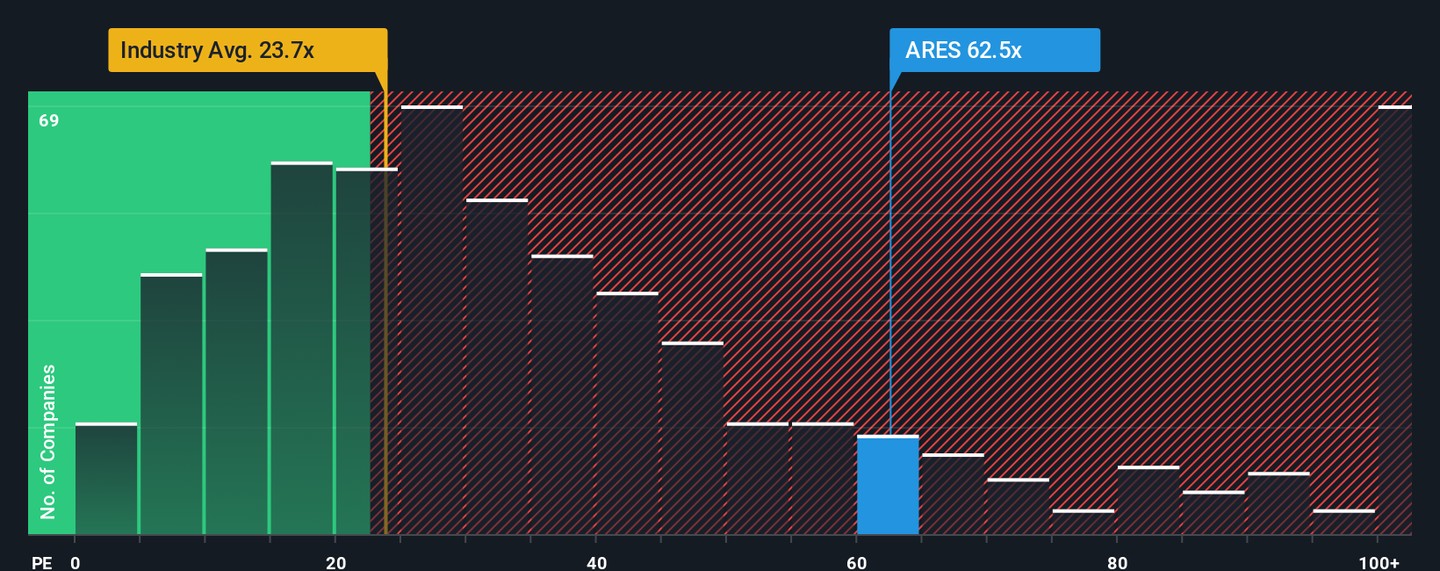
Ares currently trades on a PE of about 70.2x, which is far above both the Capital Markets industry average of roughly 24.0x and the broader peer group average of about 13.9x. To add more nuance than a simple peer comparison, Simply Wall St uses a proprietary Fair Ratio, which estimates what PE multiple might be reasonable given Ares earnings growth profile, profitability, industry, market cap and risk factors. For Ares, that Fair Ratio is 22.7x, well below the stock's current 70.2x.
Because the market price implies a PE multiple roughly three times higher than the Fair Ratio, Ares appears expensive on this preferred multiple framework.
Result: OVERVALUED
PE ratios tell one story, but what if the real opportunity lies elsewhere? Discover 1442 companies where insiders are betting big on explosive growth.
Upgrade Your Decision Making: Choose your Ares Management Narrative
Earlier we mentioned that there is an even better way to understand valuation, so let us introduce you to Narratives, a simple way to connect your view of Ares Management’s business to a financial forecast and a fair value estimate. A Narrative is your story about the company, where you spell out what you believe about its future revenue, earnings and margins, and then see how those assumptions translate into a fair value. On Simply Wall St’s Community page, used by millions of investors, Narratives are an easy, accessible tool that help you compare your Fair Value to today’s Price, and they update dynamically as new information, like earnings or news, comes in. For example, one Ares investor might build a bullish Narrative that leans toward the higher analyst target around $215, focusing on private credit strength, while a more cautious investor might anchor closer to the $160 low target, emphasizing competition and regulatory risks. Each investor can then see whether their Narrative suggests Ares is trading below or above their personal fair value.
Do you think there's more to the story for Ares Management? Head over to our Community to see what others are saying!

This article by Simply Wall St is general in nature. We provide commentary based on historical data and analyst forecasts only using an unbiased methodology and our articles are not intended to be financial advice. It does not constitute a recommendation to buy or sell any stock, and does not take account of your objectives, or your financial situation. We aim to bring you long-term focused analysis driven by fundamental data. Note that our analysis may not factor in the latest price-sensitive company announcements or qualitative material. Simply Wall St has no position in any stocks mentioned.
