


Is Booking Holdings Attractively Priced After Recent Travel Demand Strength?

The article discusses whether Booking Holdings is attractively priced at $5,200 per share, given its recent performance and future potential. Despite a slight negative return over the past year, the stock is considered undervalued based on a Discounted Cash Flow analysis, suggesting a 31.6% discount to its estimated fair value of $7,593 per share. Additionally, its PE ratio indicates undervaluation compared to industry averages. The analysis highlights Booking's growth prospects in alternative accommodations and payments amidst competitive pressures.
- If you are wondering whether Booking Holdings is still a smart buy at around $5,200 a share, you are not alone. Investors are debating whether the current price fairly reflects its long term potential.
- The stock has climbed 5.7% over the last week and 5.8% over the past month, but its 1 year return is slightly negative at -1.2%, even after a 161.5% gain over 3 years and 152.8% over 5 years.
- Recent headlines have focused on continued strength in global travel demand and Booking's push into alternative accommodations and payments, which together reinforce the idea that this is no longer just a traditional online travel agency. At the same time, investors are weighing competitive pressure from peers and regulatory scrutiny in key regions, which helps explain why the share price has not moved in a straight line.
- On our framework, Booking Holdings currently earns a 3/6 valuation score, suggesting it screens as undervalued on half of the key checks we run. Next we will unpack those different valuation methods before finishing with a more holistic way to think about what the stock is really worth.
Booking Holdings delivered -1.2% returns over the last year. See how this stacks up to the rest of the Hospitality industry.
Approach 1: Booking Holdings Discounted Cash Flow (DCF) Analysis
A Discounted Cash Flow model estimates what a company is worth by projecting the cash it can generate in the future and discounting those cash flows back to today, using a required rate of return.
For Booking Holdings, the latest twelve month Free Cash Flow is about $8.2 billion, giving a starting base. Analysts supply detailed forecasts for the next few years, and Simply Wall St then extrapolates those estimates out to 10 years using a 2 stage Free Cash Flow to Equity model. On this basis, Booking's Free Cash Flow is projected to rise to roughly $17.9 billion by 2035, reflecting growth that gradually slows as the business matures.
When all those projected cash flows are discounted back to today, the model arrives at an intrinsic value of about $7,593 per share. Compared with the current share price around $5,200, this implies the stock is trading at roughly a 31.6% discount to its estimated fair value.
Result: UNDERVALUED
Our Discounted Cash Flow (DCF) analysis suggests Booking Holdings is undervalued by 31.6%. Track this in your watchlist or portfolio, or discover 905 more undervalued stocks based on cash flows.
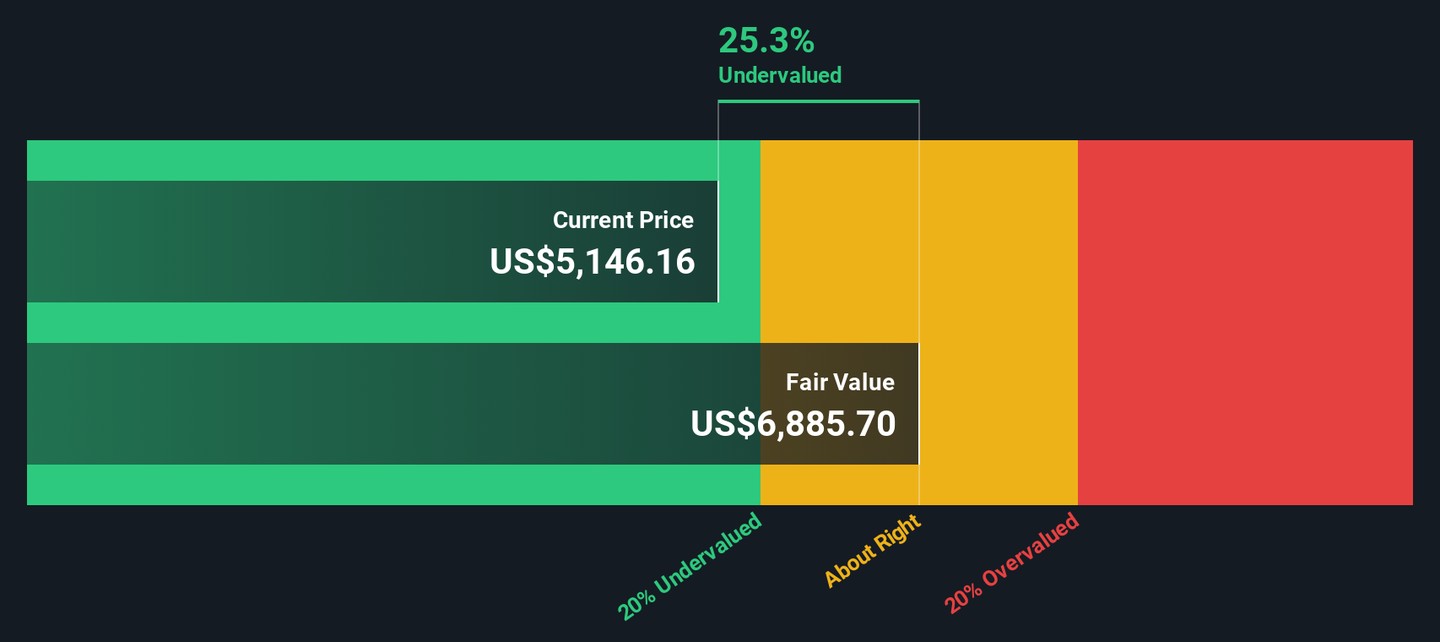
Head to the Valuation section of our Company Report for more details on how we arrive at this Fair Value for Booking Holdings.
Approach 2: Booking Holdings Price vs Earnings
For a mature, consistently profitable business like Booking Holdings, the price to earnings ratio is a practical way to gauge whether investors are paying a reasonable price for each dollar of current profits. In general, companies with faster, more reliable earnings growth and lower risk can justify a higher normal PE multiple, while slower growing or riskier businesses tend to trade on lower multiples.
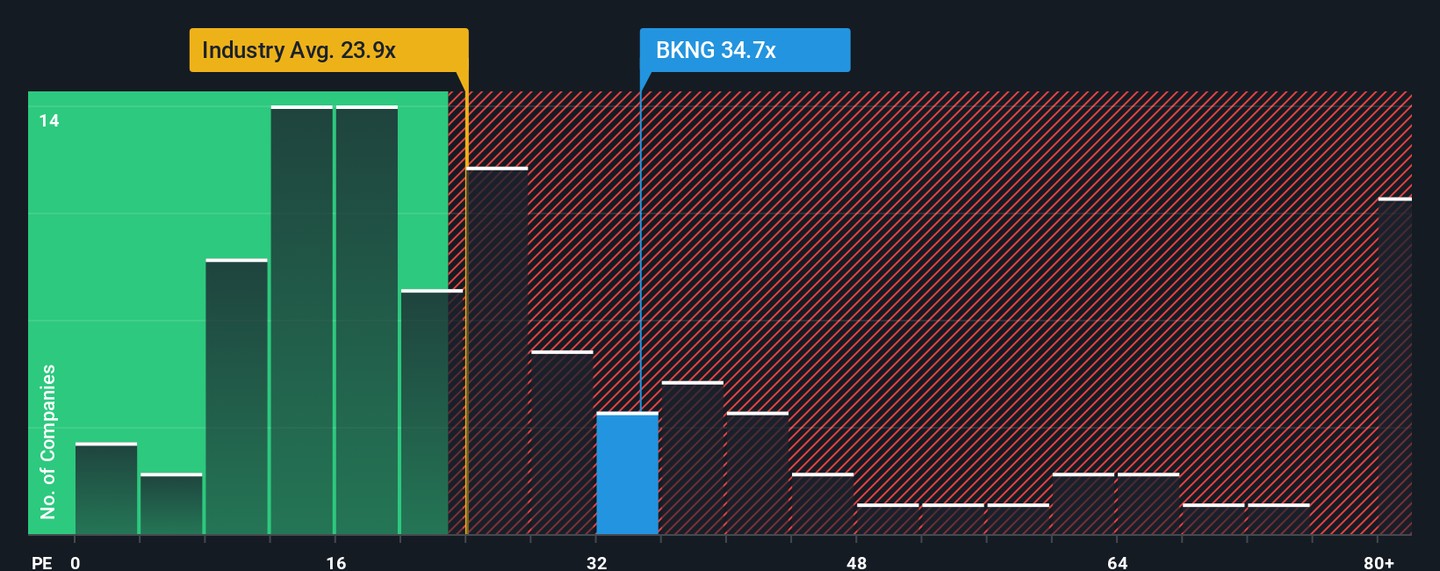
Booking currently trades on a PE of about 33.2x, which is well above the Hospitality industry average of roughly 21.2x and also higher than the peer group average of around 28.5x. Simply Wall St goes a step further by calculating a Fair Ratio, its proprietary estimate of the PE that would be justified given Booking's specific earnings growth outlook, profitability, industry, market cap and risk profile. For Booking, that Fair Ratio sits near 39.1x, suggesting that, when all those factors are considered together, the stock could reasonably support a higher multiple than it currently commands.
Because the actual PE of 33.2x is meaningfully below the 39.1x Fair Ratio, this lens points to Booking as undervalued on an earnings multiple basis.
Result: UNDERVALUED
PE ratios tell one story, but what if the real opportunity lies elsewhere? Discover 1440 companies where insiders are betting big on explosive growth.
Upgrade Your Decision Making: Choose your Booking Holdings Narrative
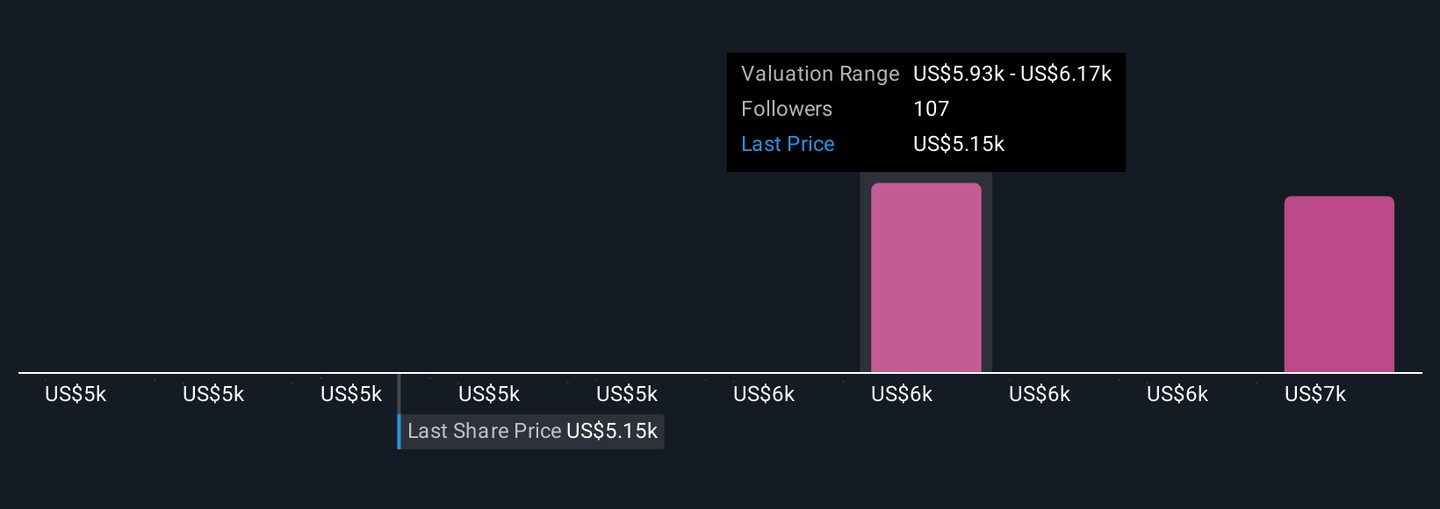
Earlier we mentioned that there is an even better way to understand valuation, so let us introduce you to Narratives, a simple idea where you write the story behind your numbers by linking what you believe about Booking Holdings future revenue, earnings and margins to a financial forecast and then to a fair value estimate. Narratives on Simply Wall St, available to millions of investors through the Community page, make this easy and accessible by guiding you to translate your view of Booking, for example that AI driven product improvements, alternative accommodations and new travel verticals will support resilient growth, or alternatively that rising competition, softer travel demand and margin pressure will cap earnings, into explicit assumptions that produce a fair value which you can then compare to today price to decide whether to buy, hold or sell. Because these Narratives update dynamically as new earnings, news and analyst revisions come in, you can see how bullish views that put fair value closer to $7,218 and more cautious perspectives nearer $5,200 evolve over time, and quickly judge whether the current market price still fits your story.
Do you think there's more to the story for Booking Holdings? Head over to our Community to see what others are saying!
This article by Simply Wall St is general in nature. We provide commentary based on historical data and analyst forecasts only using an unbiased methodology and our articles are not intended to be financial advice. It does not constitute a recommendation to buy or sell any stock, and does not take account of your objectives, or your financial situation. We aim to bring you long-term focused analysis driven by fundamental data. Note that our analysis may not factor in the latest price-sensitive company announcements or qualitative material. Simply Wall St has no position in any stocks mentioned.
