
U.S. Stock Market Outlook | Futures for the three major indices rise together, with earnings reports from the four major tech giants and the Federal Reserve's interest rate decision making headlines this week. The easing of tensions between the U.S. and Iran significantly impacts oil prices
 Complete. Here is the key summary
On July 27th, before the US stock market opened, the three major stock index futures rose together. This week is a busy week for earnings reports, with Microsoft, Meta, Apple, and Amazon set to announce their earnings, and the market is focused on the return on AI capital expenditures; the Federal Reserve will hold a monetary policy meeting on the 28th-29th, with expectations to maintain interest rates unchanged. In addition, influenced by the easing of tensions between the US and Iran, international oil prices have fallen sharply
Pre-Market Market Trends
- As of July 27 (Monday) pre-market, U.S. stock index futures are all up. As of the time of writing, Dow futures are up 1.05%, S&P 500 futures are up 0.82%, and Nasdaq futures are up 1.31%.

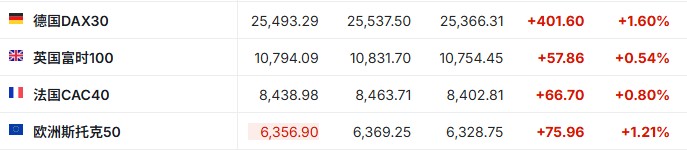
- As of the time of writing, the German DAX index is up 1.60%, the UK FTSE 100 index is up 0.54%, the French CAC 40 index is up 0.80%, and the Euro Stoxx 50 index is up 1.21%.
- As of the time of writing, WTI crude oil is down 6.02%, priced at $83.93 per barrel. Brent crude oil is down 5.43%, priced at $86.70 per barrel.

Market News
Super Heavyweight Week for U.S. Stocks is Coming! Major Tech Giants' Earnings Reports, Federal Reserve's Interest Rate Decision, and Easing Tensions in the U.S.-Iran Situation Impact Oil Prices. The U.S. stock market has just ended a turbulent week, with all three major indices closing lower for the week. The new week will welcome the highest information density trading window of the quarter: the four major tech giants will announce their earnings reports, and the Federal Reserve will hold an interest rate meeting. In addition, the easing of geopolitical tensions in the Middle East has led to a significant drop in international oil prices from the $100 mark. This week, the earnings season for U.S. stocks reaches its peak, with the performance of four companies among the "seven major tech giants" becoming the market focus: Microsoft (MSFT.US) and Meta (META.US) will announce their earnings on Wednesday; Apple (AAPL.US) and Amazon (AMZN.US) will announce their earnings on Thursday. Similar to last week's earnings reports from Alphabet (GOOGL.US) and Tesla (TSLA.US), the core market focus is whether the massive AI capital expenditures can deliver real returns. In addition to the four major tech giants, leading companies from various industries will also disclose their earnings reports this week, notably, SK Hynix (SKHY.US) will release its first earnings report since going public in the U.S. Beyond earnings reports, central banks around the world will also announce their latest interest rate decisions. The Federal Reserve will hold its interest rate meeting from July 28 to 29, with investors generally expecting the central bank to hold steady, but the risk of an unexpected rate hike cannot be ignored. Additionally, the Bank of England and the Bank of Japan will also announce their interest rate decisions.
U.S. and Iran Suspend Military Actions, Iran Doubts U.S. Commitment to Ceasefire. After 13 consecutive nights of airstrikes by the U.S. on Iran, the Pentagon suspended bombings late last Friday, and no new strikes were launched on Saturday and Sunday. Iran also simultaneously stopped retaliatory strikes against neighboring countries with U.S. military bases, refraining from firing for two consecutive days. A senior Iranian official stated that Tehran's position is clear—"to respond to attacks with attacks," and if the U.S. stops its strikes, Iran will also cease its actions; this message has been conveyed to the U.S The U.S. Ambassador to the United Nations, Linda Thomas-Greenfield, stated that President Trump’s suspension of airstrikes is to allow space for diplomatic negotiations and provide some operational flexibility. However, a U.S. official revealed that the military reason for the suspension is that the pre-planned target list has been largely exhausted, and General Mark Milley, Chairman of the Joint Chiefs of Staff, privately warned the president that if large-scale operations were to resume, the ammunition stockpile (including air defense intercept missiles) would be at risk. Despite the apparent calm, a senior Iranian source indicated that Tehran is "more skeptical than optimistic" about this suspension, generally viewing it as a tactical adjustment rather than a genuine change of intent, as Iran has accumulated too many lessons from being deceived by the U.S. According to multiple media reports, Trump made the decision to suspend after a meeting last Friday, where Milley and several senior military and political advisors expressed concerns about subsequent actions.
AI giants spend tens of millions to influence the U.S. elections! The war of political agents has begun, who will define the future of the industry? Some giants in the AI and tech sectors are using the midterm elections to engage in a war of agents over the future of the industry. Various parties, including Anthropic, Meta, and OpenAI President Greg Brockman, are linked to peripheral organizations and super PACs aimed at shaping the power dynamics of the next Congress and some state legislatures. Currently, these organizations have spent over $65 million and still hold tens of millions in reserve funds. Since so-called "dark money" organizations are not required to publicly disclose their expenditures regularly, the final total may take some time to clarify. The Trump administration has generally taken a friendly stance on AI regulation, but tensions escalated after the White House delayed the release of Anthropic and OpenAI's latest cutting-edge models. Both companies are closely monitoring what actions the Trump administration and lawmakers will take regarding Chinese open-source weighted AI models (such as the popular Kimi K3 from Moon's Dark Side). As the number of users employing more advanced models increases, AI is facing a critical moment. Meanwhile, the industry's favorability among the public has significantly declined. Some states are even considering implementing moratoriums on data centers, such as the recent ban signed into effect by New York Governor Kathy Hochul.
Various capital increases investment in OpenAI! Reports say SoftBank's $40 billion bridge loan was "snatched up" by 21 institutions. According to insiders, SoftBank Group (SFTBY.US) arranged a $40 billion bridge loan to invest in the American AI giant OpenAI, which attracted a new batch of 21 lending institutions during the broader syndicate loan phase. Insiders indicated that this new group of financial institutions further increased the number of entities participating in this financing, totaling approximately $7 billion in loan commitments. Among them, First Abu Dhabi Bank, Singapore's Government Investment Corporation, and Standard Chartered each committed nearly $1 billion. The remaining loan amounts were allocated to several banks from Europe, Japan, and Taiwan. Insiders noted that since some lending institutions participated in this financing through multiple branches, the number of new lenders was counted at the parent company level of each financial institution Informed sources added that the remaining $33 billion of the bridge loan is still held by underwriting banks and senior lenders, but may be further syndicated in the future. For large financing transactions, institutions initially involved in the loan typically distribute part of the loan amount to a broader range of financial institutions.
"Big Short" strikes again! Increasing short positions on Micron (MU.US) and Nvidia (NVDA.US). Investor Michael Burry, known as the "Big Short," disclosed his latest portfolio moves on the Substack platform last Friday, increasing his bearish bets on semiconductor-related stocks. This move reflects his continued skepticism about the semiconductor industry. Burry, who was the real-life inspiration for the protagonist in the movie "The Big Short," accurately predicted the 2008 U.S. subprime mortgage crisis. Burry stated last Friday that he increased his short position on Micron Technology (MU.US) at a price of $933.86 and added to his short position on Nvidia (NVDA.US) at a price of $210.28. He also mentioned that he still holds a "significant" amount of Nvidia put options and added that he believes that much of Nvidia's current and future demand is not driven by end customers. Burry cited the 2026 annual report from the Bank for International Settlements (BIS), stating that a significant portion of demand financing arrangements is off-balance-sheet and undisclosed, with future revenues "largely realized through revolving financing arrangements." He also expressed his continued bearish outlook on the entire tech sector and continues to hold put options on the Invesco QQQ Trust, which tracks the Nasdaq 100 index.
Kishida's declining approval ratings may trigger "fiscal stimulus," watch for risks in the Japanese market spilling over to global stocks and bonds. Some senior strategists in the financial markets indicated that Japanese Prime Minister Fumio Kishida's declining approval ratings may prompt the government to adopt a more aggressive stance on fiscal spending and tax policy, further exacerbating investors' already severe concerns about the country's currency and bond markets. This wave of concern could spill over into global stock and bond markets, leading to continued volatility. Strategists are generally worried that if Japan's polling results continue to deteriorate, the government may place greater emphasis on stimulus policies, which would be detrimental to bonds and the yen, as well as the trends in global stock and bond markets. Although Kishida's approval rating remains above 50%, recent public opinion polls conducted by local Japanese media show that the Prime Minister's approval rating has fallen to its lowest level since taking office. Kishida stated in parliament on Monday that she has not yet analyzed the specific reasons for the decline in approval ratings but said she would consider the poll results "as a reflection of public opinion." Additionally, Kishida stated after a hearing in the House of Representatives Budget Committee that Japan must exit overly tight fiscal policies and shift to responsible and proactive fiscal policies. Kishida mentioned that tax revenues would be increased through GDP expansion and that reckless fiscal spending would not be undertaken, while also needing to boost domestic investment to get the economy back on a growth track. Regarding the proposal to reduce the food consumption tax from 8% to 1%, she stated that it would be submitted after an agreement is reached among lawmakers, but no consensus was reached during that day's hearing, and the topic will continue into the fall
Individual Stock News
South Korea invests $950 billion All in AI! SK Hynix and other Korean companies team up with US tech giants to restructure the global computing power landscape. South Korea's SK Group has expanded its partnership with NVIDIA, announcing a collaboration initiative exceeding $500 billion that spans AI data centers and next-generation storage chips. SK Group is the parent company of South Korean memory chip manufacturer SK Hynix. The group stated that this collaboration includes the recently announced plan by SK Telecom to build a 2 gigawatt (GW) level AI cloud in South Korea. SK Hynix will also establish a long-term partnership with NVIDIA for AI storage chips. This agreement allows NVIDIA to secure a stable supply of next-generation AI storage chips. SK Group has signed agreements worth $750 billion, which include the latest collaboration with NVIDIA. Jensen Huang, founder and CEO of NVIDIA, announced this partnership and several others at the Korea AI Summit held in San Francisco. South Korean President Yoon Suk-yeol and several top business leaders from South Korea attended the summit. Business leaders from Samsung Electronics (SSNLF.US), Hyundai Motor, and internet giant Naver met with Jensen Huang at NVIDIA's headquarters. NVIDIA has announced plans to invest $1 billion to acquire 4.5% of Naver's shares. Meanwhile, Samsung has signed a memorandum of understanding (MOU) to provide storage chips and foundry chips to Broadcom (AVGO.US) in a deal worth over $200 billion by 2030. Overall, South Korea has announced a new AI initiative worth $950 billion involving Samsung, SK Group, and US tech companies.
“AI shovel sellers” transform into “AI infrastructure banks”! Reports suggest NVIDIA is negotiating to provide $250 billion in financial guarantees for OpenAI to lease data center resources. According to media reports citing informed sources, NVIDIA is discussing providing approximately $250 billion in guarantees to assist OpenAI in leasing computing resources for a large data center project in southern Ohio, USA. The report states that this deal will help the AI lab rent a 10 GW level data center hub being developed by SoftBank Group in Ohio. SoftBank founder Masayoshi Son previously indicated that the project could cost around $500 billion. The guarantees provided by NVIDIA will help SoftBank secure additional financing to support the construction of the data center. Reports indicate that OpenAI has been negotiating with relevant parties for weeks regarding the leasing of capacity at the data center. According to plans, this data center complex will become one of the largest computing infrastructures globally, marking a significant project in response to the enormous computing power demands of AI development. Additionally, this project is one of the core initiatives strongly promoted by SoftBank and the Trump administration, which previously referred to this investment as a major victory.
NVIDIA leads the establishment of the “Open Security AI Alliance.” Reports indicate that NVIDIA, in collaboration with Palantir (PLTR.US), IBM (IBM.US), CrowdStrike (CRWD.US), SpaceX (SPCX.US), and HuggingFace, has formed the “Open Security AI Alliance” aimed at enhancing the security of open-source AI The alliance will share open models, data, and cybersecurity tools, and call on policymakers to support open AI through accompanying security measures rather than implementing broad restrictions.
United Airlines (UAL.US) secretly approached Delta Air Lines (DAL.US) last year to create a "super airline," but the century merger concept was ultimately shelved due to antitrust issues. According to insiders, United Airlines CEO Scott Kirby personally called Delta Air Lines CEO Ed Bastian in 2025 to discuss the possibility of a merger between the two companies. If this concept were to materialize, it would create the world's largest airline with a market value close to $100 billion, controlling about 50% of the U.S. air travel market. However, Delta's management decided to abandon the initiative after conducting preliminary due diligence, and the two parties did not enter formal negotiations. United Airlines and Delta Air Lines are the second and third largest airlines in the U.S., respectively, contributing over 90% of the profits in the U.S. airline industry in 2025. Based on their market values at the time, Delta Air Lines was valued at approximately $56 billion, and United Airlines at about $38 billion, with the combined entity's scale approaching $100 billion. The two companies are expected to generate approximately $120 billion in revenue combined in 2024.
Apple bets on "privacy" to break into the smart glasses market! Aiming to challenge Meta and seize the next generation of AI hardware entry. Reports indicate that Apple is making privacy protection the core of its smart glasses strategy to differentiate itself from competitors and address consumer concerns about wearable devices equipped with cameras and driven by artificial intelligence (AI). Apple previously delayed the launch of its smart glasses, partly because the company wanted to further refine product design and related privacy policies. Currently, Apple plans to showcase the product for the first time at the global developer conference in June next year, with consumer availability expected as early as the end of 2027. Apple is developing a series of protective measures to assure consumers that its smart glasses will not infringe on personal privacy. Potential measures include relying more on device-side AI processing, avoiding facial recognition technology, limiting continuous environmental analysis, and not using user-recorded content to train AI models. Reports also indicate that the company is testing more privacy protection features at both hardware and software levels.
Argenx (ARGX.US) splashes $2.2 billion, a 40% premium, to acquire Forte Biosciences (FBRX.US), enhancing its immunology drug portfolio. Dutch biotech company Argenx SE has agreed to acquire clinical-stage biopharmaceutical company Forte Biosciences for approximately $2.2 billion in cash to expand its immunology drug product portfolio. Argenx announced on Monday that it will acquire Dallas-based Forte Biosciences at a price of $77 per share, representing a premium of about 40% over the latter's closing price last Friday. Argenx stated that the boards of directors of both companies have approved the transaction. The deal is expected to be completed in the third quarter, but is still subject to customary closing conditions. Following this news, Forte Biosciences surged nearly 40% in pre-market trading on Monday AstraZeneca (AZN.US) Q2 Earnings Exceed Expectations, Market Focuses on New Generation of Anticancer Drug Development. Due to the strong sales of its blockbuster cancer drugs, British pharmaceutical giant AstraZeneca (AZN.US) reported Q2 earnings that exceeded expectations. The market's attention has now shifted to the company's new generation of anticancer pipeline. AstraZeneca announced on Monday that, at constant exchange rates, Q2 revenue grew by 5% to $15.38 billion, slightly below the market expectation of $15.39 billion; adjusted earnings per share rose 18% to $2.63, better than the market expectation of $2.48. Sales of the breast cancer drug Enhertu saw significant growth. This British pharmaceutical company is known for its strong presence in the cancer drug field, having launched several blockbuster drugs including Tagrisso and Imfinzi. However, investors are now more concerned about whether the company can sustain this success, as it will disclose multiple key clinical trial data in the second half of this year. AstraZeneca still expects core earnings per share to achieve low double-digit year-on-year growth by 2026, with total revenue growth in the mid-to-high single digits. In 2025, its revenue and profit are expected to grow by approximately 8% and 11% year-on-year, respectively.
Important Economic Data and Event Forecast
Beijing Time 20:30: U.S. June Durable Goods Orders Month-on-Month Preliminary Value.
Earnings Forecast
Tuesday Pre-Market: GlaxoSmithKline (GSK.US), Barclays (BCS.US), Philips (PHG.US), Royal Caribbean Cruises (RCL.US), United Parcel Service (UPS.US), PayPal (PYPL.US), Coca-Cola (KO.US), Boeing (BA.US)