
First in the ChatGPT Era! "Magnificent Seven" Earnings Trigger Volatility from Earnings Beat, US Stock Dispersion Hits 30-Year High
 Complete. Here is the key summary
Bank of America found that the frequency of "fragility events" in S&P 500 technology stocks is on track to match the historical peak of 2025. The dispersion of US stock volatility continues to hit new highs, with bubble patterns approaching the extremes of the Dotcom Bubble era. Bank of America believes that while the AI rally may not be over, short-term rotation risks are increasing. Future market performance may depend more on companies' ability to deliver earnings rather than the AI concept itself
By the end of July, six of the US stock market's "Magnificent Seven" had released their latest quarterly earnings reports. Rather than calming down, the AI-driven narrative in the US stock market has entered a phase of intense revaluation.
A recent report by Bank of America's equity derivatives team revealed a surprising finding: for the first time since OpenAI's ChatGPT was launched, almost all of the "Magnificent Seven" saw post-earnings realized volatility exceed the implied volatility priced into options before the earnings announcements. This indicates that the options market systematically underestimated the impact of earnings from large-cap technology stocks for the first time.
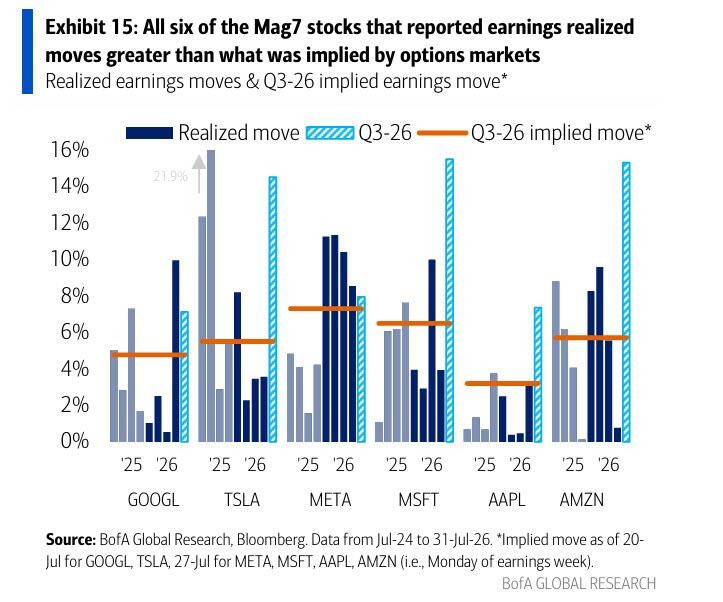
Among them, Microsoft's stock surged by about 16% after its earnings release, marking one of its largest single-day gains in recent years. In contrast, Tesla plummeted by about 15% as its performance and outlook disappointed the market. Together, these moves reflect a more violent repricing of valuations for leading companies in the AI era.
Bank of America's findings imply that the market is repricing AI leaders with magnitudes far exceeding expectations, whether the news is positive or negative. This has also pushed the level of individual stock dispersion in the US stock market to its highest point in nearly 35 years.
Benjamin Bowler, Head of Equity Derivatives at Bank of America, warned that macroeconomic uncertainty continues to rise, providing strong support for volatility amid the current chaotic market backdrop. Strategically, Bank of America is positioning for both the medium-to-long-term upward structure of the technology sector and short-term hedges against rotation into value stocks. It specifically recommends SPX put spread combinations expiring in December 2026 as core hedging positions.
Tech Giants' Volatility Unmoored: First Collective Earnings Beat in the ChatGPT Era
Over the past two years, following the generative AI frenzy sparked by ChatGPT, the "Magnificent Seven" have become the core force driving the S&P 500 higher.
As the market gradually formed a consensus on the commercialization path of AI, the options market became increasingly adept at predicting post-earnings volatility ranges. In most cases, actual price movements did not deviate significantly from implied volatility.
However, Bank of America believes that this earnings season has broken that pattern.
In a report titled "Market Derailment Is a Feature, Not a Bug," Bank of America's derivatives team pointed out that, to date, except for Nvidia which has yet to report, the actual volatility of the remaining "Magnificent Seven" stocks has far exceeded the expected volatility levels implied by the options market. The bank described this as a "first in the ChatGPT era."
This phenomenon reflects a declining ability of the market to price technology giants accurately. In an AI-narrative-driven rally, the options market has consistently underpriced tail risks.
Single-stock fragility issues remain prominent in 2026. Bowler calculated that the current frequency of "fragility events" in S&P 500 technology stocks is on track to match the historical peak of 2025. On July 30, the single-day return dispersion of S&P technology stocks approached historical extremes. This timing coincided with the position impact of de-risking operations by Situational Awareness and the concentrated release of earnings from large-cap technology stocks.

US Stock Volatility Dispersion Hits New Highs, Bubble Patterns Approach Dotcom Era Extremes
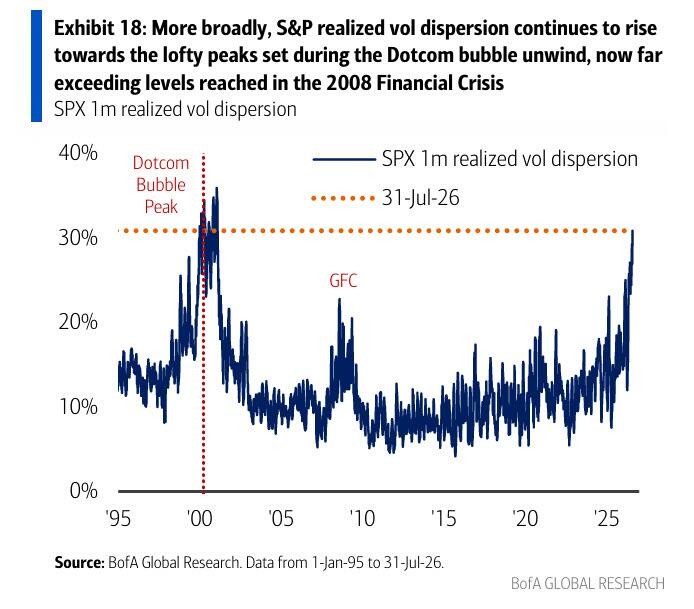
Further calculations by Bank of America show that due to the combined effects of earnings reports from tech leaders, the liquidation of hedge fund Situational Awareness, and significant uncertainty regarding the policy path of the new Federal Reserve Chair, Warsh, the dispersion of individual US stocks has risen to its highest level in nearly 35 years.
Stock dispersion refers to the widening gap in performance returns between different stocks.
Compared to markets where all stocks rise or fall in sync, a high-dispersion market means that stock selection becomes significantly more important, while index trends become less representative of investors' actual returns.
For derivatives trading, this usually means that the value of single-stock options rises, while index options do not necessarily benefit in sync. This also makes market-neutral strategies, pair trading, and volatility trading more active.
On a broader macro level, the realized volatility dispersion of the S&P 500 continues to approach the historical highs seen during the burst of the Dotcom Bubble.
Bank of America believes this aligns closely with its previous judgment: as the AI bubble accumulates, weighted dispersion could surpass the extreme levels of the internet era. The reason lies in the abnormally high volatility of mega-cap stocks, which currently hold highly concentrated market capitalization weights.
A market structure characterized by low correlation and high rotation has further pushed up the dispersion of individual stocks within and across sectors, even within the technology sector itself. Bowler pointed out that return and volatility dispersion are core indicators for measuring the evolution of bubble-like price behavior, a framework he pioneered two years ago.
Bank of America: AI Rally May Not Be Over, But Short-Term Rotation Risks Are Increasing
Despite the significant amplification of market volatility recently, Bank of America does not believe the AI rally has ended.
The report stated that historical experience shows that during the formation of technology bubbles, periodic adjustments and capital rotation into value stocks are common, even if the long-term upward trend remains unchanged.
Based on this judgment, Bank of America suggests that investors consider using derivatives for risk management rather than simply reducing equity positions.
The report proposed two representative strategies:
First, positioning using call spreads in the healthcare sector. Bank of America believes that the healthcare sector currently ranks high in its "bubble risk indicators," but spread strategies can offer higher upside elasticity while controlling downside risk.
Second, for investors who expect the S&P 500 to enter a phase of slow correction, they may consider using put spreads or collar strategies to cope with the current pricing environment characterized by frequent market rotations and strong demand for protective options.
Bank of America emphasized that in the current AI-dominated market environment, while indices may still appear strong on the surface, the internal structure is undergoing drastic changes. Future market performance may depend more on companies' ability to deliver earnings rather than the AI concept itself.