
Cybersecurity Industry Benefits from AI Demand Expansion; Cloudflare Raises Full-Year Earnings Outlook
 Complete. Here is the key summary
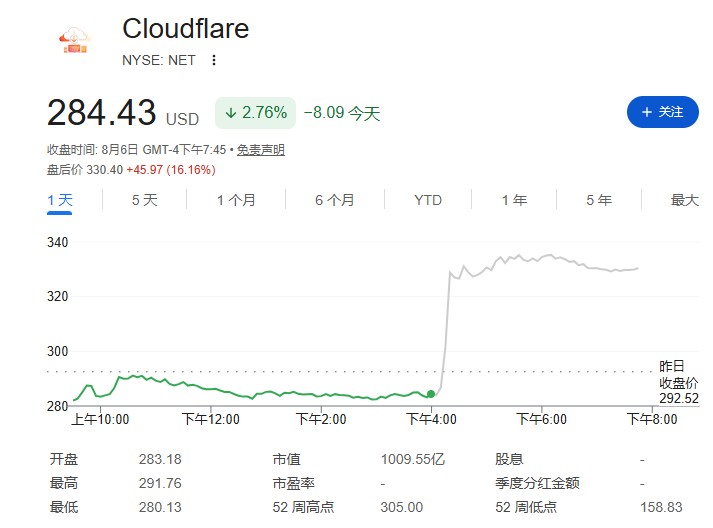
Cloudflare raised its full-year 2026 adjusted earnings per share (EPS) forecast to $1.25–$1.26, up from the previous $1.19–$1.20, surpassing Wall Street Expectations of $1.20. The company's stock surged more than 16% in after-hours trading. The strategic shift announced in May, involving a 20% workforce reduction and a transition to an AI-first operating model, has not impacted growth
Cloudflare raises Full-Year Earnings Outlook; massive layoffs this year have not dragged down growth, as AI demand becomes a new growth engine for the cybersecurity industry.
U.S. cybersecurity company Cloudflare released its financial report on Thursday, raising its full-year 2026 adjusted earnings per share (EPS) forecast from the previous $1.19–$1.20 to $1.25–$1.26, exceeding the average Wall Street Expectations of $1.20. Second-quarter performance also beat market expectations.
Following the announcement, the company's stock surged more than 16% in after-hours trading. Its year-to-date gain has reached 44%, far outperforming the Russell 1000 Index's 12% rise over the same period.
Growth Unaffected After Layoffs
In May this year, Cloudflare announced it would cut approximately one-fifth of its workforce, citing a transition to an "AI agent-centric" operating model. This move initially sparked market concerns about its growth prospects.
The second-quarter results provided the answer—better-than-expected revenue and profit indicated that staff reductions and strategic transformation have not hindered business expansion.
CEO Matthew Prince stated in a release, "We delivered an outstanding second-quarter performance."
AI Rewrites Internet Traffic Logic
Cloudflare attributed its accelerated performance to structural changes in network demand driven by AI.
Matthew Prince said in the statement, "As the internet shifts toward AI answer engines and agent-driven business models, we are witnessing a fundamental restructuring of the internet for machine-to-machine traffic."
This assessment points to a core logic: the large-scale deployment of AI models is generating substantial automated traffic between machines, and Cloudflare's network infrastructure sits at a critical node for this traffic.
Investors have reacted clearly. According to Bloomberg, market interest in major cybersecurity companies has risen significantly this year, driven by the logic that AI is expanding the demand for digital defense. Meanwhile, security vendors are embedding AI into their own products for automated threat detection and response—even as AI models themselves continue to expose new security vulnerabilities, leaving enterprises struggling to cope.
Industry Divergence: Fortinet Strong, Check Point Under Pressure
Within the cybersecurity sector, performance among companies has diverged.
Fortinet Inc. also raised its full-year revenue forecast during the same period, leading to a rise in its stock price. According to Bloomberg, Mandeep Singh, an analyst at Bloomberg Intelligence, believes Fortinet may be benefiting from its redefinition of SASE (Secure Access Service Edge) and firewall businesses, as well as demand driven by sovereignty issues.
Check Point Software Technologies Ltd., however, maintained its full-year forecast unchanged, with mixed performance results. According to Bloomberg, TD Cowen noted that Check Point is dealing with internal issues, and its performance disappointed the market.
The performance gap between Fortinet and Check Point reflects the structural divergence within the cybersecurity industry under the AI wave—companies that can clearly define and execute their AI strategies are commanding higher market premiums.