Hyperscalers Begin to Lead the Market: Is the Second Wave of the Tech Rally About to Start?
 I'm LongbridgeAI, I can summarize articles.
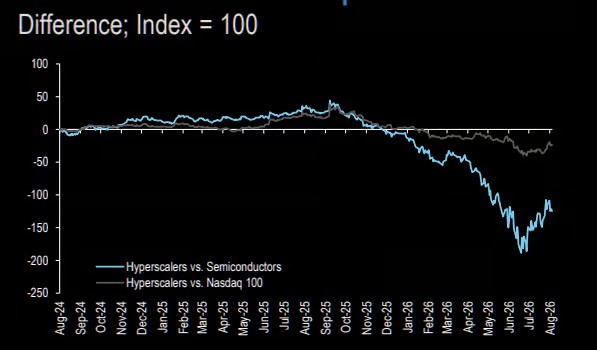
Over the past month, the MAGS Index has significantly outperformed the Nasdaq 100 Index and the Philadelphia Semiconductor Index. As AI capital expenditure approaches the trillion-dollar mark, hyperscale cloud providers are sending positive signals through accelerating cloud business growth, surging order backlogs, and improving AI investment returns. Meanwhile, hedge funds have significantly reduced their positions earlier, with the long/short ratio dropping to the 25th percentile since 2018, and valuations have retreated, creating room for capital to flow back in. Whether cloud providers can continue to lead may become the key to the second wave of the tech stock rally
Hyperscalers are transforming from "laggards" in the technology sector into leaders. Against the backdrop of continuously expanding AI capital expenditure and pressure on free cash flow, multiple factors are resonating: accelerated monetization of cloud businesses, a surge in order backlogs, significant compression in valuations, and a thorough cleansing of hedge fund positions. The market is beginning to discuss whether the second wave of the tech rally has already begun.
Over the past month, the performance of the MAGS Index has clearly outperformed the Nasdaq 100 Index (NDX) and the Philadelphia Semiconductor Index (SOX), marking a substantive shift in the relative strength of hyperscale cloud providers.
At the same time, hedge funds significantly reduced their exposure to the "Mag-7" in the preceding weeks, with the long/short ratio falling to the 25th percentile since 2018. Positions have been fully reset, making room for new capital inflows.
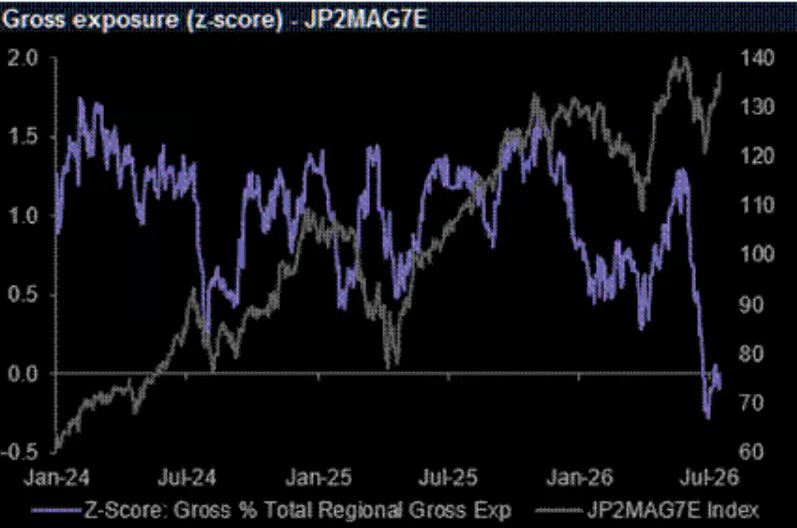
The timing of this rebound is quite subtle—hedge funds completed their de-risking just before the rally started, followed by a rapid market surge. Data from JPMorgan shows that positions in hyperscale cloud providers have been quickly covered during the rebound but remain far below previous highs, implying that potential space for incremental capital still exists.
AI Capital Expenditure Continues to Expand, Approaching $1 Trillion
Investment in AI infrastructure is expanding at an astonishing pace. According to JPMorgan data, the market consensus expects AI capital expenditure to reach approximately $900 billion this year, an 85% year-over-year increase, and it is expected to exceed $1.2 trillion next year. Hyperscale cloud providers are projected to account for about 87% of this spending, with AI-related investments constituting nearly 60% of the total capital expenditure of the S&P 500 Index.
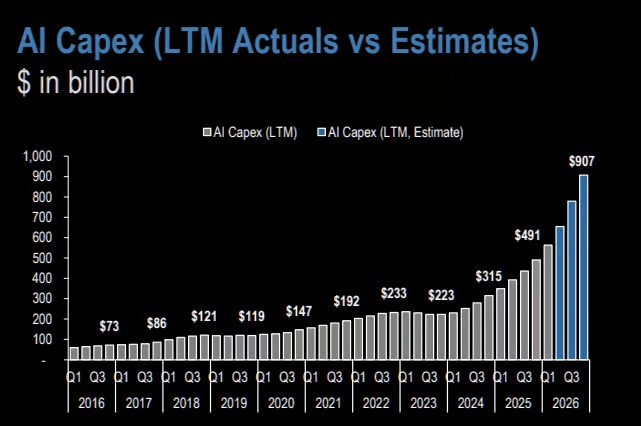
The continuous rise in this figure reflects both industry confidence and a source of market concern—the sharp expansion in capital expenditure is eroding free cash flow, making the sustainability of Return on Invested Capital a core concern for investors.
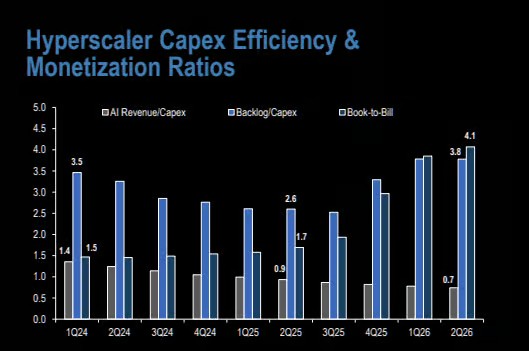
Accelerated Monetization of Cloud Business, Order Backlogs Validate Demand Resilience
Despite immense pressure on capital expenditure, the revenue side of the cloud business is providing positive signals. AWS grew 37% year-over-year, Azure grew 43% year-over-year, and Google Cloud grew 82% year-over-year, all maintaining strong growth rates.
Order backlog data is even more impressive. Google Cloud's backlog reached $514 billion, increasing by $52 billion quarter-over-quarter; AWS's backlog rose to $496 billion, up 36% quarter-over-quarter and nearly 2.5 times year-over-year. For Azure, new capacity was monetized rapidly after coming online, with demand consistently exceeding supply. Amazon also disclosed that the payback period for server and network investments is less than three years, a figure that helps alleviate market concerns about Return on Invested Capital and provides fundamental support for continuously expanding AI capital expenditure.
Free Cash Flow Under Pressure, But Market Looks Ahead
Financial pressures cannot be ignored. According to JPMorgan data, the combined net profit of hyperscale cloud providers over the past twelve months reached $599 billion, while free cash flow was only $169 billion, leaving a gap of as much as $430 billion between the two. With the exception of Microsoft, most hyperscale cloud providers are expected to remain in a state of negative free cash flow from 2026 to 2027.
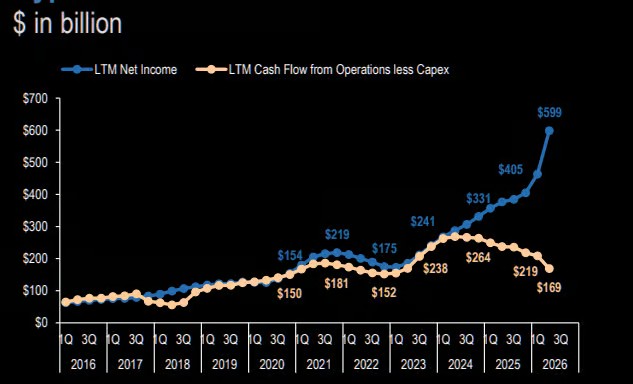
However, market pricing mechanisms are forward-looking. Current valuations have been significantly compressed—the premium of the sector's overall forward P/E ratio relative to the S&P 500 is approaching a ten-year low. This has, to some extent, digested expectations of short-term deterioration in cash flow and provided room for valuation repair.
Position Reset Complete, Conditions Mature for Incremental Capital Entry
Changes in positioning are one of the important catalysts for this round of the rally. A few weeks ago, hedge funds significantly reduced their Mag-7 exposure, with the long/short ratio dropping to the 25th percentile since 2018. Both net and gross exposures were reset, leaving the Mag-7 significantly underweight.
As the rebound unfolded, positions in hyperscale cloud providers were quickly covered, but according to JPMorgan data, current levels remain far below previous highs. This means the risk of crowded trades has not yet re-emerged, leaving ample room to accommodate new capital inflows. Data from Deutsche Bank also corroborates this judgment.
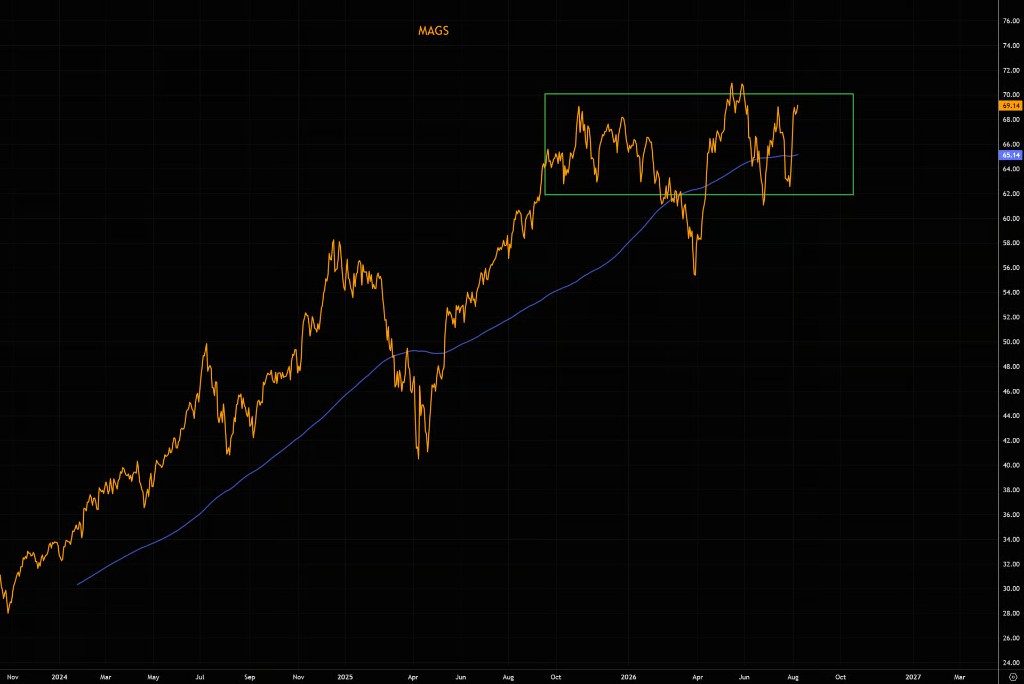
From the options market perspective, the MAGS August 67.5/72.5 call spread, which had previously attracted market attention, has yielded good returns. If MAGS can effectively break through the key resistance level of $70, the second phase of the rally may begin; if the short squeeze continues, consideration should be given to rolling positions to September contracts with higher strike prices.