
NVIDIA rises nearly 2% in pre-market trading: Reports indicate the company is developing new proprietary AI models
 I'm LongbridgeAI, I can summarize articles.
NVIDIA is developing its largest Nemotron 4 series AI model, targeting over one trillion parameters, with computing power investment increasing to $28 billion. This move aims to expand GPU demand through an open-source strategy and diversify customer risk, but it also creates competition with some customers. Affected by this news, NVIDIA's pre-market stock price rose nearly 2%
NVIDIA is heavily betting on self-developed open-source artificial intelligence models, attempting to expand GPU demand in the process. However, this strategy also places it in competition with some key customers and investees.
According to a report by The Information on the 11th, NVIDIA is developing the largest model in its Nemotron 4 series, aiming to match the performance of the world's best open-source AI models. Meanwhile, NVIDIA has significantly increased its spending on computing power for training its own models—as of April this year, its multi-year cloud service commitments had risen to $28 billion, approximately three times the level of a year ago.
With the proliferation of high-quality open-source models, a broader range of enterprise users will be guided to use and build AI applications, thereby driving growth in demand for NVIDIA hardware. Anastasios Angelopoulos, CEO of AI model evaluation firm Arena, stated, "Whoever produces excellent open-source models, NVIDIA is the winner."
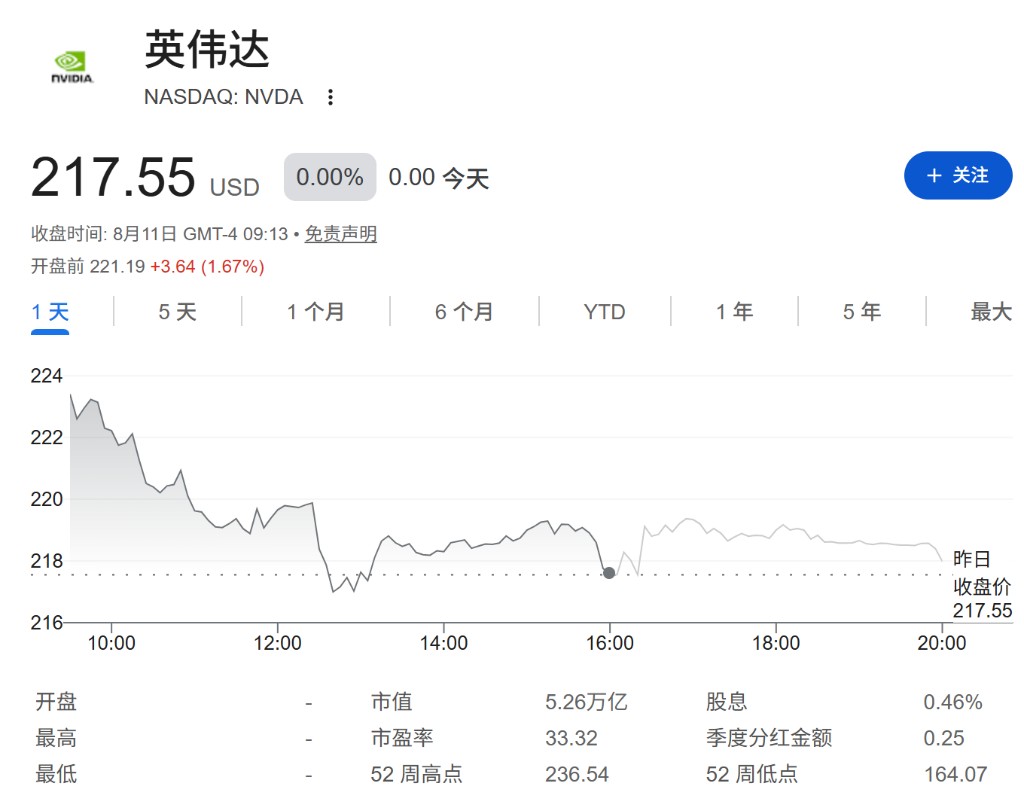
NVIDIA's US stock rose nearly 2% in pre-market trading.
Trillion-parameter target, threefold surge in computing investment
According to several employees involved in the Nemotron project, NVIDIA plans to develop its largest Nemotron 4 model with at least one trillion parameters, roughly double the size of its current largest model, Nemotron 3 Ultra, released this June. While this parameter scale remains far below that of China's leading open-source models, NVIDIA emphasizes that its compression technology enables smaller models to achieve superior performance.
Regarding computing investment, NVIDIA acquires computational resources by leasing back AI servers from cloud operators that purchase its chips. As of April this year, NVIDIA's multi-year cloud service commitments had increased to $28 billion, covering the period until early 2031, significantly higher than the level a year ago. A substantial portion of this computing power will be dedicated to training Nemotron models.
It is understood that NVIDIA has made some decisions regarding the pre-training data and architecture for the largest Nemotron 4 model, but final specifications and release dates have not yet been determined, and the final training run has not yet begun. This process could take several months. Several employees expect the model to be released as early as late autumn this year, while others believe the timeline may be later.
Behind the open-source strategy: Diversifying customer concentration risk
NVIDIA's current chip demand relies heavily on a few frontier AI labs and cloud operators, including OpenAI, Microsoft, and SpaceX, some of whom are developing their own AI chips. The core logic behind NVIDIA's push for Nemotron is to cultivate an open-source ecosystem, attracting a wider user base ranging from startups to large traditional enterprises, thereby reducing dependence on a few major customers.
Kari Briski, Vice President of Generative AI at NVIDIA, stated in an email, "NVIDIA invests in Nemotron because we believe every company and every country needs accessible cutting-edge open-source models to strengthen security guarantees, accelerate innovation, and provide a foundation that can be relied upon across generations."
Bryan Catanzaro, Vice President of Applied Deep Learning Research at NVIDIA, also stated in a podcast in January this year that investing in Nemotron is "crucial to our company's future."
In terms of commercial implementation, Nemotron models have been adopted by some enterprises, including Palantir, which announced a partnership with NVIDIA in June to use Nemotron models for US government clients. However, Nemotron 3 Ultra currently ranks only second among US open-source models in various performance benchmarks conducted by institutions such as Arena and Artificial Analysis, and falls outside the top 40 globally among all models.
The dilemma of competing with customers
NVIDIA's open-source bet has placed it in a delicate position: on one hand, it competes with open-source startups it has already invested in; on the other, it poses a potential threat to its largest customers.
NVIDIA has invested $30 billion in OpenAI, one of the most important drivers of its chip demand. Meanwhile, NVIDIA has also made significant investments in several US open-source companies, including Reflection AI and Thinking Machines Lab, which are themselves vying for corporate clients to use their own models.
Despite this, NVIDIA seeks synergies by building the "Nemotron Alliance." Members of this alliance include Reflection, Cursor, Thinking Machines, and Mistral. While developing their own open-source projects, these companies contribute training data, evaluation support, and model design suggestions for Nemotron 4. Startup Prime Intellect contributed 300,000 simulated environments for model training; AI coding tool startup Cognition has discussed providing coding training data to NVIDIA, but its participation has not been officially announced.
Vincent Weisser, CEO of Prime Intellect, positions this alliance as a collective action to resist the monopoly of a single "god" model, rather than a race for the title of the best open-source model.
Intensifying geopolitical games, open source becomes a national interest issue
NVIDIA's transformation towards open source also reflects the geopolitical dimensions of AI competition. According to two employees, NVIDIA realized early last year that US open-source models had fallen significantly behind. Based on its assessment of commercial value, it decided to push to bridge this gap.
In terms of funding scale, NVIDIA's cloud service commitments for fiscal year 2028 are approximately $7 billion. While this still lags behind the spending scales of OpenAI and Anthropic, it exceeds the total historical cumulative financing of most leading open-source labs. One employee revealed that NVIDIA is striving to secure more computing power for the Nemotron project.
Continuously updating...
Risk Warning and Disclaimer
The market carries risks; investment requires caution. This article does not constitute personal investment advice, nor does it consider the specific investment objectives, financial status, or needs of individual users. Users should consider whether any opinions, views, or conclusions in this article align with their specific circumstances. Investment based on this content is at your own risk.