
Baidu Q2 Revenue of RMB 31.3 Billion Slightly Misses Expectations; AI Business Accounts for Over Half; GPU Cloud Surges 283% | Earnings Insights
 I'm LongbridgeAI, I can summarize articles.
Baidu's Q2 2026 revenue reached RMB 31.3 billion, with AI revenue accounting for 50%. However, adjusted profit per ADS was RMB 7.22, significantly below the expected RMB 9.75, indicating that continued AI investment is suppressing profits. GPU cloud revenue soared 283% year-over-year, emerging as a core highlight and driving overall AI cloud growth of 50%. On the application side, the office product matrix is expanding, while the autonomous driving service Apollo Go is accelerating its overseas expansion
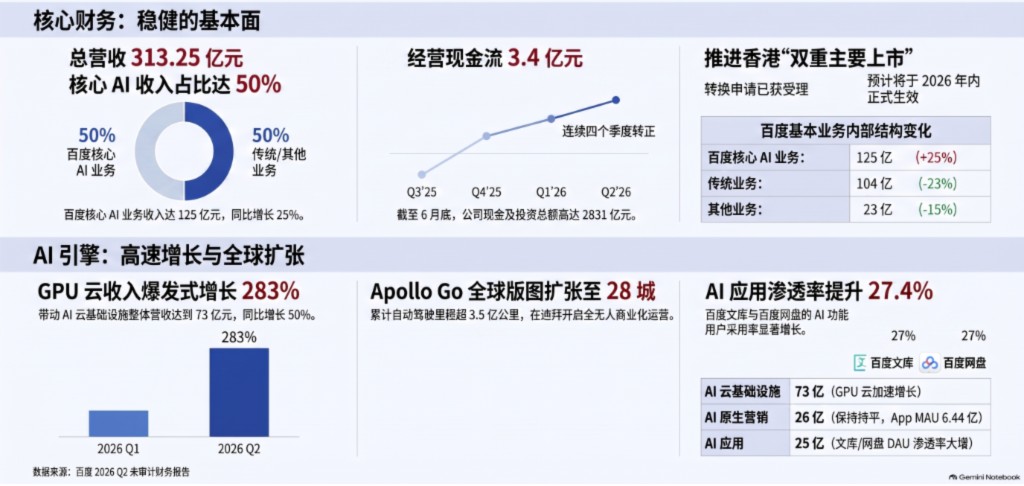
Baidu's latest quarterly report reveals characteristics of a transition marked by accelerated expansion of its AI business and ongoing adjustments in profitability.
On August 18, Baidu released its financial results for the second quarter of 2026. Total quarterly revenue was RMB 31.3 billion, slightly below the market expectation of RMB 31.6 billion. Notably, AI revenue accounted for 50% of Baidu's core business, exceeding half for two consecutive quarters, indicating that AI is becoming a significant component of the company's revenue structure.
However, the expansion of the AI business has not yet fully translated into profit growth. This quarter, Baidu's adjusted profit per ADS was RMB 7.22, significantly lower than the market expectation of RMB 9.75. Although adjusted operating profit and EBITDA were both slightly higher than market expectations, the notable gap in earnings per share suggests that investments in AI infrastructure continue to exert pressure on profitability.
In his earnings statement, Baidu founder, chairman, and CEO Robin Li stated that the continued growth of the AI business further validates Baidu's transformation from an internet company to an AI-first company, noting that this "further strengthens Baidu's confidence in its long-term growth potential."
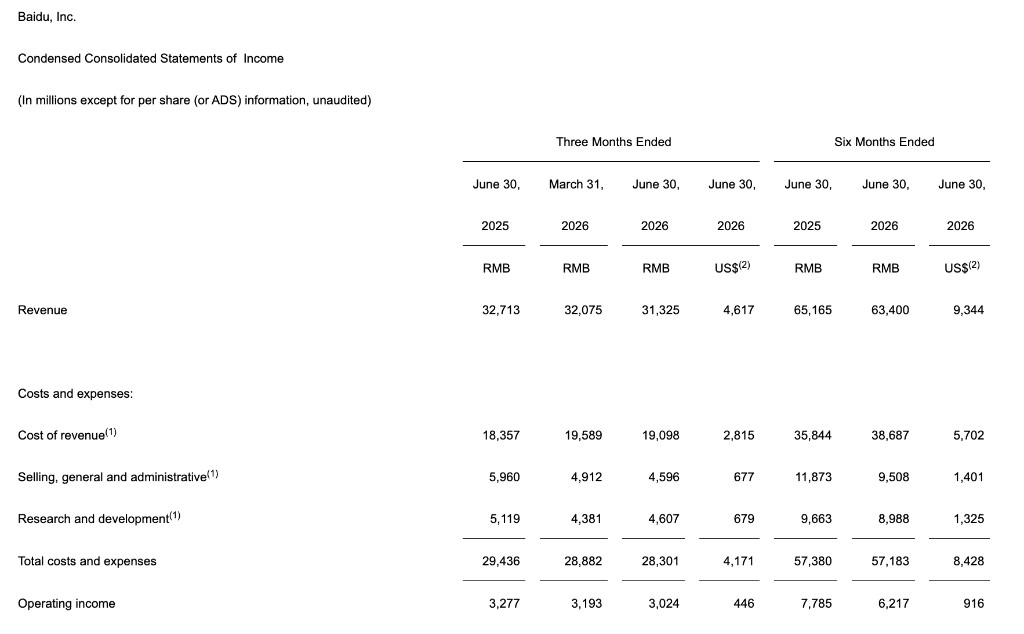
AI Cloud Growth Accelerates, GPU Business Becomes Major Highlight
This quarter, Baidu's AI cloud infrastructure revenue reached RMB 7.3 billion, a year-over-year increase of 50%.
Among these, GPU cloud revenue grew by 283% year-over-year, a significant acceleration from the 184% growth in the previous quarter, marking four consecutive quarters of triple-digit growth. In his earnings statement, Robin Li noted that the GPU cloud business is "accelerating growth further on a higher base," indicating that its growth is not solely reliant on a low-base effect.
Data from IDC shows that Baidu Intelligent Cloud holds the number one market share in industries such as finance, gaming, and embodied intelligence. In contrast, growth in the AI application business was relatively moderate. AI application revenue this quarter was RMB 2.5 billion, a 3% year-over-year increase; AI-native marketing services revenue was RMB 2.6 billion.
From a revenue structure perspective, Baidu is forming a distinct "infrastructure-first" characteristic: rapid growth in demand for AI infrastructure such as GPU cloud, while commercialization on the application side remains in a relatively early stage.
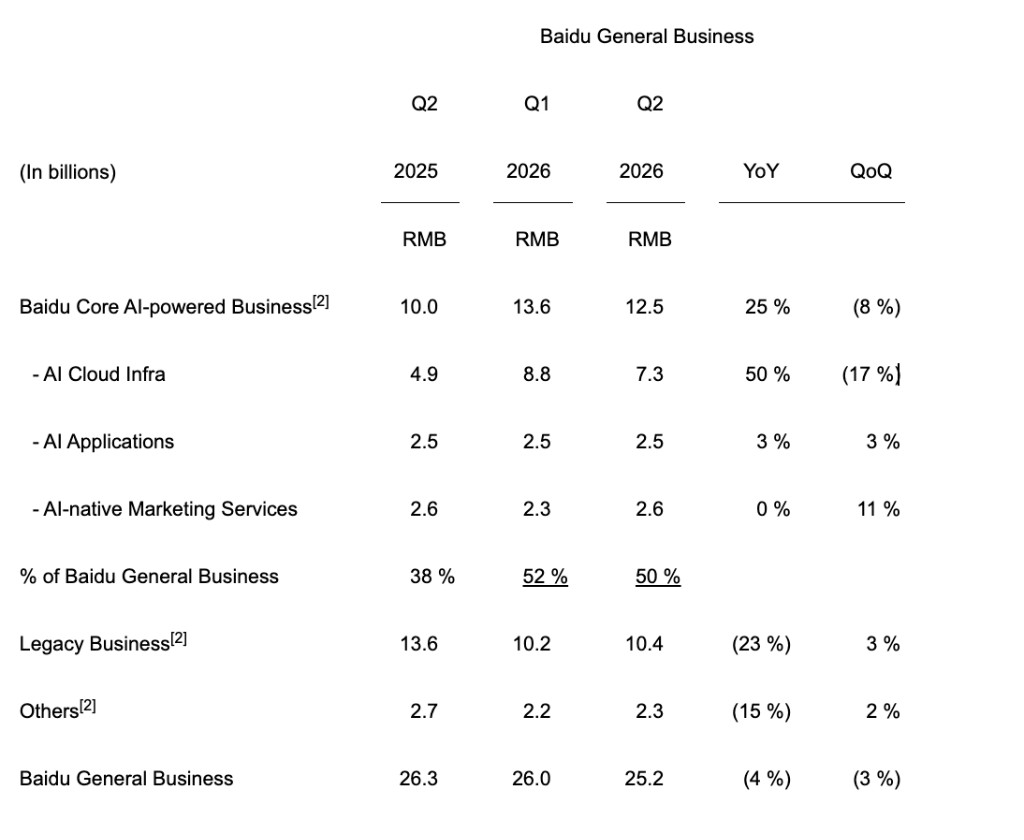
Profitability Under Pressure, AI Investment Remains Key Variable
Regarding profitability, Baidu's adjusted operating profit for the quarter was RMB 3.79 billion, higher than the market expectation of RMB 3.61 billion; adjusted EBITDA was RMB 6.15 billion, also slightly above the market expectation of RMB 5.81 billion.
However, adjusted profit per ADS was only RMB 7.22, approximately 26% lower than the market expectation of RMB 9.75. This means that while the company's cost control at the operational level remains relatively robust, the final performance in terms of earnings per share was significantly weaker than expected.
As investments in AI infrastructure continue to increase, costs related to depreciation and computing power may continue to affect the pace of profit release. Nevertheless, as of the end of the quarter, Baidu's total cash and investments reached RMB 283.1 billion, providing ample liquidity space for the company to continue advancing its AI transformation.
Expansion of AI Product Matrix, Office Scenarios Become Focus
At the application level, Baidu completed the integration of its AI office product line this quarter, forming a product matrix that includes Baidu Dazi, Kuku AI, and Miaoda.
Data shows that Baidu Dazi's monthly active users (MAU) increased by 1063.79% month-over-month in July, ranking first in MAU growth within the AI office sector; Kuku AI's office MAU exceeded 25 million, ranking first in the AI office sector.
The version 3.5 of Miaoda, released in July, completed upgrades to six capabilities. A Sullivan report indicates that Miaoda ranks first in China's AI-native no-code application generation platform industry with a 33.4% market share.
Baidu's enterprise-level AI agent, Baidu Famou, has received trial applications from 3,000 enterprises since its launch. As of June, the monthly active users of the Baidu App reached 640 million.
Overall, Baidu is accelerating the extension of its AI capabilities into scenarios such as office work, marketing, and enterprise services, but the commercial scale of these applications is currently significantly smaller than that of the AI cloud infrastructure business.
Apollo Go Accelerates Overseas Expansion
The autonomous driving business, Apollo Go, continued to advance its overseas commercialization this quarter.
In Dubai, Apollo Go has launched fully driverless commercial operations, allowing users to hail rides via the Uber App; in the Hong Kong Special Administrative Region of China, the company obtained the first batch of local fully driverless test licenses and initiated testing on Airport Island; in London, Apollo Go is conducting open-road tests in collaboration with Uber and Lyft.
Additionally, Apollo Go signed a strategic cooperation agreement with Kazakh enterprise Turlov Private Holding Ltd. (TPH) to explore launching driverless mobility services locally; in June, Apollo Go also partnered with PostBus to conduct public road tests in Switzerland.
To date, Apollo Go has covered 28 cities globally, with cumulative autonomous driving mileage exceeding 350 million kilometers, of which fully driverless mileage exceeds 240 million kilometers.
Overall, the core contradiction for Baidu this quarter remains the time lag between AI business growth and profit realization: infrastructure businesses such as GPU cloud maintain high growth, driving the AI revenue share to exceed 50% for two consecutive quarters, but high investments have also caused earnings per share to fall significantly short of market expectations. For the market, whether the commercialization of AI applications can accelerate, and whether the high growth of infrastructure can gradually translate into stronger profitability, will be key indicators for observing the effectiveness of Baidu's transformation.