
AI trading sentiment reversal: Apple's "anti-AI" attribute is becoming a drag on its stock price
 I'm LongbridgeAI, I can summarize articles.
As investor concerns about AI trading deepen, Apple once benefited from an "anti-AI" strategy, but now market sentiment has reversed. Since the peak on July 28, Apple's stock price has fallen by about 10%, primarily affected by disappointing earnings outlooks and capital rotation towards AI winners like Microsoft and Amazon. Apple's choice to rely on partners rather than building its own computing infrastructure has led to its recent performance lagging behind the Nasdaq and semiconductor indices, increasingly diverging from the broader market
As investor concerns about AI trading deepen, Apple's "anti-AI" trading attributes had previously driven its stock price up significantly in the first half of the year. However, market sentiment has now reversed, and Apple's stock price has begun to struggle.
Since closing at a record high on July 28, Apple's stock price has fallen about 10%, following disappointing earnings guidance from the iPhone manufacturer. Meanwhile, investors have shifted back to stocks seen as AI winners, with Microsoft, Amazon, and Alphabet Inc.'s performances alleviating market worries about excessive investment in AI technology, driving up stocks of companies with the largest AI spending, chip manufacturers, and others benefiting from related investments.
"Since the beginning of the year, the market's attitude towards capital expenditure has oscillated between concern and optimism. In July, the market was almost entirely worried about capital expenditure issues, but the latest earnings reports have clearly alleviated some anxiety, leading to this round of capital rotation," said Jordan McCall, a senior portfolio manager at Russell Investments, which manages $418 billion in assets. "Now the market is more reassured about capital expenditure, and Apple remains another way to bet on the AI capital cycle. I expect this seesaw market trend to continue."
Apple has chosen to rely on partners to support its AI services, avoiding participation in the costly arms race for computing infrastructure. Over the past three weeks, Apple has been one of the 25 worst-performing stocks in the S&P 500 index. In contrast, other tech stocks have performed well, with the Nasdaq 100 index rising 6.6% during the same period, and the Philadelphia Semiconductor Index (SOX) up 10%.
This is in stark contrast to the performance in July. In that month, Apple's stock price rose 6.8%, while the Nasdaq 100 index fell 6.6%, and the semiconductor index plummeted 21%, marking the largest monthly decline since 2008, when investors questioned how long massive AI spending could be sustained.
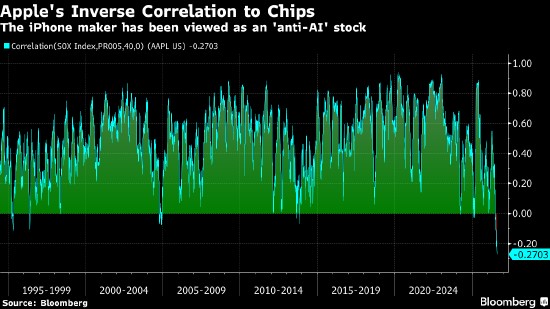
This significant volatility in Apple's stock price once again shows that its performance is increasingly diverging from the broader market. The 40-day correlation between Apple and the S&P 500 index is currently essentially zero, the lowest since 2013; the correlation with the chip index has dropped to the lowest level since data has been available in 1994 and has recently turned negative, indicating that Apple's stock price moves in the opposite direction of semiconductor stocks.
This trend continued on Tuesday. Apple rose 0.4%, while the SOX index fell 3.8%, and the Nasdaq 100 index dropped 1.4%.
 "Apple's stock price does not fully synchronize with the AI infrastructure supply chain, which is reasonable; sometimes the negative correlation can drag down Apple's performance," said Clayton Allison, portfolio manager at Prime Capital Financial, which manages about $50 billion in assets and holds Apple shares. "But now that AI trading is in full swing, we can't say that Apple is enjoying this wave of benefits like other companies."
In fact, the influx of funds into computing power infrastructure is directly adversely affecting Apple, as it raises the costs of components used in Apple devices and leads to a tightening supply of certain parts. With strong demand for data centers, the prices of storage chips have surged. It is estimated that storage chips account for about 10% to 20% of smartphone manufacturing costs.
As storage chip costs are expected to remain high for an extended period, investors are concerned that rising costs will erode profit margins or weaken demand, especially if Apple raises iPhone prices. Apple has already increased prices for other products, including iPads and Macs. Given that Apple is expected to release a foldable iPhone next month, this issue is particularly concerning.
Last week, Jefferies mentioned the risk of iPhone price increases when it downgraded Apple stock to "underperform." The number of analysts giving Apple a rating equivalent to "sell" is currently increasing. Among the 58 analysts covering Apple tracked by Bloomberg, 6 currently recommend selling, the highest number in nearly two years.
The bigger challenge is that Apple's valuation is already high, and the company may not have much room for error. Currently, Apple's expected price-to-earnings ratio is 32 times, the highest among the seven largest tech companies in the U.S., which also includes Nvidia, Broadcom, and Meta Platforms Inc.
Apple's revenue for the current fiscal year is expected to grow by 15%, which would be the fastest growth rate since 2021. However, this is still significantly lower than the market's growth expectations for the S&P 500 technology sector. The average forecast compiled by Bloomberg analysts shows that Apple's revenue growth is expected to slow down year by year over the next two fiscal years.
Despite Apple's high valuation and lingering questions about where the company's next phase of revenue growth will come from, Allison from Prime Capital still finds the stock attractive.
"From a robust balance sheet, ecosystem, and stock buybacks perspective, Apple remains one of the best companies," he said. "If AI trading reverses again, as it has already happened this year, Apple's characteristic of lacking correlation with the market will be beneficial, helping to alleviate downward pressure."