
 I'm LongbridgeAI, I can summarize articles.
U.S. financial stocks plunged about 2% in a single day on Tuesday. Institutions such as JPMorgan Chase, Wells Fargo, and Charles Schwab saw their declines hit multi-month highs. Insurer Allstate and travel booking platform Booking Holdings were not spared. Analysts pointed out that AI agents can automatically complete price comparisons and bill management, directly dismantling business models that rely on "consumer inertia."
Meta's consumer-grade AI agent Muse topped the Apple App Store with overwhelming download numbers, triggering a new round of Wall Street concerns about AI disrupting the financial services industry. Bank and brokerage stocks suffered their largest single-day drop in months.
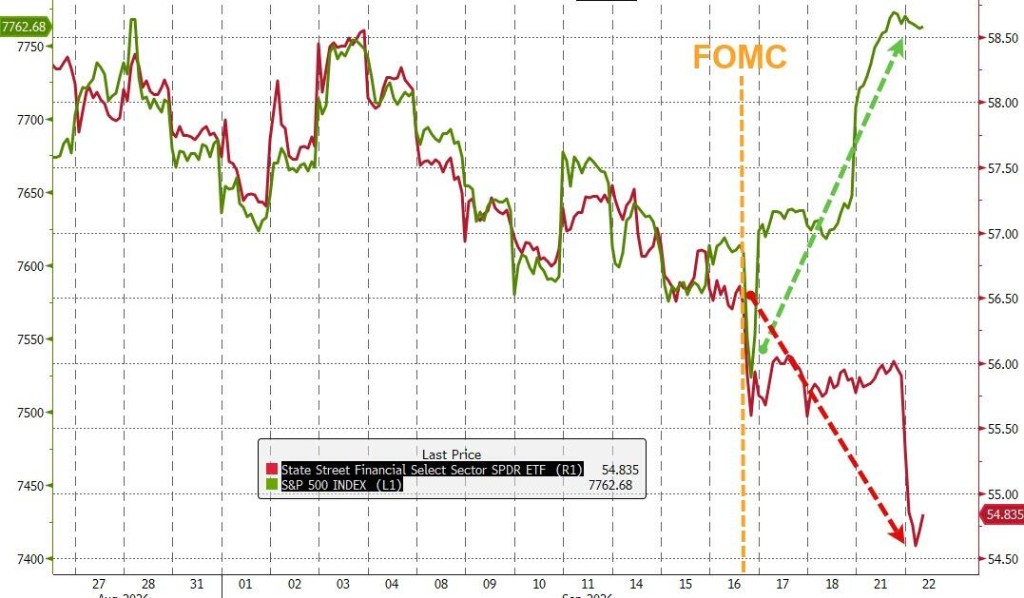
On September 22, the U.S. financial sector slumped, with the S&P 500 Financial Sector falling about 2%, dragging the broader market to a basically flat close.
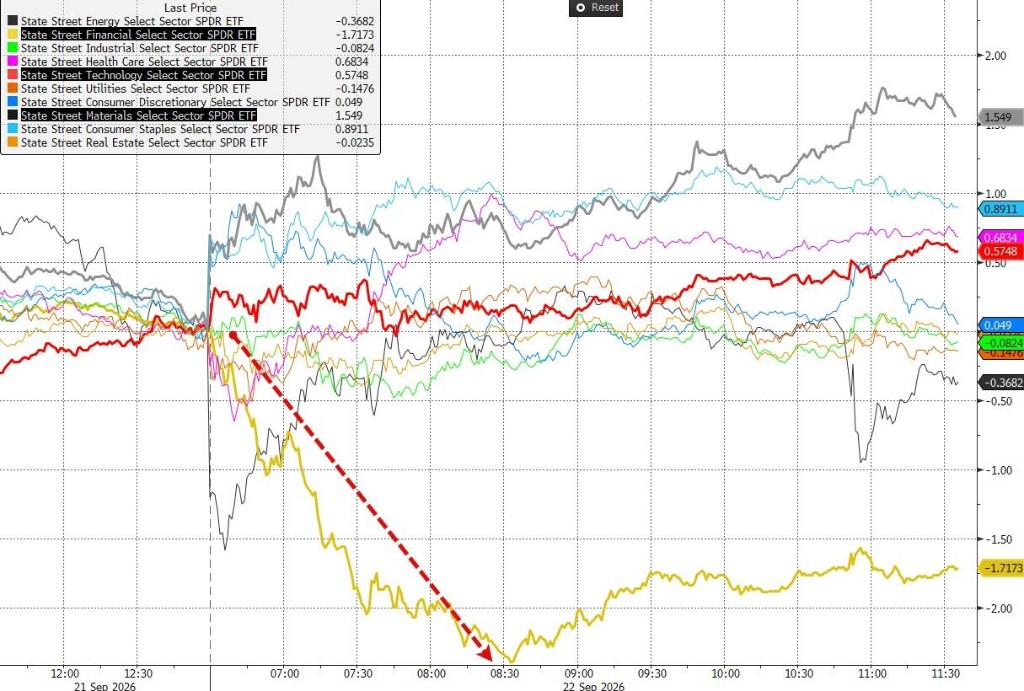
Brokerages Charles Schwab and LPL Financial each dropped more than 6%. JPMorgan Chase fell 3.4%, marking its largest single-day decline since July; Wells Fargo dropped 3.9%, its biggest fall since May; Bank of America and Citigroup declined 3% and 2%, respectively.

Insurer Allstate and travel booking platform Booking Holdings were also not spared.
The core market concern is that once AI agents like Muse become widely adopted, they will erode traditional business models that rely on consumer behavioral inertia—from wealth management and brokerage services to insurance pricing, all face the risk of being bypassed or even replaced.
Analysts pointed out that the scope and intensity of this sell-off far exceeded the market volatility triggered by similar events earlier this year.
Muse Climbs the Charts, "Consumer Inertia" Model Under Pressure
Muse officially launched on September 8. Within six days of its release, downloads exceeded 902,000, rapidly topping the charts for free apps on both the U.S. iOS App Store and Google Play.
The app can perform digital tasks on behalf of users, enabling cross-platform operations by integrating with third-party services such as Gmail and OpenTable. It has also established partnerships with PayPal and the fintech company Plaid.
Devin Ryan, Head of Financial Services and Fintech Research at Citizens JMP, noted that although no AI agent can disrupt an entire industry overnight, the 密集 product launches in recent months have "created a narrative in the market that the world is changing, and uncertainty is rising accordingly."
The threat of AI agents to financial institutions goes far beyond replacing human advisors or diverting channel premiums. Its true disruptive power lies in its ability to automatically compare prices, switch services, and manage bills for users. This directly destroys business models that survive on "consumer inertia"—where users tend to maintain existing consumption habits in the absence of active decision-making.
Goldman Sachs' trading desk pointed out in a research report that as AI agents continue to improve their capabilities in price comparison, travel booking, and customer service interactions, industries reliant on periodic billing, negotiable pricing, and add-on services, such as telecommunications, insurance, and utilities, will be the first to come under pressure.
Goldman Sachs' "Consumer Inertia" risk stock basket fell 2.6% on Tuesday, its worst performance in nearly six months, with a cumulative decline of over 7% in the past six trading days. The Goldman Sachs risk basket includes targets such as AT&T, T-Mobile, Allstate, Progressive, Netflix, Paramount Skydance, Expedia, and Booking.
Rhys Williams, Chief Strategist at Wayve Asset Management, stated:
Muse is undoubtedly a negative factor for these companies. It is still more of a novelty now, but I believe that in two years, we will all be using agents.
Brokerages and Wealth Management Bear the Brunt
In this sell-off, brokerage stocks fell even harder. Charles Schwab dropped more than 6%, LPL Financial plunged over 7%, and Raymond James and Ameriprise Financial also saw significant declines.
Devin Ryan, Head of Financial Services and Fintech Research at Citizens JMP, explained that the threat is not limited to AI replacing human advisors and compressing fee margins.
In his view, agents could potentially perform capital allocation operations, such as tax-loss harvesting, more efficiently for clients, thereby reducing the time funds remain idle in brokerage accounts and compressing the space for these firms to convert customer idle cash into their own revenue. Ryan stated:
If an agent optimizes asset allocation around the clock, will the idle cash balances in the system be depleted?
It is worth noting that this panic is not the first of its kind. Earlier this year, when fintech company Altruist launched its personalized tax strategy tool, it triggered a similar sell-off; in February, after Anthropic released its Claude agent tool, software-as-a-service (SaaS) stocks also experienced a sharp plunge.
However, analysts believe that leveraging Meta's existing user base of billions across its various applications, Muse has a broader potential impact and faster penetration speed.
Bank Stocks Under Pressure, Fundamental Concerns Compound
In addition to the impact brought by AI agents, the banking industry's own fundamentals are also facing tests.
Wallstreetcn mentioned that Bank of America CEO Brian Moynihan stated that third-quarter sales and trading revenue "will be one of our better third quarters ever, but will be basically flat compared to last year."
Wells Fargo Chief Financial Officer Mike Santomassimo stated at a Barclays financial industry conference last week that growth in core businesses such as lending will continue, but the growth rate is expected to slow down compared to the first half of the year. These remarks already triggered a broader correction in bank stocks last week.
Furthermore, against the backdrop of the Federal Reserve's interest rate hiking cycle, the flattening yield curve has further compressed banks' net interest margins.
Diverse Views: Disruption is Both an Opportunity and a Threat
Facing market panic, some investors and consultants warned against excessive pessimism.
Alois Pirker, founder of wealth management consulting firm Pirker Partners, stated that large financial institutions possess rich customer data and inherently have a 先天 advantage in technological transformation, calling it "a huge opportunity for these institutions," but noting that transformation takes time, "after all, you cannot turn an ocean liner around overnight."
Last week, Anthropic just launched a suite of Claude workflow tools, which have been integrated into platforms such as Schwab and Vanguard. Macrae Sykes, portfolio manager at Gabelli Funds, wrote in an email, "If Schwab can use this to serve advisors, improve the quality of their advice and asset acquisition efficiency, it will ultimately benefit the company through custody, customer interaction, and other links."
Goldman Sachs strategists' judgment was more cautious: "This is still much more complex and subtle than 'buy everything AI.'"
As Anthropic and OpenAI successively launch lower-cost frontier models, the next wave of AI may not just be about a few laboratories building ultra-large-scale computing clusters, but rather being driven by billions of dispersed agents.
This will reshape the landscape of demand for the entire AI infrastructure, and the financial industry will continue to face pressure and adjustment in this process.