
 I'm LongbridgeAI. Here is the key information I extracted
TradingKey - Amid a significant rebound in U.S. stock risk appetite, Microsoft (MSFT) shares rose about 6.7% in a single day, reaching an intraday high of $559.15 and closing at $555.80, both setting new all-time records, lifting its market capitalization to approximately $4.14 trillion. A broad-based recovery in tech stocks and continuous growth in the company's cloud computing and AI businesses combined to boost market sentiment.
The rally also benefited from an improving broader U.S. market environment, as the Dow Jones Industrial Average surged more than 1,569 points in a single day to log its largest single-day gain in about a year and a half. Tech stocks were a key driving force behind the market rebound, with shares of both Microsoft and Apple (AAPL) hitting record highs.
From a fundamental perspective, Microsoft recently delivered solid results for the first quarter of fiscal 2027, with quarterly revenue reaching $92.3 billion, up 19% year-over-year, and adjusted diluted earnings per share at $4.89, up 18.4% year-over-year. Among its segments, Azure cloud services stood out with revenue growth of 48%, continuing to serve as a vital engine driving Microsoft's overall performance. As enterprises accelerate their deployment of generative AI applications, demand for cloud computing resources, data processing capabilities, and related software services continues to grow, positioning Microsoft to capture more revenue from corporate AI investments.
Azure's growth pace is also a primary reason Wall Street has raised its valuation expectations for Microsoft. The development of artificial intelligence is reshaping the competitive landscape of the cloud computing industry. Enterprises need not only to purchase GPUs and servers, but also to rely on cloud platforms for model deployment, data storage, compute scheduling, and security management. Leveraging business synergies across Azure, Microsoft 365, and its AI products, Microsoft can offer comprehensive solutions to enterprise clients. If AI applications advance further from pilot stages to large-scale commercialization, cloud revenue and related software services are poised to continue benefiting.
Wall Street firms have also recently raised their price targets on Microsoft. StoneX lifted its price target to $630, primarily optimistic about Azure's business growth; UBS (UBS) raised its target to $700, noting that cloud services outperformed prior expectations; TD Cowen increased its price target to $650, focusing on the high growth delivered by Azure. Cantor Fitzgerald adjusted its target to $630, commending Microsoft for maintaining a focus on cash flow management while expanding AI infrastructure investment. Citi (C) also raised its AI revenue forecasts for major cloud hyperscalers including Microsoft, reflecting an improved assessment of AI commercialization prospects among institutions.
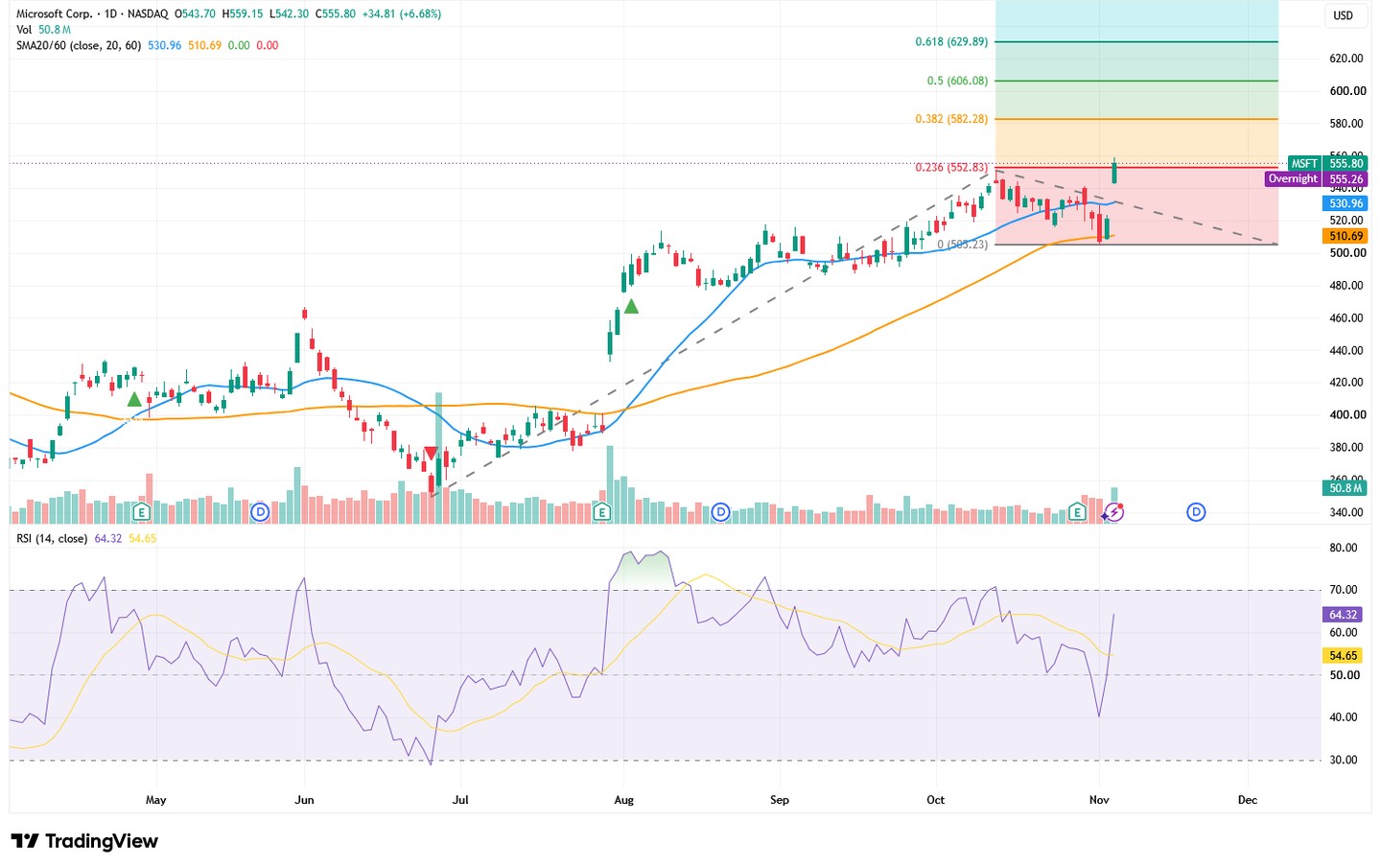
Source: TradingView
From a technical perspective, Microsoft shares have broken above their prior highs and the Fibonacci 0.236 extension level of $552.83, while trading volume expanded to 50.8 million shares, indicating that the breakout was accompanied by capital inflows. The 20-day moving average has risen to $530.96, and the 60-day moving average stands at $510.69, with both moving averages pointing upward, keeping the overall bullish trend intact.
The RSI currently stands at 64.32, above its signal line of 54.65, but has not yet entered overbought territory above 70, indicating further upside potential for the stock. If MSFT can achieve consecutive closes above $552–$555, the next technical target lies at the 0.382 extension level of $582.28, followed by a potential test of the 0.5 extension level at $606.08, making the $600 target technically supported. In a stronger scenario, the 0.618 extension level at $629.89 will serve as the next-stage objective.
On the downside, the $552–$555 zone has shifted from prior resistance to primary support; if the stock falls back below this area, investors should watch for a false breakout, with a short-term pullback to the 20-day moving average at $530.96 possible. Stronger support lies in the $510–$505 area, and only a break below this level would noticeably weaken the current medium-term upward structure.
Find out more