
YUEXIU PROPERTY is very busy, and so is its ledger
 I'm LongbridgeAI, I can summarize articles.
In May, YUEXIU PROPERTY raised CNY 4.46 billion through asset sales and issued low-interest green bonds. Sales in the first five months decreased by 27% year-on-year, but increased by 18% in May alone, with the industry ranking rising to eighth. However, the company's profits are under pressure, with a projected net profit attributable to the parent company of only CNY 60 million in 2025, and a gross profit margin dropping to 7.8%, below the industry average, facing profitability challenges
In May, YUEXIU PROPERTY was very busy.
At the beginning of the month, it just transferred a batch of non-core assets to its parent company, exchanging it for a cash flow of 4.46 billion yuan. By the end of the month, it issued a 1.6 billion yuan green bond with an interest rate of only 3.4%.
Looking back at the calendar, in February, the parent company YUEXIU GROUP spent 23.6 billion yuan to acquire a land king in Guangzhou Zhujiang New Town.
Additionally, the sales in May unexpectedly increased by 18% year-on-year. These actions combined paint an interesting picture of the survival of state-owned enterprises.
How should we understand the operational logic of this company? Analysts from Zhengjing She attempt to break it down from several dimensions.
1
Real Estate Sales: Down, but not lagging behind
When we look at the data of state-owned enterprises, we need to compare it within the industry context; otherwise, we may misjudge.
In the first five months, YUEXIU sold 37.014 billion yuan, a decrease of 27% year-on-year. During the same period, the total sales of the TOP 100 real estate companies also declined, so this drop is not particularly eye-catching when viewed in the broader context.
The monthly changes are even more interesting: in May, sales reached 11.3 billion yuan, an 18% increase year-on-year, with sales area increasing by 33%.
One drop and one rise perfectly hit the industry's seasonal rhythm of "low in the front and high in the back."
The rankings are also noteworthy. In 2025, YUEXIU's total sales reached 106.21 billion yuan, ranking ninth in the industry. In the first five months of this year, it moved up one place to eighth. However, the 27% drop is the second largest among the TOP 10, which seems contradictory, right? In fact, it's a base effect; last year at this time, a major project in Beijing was launched, which inflated the data significantly.
At the 2025 performance meeting, YUEXIU's management set a target of "maintaining a scale of 100 billion" for 2026, with available resources of 221.3 billion yuan, assuming a 50% absorption rate. The industry is still exploring the bottom, so this target is not exactly aggressive, but at least it serves as an anchor for the market.
2
Real Estate Company Profit: Gross Margin 7.8%, Quite Eye-Catching
While there are some bright spots on the sales side, the profit statement is really not looking good.
In 2025, YUEXIU's revenue was 86.46 billion yuan, remaining stagnant. The net profit attributable to the parent company was only 60 million yuan, a drop of 94.7%. The core net profit was 260 million yuan, down 83.5%. The pressure on the profit statement comes from the gross margin, which plummeted from 10.5% in 2024 to 7.8%.
What does 7.8% represent? Industry data shows that the overall gross margin of sample real estate companies in 2025 is about 11.8%, already at a historical low. YUEXIU is 4 percentage points lower than the industry average. The management's explanation is "digesting early land reserves," meaning that the land acquired at high prices in previous years is now being settled in bulk, gradually eating into profits.
Another financial detail worth noting is that in 2025, the profit share of minority shareholders in YUEXIU surged from 29% in 2024 to 96.9%. What does this mean?
The profits generated from YUEXIU's 86.46 billion yuan revenue are mostly taken away by partners. This model of scaling through cooperative development is a shortcut during the upturn, but it becomes a leaky pipe during the downturn. It is indeed rare for minority shareholders to hold such a high proportion among leading real estate companies However, there are two accounts that need to be calculated separately. In 2025, YUEXIU's operating cash flow net inflow exceeded 10 billion yuan, with over 40 billion yuan in cash on hand at the end of the year. Fitch specifically mentioned on June 1 when confirming the "BBB-" rating: although sales were below expectations, cash flow was positive, and land acquisition expenditures were 24.4 billion yuan, lower than the 30 billion yuan budget.
The income statement is bleeding, while the cash flow statement is generating blood; this contrast precisely points out the first principle of survival for real estate companies today:
In a downturn cycle, cash flow is much more important than profit.
3
Smooth Financing: A "Temperature Difference Zone" That Is Being Torn Apart
Sales and profits reflect operational levels, while financing costs serve as an identity card, directly indicating how the market categorizes the company.
On May 21, YUEXIU issued a 1.6 billion yuan, 3-year offshore green note through its subsidiary, Yuxin International, with a coupon rate of 3.4%.
Almost simultaneously, a 10-year corporate bond aimed at professional investors was set at a coupon rate of 2.30%.
On June 4, another 1 billion Hong Kong dollar term loan was signed.
Throwing these numbers into the industry pool reveals the temperature difference immediately. According to data from the China Index Academy, the average bond interest rate in the industry will be 2.56% by March 2026. However, there is a premise behind this average: the proportion of bonds issued by central state-owned enterprises has reached as high as 94%. In simple terms, the bond market is basically an exclusive channel for state-owned enterprises, while private enterprises have been squeezed out.
The gap in the offshore market is even more alarming. The dollar bond issued by Ruian Real Estate has an interest rate of 9.75%, while New Town Holdings is at 11.8%. The 3.4% offshore green bond from YUEXIU and the cost of over 11% for private enterprises create a spread of more than 800 basis points.
What does an 8 percentage point difference mean? For a 1 billion dollar bond, the interest difference in one year is 80 million dollars, enough to buy several plots of land.
YUEXIU's weighted average borrowing rate for the entire year of 2025 is 3.05%, a decrease of 44 basis points year-on-year. In 2026, when the overall industry financing scale hits a historical low, this low-cost financing capability itself is a moat. Fitch stated directly in its report that it upgraded YUEXIU's rating by two sub-levels based on an independent credit foundation of "bb," citing support from the parent company, Guangzhou YUEXIU Group.
The Guangzhou State-owned Assets Supervision and Administration Commission holds it entirely, and this single label is a form of institutional endorsement that private enterprises can never obtain, no matter how hard they try.
4
Asset Maneuvering: The Tricks in "Left Hand to Right Hand"
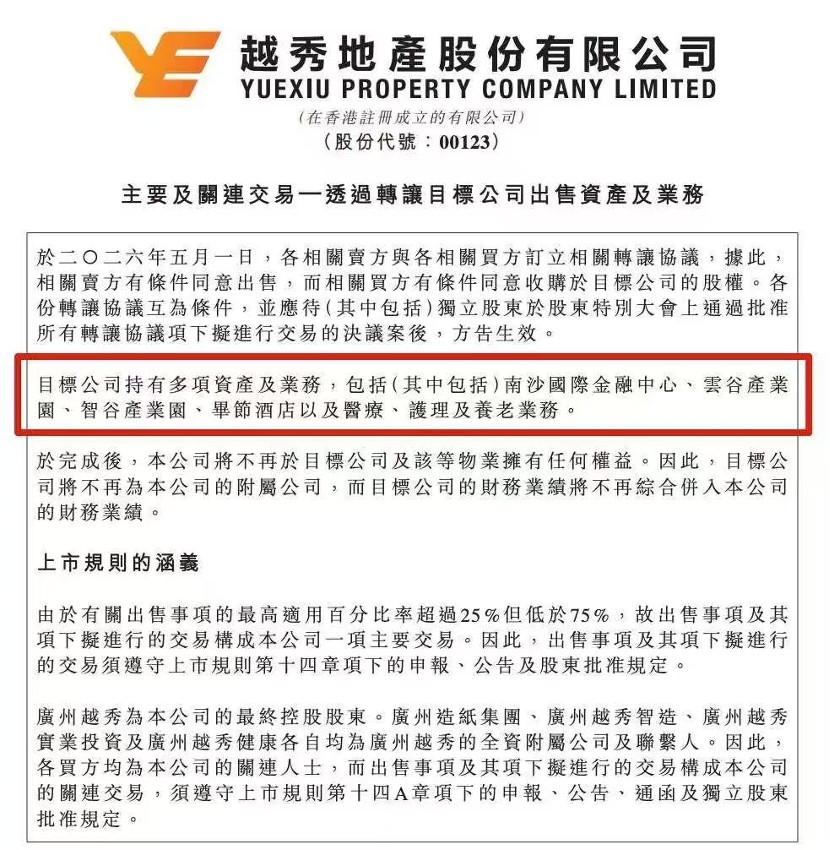
This transaction in May was not small. YUEXIU sold the Nansha International Financial Center, Yungu Industrial Park, Zhigu Industrial Park, Guizhou Bijie Hotel, and equity and assets related to the health care business to its parent company. The funds returned amounted to 4.46 billion yuan, with total asset value decreasing by approximately 5.9 billion yuan and net asset value increasing by about 108 million yuan.
Peeling it back: using 5.9 billion yuan in book assets to exchange for 4.46 billion yuan in cash, while also recording a book profit of 108 million yuan, the intention to shrink the balance sheet for liquidity is very straightforward.
 imageView2/2/w/1000/format/png/interlace/1/q/85)
All counterparties are "insiders": Guangzhou Paper Group, YUEXIU Intelligent Manufacturing, YUEXIU Industrial Investment, and YUEXIU Health are all wholly-owned subsidiaries of YUEXIU Group. This is a typical internal maneuver.
However, this "left hand to right hand" transaction is not without substantive significance. The several projects in Nansha have "slow asset turnover," which means that a large amount of capital is tied up and cannot be moved; the health care business "is still in the early incubation stage," with no return in sight in the short term; and the Bijie hotel is not even in the core layout area.
By divesting these, the funds can be "fully used for core residential development." Essentially, this lightens the balance sheet, reduces long-term capital occupation, and concentrates resources on the main battlefield of residential development.
What makes YUEXIU special is that it has a parent company with total assets exceeding 1 trillion yuan, spanning real estate, finance, and transportation as a backing. This "group support, real estate focus" structure is an extremely rare institutional dividend in the entire industry. Most private real estate companies can only sell assets at low prices during contractions, with no "rich dad" to take over.
5
23.6 billion yuan land king: Betting on the future
A few days ago, I passed by Zhujiang New Town, and the fenced area is where the horse racing land is located, surrounded by dense high-rise buildings, with this empty space being the last placement point on the chessboard.
Selling assets is "subtraction," while acquiring the horse racing land in Guangzhou's Zhujiang New Town for 23.6 billion yuan is the biggest "addition" made by the YUEXIU system this year.
On February 25, after nearly 9 hours and 243 rounds of bidding, YUEXIU Group won the bid for 23.6 billion yuan, with a premium rate of 26.6%, and the residential floor price is about 85,000 yuan/square meter, setting a record in Guangzhou. The land is located in the eastern area of Zhujiang New Town, the last large-scale undeveloped land in the core area, the final piece on the chessboard.
Note that the bidder is the parent company YUEXIU Group, not the listed company. Fitch revealed that YUEXIU Group will phase in the residential portion (valued at about 19 billion yuan) into YUEXIU Property, with the first phase expected to be completed before the opening in 2027, while the commercial portion will remain on the parent company's books.
The strategy of "parent company acquiring land, subsidiary developing" is not new in the state-owned real estate enterprise circle, but the scale of 23.6 billion yuan gives this case a specimen significance. The direct benefit for the listed company is that the initial land payment and debt do not need to be reflected in the financial statements, nor will it occupy the annual 30 billion yuan equity investment quota. The parent company bears the pressure first, and once the project matures, it is injected, which avoids the financial risks for the listed company while securing quality land reserves in core cities.
 YUEXIU PROPERTY Chairman Lin Zhaoyuan said at the performance meeting that the horse racing project "will start construction soon and should be completed in 3 to 4 years." For a project with a floor price of 85,000 yuan/square meter, this development cycle means it will become a key variable in YUEXIU's profit statement from 2027 to 2030, provided that the high-end residential market in Guangzhou can support its selling price by then.
6
Two sets of accounts, a mirror
Looking at YUEXIU's operations in the first half of 2026, a judgment is emerging: state-owned real estate companies are calculating two sets of accounts during the industry's downturn.
One is the commercial account, which is presented to the capital market. A 27% drop in sales, a gross profit margin of 7.8%, and a core net profit decline of 83.5%—these numbers do not look good in anyone's annual report. Although Fitch has given a "BBB-", it also clearly stated that "profit margins will remain weak in 2026."
The other is the strategic account, which is not shown to outsiders. A financing cost of 3.05%, over 40 billion yuan in cash reserves, Fitch's stable outlook, and the parent company's trillion yuan assets as a safety net—these factors constitute an institutional safety cushion, allowing it to "survive" in the winter and "wait it out."
In the first five months, national real estate development investment reached 3.04 trillion yuan, a year-on-year decrease of 16.2%. The gap in growth rates between the investment side and the sales side is widening, and the supply side's clearing is far from over. The industry has shifted from "incremental competition" to "stock game," from "scale is king" to "safety first." At this turning point, state-owned enterprises are writing their survival rules at a slower and steadier pace.
The 23.6 billion yuan land king is a bet on the future. The 4.46 billion yuan asset sale is a choice to contract in the present. A financing cost of 3.4% and a gross profit margin of 7.8% are costs that must be borne during the transformation period.
Ultimately, YUEXIU's story is not an isolated case of one enterprise, but a common sample of the entire state-owned real estate sector.
This mirror reflects not only the choices and trade-offs of a state-owned enterprise but also the common issues that the entire industry must face during this structural turning point.【Produced by Zhengjing She】