
Tesla Officially Announces FSD Entry into China, Smart Driving Sector Surges with Limit-Ups
 Complete. Here is the key summary
On Thursday, A-share smart driving concept stocks surged, with more than ten stocks, including Desay SV and LCE, hitting their daily limit-ups. In response to consumer inquiries, Tesla customer service stated that the company is actively advancing the approval process in accordance with relevant national regulations, and will "push updates to domestic customers as soon as approvals are secured"
Tesla has officially announced the launch of its supervised Full Self-Driving (FSD) system in the Chinese market. This news quickly ignited the A-share smart driving sector, with multiple core stocks hitting their daily limit-ups, prompting a revaluation of valuation logic across the industry chain.
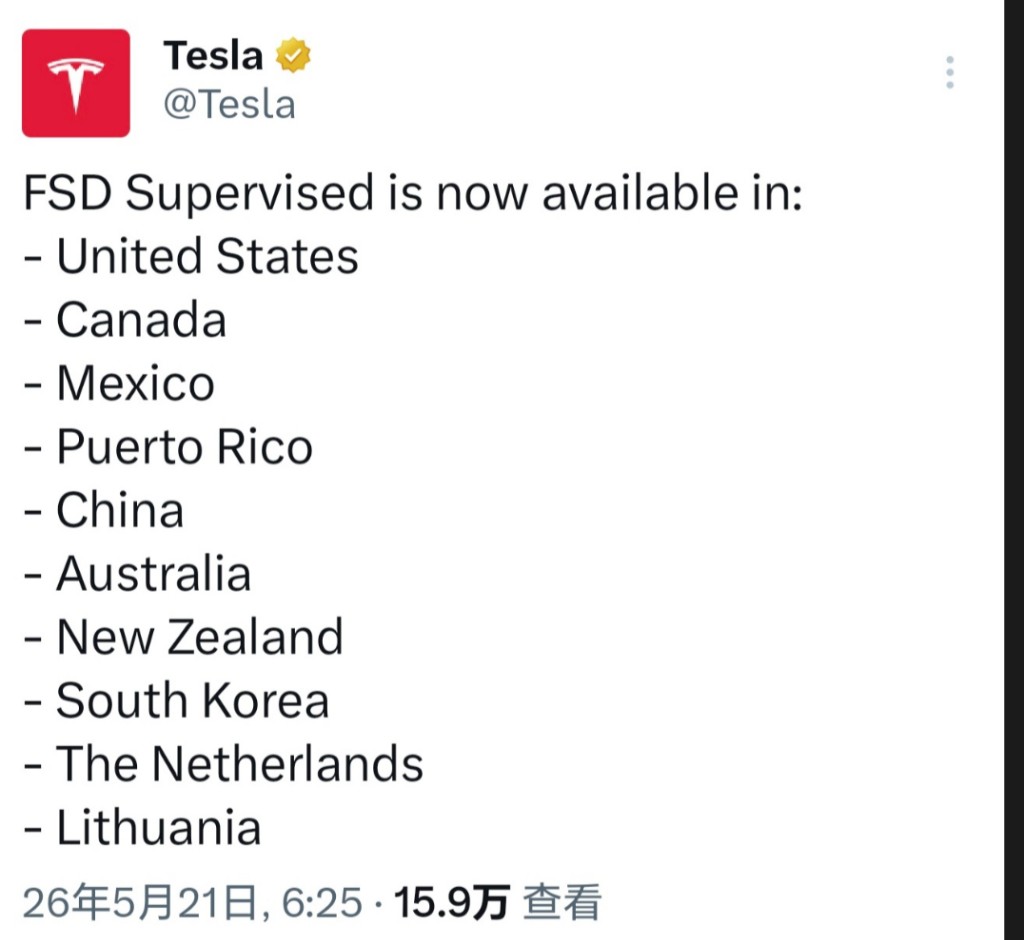
On May 21, Tesla officially announced the latest rollout plan for the supervised version of FSD, confirming that the feature can be used in China while simultaneously launching in 10 other countries and regions globally.
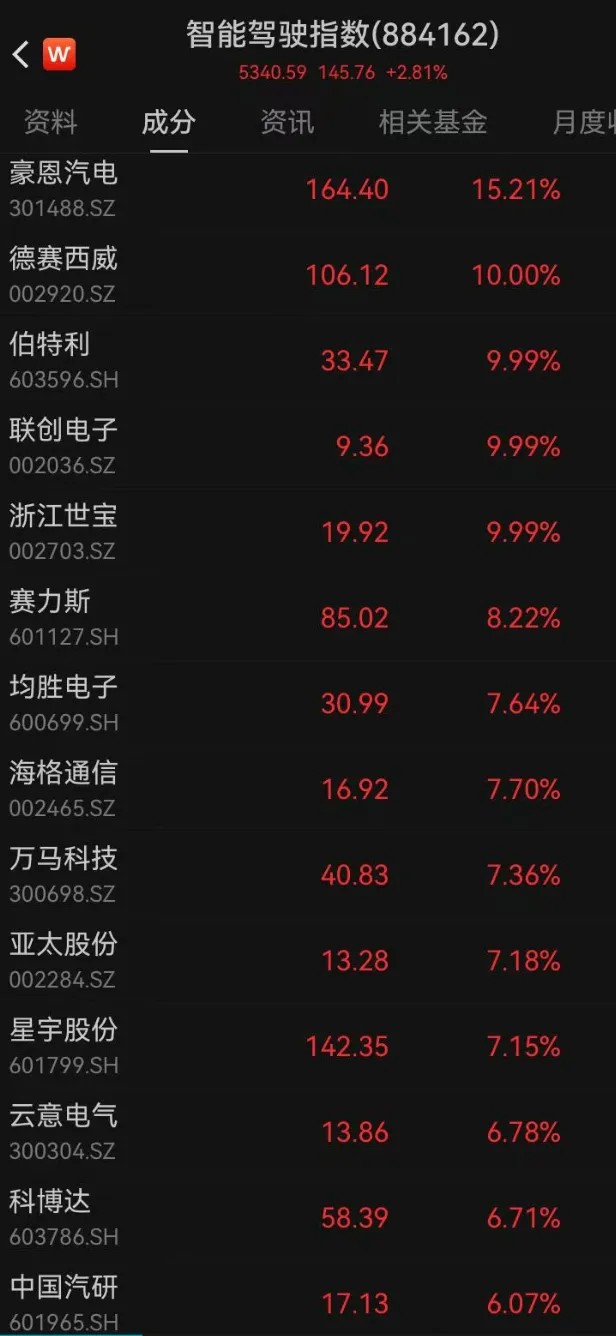
The A-share smart driving concept sector saw a strong pull-up. More than ten stocks, including Desay SV, LCE, Zhejiang Shibao, Bethel, Bomin Electronics, and Suoling Shares, were locked at their daily limit-ups. Haoen Auto Electric's gains exceeded 16% at one point, while Hanxin Technology, Jingwei Hirain, and Luchang Technology also strengthened simultaneously.
The direct significance of this official announcement lies in confirming the time window for FSD's landing in China. In response to consumer inquiries, Tesla customer service stated that the company is actively advancing the approval process in accordance with relevant national regulations, and will "push updates to domestic customers as soon as approvals are secured."
Official Launch Confirms Accumulating Signals
Expectations for Tesla's FSD to enter China have long existed, and this official announcement serves as a formal confirmation following the accumulation of multiple signals.
During the first-quarter earnings conference call this year, Tesla's Chief Financial Officer expressed hope that FSD would receive approval from relevant Chinese authorities in the third quarter of this year. In February, Tesla Vice President Tao Lin publicly stated that Tesla's assisted driving data does not need to leave the country and promised strict compliance with China's data regulatory requirements.
In terms of infrastructure layout, Tesla has established a local AI training center in China to deploy localized training capabilities. Meanwhile, Tesla China recently posted several job openings related to smart driving testing, further fueling market expectations for an accelerated FSD rollout. This official announcement has transformed previous market speculation into clear expectations.
Industry Chain Logic: Deep Supply Chain Integration Benefits Multiple Segments
The supervised version of FSD covers core functions such as highway full-self-driving and urban Navigate on Autopilot (NOA). Relying on the HW4.0 hardware platform, it places high demands on key links such as vehicle perception, domain control computing, and wire-controlled execution. The deep binding relationship between Tesla and related A-share supply chain enterprises is the core logical support behind the sector's collective surge.
In the field of automotive optics, LCE, as the main supplier of 8MP automotive lenses for Tesla's HW4.0 platform, is regarded as a core beneficiary in the perception layer. In the domain controller segment, Desay SV has deeply cultivated high-computing-power platforms and has secured FSD-related orders. In the wire-controlled chassis track, Bethel's wire-controlled braking and Zhejiang Shibao's wire-controlled steering are considered adaptable to high-level smart driving needs, while Tuopu Group is deeply involved as a Tier 0.5 supplier. Additionally, WUS Printed Circuit, Sanhua Intelligent Controls, and NavInfo occupy respective positions in multi-layer PCBs, computing power cooling, and high-precision mapping.