
In 2025, turning from profit to loss, with negative cash flow in the first half of the year, is "Childhood White Moonlig…
 I'm LongbridgeAI, I can summarize articles.
QINQIN FOODS Group issued a profit warning for 2025, expecting a net loss of between 1 million and 3 million yuan, with revenue potentially experiencing negative growth for the first time in nearly five years. The net profit for the first half of 2025 is projected to be 21 million yuan, but a loss of 22 million to 24 million yuan is expected in the second half. The company is facing multiple pressures, including a decline in revenue from traditional sales channels and reduced gross profit, as well as one-time losses due to asset sales and project suspensions. Revenue has continued to grow from 2021 to 2024, but a decline in revenue for 2025 has already become apparent
The joy of turning a profit in 2024 could not be sustained. According to the profit warning, QINQIN FOODS is expected to return to a loss in 2025, with revenue possibly experiencing its first negative growth in nearly five years.
Main Business Under Pressure
On the evening of March 5, QINQIN FOODS GROUP (Cayman) Co., Ltd. (hereinafter referred to as "QINQIN FOODS") announced a profit warning for 2025, predicting a net loss of between RMB 1 million and RMB 3 million for the year, compared to a profit of RMB 21 million in 2024.
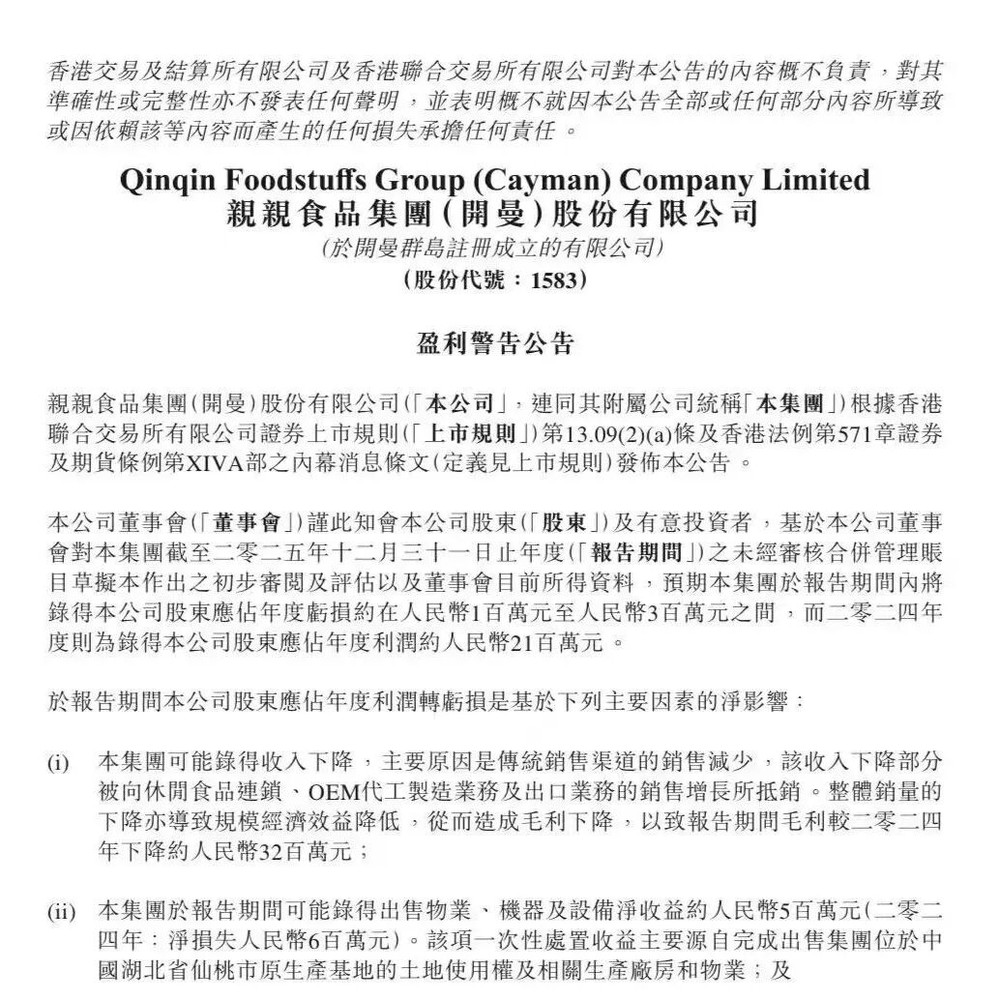
The 2025 interim report shows that the company recorded a net profit of RMB 21 million in the first half of the year, which means that the company lost between RMB 22 million and RMB 24 million in the second half of the year.
In the face of losses, QINQIN FOODS explained that several factors contributed to this situation. Firstly, the company may record a decline in revenue, primarily due to reduced sales in traditional sales channels, leading to a decrease in overall sales and a reduction in economies of scale, which in turn caused a decline in gross profit, with gross profit decreasing by approximately RMB 32 million compared to 2024.
Additionally, there were impacts from two "one-time" projects, "one sale and one stop." "One sale" refers to the sale of the land use rights and related production facilities of its original production base in Xiantao City, Hubei Province in 2025, which generated a net gain of approximately RMB 5 million. "One stop" refers to the impairment loss of approximately RMB 7 million for a construction project in progress in Xiaogan, Hubei Province, as the group decided to no longer pursue this development project.
From the perspective of the balance sheet, such one-time projects only resulted in a loss of about RMB 2 million. Combined with the expected annual loss attributable to shareholders of between RMB 1 million and RMB 3 million, it indicates that QINQIN FOODS' main business is almost "stagnant" in 2025.
Looking at the longer term, from 2021 to 2024, QINQIN FOODS' revenues were RMB 860 million, RMB 958 million, RMB 982 million, and RMB 996 million, achieving consecutive annual growth. The profit warning indicates that a revenue decline may occur in 2025, suggesting that QINQIN FOODS may face its first revenue negative growth in nearly five years.
The downturn in 2025 was already hinted at in its interim report. In the first half of 2025, QINQIN FOODS' revenue was RMB 530 million, a year-on-year decrease of 6%, with gross profit of RMB 154 million, a year-on-year decrease of 10.2%, and profit attributable to shareholders of RMB 21.55 million, a significant decline of 34.3%, putting pressure on overall performance.
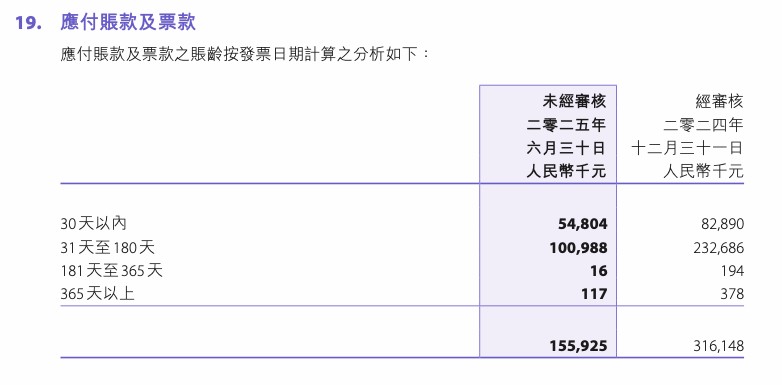
More seriously, in the first half of 2025, QINQIN FOODS' net cash flow from operating activities was -RMB 107 million, compared to RMB 42.4 million in the same period last year, indicating that profits were merely "paper wealth," and the company's ability to collect payments was poor or it had paid off a large amount of prior debts Specifically, accounts receivable decreased from 15.04 million yuan to 14.39 million yuan, showing little change. However, accounts payable balance significantly decreased by 50.6%, dropping from 316 million yuan at the end of 2024 to 156 million yuan in mid-2025, indicating that QINQIN FOODS is reversing the situation of relying on suppliers for "blood transfusions."
At the end of 2024, the company owed suppliers 316 million yuan, which was equivalent to utilizing supplier funds for operations. In the first half of 2025, the company's accounts payable aged 31-180 days plummeted from 233 million yuan to 101 million yuan. This means that the company's bargaining power with suppliers is weakening, and it can no longer delay payments to suppliers.
With no improvement in cash collection, QINQIN FOODS had to use cash to repay supplier debts. Coupled with a 30% year-on-year decline in net profit, this resulted in a net cash outflow from operating activities in the first half of the year.
Shifting for "survival"?
It is noteworthy that the Hubei Xiaogan project mentioned in the 2025 profit warning has now reached its final outcome—being "sold" to a state-owned enterprise.
According to Qichacha, on February 26 this year, the equity structure of Xiaogan QINQIN FOODS changed, with the original wholly-owned shareholder, Xiaogan QINQIN (Hong Kong) Co., Ltd., exiting, and the new shareholder being Xiaogan Wanyi Asset Operation Co., Ltd., which is a state-owned enterprise, wholly owned by Xiaogan Gaocuo Investment Co., Ltd.
In January this year, the Wuhan Optics Valley United Property Rights Exchange added a new item, with 100% equity of Xiaogan QINQIN FOODS Co., Ltd. intended to be transferred at a base price of 23.4555 million yuan. At that time, there were reports that Xiaogan Gaocuo Investment Co., Ltd., controlled by the Xiaogan State-owned Assets Supervision and Administration Commission, was interested in acquiring it.
Public information shows that Xiaogan QINQIN FOODS was established in 2018, with its main asset being a cultural facility land of approximately 23,600 square meters. The main structure of the land has been completed, and it was originally planned to build a rice wine and sesame candy exhibition hall.
At that time, Xiaogan Gaocuo Investment Co., Ltd. stated that after acquiring Xiaogan QINQIN FOODS, it would strictly follow the previously formulated operational plan to create an industrial window and urban landmark that integrates a sesame candy and rice wine exhibition hall, a rice wine culture museum, and a restaurant featuring Xiaogan landmark cuisine and specialties. In other words, QINQIN FOODS is exiting a cross-industry attempt of "industry + cultural tourism," while the state-owned enterprise is taking over the sequel.
In the mid-2025 report, QINQIN FOODS disclosed that the original intention of constructing this project was to promote the development of the group's food manufacturing industry in the local area. However, after comprehensive consideration of changes in the economic environment, business development prospects, and expected returns, the group decided to terminate the construction and recognized an impairment loss of 5.4 million yuan on construction in progress in the first half of 2025 From the operational data, the project has long been a mere formality. In the entire year of 2025, QINQIN FOODS in Xiaogan achieved an operating income of only 4,100 yuan, with a net profit of -34,900 yuan, essentially in a state of stagnation. From "suspension" to "impairment provision," and finally to the ultimate "equity transfer," QINQIN FOODS has completely withdrawn from the Xiaogan rice wine exhibition project.
"Withdrawing from the rice wine exhibition" does not mean "withdrawing from rice wine." In fact, reviewing QINQIN FOODS' business structure, rice wine and sesame candy are not its core, but they are indeed a relatively bright growth driver.
The financial report shows that the revenue pillars of QINQIN FOODS are jelly products and puffed foods, which together account for about 70% of total revenue. The "candy and other products" category accounts for less than 6% of total revenue but is growing rapidly, with rice wine and sesame candy being classified under this category.
In 2024, among the four major business categories of jelly products, puffed foods, seasoning products, and candy and other products, puffed foods grew by 13.7% year-on-year, and candy and other products grew by 30%, while jelly products and seasoning products both declined by about 6.5% year-on-year.
In the first half of 2025, the year-on-year changes in sales for QINQIN FOODS' four major business categories—jelly products, puffed foods, seasoning products, and candy and other products—were -6.6%, -2.9%, -17.6%, and 0.7%, respectively. This means that candy and other products are the only category experiencing growth.
The narrative of "using cultural exhibitions to drive industrial development" has not been successful, but obtaining a cash inflow of 23.4555 million yuan after selling the project is also a rare achievement.
Data shows that from 2021 to 2023, QINQIN FOODS accumulated losses of nearly 84.721 million yuan over three years, and in 2025, it returned to a loss of 1 million to 3 million yuan. The only profitable year, 2024, was largely due to financial engineering at play.
A more realistic question is: as of the first half of 2025, the company's cash on hand has decreased from 413 million yuan in the same period last year to 385 million yuan. If the main business continues to bleed, where will the next asset to "extend life" come from?