
New Stock Interpretation | Positioning in the Three Major Strategic Heights of AI Hardware - The Industrial Upgrading an…
 I'm LongbridgeAI, I can summarize articles.
LY iTECH officially passed the Hong Kong Stock Exchange hearing on June 22, marking a key step in its global capital layout. As a leader in precision functional components, the company benefits from the growing demand for AI hardware supply chains, with revenue continuing to grow strongly, reaching 44.26 billion yuan in 2024, a year-on-year increase of 29.6%, demonstrating the strategic effectiveness of its transition from precision manufacturing to an intelligent manufacturing platform
As the global technology industry focuses on how AI transitions from "computing power accumulation" to "commercial implementation," the capital market's "barometer" has already taken the lead. Currently, the AI industry is in an upward cycle driven by capital expenditure, and the expansion pace of capital expenditure by leading cloud vendors has become the core pulse for measuring industry prosperity. In this wave of infrastructure reconstruction worth trillions of dollars, hardware devices have become the physical carriers for AI implementation, and their strategic value is being re-evaluated.
On June 22, LINGYI ITECH (01688), a leader in precision functional components, officially passed the Hong Kong Stock Exchange hearing, marking a timely milestone. This not only signifies a key step in the global capital layout of a benchmark Chinese intelligent manufacturing enterprise but also symbolizes the market's deep recognition of the core value of the AI hardware supply chain. In the grand picture of AI reconstructing the world, LINGYI ITECH is becoming a key "connector" between virtual intelligence and the physical world, thanks to its profound accumulation in the field of precision manufacturing.
The "Connector" of Edge AI and the Physical World — Elevating from Precision Manufacturing to Hardware Intelligent Manufacturing Platform
According to Zhitong Finance APP, the competition in the AI industry has shifted from a singular focus on computing power accumulation to a contest of hardware implementation capabilities. The explosion of edge AI and physical AI has raised higher demands for high-precision functional components. In this transformation, LINGYI ITECH's role has elevated from a leading precision manufacturing enterprise to a "globally leading intelligent manufacturing platform for electronic devices."
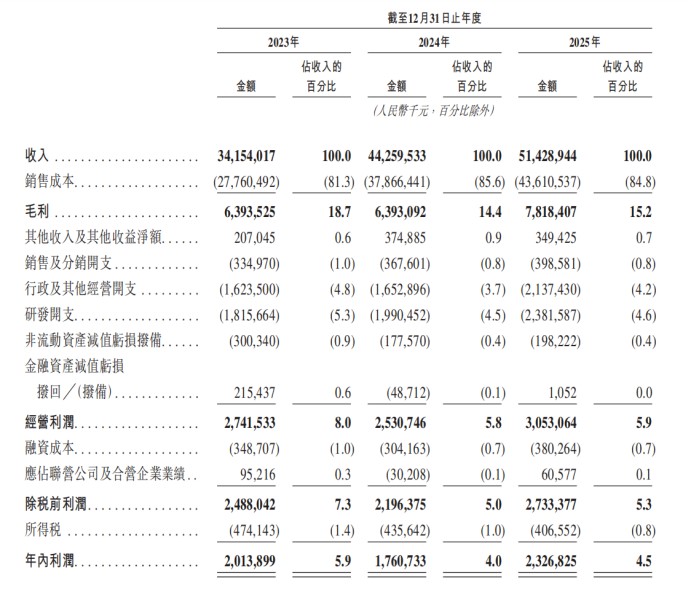
From 2023 to 2025, LINGYI ITECH has demonstrated a strong and steady growth trend in performance, providing a solid financial foundation for this strategic elevation. According to the prospectus data, the company's total revenue is expected to grow from RMB 34.154 billion in 2023 to RMB 44.260 billion in 2024, a year-on-year increase of 29.6%; further climbing to RMB 51.429 billion in 2025, with a year-on-year growth of 16.2%. The compound annual growth rate of operating revenue over three years is as high as 22.7%, with the pace of scale expansion continuing to accelerate.
Profitability also shows a clear trend of recovery growth: the profit for the year 2023 is RMB 2.014 billion, which is slightly adjusted to RMB 1.761 billion in 2024 due to industry cyclical adjustments and increased R&D investment, but rebounds rapidly to RMB 2.327 billion in 2025, with a year-on-year increase of 32.2%, not only recovering lost ground but also setting a historical high. The discrepancy between a 16% revenue growth and a 32% profit growth in 2025 validates the company's optimization of its profit structure brought about by internal cost reduction and efficiency enhancement, as well as an increase in the proportion of high value-added products, significantly releasing operational leverage effects.
 The resilience and quality of this growth are rooted in its deep layout in the edge AI field. According to Frost & Sullivan data, LINGYI ITECH ranks first in the "Global AI Terminal Device High-Precision Functional Components Market," with a market share more than twice that of the combined second to fifth places, and it also ranks third in the "Global AI Terminal Device High-Precision Intelligent Manufacturing Platform." This dominant position directly translates into high-quality business growth.
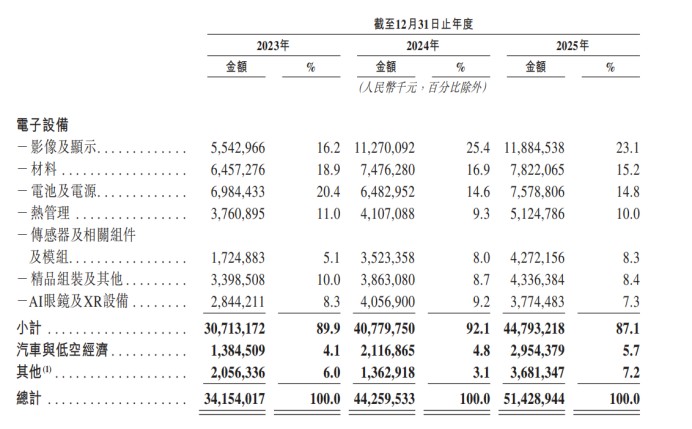
By 2025, the company's AI hardware-related business is expected to achieve revenue of approximately 44.793 billion yuan, accounting for more than 87% of total revenue, with battery power and thermal management sectors forming the main force of the edge AI business, both achieving double-digit year-on-year growth. In particular, the thermal management business directly benefits from the iteration of cooling solutions brought about by the improvement in computing power of edge AI chips—from traditional graphite sheets to ultra-thin VC (Vapor Chamber) heat spreaders, and then to high-value stainless steel/titanium alloy VC solutions, with product unit prices and gross margins increasing simultaneously. The company's self-developed "Feather Copper Bionic Structure" nano cooling technology has already achieved mass shipments, and the construction of technological barriers further consolidates profit levels. In the typical edge AI hardware innovation of foldable screens, the company's titanium alloy support plates and carbon fiber support plates have entered mass production, clearly indicating that future growth momentum is shifting from "quantity" expansion to "price" enhancement.
Physical AI and the "Bone Maker" of Embodied Intelligence—From Core Components to Complete Machine ODM Mass Production Loop
Since NVIDIA defined physical AI as the next trillion-dollar track for artificial intelligence, industry competition has shifted from virtual large models to the ability to implement physical hardware. Humanoid robots, as the best carrier of physical AI, face commercial bottlenecks not in algorithm iteration but in the ability to achieve large-scale mass production of precision hardware from components to complete machines. LINGYI ITECH's role is to be the "bone maker" that constructs the physical skeleton for embodied intelligence.
The company builds its core competitiveness in embodied intelligence through a three-in-one strategy of core component research and development, hardware manufacturing, and scene implementation. On the component side, the company has developed its own joint modules and RV reducers, launching lightweight modules with hollow wiring that cover all motion units of robots.
At the complete machine level, the company has created a matrix of four mass-produced models: "Walker," "Rock," "Linglong," and "Aimas," covering three major scenarios: commercial services, heavy industrial, and precision manufacturing. In 2026, the embodied intelligence super factory in Beijing Yizhuang will officially start large-scale production, planning to achieve an annual production capacity of 10,000 units by 2026 and 500,000 units by 2030, marking the formal establishment of a closed loop for large-scale delivery from core components to complete machine ODM.
In terms of customer expansion, the company has reached strategic cooperation with several global leading embodied robot companies. According to public information, domestic partners include Zhiyuan Robotics, UBTECH, and Honor— the company has manufactured 159 core structural components for Honor's "Lightning" robot, helping it secure the top six positions in the Beijing Yizhuang Humanoid Robot Half Marathon Providing complete machine manufacturing and assembly testing for Zhiyuan Robotics, the Chengdu base will deliver 200 customized complete machines to Zhiyuan by May 2026. By the end of 2025, the company has completed thousands of sets of humanoid robot hardware and complete machine assembly services.
In short, LINGYI ITECH defines the physical boundaries of embodied intelligence with its hardware capabilities and promotes the commercial popularization of humanoid robots from technological validation through a closed-loop mass production, becoming an indispensable "bone maker" in the physical AI era.
The "Water Seller" of Computing Power Infrastructure - Positioning in the Core Heat Dissipation Segment of AI Servers, Deeply Benefiting from the Global Capital Expenditure Wave
Global cloud vendors are directing capital expenditures towards energy efficiency with unprecedented intensity, leading to an explosive growth in the demand for high-power AI server heat dissipation. Microsoft’s capital expenditure for the entire fiscal year 2025 reached $88.2 billion, a year-on-year increase of 58.35%, and is expected to exceed $30 billion in the first quarter of fiscal year 2026; Google has raised its total capital expenditure for 2025 to $85 billion, with further increases in 2026. NVIDIA's Vera Rubin platform has announced the adoption of a 100% liquid cooling solution, upgrading liquid cooling from an "optional" feature to a rigid necessity for computing power infrastructure.
LINGYI ITECH is strategically positioned in this rigid track with its "full-stack heat dissipation" capabilities - aiming to be the "water seller" of computing power infrastructure.
In terms of core heat dissipation technology, the company has formed a product matrix covering the entire range of air cooling and liquid cooling. Its self-developed multi-axis cavity heat dissipation component (BigMAC) outperforms mainstream 3D heat spreaders in the 400W-1000W power range and offers cost advantages. The company's thermal management solutions have been supplied in bulk to one of the largest computing power leaders globally and have fully prepared production capabilities for thermal modules, liquid cooling modules, liquid cooling plates, air cooling modules, heat pipes, heat spreaders, and other products for international clients such as AMD.
The acquisition of Limin Da is a key move for LINGYI ITECH to complete the closed loop of the computing power industry chain. According to UBS, the global liquid cooling market is expected to have a compound annual growth rate of 51% from 2026 to 2030.
The funds raised from the Hong Kong stock listing will focus on expanding liquid cooling capacity and building overseas delivery centers. Relying on a global layout of 80 production bases, Limin Da has achieved mass production in Dongguan and Suzhou, with overseas bases in the Philippines and Vietnam accelerating construction. Through the dual drive of "liquid cooling + power supply," LINGYI ITECH has formed a closed loop of the server industry chain from heat dissipation to power supply, with its subsidiary Saierkang CRPS high-end power supply achieving large-scale production and delivery. In the ongoing upward cycle of capital expenditure in AI computing power infrastructure, LINGYI ITECH is continuously consolidating its "water seller" industrial position with its rare supply chain qualifications and global delivery capabilities.
In summary, LINGYI ITECH positions itself as a "connector" in the precision manufacturing moat of edge AI, defines the hardware boundaries of physical AI as a "bone maker," and locks in the rigid demand for heat dissipation in computing power infrastructure as a "water seller" - three roles, three closed loops, together forming its irreplaceable hub position in the AI hardware industry chain. In the industrial wave of AI transitioning from computing power accumulation to commercial implementation, LINGYI ITECH has demonstrated its leap from following to leading in Chinese manufacturing in the AI era to the capital market with solid performance growth, rare supply chain qualifications, and forward-looking strategic positioning. As the Hong Kong stock listing process advances, this platform-based enterprise rooted in precision manufacturing is occupying an increasingly core strategic position in the global AI hardware landscape