
LIULIUMEI IPO: Who is ringing the bell, and who is counting the money?
 I'm LongbridgeAI, I can summarize articles.
LIULIUMEI was listed on the Hong Kong Stock Exchange on June 15, opening with a surge of 118% and closing with an increase of 193.71%, with a market value of approximately HKD 10.09 billion. The founders, Yang Fan and his wife, saw their wealth soar to about HKD 7.5 billion. This listing took seven years and was mainly driven by the clearing deadline of the betting agreement on June 30. Despite the successful listing, the company faces issues such as a sharp decline in core product sales, performance slowdown, and a drop in gross margin, along with significant dividends cashed out by the founders just before the listing
(This article is authored by LanMeiHui and published with permission from TMTPost)
Text | LanMeiHui
Are you okay? If you're fine, then eat that LIULIUMEI, which has finally realized its dream of going public.
On the morning of June 15, at the Hong Kong Stock Exchange bell-ringing ceremony, LIULIUMEI founder Yang Fan and his wife stood in the center, surrounded by a group of executives and investors, all of whom simultaneously made a "6" gesture towards the camera, their smiles particularly radiant.
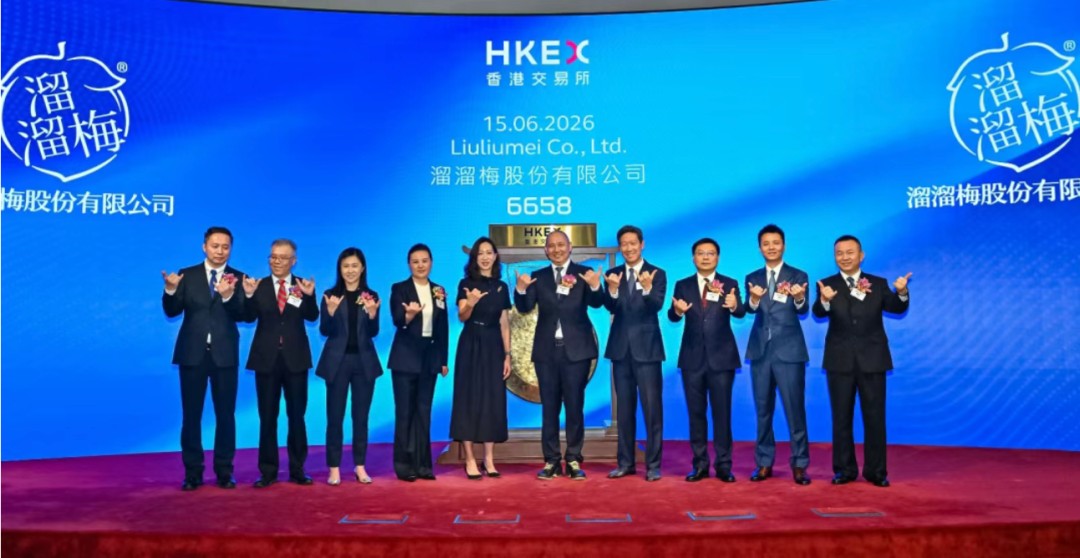
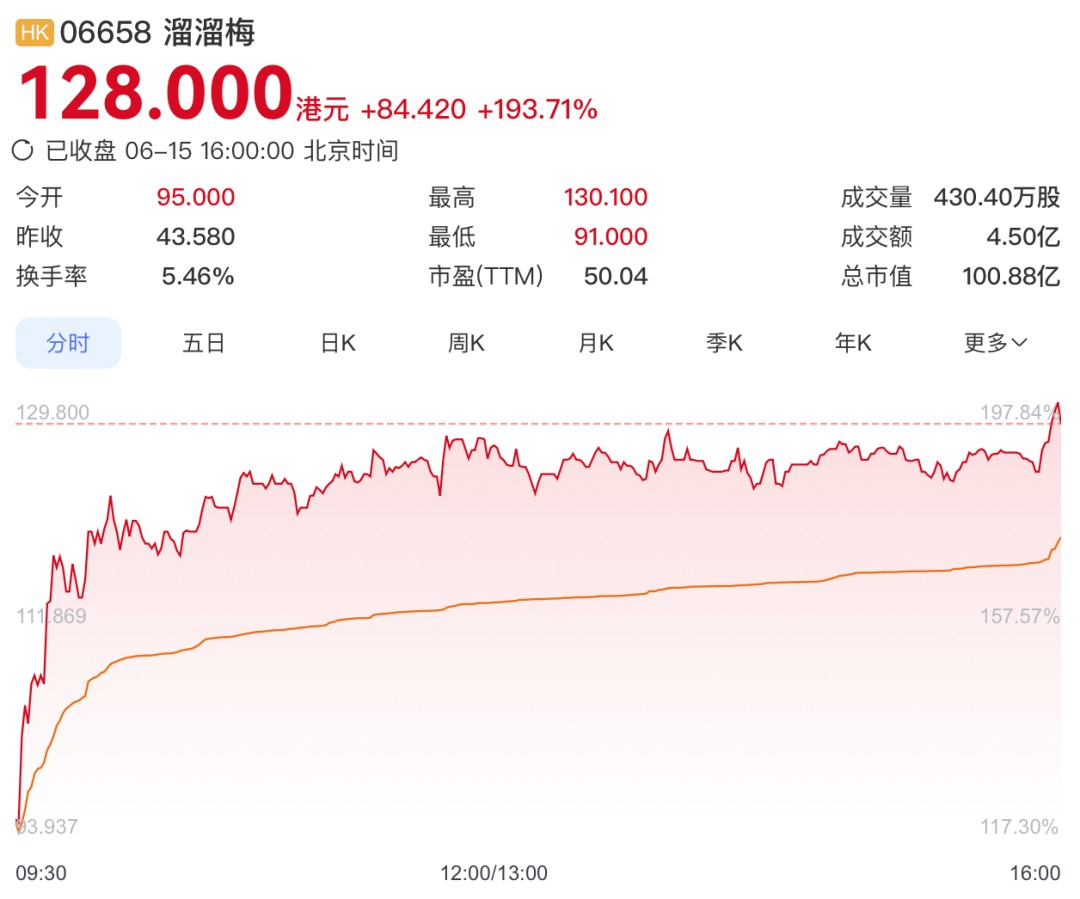
As soon as the gong sounded, LIULIUMEI's stock surged 118% at the opening. By the close, its stock price was reported at HKD 128 per share, with a daily increase of 193.71%, and a market capitalization fixed at HKD 10.09 billion.
Founders Yang Fan and his wife collectively hold about 75% of the company's shares, which means their wealth has soared to approximately HKD 7.5 billion.
At this moment, the Yang couple has waited a full 7 years.
As early as 2019, LIULIUMEI attempted to go public on the A-share market, subsequently shifting to the Shenzhen Stock Exchange and the Hong Kong Stock Exchange, submitting applications four times, all of which ended in failure. Behind this is a series of hefty betting agreements that acted as a shackle.
Over the seven years, this pressure has been ever-present, and only today, with the sound of the gong, did the Yang couple finally breathe a sigh of relief.
However, the excitement is in the secondary market, and beneath the noise lies another layer of story: a sharp decline in core product sales, a slowdown in performance, a drop in gross profit margin, and large dividends cashed out by the founders just before the IPO.
LIULIUMEI's journey to going public is far from "just fine."
On the eve of the IPO, the Yang family took a share first
LIULIUMEI's IPO was not a choice but a must-answer question.
First, let’s discuss an intriguing timeline: On May 21, 2026, LIULIUMEI submitted its application to the Hong Kong Stock Exchange for the Nth time. Five days later, it quickly passed the hearing, on June 5 it launched its public offering, and on June 15 it was listed, with the speed of listing akin to riding a rocket.
Behind this efficient progression is a crucial deadline: June 30.
Why this day? Because that is where the clearing line for the betting agreements is drawn.
Since 2019, LIULIUMEI has attempted an IPO four times, spending seven years shifting between the A-share and Hong Kong stock markets, backed by a series of betting agreements.
From the entry of Sequoia Capital in the A round, LIULIUMEI's financing history has almost been a history of betting agreements, with six rounds of financing: A round, B round, C1, C2, D1, D2, and six betting agreements.
The A round investor Sequoia Capital ultimately did not wait for the day of the IPO. In June 2024, Sequoia officially exercised its redemption rights, and LIULIUMEI paid a principal of 135 million yuan, plus 126 million yuan in interest, totaling 261 million yuan, which is almost equivalent to the company's total net profit over more than two years More urgently, the D round financing comes with a bet: if an IPO is not completed by the end of 2025, D round investors have the right to exercise their buyback rights. The two applications for a Hong Kong stock listing in 2025 both became invalid, and in April 2026, all parties signed a supplementary agreement to extend the deadline to June 30.
However, the pressure from the bet has not disappeared; if the company ultimately fails to go public, B round and C round investors will also simultaneously gain buyback rights, at which point the total buyback amount that founders Yang Fan and his wife need to bear will reach approximately 389 million yuan.
In other words, LiuLiuMei's journey to go public is essentially running with a loaded gun.
The pressure of the company's listing falls entirely on the Yang family.
The prospectus shows that LiuLiuMei's equity structure is highly concentrated. Before the IPO, founder Yang Fan directly holds 37.97% of the shares, and his spouse Li Huimin directly holds 4.37%. Together with the 100% controlled JuRun Investment (holding 36.53%) and other related entities, the controlling shareholders collectively control about 87.77% of the company's equity.
In other words, this company is surnamed "Yang."
On June 15, LiuLiuMei ringing the bell means that the gun hanging over the Yang family's head has temporarily been taken off safety.
However, it is worth noting that just before the IPO, the Yang family suddenly implemented a large dividend.
On May 10, 2026, LiuLiuMei declared a dividend of 67.3 million yuan.
In other words, just before submitting the application to the regulatory authorities, the Yang family took all the money that could be distributed from the company's accounts.
It is not uncommon for companies planning an IPO to distribute dividends before going public, but the key question is how large this amount is.
If calculated based on a net profit of 182 million yuan in 2025, the 67.3 million yuan dividend accounts for 37% of the annual profit. This means that nearly 40% of the company's annual profit was distributed before the IPO.
More importantly, there is not enough cash on hand to support this. According to the prospectus, by the end of 2025, the company's cash and cash equivalents amounted to only 33.904 million yuan, which is less than half of the dividend amount.
With the pressure of the bet looming and the outcome of the IPO approval uncertain, such a large dividend at this critical moment undoubtedly exacerbated the company's financial pressure.
The King of Green Plums, Sales Have Stalled
All of this is closely related to LiuLiuMei's sudden performance decline.
In 2025, its revenue growth rate plummeted from 22.24% the previous year to 5.86%, and the net profit growth rate also slowed from 48.86% to 23.3%.
The core reason is that LiuLiuMei's flagship products seem to be selling poorly.
Its product structure is very clear, with dried plum snacks, fresh plums, and plum jelly as the three main pillars, accounting for 48.5%, 22.2%, and 27.3% of revenue in 2025, respectively. The nearly half share of dried plum snacks is the basic support, but this foundation is starting to weaken In 2025, its dried plum snack revenue dropped from 974 million yuan the previous year to 830 million yuan, a decrease of approximately 14.8%.
Products are not selling well, and channel transformation has dealt another blow.
In the past two years, LIULIUMEI has significantly reduced traditional distributors, with distributor revenue shrinking from 882 million yuan in 2023 to 531 million yuan in 2025, with the proportion plummeting from 66.7% to 31%.
In their place are specialty snack stores. Revenue grew from 134 million yuan in 2023 to 648 million yuan in 2025, increasing its share to 38%, becoming the largest sales channel.
However, the cost of transformation has been a continuous pressure on gross profit margins. The bargaining power of bulk sales channels is extremely strong, diluting LIULIUMEI's pricing power under this model.
As a result, its overall gross profit margin fell from 40.1% in 2023 to 36% in 2024, and then to 35.6% in 2025, continuing to decline, with profitability consistently decreasing.
The marketing engine that once helped it take off is also showing signs of fatigue.
Since Yang Mi's brainwashing line "Are you okay?" in 2013, LIULIUMEI has tied itself to the chariot of traffic stars. Xiao Zhan, the Times Youth League, Guan Xiaotong... generations of top influencers have come and gone, with none left behind.
After more than a decade of marketing-driven strategies, the costs are clear. In 2023, its sales and distribution expenses were 309 million yuan, in 2024 it was 310 million yuan, and in 2025 it was compressed to 272 million yuan, still accounting for 15.9% of revenue, with annual marketing expenses exceeding net profit for the same period.
The problem is, money has been spent, top influencers have changed, but performance has not brought equivalent returns.
The marginal effect of marketing is visibly decreasing, and LIULIUMEI seems to have yet to find its next pivot.
Of course, LIULIUMEI does have a moat.
According to data from Frost & Sullivan, in 2024, the company ranked first in retail sales in China's fruit snack industry, with a market share of 4.9%. From the perspective of market share, it is indeed a leading player in the segment.
However, the problem is that the top five companies in the fruit snack industry only account for 14.5% of the total market. Beneath LIULIUMEI's "first" halo reflects the high dispersion and low barriers to entry in the entire track, making competition exceptionally fierce.
The moat is real, but this track itself seems unable to accommodate overly ambitious imaginations.
For more exciting content, follow the WeChat account of TMTPost (ID: taimeiti), or download the TMTPost App