

14116
0.0611.67%
D
11 hours ago
LI: Range‑Extender Ace Stalls; Guidance Proves Wishful Thinking?
 I'm LongbridgeAI, I can summarize articles.
$Li Auto(LI.US) released its Q2 2026 results after HK market close and before US market open on Aug 26 Beijing time. The quarter was decent, but the Q3 guide was disappointing. Details below:
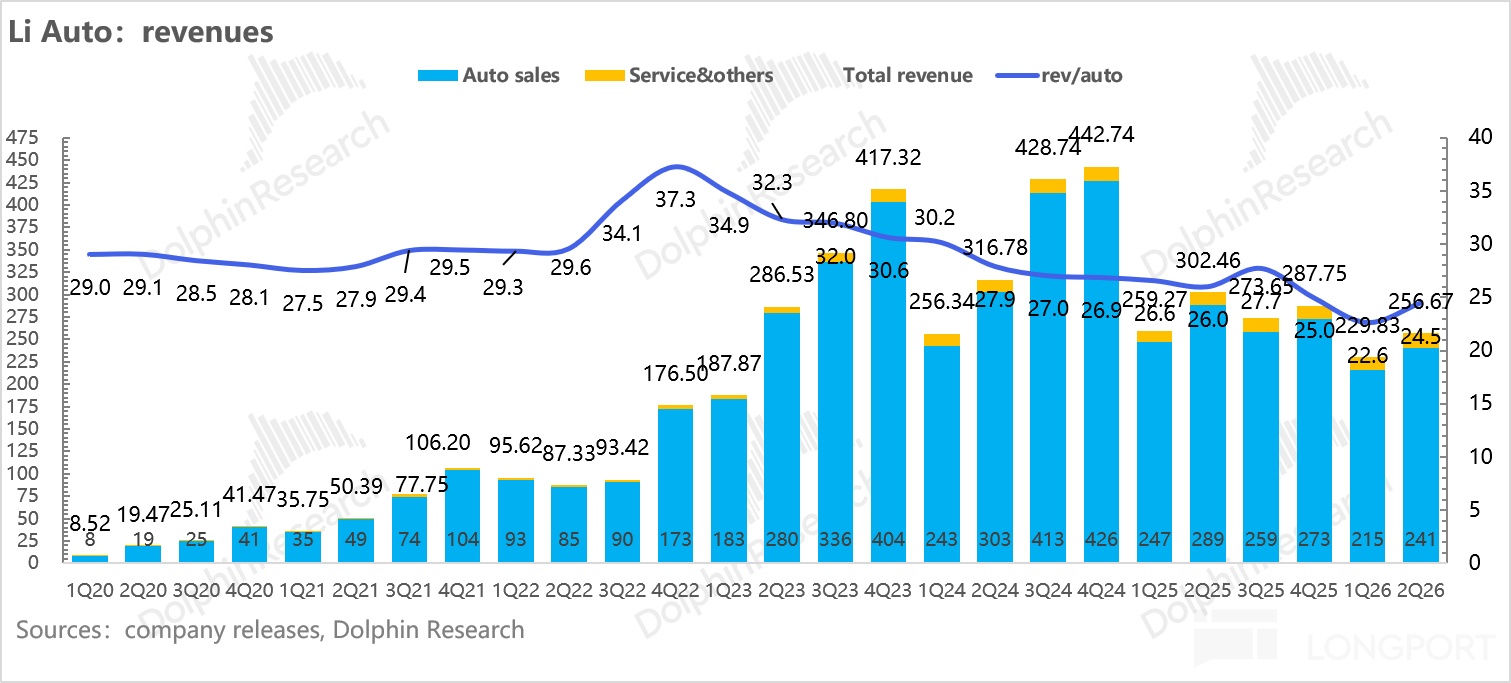
① Revenue beat, driven by a higher-than-expected ASP: Q2 total revenue was approx. RMB 25.7bn (-15% YoY), above the street’s RMB 25.0bn. Vehicle sales were RMB 24.1bn, underpinned by an ASP rebound QoQ of about RMB 20k to RMB 245k (vs. market est. RMB 239k).
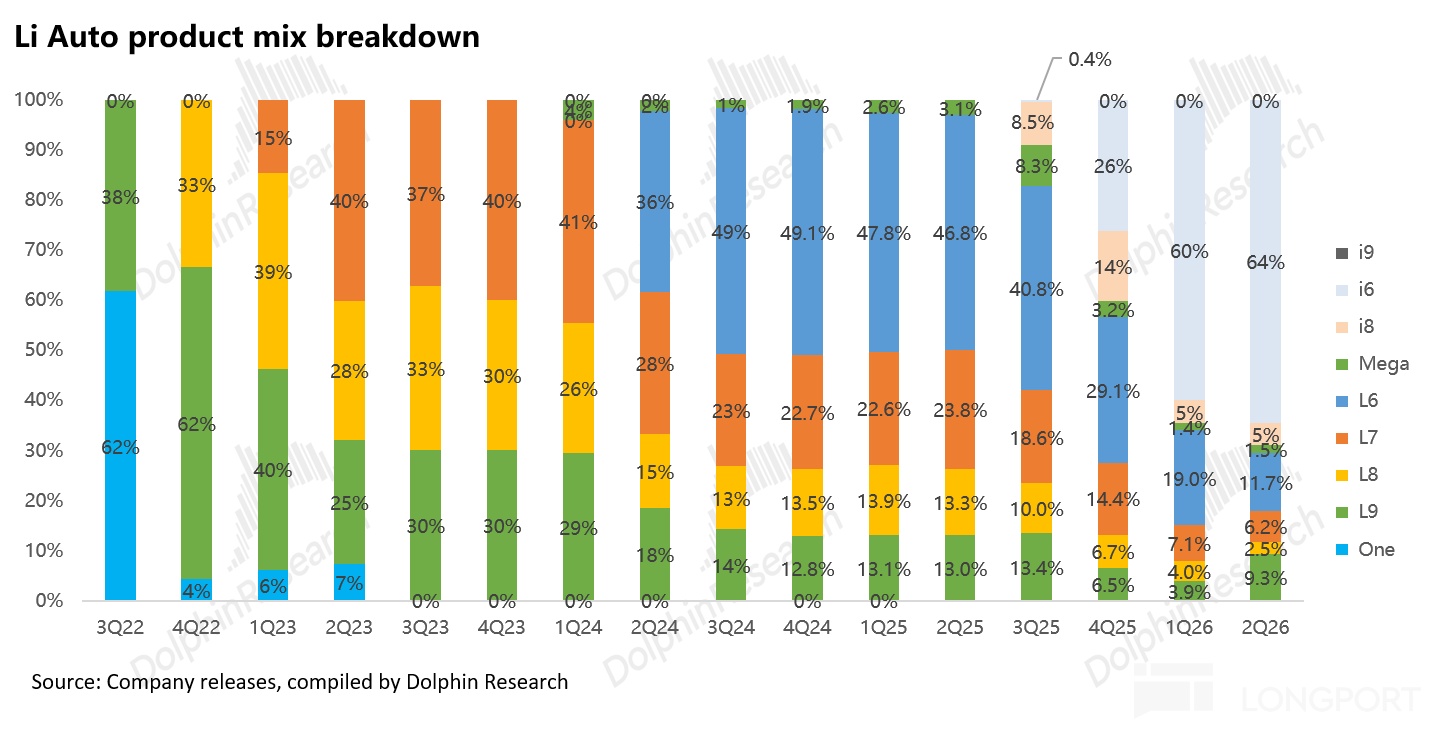
The ASP outperformance stemmed from two factors. First, mix improved as the higher-priced new L9 lifted its share by about 5ppt QoQ to 9%, while the lower-priced L6 saw its share temporarily slip to 12% as buyers waited for the refresh. Second, discount rollbacks: after the new L9/L8 launch, some legacy model discounts were withdrawn and the RMB 15k purchase tax cash subsidy on the i6 was removed, together pushing ASP higher.
② Auto GPM stabilized and improved, but came in slightly below guidance due to cost pressure: Q2 auto GPM was 9.4%, up 330bps from the 6% trough in Q1. Despite a solid ASP, GPM was marginally below the company’s prior 10% guide.
GPM failed to fully recover as upstream costs kept rising. Q2 unit cost increased by roughly RMB 10k QoQ to RMB 222k.
On the one hand, deliveries of 98k units were up only 3% QoQ, limiting scale efficiency during the model changeover. On the other hand, memory chips, commodities and batteries continued to rise in price, with memory alone pressuring i6 margins by roughly 300–400bps.
As a result, unit GP recovered to about RMB 23k in Q2, but the reported GPM at 9.4% remained well below the prior healthy ~20% level. Unit economics are still under pressure.
③ Opex well managed; net profit barely met expectations:
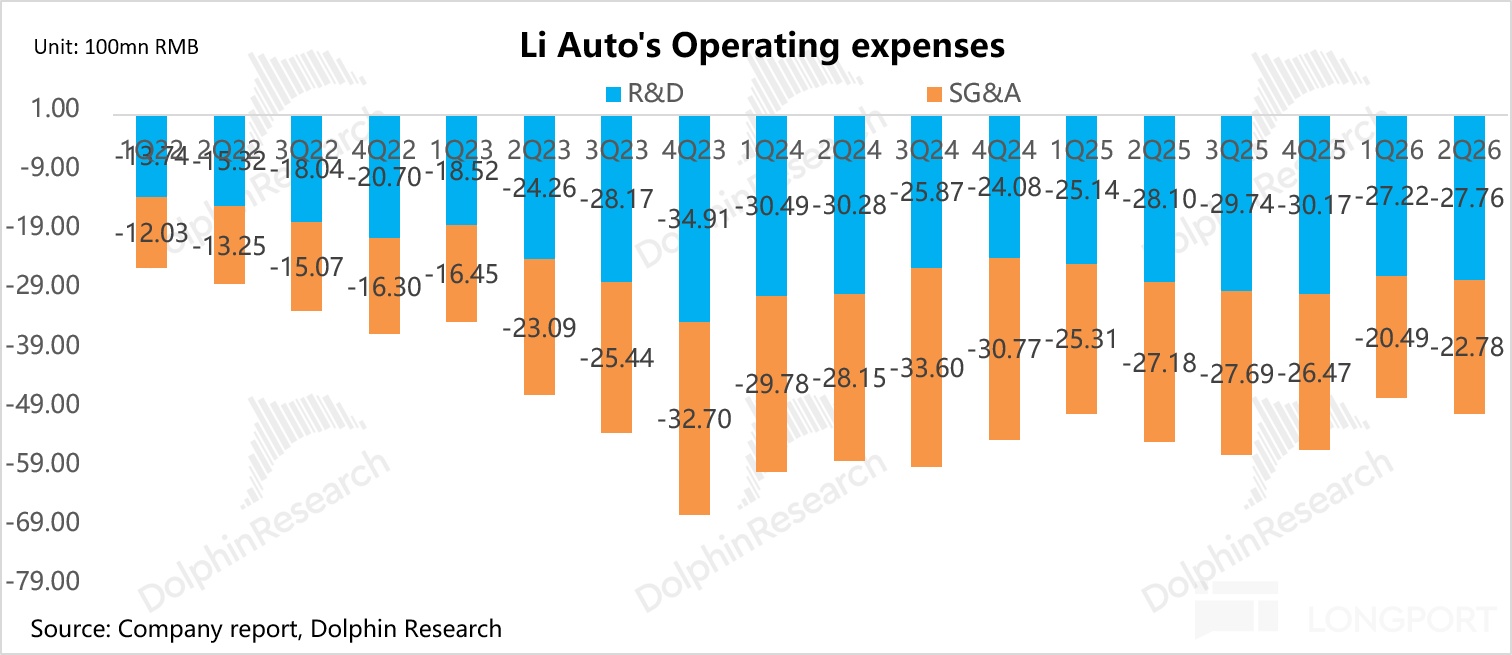
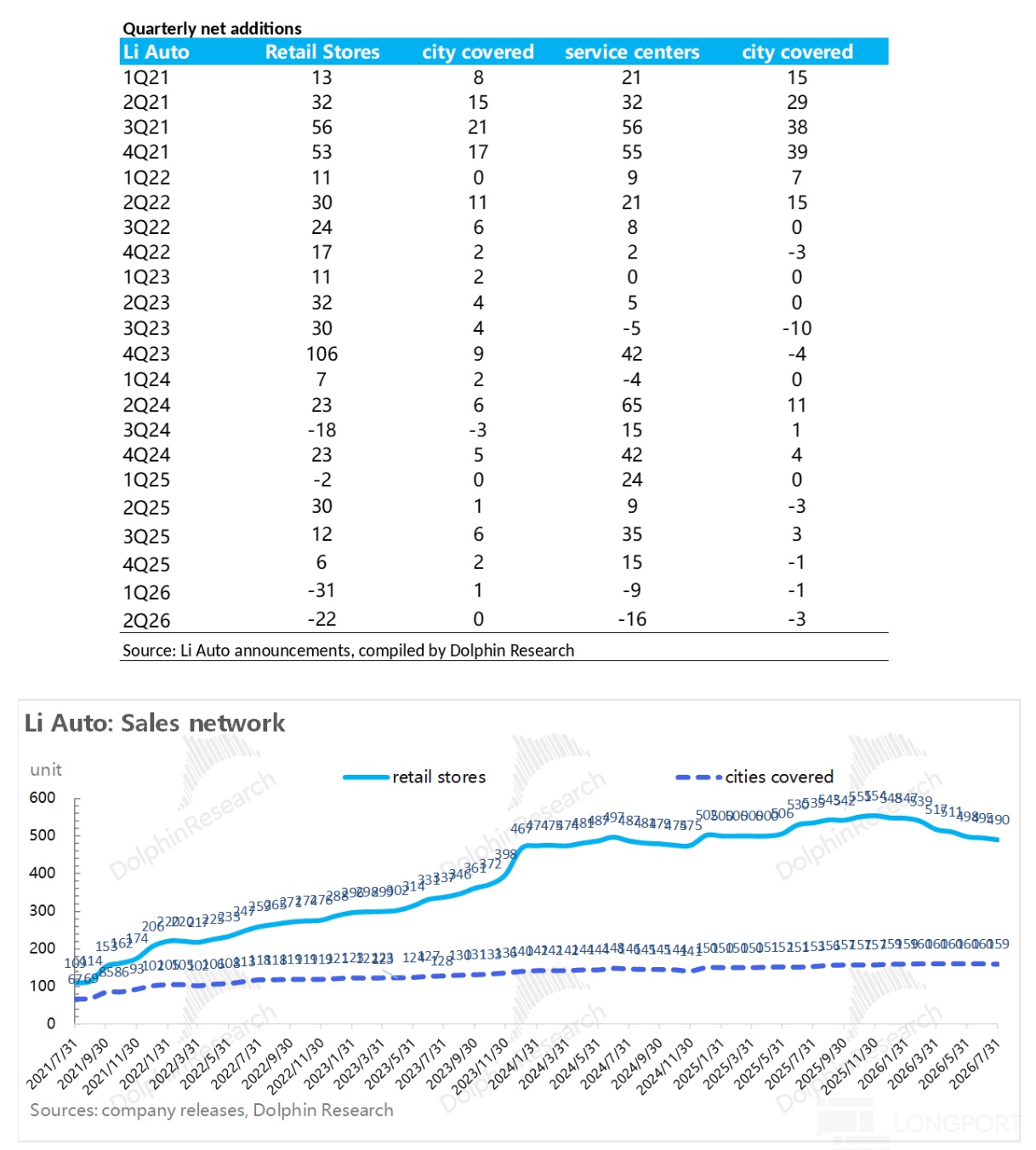
R&D expense edged up QoQ to RMB 2.78bn and S&M expense to RMB 2.28bn, reflecting org. optimization, headcount trimming (approx. 15% attrition in direct-sales frontline) and a shift from expansion to operational excellence (net reduction of 38 retail and service centers). This helped the quarter just meet profit expectations, but it does not offset the drag from stagnant volumes and intensifying share battles, which ultimately drove a sharp cut to the Q3 outlook.
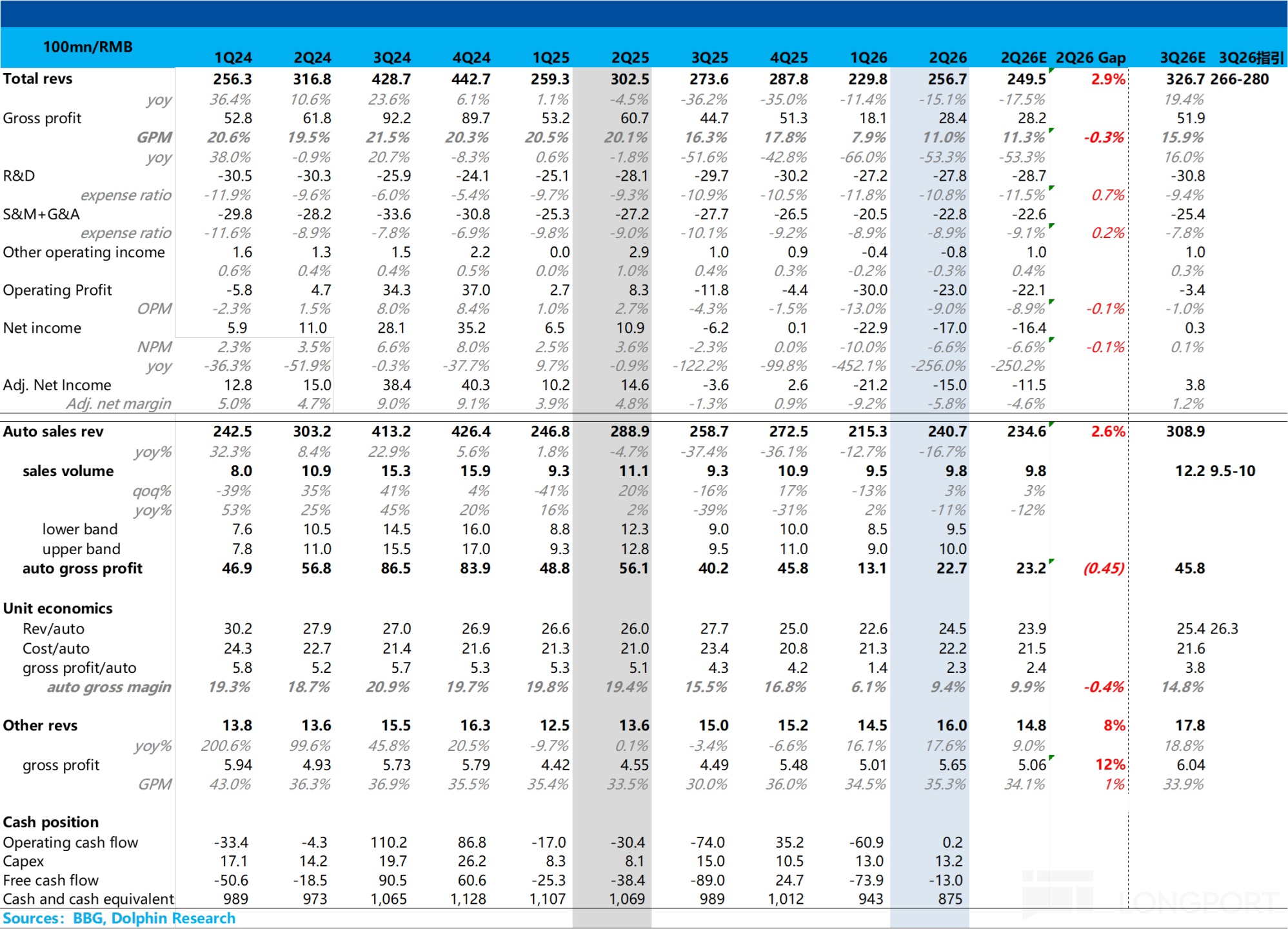
Overall, Q2 results were not the core issue. Auto GPM of 9.4% was slightly below the 10% guide due to higher upstream costs, while ASP beat on mix (higher L9, lower L6) and the rollback of i6 promotions. Revenue beat expectations, and with disciplined opex, profitability barely met the bar.
The disappointment lies in the Q3 guide, with both volume and revenue underwhelming:
a) Volume guide below expectations, indicating muted orders for refreshed L6/L8
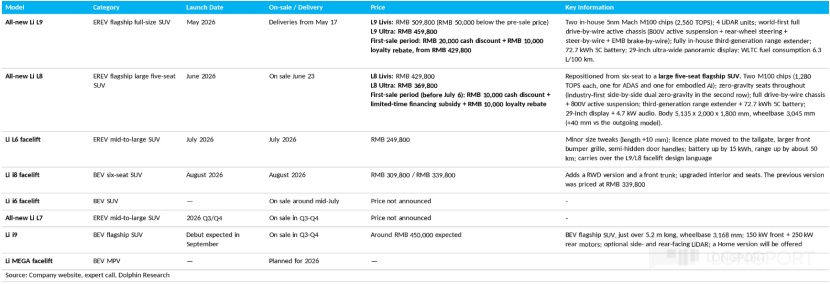
The Q3 delivery guide of 95–100k units implies no QoQ growth versus Q2’s 98k. This misses the market’s 122k expectation despite a dense refresh cycle for the L family and concurrent i family facelifts (L9 on May 15, L8 on Jun 23, new L6 in Jul, and refreshed i8 in Aug).
The core reasons: orders for the refreshed L6/L8 are lukewarm, limiting the uplift from the new model cycle. Even the mass-volume L6 refresh is not driving a rebound, and it is cannibalizing the brand’s BEV i6 to some extent. Meanwhile, competition in large range-extended SUVs is intense, with rivals crowding the RMB 250k–350k band, and the purchase tax rollback further compressing growth headroom.
b) Revenue guide also disappoints
Q3 auto revenue guidance of RMB 26.6–28.0bn is well below the market’s RMB 32.7bn, fundamentally reflecting the weaker volume guide.
However, the implied ASP of RMB 263k continues to rise by nearly RMB 20k QoQ from RMB 245k. This is driven by mix upgrades from the refreshed L9 and L8, with a lower mix from the more affordable i6, and also underscores the modest order intake for the refreshed L6.
Looking across full-year 2026:
① A dense slate of full refreshes for the L series and facelifts for the i series, with the flagship BEV i9 to follow
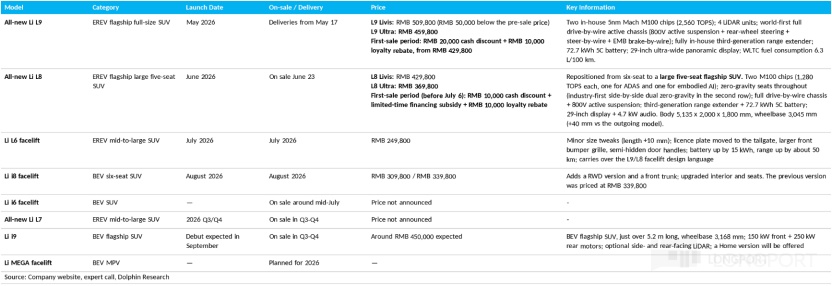
Li Auto has refreshed the L9 (May 15) and L8 (Jun 23), launched the new L6, and rolled out the refreshed i8 in Aug. Next, it plans to introduce the large SUV L7, essentially a better-equipped, lower-priced version of the former six-seat L8 to move below RMB 300k, forming a high-end duo with the L6 and potentially boosting volumes. The flagship BEV i9 is slated for H2 2026 and should support volumes incrementally.
Based on the released L-series refreshes, the 2026 product playbook follows a ‘more features, steady pricing + streamlined focus’ approach:
a) More features with pragmatic pricing: For the new L9, the Ultra is priced at RMB 459.8k (up RMB 20k vs. prior, with larger spec upgrades), while the Livis is RMB 509.8k (down RMB 50k vs. presale). The L8 Ultra starts at RMB 369.8k, down RMB 30k. The i8 adds an entry variant around the RMB 300k level and, with launch-period cash incentives, offers a more competitive effective price.
b) Fewer SKUs, sharper product focus: L8 moves from six seats to five, L7 from five seats to six, forming two lines: the flagship series (L9 six-seat + L8 five-seat, >RMB 300k) and the high-end series (L7 large six-seat + L6 large five-seat,
c) Fixing gaps:
Battery and range upgrades: L9/L8 now standardize a 72.7kWh 5C fast-charging pack, with CLTC EV range at 420km (+50% vs. prior). L6 adds a 51kWh variant, with CLTC EV range at 300km (+42%).
New range extender system: L9/L8 adopt the 3rd-gen in-house extender, cutting L9’s WLTC fuel consumption in charge-sustaining mode to 6.3L/100km.
Handling upgrades: steer-by-wire active chassis + 800V active suspension + EMB brake-by-wire, front travel compressed ~30mm, rear extended ~40mm, turning radius shortened to 5.1m, addressing prior handling pain points of the L family.
d) Reinforcing strengths: In-house M100 chip (5nm, 1,280 TOPS per die at half the cost of external chips), the VLA foundation model, and zero-gravity seats to differentiate while lowering cost.
② The AI investment strategy remains intact:
a. In-house compute base is in production: the 5nm ‘Mach 100 (M100)’ chip is now mass-produced, delivering up to 2,560 TOPS per vehicle with a dual-die setup. It is equipped on L9/L8/L6, and the VLA model is planned to be standard across the lineup in 2026.
b. Cross-over embodied intelligence: R&D is extending into ‘spatial robots’, integrating the base model, in-house chips and a robotics OS. The first two-wheeled embodied robot could debut in 2026 per market chatter.
From the current share price setup:
The company maintained a 2026 delivery growth target of 20%+, or about 480k units, with incremental contributions from three areas: ① comprehensive L-series refreshes; ② i8/i6 facelifts, with i6 having a full-year delivery cycle; ③ the new flagship BEV i9 (H2 launch).
But the Q3 guide signals orders for the refreshed models are below plan, particularly for the volume-oriented L6. Competition is intensifying with multiple rivals launching large range-extended SUVs targeting the L series across RMB 250k–350k, while the purchase tax rollback is a negative industry beta. The i9 is a brand and tech halo, not a volume driver, limiting its ceiling.
Based on the guide, total deliveries for the first three quarters of 2026 are only 283k–293k (-1.4% to -4.8% YoY). Dolphin Research estimates full-year deliveries at just 420k–430k, up only 3–6% YoY, far below the 20%+ company target.
On revenue, with higher-priced models (refreshed L9/L8) gaining share and i6 remaining stable, full-year ASP should recover to around RMB 250k as mix improves. Adding other revenue (charging network, parts and services, etc.) of roughly RMB 6.9bn, total revenue is estimated at RMB 111.9–114.4bn.
Given ample cash on hand (approx. RMB 91.7bn) and concurrent progress in embodied intelligence (M100, VLA AD model, humanoids), under a neutral case we assign 0.8x 2026 P/S, implying a fair mkt cap of RMB 89.5–91.5bn. This is broadly in line with the current US mkt cap of RMB 88.3bn.
Detailed analysis follows:
With deliveries already disclosed, the key incremental datapoints are: 1) Q2 auto GPM, and 2) Q3 2026 outlook.
I. Auto GPM slightly below guidance
On the core auto biz: management had guided Q2 auto GPM to recover to 10% from 6% in Q1, driven by ① removal of the RMB 15k purchase tax cash subsidy on i6, and ② mix upgrade from higher-margin L9/L8 launches.
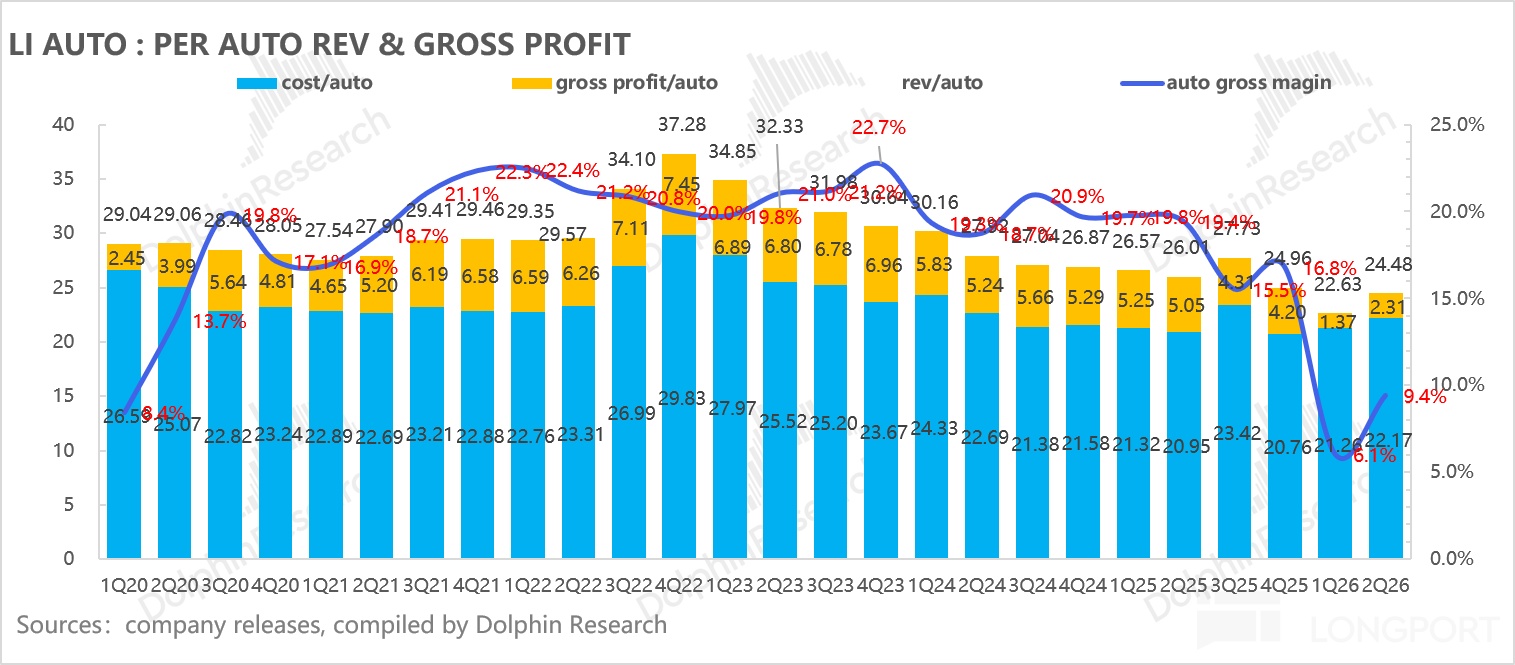
Actual Q2 auto GPM was 9.4%, up 330bps QoQ from 6%, but slightly below guidance, mainly due to rising costs limiting margin release.
(Note: Q2 2022 auto GPM excludes >RMB 800mn contract loss impact; Q2 2023 auto GPM excludes RMB 400mn warranty reserve.)
From a unit economics perspective:
1. ASP rose more than expected QoQ, driven by mix and fewer promotions
Q2 ASP was about RMB 245k, up roughly RMB 20k QoQ and above the market’s RMB 239k. The QoQ increase was mainly due to:
① Mix upgrade
Lineup mix improved: the new L9 (RMB 459.8k/509.8k) started deliveries in May, lifting its share by about 5ppt QoQ to 9%. The lower-priced L6 (about 19% in Q1 2026) fell by about 7ppt QoQ to 12%, as the July L6 refresh caused buyers to postpone purchases, temporarily reducing L6’s Q2 share.
② Discount rollback
After the new L9/L8 launch, Li Auto withdrew part of the legacy model discounts, and narrowed i6 terminal promotions by removing the RMB 15k purchase tax cash subsidy. Both factors supported the QoQ ASP uplift.
2. Unit cost rose by RMB 10k QoQ as upstream inputs kept a lid on margin expansion
Q2 unit cost was about RMB 222k, up roughly RMB 10k QoQ, mainly because:
① Scale efficiency did not materialize: Q2 deliveries were 98k, up only ~3% QoQ from a low base and down ~11% YoY. This was tepid despite two major mid-cycle refreshes (L9/L8) in Q2, partly as L9 underperformed expectations and buyers waited for the new L6, depressing L6’s QoQ sales.
② Input costs continued rising: Li Auto faced higher prices for memory, commodities and batteries. The i6’s target margin was 15%, but sustained increases in key components such as memory cut overall GPM by about 300–400bps, and management acknowledged the material cost impact from memory chips and other core parts.
3. Unit GP reached RMB 23k in Q2, up about RMB 9k QoQ
Unit profit improved to roughly RMB 23k from ~RMB 14k in Q1, mainly driven by the ASP rebound as new L9/L8 lifted ASP from RMB 226k to RMB 245k.
That said, reported auto GPM remained about 9.4%, down roughly 10ppt YoY and far below the prior ~20% healthy level. With purchase tax rollbacks dampening demand, rising memory and raw material costs eroding profits, and intensifying competition in range-extended SUVs, the sales profitability backdrop remains challenging.
II. Q3 volume and revenue guidance both disappointed
a) Volume guide below expectations, suggesting muted orders for refreshed L6/L8
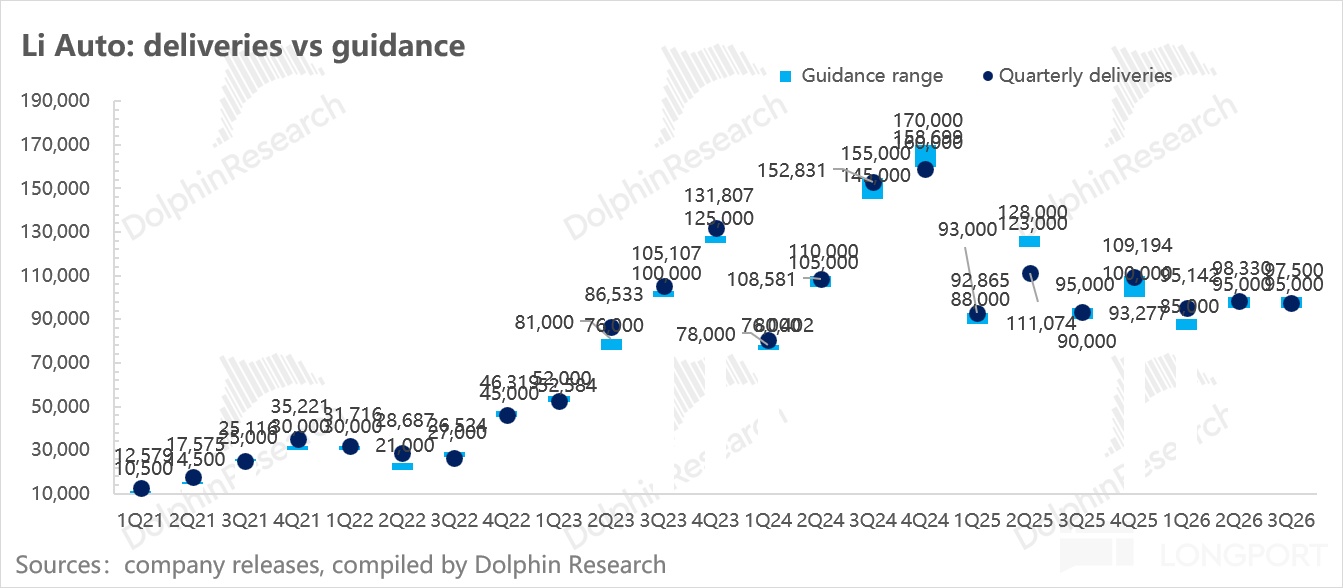
Q3 deliveries are guided at 95–100k, well below the 122k market view, and flat vs. Q2’s 98k despite a dense mid-cycle refresh across the L family and i family facelifts.
With 30k units delivered in Jul, the guide implies Aug/Sep monthly avg. of 32–35k. Despite L9 (May 15), L8 (Jun 23) and L6 (Jul 16) refreshes, Jul deliveries were 30,468 units, down 1% YoY/QoQ and below expectations, mainly due to a temporary headlamp component supply disruption for the i6 that cut about 4,000 units vs. plan in mid-to-late Jul.
Moreover, the L9 refresh has yet to show a sustained pull-through, with Jul sales down QoQ. The underwhelming Q3 guide likely reflects average order intake for the refreshed L6/L8, particularly the volume-oriented L6, and some cannibalization of the i6 post the L6 refresh. Overall, the new model cycle is providing limited volume lift, and sales pressure remains heavy.
b) Revenue guide also disappointed
Q3 auto revenue guidance of RMB 26.6–28.0bn is far below the street’s RMB 32.7bn, primarily due to the delivery miss vs. expectations.
The implied ASP of RMB 263k is up nearly RMB 20k QoQ from RMB 245k, driven by mix upgrade from refreshed L9 + L8, with a lower contribution from the lower-priced i6. This also signals mediocre orders for the refreshed L6.
III. Opex control remains acceptable
1) R&D: only a modest QoQ increase
Q2 R&D was RMB 2.78bn, up just RMB 60mn QoQ from RMB 2.72bn and below the market’s RMB 2.87bn. Management’s prior 2026 full-year R&D guide of RMB 12.0bn (+6% YoY) is likely to be revised, with spend focused on:
a. Front-loaded investments for a dense new model cycle: gearing up for a product-heavy 2026, spanning full L-series refreshes (L6, L7, L9, etc.), i-series facelifts (i8, i6) and the all-new full-size BEV SUV i9.
b. Continued ‘All in AI’ spending: AI was the largest R&D item in 2025 at over RMB 6.0bn, more than half of total R&D of RMB 11.3bn. For 2026, AI is still expected to account for roughly half of R&D, with three pillars:
① In-house compute base: the 5nm ‘Mach M100’ chip is in mass production, delivering 1,280 TOPS per die and up to 2,560 TOPS per vehicle with dual-die. It is deployed on refreshed L9/L8/L6, with the VLA model to be standard across the lineup in 2026.
The MindVLA parameter count is up 10x vs. the prior version, and together with M100 aims to materially improve AD performance, with more human-like decisions and smoother longitudinal/lateral control in complex scenarios. Next steps include scaling input data and precision and enhancing short-term causality understanding, with a target to match Tesla FSD v14 performance in the US by H2 this year.
② Embodied intelligence: R&D extends to ‘spatial robots’, integrating the base model, in-house chips, and a robotics OS. Management likens the current stage of robotics to NEVs circa 2010–2015, with at least 3+ years to large-scale commercialization and many unresolved hard-tech problems.
③ Pushing to L4 AD: L4 is framed as the core capability of ‘spatial robots’, with a latest-by 2028 target for L4 deployment.
2) S&M up QoQ but overall under control
Q2 S&M was RMB 2.28bn, up about RMB 230mn QoQ from ~RMB 2.05bn and broadly in line with expectations. The increase reflected back-to-back L9/L8 refresh launches and related marketing, while overall control remained solid due to:
a. Org. optimization and headcount trimming: salesforce optimization in direct channels led to about 15% attrition, reducing payroll costs.
b. Channel strategy shifted from expansion to focus: Li Auto proactively rationalized lower-efficiency stores to cut costs, with a net reduction of 22 retail centers and 16 service centers in Q2.
IV. Revenue declined YoY again
With deliveries known, Q2 total revenue was approx. RMB 25.7bn (-15% YoY), above the street’s RMB 25.0bn.
Auto revenue was RMB 24.1bn (-17% YoY), above the street’s RMB 23.5bn. The decline reflects both lower deliveries (-11% YoY) and lower ASP (-6% YoY), showing that even with lower-priced volume models (L6/i6) and heavier promotions on legacy L models, purchase tax rollbacks and fierce competition still weighed on volumes.
Other revenue was RMB 1.6bn, beating the RMB 1.48bn estimate and up 18% YoY, driven by a growing vehicle base that boosted parts and service sales.
Overall GPM was 11.0%, slightly below the street’s 11.3% but up 310bps QoQ, mainly thanks to the rebound in auto GPM to 9.4% (+330bps QoQ) on higher ASP. Other biz GPM was ~35.3%, up ~80bps QoQ, likely benefiting from scale effects as the installed base grows and a higher mix of high-margin repair, maintenance and parts.
V. FCF still negative but liquidity remains solid
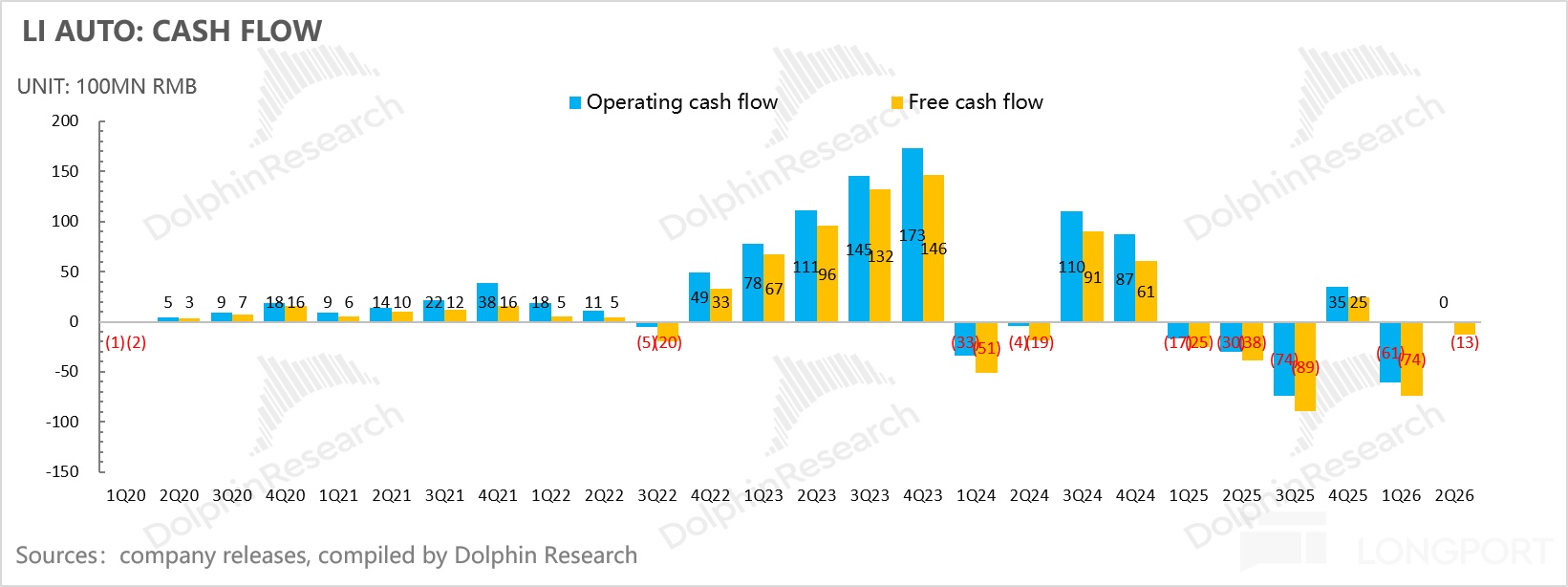
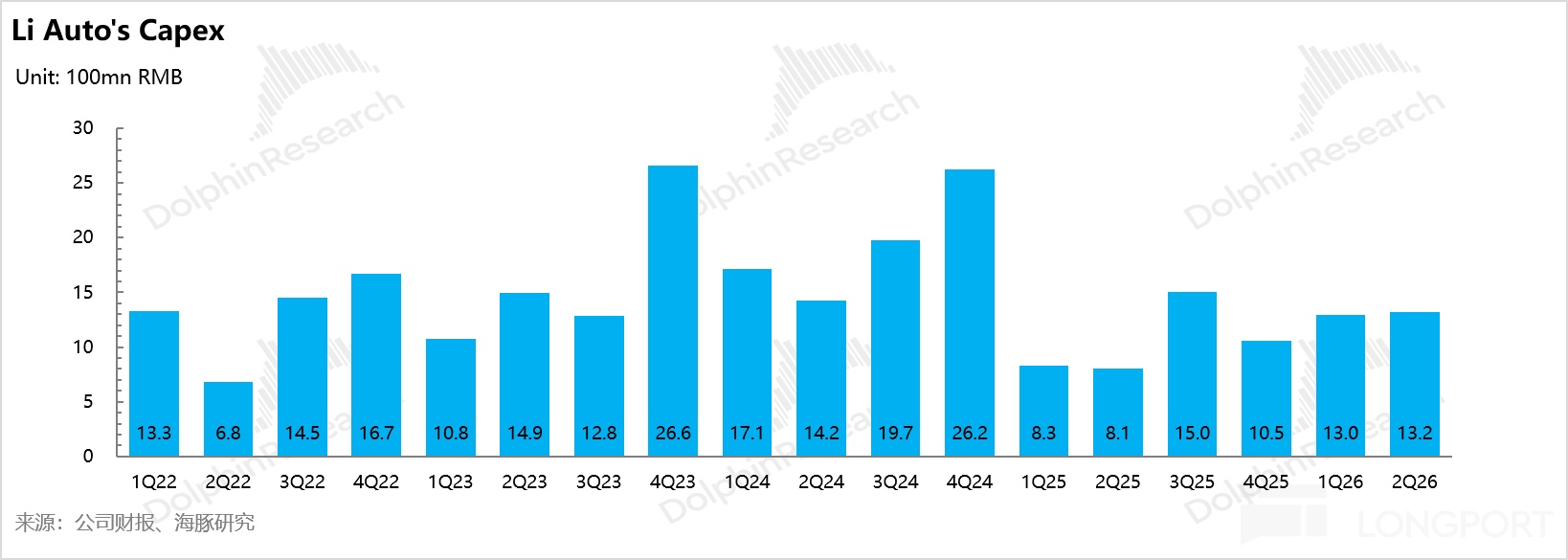
Operating cash flow was RMB 20mn in Q2, up about RMB 6.1bn QoQ, driven by margin recovery, better net profit and increased payables/prepayments. Capex was stable QoQ at RMB 1.32bn, resulting in FCF of -RMB 1.3bn, an improvement of about RMB 6.1bn QoQ.
Even so, cash remains ample. As of Q2-end, cash and cash equivalents were RMB 85.6bn (net cash RMB 80.3bn), keeping near-term liquidity risks manageable and supporting the upcoming model cycle and AI investments.
<End here>
Dolphin Research historical articles for reference:
Earnings reviews:
Sept 28, 2025 i6 launch review: Li Auto (with transcript): i6 orders took off, so why did the stock sell on the news?
Aug 28, 2025 earnings review: Li Auto: Range extenders are aging, pure EVs are tough — can i6 turn the tide?
Aug 28, 2025 call transcript: Li Auto (Q2 2025 Trans): back to a single-SKU blockbuster strategy
Aug 9, 2025 i8 launch review: Li Auto: rapid U-turn on i8, yet still not enough to save the day?
Deep dives:
Jun 24, 2025: Aito vs. Li Auto: two champions — who wins?
Jun 25, 2025: Seres vs. Li Auto: who is the destined ‘BBA’ of China-made cars?
Risk disclosure and disclaimer: Dolphin Research disclaimer and general disclosure


The copyright of this article belongs to the original author/organization.
The views expressed herein are solely those of the author and do not reflect the stance of the platform. The content is intended for investment reference purposes only and shall not be considered as investment advice. Please contact us if you have any questions or suggestions regarding the content services provided by the platform.