
The robot track is too hot, and the battery king of Huizhou has also entered the arena
 I'm LongbridgeAI, I can summarize articles.
EVE Chairman Liu Jincheng heavily bets on the AI robotics sector, promoting the vision of "robots making batteries for robots." The company's stock price surged over 13% due to a projected performance increase of 95%-110% in the first half of 2026, with a market value exceeding 140 billion. The energy storage business has become the core of growth, with significant year-on-year increases in the shipment volumes of power batteries and energy storage batteries
As hot capital continues to flow into the AI and robotics sectors, Liu Jincheng, the former richest person in Huizhou and chairman of EVE Energy, can no longer hold back.
More than half a year ago, the headquarters of EVE Sodium Energy and the Jinyuan Robotics AI Center (hereinafter referred to as the "Jinyuan Robotics AI Center") officially broke ground. At the groundbreaking ceremony, Liu Jincheng clearly identified AI as the definitive main line of the new industrial cycle, believing that the traditional manufacturing phase has basically come to an end. He pointed out, using the valuation logic of GPU companies as an example, that under the same revenue scale, the capital market premium for AI-related businesses is far higher than that of the traditional manufacturing sector.
Regarding EVE Energy's new direction, Liu Jincheng proposed to make "robots manufacturing batteries for robots" a long-term vision, aiming to reconstruct the lithium battery manufacturing paradigm with intelligent production lines. Xiao Gang, director of the Jinyuan Robotics Research Institute, also publicly stated that AI robots have been elevated to a strategic level within the company, with no hard budget limits set for related R&D investments.
The attitude is resolute, and the actions are swift. More than a month ago, EVE Energy increased the registered capital of its wholly-owned subsidiary Jinyuan Robotics to 33 million yuan, a staggering increase of 1000%.
Behind this heavy bet is Liu Jincheng's dual logic: on one hand, upgrading lithium battery manufacturing comprehensively with AI, pursuing the vision of robots manufacturing batteries for robots; on the other hand, relying on the practical data from ultra-large-scale battery factories to feed back into the iteration of AI technology.
However, the pressure of reality cannot be ignored. Wind data shows that from 2023 to 2025, EVE Energy's annual net profit attributable to the parent company has remained around 4 billion yuan, with no breakthroughs for three consecutive years. However, the situation seems to have improved recently, as EVE Energy's performance forecast indicates that in the first half of 2026, the company's net profit attributable to the parent company is expected to grow by 95.00% to 110.00% year-on-year, reaching 3.13 billion to 3.37 billion yuan, equivalent to 80% of the total profit for 2025.
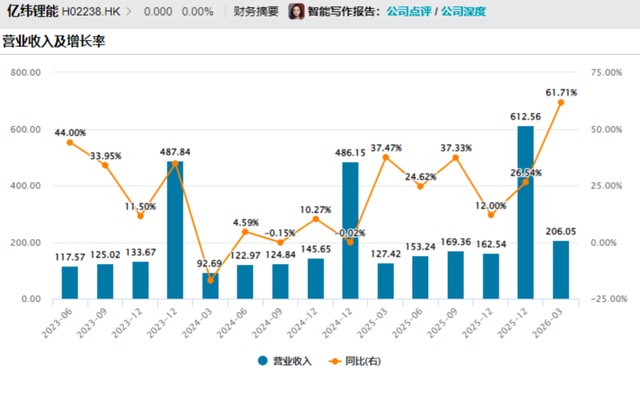
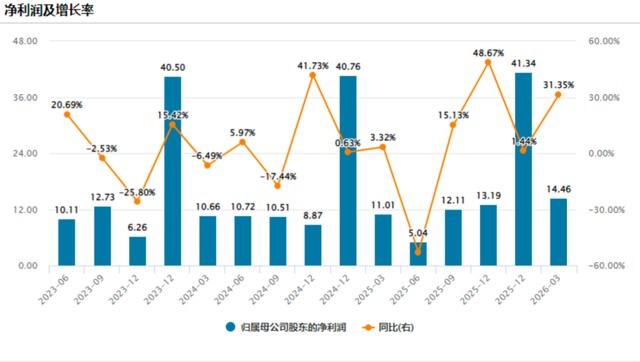
Image source: Wind
The day after the news was announced, EVE Energy's stock price opened up over 13%, with a market value exceeding 140 billion yuan, and Liu Jincheng's wealth also surged accordingly. In recent years, Liu Jincheng and his wife have consistently appeared on the Hurun Rich List, becoming the richest person in Huizhou in 2024 with a fortune of 33 billion yuan.
The core engine driving EVE's performance this time is the company's energy storage business.
In the first quarter of 2026, EVE's shipments of power batteries and energy storage batteries increased by 40.93% and 60.82% year-on-year, reaching 14.34 GWh and 20.38 GWh, respectively. The energy storage shipments also surpassed power batteries for the first time.
According to Dongxing Securities' forecast, in the second quarter, the company's power battery and energy storage battery shipments are expected to be 15 GWh+ and 25 GWh+, respectively. On the investor platform, EVE also clearly responded that the orders for the energy storage business are full, with full production and sales.
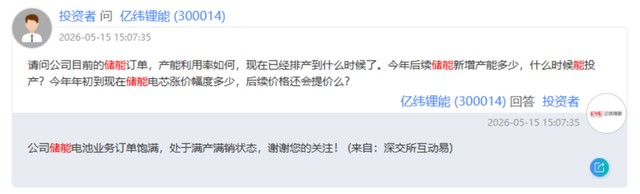
Image source: Investor Relations Interactive Platform
On one side, there is a surge in performance, and on the other, an increased investment in the hot robotics sector. This lithium battery giant seems to have found a new growth pole.
Not Just an Ordinary Robot Manufacturer
In May this year, EVE announced that it would use its own funds of 30 million yuan to increase its investment in its wholly-owned subsidiary Huizhou Jinyuan Intelligent Robot Co., Ltd. (hereinafter referred to as "Jinyuan Robotics"). The registered capital of Jinyuan Robotics jumped from 3 million yuan to 33 million yuan, an increase of 1000%.
The reason given by the company is to meet the funding needs for Jinyuan Robotics' operational development and enhance its sustainable development capabilities.
From a business scope perspective, Jinyuan Robotics covers the entire industry chain of intelligent robot research and development, AI system integration, and industrial robot installation and maintenance, demonstrating EVE's determination to deeply cultivate this sector rather than just riding the short-term trend.
Interestingly, just over a month after the capital increase, the company announced a performance forecast, which immediately ignited the market. Clearly, EVE may want to leverage the cash flow from its energy storage business to accurately support the robotics sector and lock in the next battlefield in advance.
If this round of capital increase is "logistics in advance," then the project commenced at the end of 2025 signaled the company's determination to officially sound the horn for entering the robotics sector.
At that time, the AI center of Jinyuan Robotics officially broke ground at EVE's Huizhou headquarters District D. The project is planned to have a construction area of 90,000 square meters for the sodium battery sector and 50,000 square meters for the AI and robotics sector. This center encompasses the entire production process from research and development to final assembly, with "robotics + generative AI" as the dual core driving force.
As previously mentioned, Liu Jincheng has stated that we are currently in the era of AI and aims to fully realize "robots making batteries for robots."
This statement may seem simple, but it carries significant implications.
It can be said that EVE has never intended to be just an ordinary robot manufacturer; it does not follow the trend of crowding into the general robotics market for To C and To B, but instead positions robots as the core production tool for its intelligent manufacturing. This approach of defining products based on scenarios constitutes the essential difference between EVE and general robot manufacturers like Yushu Technology and Zhiyuan Robotics General robotics manufacturers are mostly driven by technology, first launching bipedal and quadrupedal hardware platforms, and then exploring commercialization possibilities in various potential scenarios, focusing on versatility and imagination. EVE, on the other hand, views its vast lithium battery production line as a natural testing ground, breaking down requirements around inspection, operation and maintenance, and transportation, and then customizing the performance indicators and structural plans of robots accordingly.
In other words, while peers are still searching for practical scenarios, EVE has already established a complete closed loop from problem identification to model iteration internally.
Not only is the approach different, but the business logic is also distinct.
Companies like Yushu make money by selling robotic hardware, while EVE primarily uses robots to reduce costs and increase efficiency, selling batteries cheaper and in greater quantities. However, its ambition goes beyond this; in its internal planning, the robotics business is broken down into a clear three-step path: first entering the core component segment, then extending to complete machine integration, and ultimately evolving into a supplier of intelligent solutions for industrial scenarios.
This means that EVE can supply high-performance batteries and key modules to other robotics manufacturers on one hand, and on the other hand, it has the capability to provide integrated solutions of "production line + robots," packaging and delivering battery systems with automation equipment. Compared to single hardware sales, this comprehensive service model covering energy supply and production execution is considered to have greater influence in the industrial chain and a moat effect.
Currently, EVE has iterated seven major series of robots, including bipedal, wheeled, and heavy-duty types, capable of adapting to full-scale production scenarios from small batteries weighing a few grams to bulk materials weighing tons.
According to the plan, EVE will officially launch its first robot product in 2026, prioritizing deployment in its own factories to undertake core tasks such as production line inspection, equipment operation and maintenance, and material handling. At the same time, it will initiate its overseas expansion plan.
Hitting Every Super Trend
Those familiar with EVE's development history know that this company, or rather Liu Jincheng, can definitely be called the "King of Trends."
In 2001, founder Liu Jincheng resigned to establish the predecessor of EVE, coinciding with the rise of mobile communications in China. The boom of PHS came quickly, and Liu Jincheng sold over 20 million mobile phone batteries as a result.
Subsequently, with the wave of smart meter proliferation, the company quickly rose to prominence with batteries specifically for meters, securing its position as a leader in the niche market.
Before the electronic cigarette trend emerged, the company preemptively invested in Microwell, seizing industry dividends.
During the nationwide ETC (Electronic Toll Collection) popularization phase, the company rapidly laid out its strategy, capturing over 70% of the market share, nearly monopolizing the sector.
When TWS (True Wireless Stereo) earbuds became popular worldwide, the company developed its own Jin Dou battery, breaking through overseas patent barriers and successfully entering Samsung's core supply chain.
Looking back at all past trends, EVE has never been a latecomer; each layout has been three to five years ahead of the industry. Core businesses like ETC and TWS batteries have been developed more than five years ahead of the industry.
In 2015, as the new energy vehicle trend began to rise, EVE established Hubei EVE Power, fully betting on power storage batteries, reaching a critical turning point for capacity expansion in 2021.
Today, EVE has formed a collaborative structure of three major businesses: consumer batteries, power batteries, and energy storage batteries, with lithium primary battery sales and exports ranking first globally for ten consecutive years, and energy storage battery shipments projected to be second globally by 2025 The company's current robot layout continues the previous path: Jinyuan Robotics has long been a equipment supplier for EVE, accumulating over a decade of manufacturing experience, hundreds of production line data, real-world training grounds, and over 150 patents, indicating that it has regarded robots as a key to growth in the next five years.
A closer look at EVE's layout reveals a clear business closed loop: the energy storage business contributes stable cash flow, supporting robot research and development; the R&D results feed back into the intelligentization of production lines, reducing manufacturing costs, improving yield rates, enhancing battery competitiveness, and driving order and profit growth; profits are reinvested into robots, forming a positive cycle of "capital allocation - efficiency improvement - performance realization - reinvestment."
The core barrier lies in the fact that lithium battery production lines themselves are the most authentic high-frequency testing grounds for robots, a scenario advantage that most startups do not possess. At the same time, EVE integrates its electrochemical accumulation into robot R&D, addressing the pain points of industrial robots being space-constrained and energy-intensive, working on a new generation of intelligent energy systems, aiming to improve single-charge endurance by about 50%, thereby widening the gap in underlying energy. Using batteries to nurture robots and using robots to strengthen batteries—this dual-driven approach is interlinked.
Looking back at EVE's development history now, it resembles a precise series of continuous predictions: PHS, smart meters, e-cigarettes, ETC, TWS earbuds, power batteries, energy storage... almost every time before an industrial explosion, we can see the chess pieces laid out in advance by Liu Jincheng.
The outside world often likes to describe Liu Jincheng's success as a "gamble," but perhaps "calculation" is more fitting—based on long-term deductions from the first principles of electrochemistry.
As the first self-developed robot is set to roll off the production line in 2026, a new closed loop is forming: using batteries to nurture robots, and then using robots to strengthen batteries.
This time, Liu Jincheng seems to have once again obtained an early entry ticket