
Price cuts to retain customers, betting on blockbuster hits, AI for survival: A mass exodus in the film and television i…
 I'm LongbridgeAI, I can summarize articles.
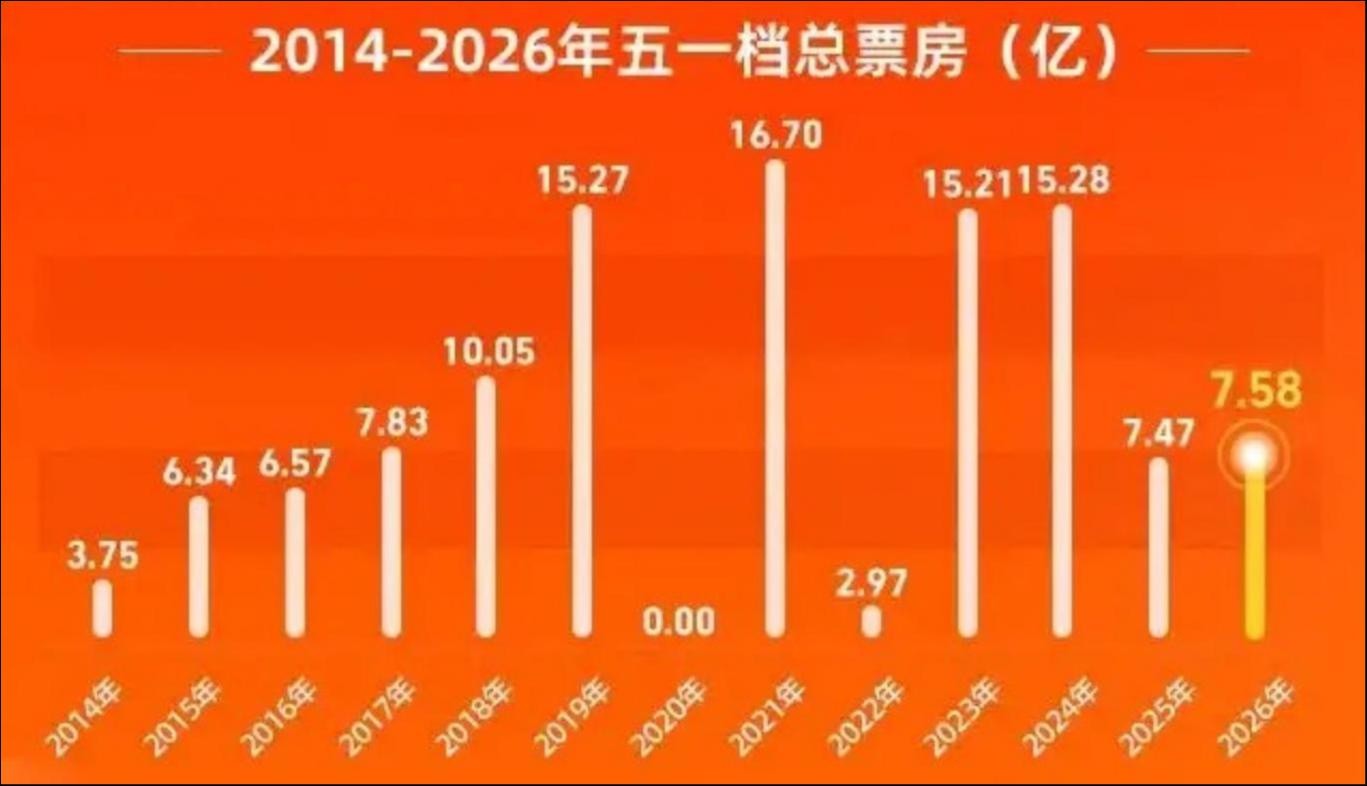
In the May Day holiday of 2026, the total box office of the film market was 758 million yuan, a slight increase compared to 2025, but nearly halved compared to 2024. Over 60% of A-share film and television companies reported losses, with Huayi Brothers accumulating losses of 8.5 billion yuan and a significant shrinkage in market value. The industry is facing systemic blood loss, capital market fluctuations, outdated content, and user attrition, urgently needing to reconstruct its profit model and capital structure
In the recently concluded May Day holiday of 2026, the total box office of the film market reached 758 million yuan. Although it saw a slight increase compared to the same period in 2025, it was nearly halved compared to 1.528 billion yuan in 2024. The number of moviegoers rebounded to 20.8419 million, but the average ticket price dropped to 36.3 yuan, hitting a four-year low. The market barely retained customers through "price reductions and promotions," with the overall market level retreating to the levels of ten years ago.
More chilling than the box office is the recently concluded earnings report season. Among more than a dozen A-share film and television companies, over 60% fell into losses. Huayi Brothers accumulated losses of 8.5 billion yuan over eight years, with its market value plummeting from a peak of 90 billion to less than 5.3 billion; Bona Film Group suffered losses of 1.464 billion yuan in 2025 due to the box office failure of "Operation Dragon"; established companies like Beijing Culture and Ciwen Media also struggled to escape the quagmire of losses.
Even Light Media, which saw a surge in 2025 thanks to "Ne Zha 2," experienced a more than 90% drop in revenue and net profit in the first quarter of 2026. A single blockbuster cannot mask the fragility of the business model, as the industry is sliding from occasional failures into systemic blood loss.
Meanwhile, the capital landscape of film and television companies is undergoing severe turbulence. Huayi Brothers has initiated a pre-restructuring process, and as of May 7, it was continuously acquired for three days by CITIC's Hengqin Tiansheng for 5.6 million shares; Huanrui Century is under a second investigation for information disclosure violations; Huace Film & TV has spent 3.3 billion yuan on cross-border computing power; Noon Sunshine aims to achieve a backdoor listing through Shaw Brothers; Wanda Film has officially changed its name to "Ruyi Film," completely bidding farewell to the Wang Jianlin era.
On one side is the retreat of capital and overwhelming debt, while on the other side are outdated content and user exodus—Chinese film and television stocks are standing on the eve of a deep reconstruction involving production logic, profit models, and capital structure.
Collective Blood Loss: Unable to Escape the "80/20 Effect" and Path Dependence
The widespread losses of film and television companies reflect the industry's shift from occasional box office failures to systemic blood loss.
The fall of Huayi Brothers is highly representative. Once the first stock in China's film and television entertainment industry, Huayi Brothers accumulated losses of over 8.2 billion yuan from 2018 to 2024, with revenue in 2025 only reaching 309 million yuan, a year-on-year decline of 33.43%. Its once Disney-benchmarked live entertainment segment generated only 169,800 yuan in annual revenue, nearly zero. Behind this is its failed gamble on diversification, the heavy burden of high premiums, and a comprehensive collapse of creative content and strategic judgment.
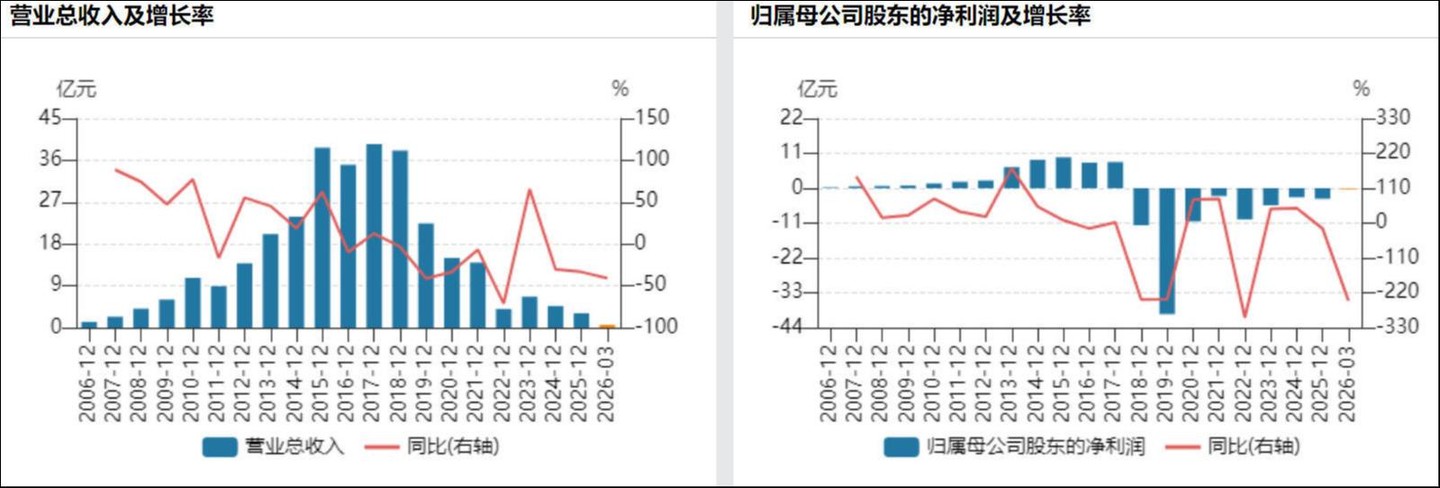 ST Huayi Financial Data
The drama "Zhu Yu," which has been commented on by state media as a "pre-made hit," has torn away the veil of Huayi Brothers. Although the show has topped the popularity charts, it has sparked controversy due to its unrealistic plot and the lead actor's exquisite makeup, which has led to ridicule as "Foundation General," resulting in a backlash against its reputation.
Bona Film Group is also deeply trapped in the "gambling on blockbusters" pitfall. In 2025, Bona Film Group invested in and released a total of 5 films, with only "Operation Dragon" being the main film. This film had an investment cost of up to 1 billion yuan, and its total box office from two releases was 428 million yuan, with the revenue share for the film side being about 145 million yuan, resulting in an overall loss of about 855 million yuan, making it the highest loss-making film of the year and dragging the company to a loss of 1.464 billion yuan in 2025, directly consuming years of accumulation.
Ciwen Media, which once established its industry position with top IPs like "Flower Thousand Bones" and "Princess Agents," is gradually exposing the hollowing out of its main business. In the first quarter of 2026, the company achieved revenue of only 2.475 million yuan, a significant decrease of 98.69% compared to 189 million yuan in the same period last year, with a net profit loss of 13.1328 million yuan. The reasons behind this include the continuous contraction of copyright procurement budgets by long video platforms, significantly weakening the company's bargaining power under the customized drama model; at the same time, the company's IP reserves are depleted, and its innovation capability is insufficient, making it difficult to adapt to current market demands.
The dramatic ups and downs of Light Media further expose the industry's fragility. In 2025, Light Media garnered a net profit of 1.672 billion yuan from "Ne Zha 2," a year-on-year increase of 472%; however, in the first quarter of 2026, when the hits disappeared, net profit plummeted to 23.2756 million yuan, a drop of 98.85%. Although "Fast and Furious Life 3" made it into the top ten box office history, its revenue contribution is vastly different from that of "Ne Zha 2."
The severe fluctuations in performance stem from the fact that the industry has long been firmly controlled by the "80/20 effect": top super blockbusters take away 70-80% of the box office, while mid-tier films quickly fall into obscurity, even going unnoticed. The cycle of "earning for one year and being idle for three years" has never so severely tormented the cash flow and talent confidence of various companies. In the cycle of losses and caution, film and television companies are even more reluctant to invest resources in content innovation, forming a self-locking vicious cycle.
External competition is also accelerating the diversion. The entertainment habits of young audiences have changed significantly, with short videos and AI short dramas aligning with the "instant gratification" trend of fragmented consumption, leading to a continuous decline in the attractiveness of long videos and cinemas.
A deeper underlying issue is the degradation of the quality of traditional film and television content and the loss of audience trust. Many series still rely on the outdated formula of "traffic stars + big flat light filter + time-traveling fantasy," with bloated plots, flat characters, and collapsed logic becoming the main areas of audience complaints. Under budget constraints, producers abandon originality, turning to reheating old content and chasing traffic, leading to a proliferation of homogenization
Fork in the Road: Restructuring, Cross-Border, Mergers and Acquisitions, Selling Out
In dire straits, various companies have taken vastly different paths to survival.
The pre-restructuring of Huayi Brothers is a hallmark case of this path. In April 2026, due to a delayed advertising debt of 11.4 million yuan, the Jinhua Intermediate People's Court decided to initiate a pre-restructuring process for Huayi Brothers, and the company's stock abbreviation was subsequently changed to "ST Huayi." Once the "king of film and television," it is now unable to repay even tens of millions in debt, which is quite ironic.
As of May 7, CITIC's Hengqin Tiansheng has consecutively acquired 5.6 million shares of ST Huayi for three days. The entry of the national team has given the market a glimmer of hope for a "white knight," but whether the pre-restructuring can successfully transition to formal restructuring and truly resolve the massive debts remains uncertain.
Against the backdrop of continued pressure on traditional main businesses, Huace Film & TV's layout in computing power holds considerable imaginative potential. On May 6, 2026, Huace announced plans to purchase servers from multiple suppliers, with a total contract amount not exceeding 3.3 billion yuan, a figure that surpasses the company's total revenue of 2.828 billion yuan for the entire year of 2025. By the end of 2025, Huace Film & TV's intelligent computing scale had reached 8000P, forming a preliminary commercialization system. In the first quarter of 2026, revenue from computing power business surged to 69.7371 million yuan, accounting for approximately 17.8%.
However, heavy asset investment also tests the company's operational capabilities. In 2025, Huace Film & TV had a net cash outflow of 1.329 billion yuan from investment activities, and in the first quarter of 2026, prepayments due to the procurement of computing power equipment surged by 149.89% year-on-year to 1.113 billion yuan; short-term loans also increased to 1.735 billion yuan, and financial expenses rose significantly due to expanded interest expenditures.
In January 2026, Hong Kong's Shaw Brothers announced plans to acquire a 50% stake in Noon Sunshine, a subsidiary of Huayi Culture, and other core assets for approximately 4.577 billion yuan. Noon Sunshine, known as the "quality ceiling" of domestic drama production, has produced benchmark works such as "Nirvana in Fire," "The Great River," and "The Story of the Sea and Mountains." The difficulty of independent capital operations has increased amid overall industry turmoil, and choosing to be acquired by Shaw Brothers can provide a larger capital platform and more stable resource support.
The fate of Wanda Film is even more dramatic. Wang Jianlin was forced to relinquish control of the film and television sector amid debt difficulties. In April 2026, "Wanda Film" was officially renamed "Ruyi Film Entertainment Co., Ltd.," and the Tencent group completed the acquisition of this massive asset, which includes over 700 cinemas and an 80 million member system.
Resurgence from Adversity: From Blockbuster Betting to Ecological Drive
In the face of the winter of the film industry, many companies are attempting to build new growth paradigms through IP operations, AI empowerment, and embracing short dramas.
In February of this year, Wang Changtian, chairman of Enlight Media, proposed the strategy of "Everything for IP" in an internal letter. He mentioned that Enlight Media has quietly initiated a transformation from a "high-end content provider" to a "creator and operator of IP" since March 2025, beginning to establish an IP-centered operational mechanism For many years, the box office revenue of mainstream Western film companies has accounted for only about 30% of total revenue, with 70% coming from copyright income, licensing income, merchandise income, and so on. In Wang Changtian's view, this model will gradually become the main survival model for Chinese film companies.
However, IP operation requires two prerequisites: one is a sufficiently strong initial IP reserve, and the other is a robust cross-media development capability. For companies already deep in losses and cash flow exhaustion, this path seems more like a "defensive battle for the rich" rather than a "lifeline for the poor."
Embracing AIGC and computational power infrastructure, Huace Film & TV's transformation provides a sample. However, it must be noted that for this model to work, the prerequisite is several years of continuous AI R&D investment and a clear business closed loop. For most film and television companies, a more realistic entry point is to use AIGC tools to reduce costs and increase efficiency.
Recently, the domestic first AI+ Sanxingdui sci-fi feature film "Sanxingdui: Future Past," produced by Bona Film Group, received the "Dragon Mark"; iQIYI launched the "Nadou Pro" platform and plans to increase the proportion of AIGC films to 50%. These cases indicate that AIGC is moving from marginal experiments to mainstream production.
"There are problems in traditional film and television production such as capital preemption, equipment stacking, process linking, and expensive trial and error, which lead to many good ideas being unable to be realized." Baodexi, co-founder of "Baodexi·iQIYI AI Theater," pointed out that AIGC has greatly lowered the creative threshold, allowing more stories that could not be filmed to finally be told.
Huayi Brothers, which has made stars like Yang Zi, Ren Jialun, and Cheng Yi, and produced "Liuli" and "Lianhua Building," has seen a lack of output in long dramas in recent years and has encountered core artists "leaving the nest." To seek new growth points, the company is betting on the short drama track. Its "Star Love Theater" and "Fenglin Theater" have built mini-programs and account matrices on platforms such as Douyin, WeChat, Kuaishou, Hongguo, and Pinduoduo, implementing a "free + paid" dual model.
Hengdian Film & TV has also adopted a cautious investment strategy for films, improving the "big horizontal and small vertical" brand system, and has launched multiple AI comic and short drama projects, adhering to a dual-line layout of "IP adaptation + original development," expanding content IP cooperation with platforms like Tomato and Qimao, and increasing the proportion of customized dramas on the platform.
However, the short drama track is already crowded with heavyweight players. Zhongwen Online is going strong overseas with ReelShort, iReader Technology is accelerating the IP conversion of AI comic and short dramas, and Huace Film & TV is promoting the strategy of "long drama IP feeding back short dramas." The short drama industry is rapidly transforming from a blue ocean to a red ocean, with competition intensity far exceeding expectations.
Regardless of which technological or capital path is chosen, one fundamental question remains unavoidable: why would audiences be willing to pay?
When the monthly active users of short dramas exceed 718 million and the average daily usage time exceeds 129 minutes, and when AIGC films flood the market at lower costs and faster speeds, the traditional film and television moat cannot rely on filters, traffic stars, or the "big production" shell.
Technology and capital are ultimately just tools. What is truly irreplaceable is compelling storytelling, three-dimensional characters, and emotional resonance that reaches the heart. Those life experiences that cannot be generated by algorithms may be the value anchor for the industry to navigate through the technological torrent Although the spring of 2026 is cold, for those willing to embrace change, the harsh winter is the best time to sow seeds. ( Source|Company Observation, Author|Ma Qiong, Editor|Cao Shengyuan)