

Chinese Hackers Spied On Cuban Embassy As Trump Ramped Up Blockade Threats
 I'm LongbridgeAI, I can summarize articles.
Chinese hackers reportedly breached the American Embassy in Cuba during a period of heightened tensions under President Trump, who threatened a naval blockade. The cyber firm Gambit Security found that the hackers compromised the emails of 68 officials, including the Cuban ambassador. This breach exploited vulnerabilities in outdated Microsoft Exchange servers and highlights ongoing cyberespionage amid geopolitical conflicts. The situation raises concerns about China's growing influence in Cuba and its implications for U.S. national security, as noted by House Intelligence Committee Chairman Rick Crawford.
In a story which hearkens back to bygone Cold War years, fresh reports say that Chinese hackers breached and spied on the American Embassy in Cuba at a moment President Trump threatened a US naval blockade, similar to what was in place just before the overthrow by US military intervention of Venezuela'sNicolás Maduro
According to the findings from the cyber firm Gambit Security, cited in a Bloomberg report, "The campaign began in January and compromised the emails of 68 officials, including the Cuban ambassador and the deputy chief of mission, researchers said."
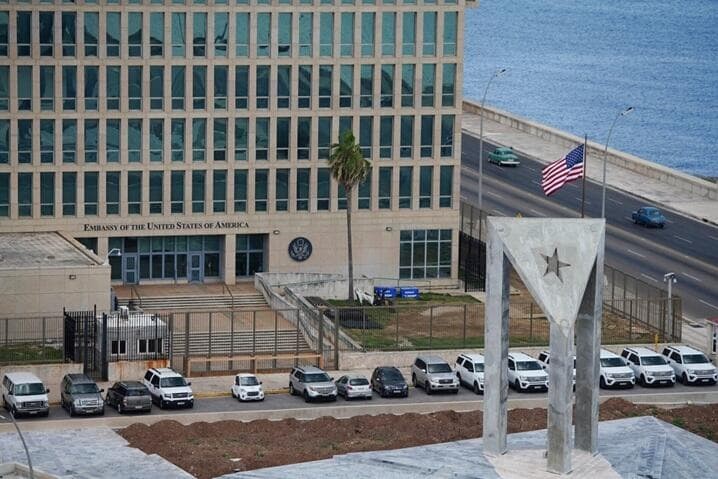
Additionally, "The breach coincided with a period of intense geopolitical friction, occurring shortly after a U.S. raid in Venezuela and roughly coincided with a decision byU.S. President Donald Trump's administrationto halt oil deliveries to Cuba, contributing to widespread blackouts across the country."
The report concluded that "The intruders bypassed embassy security by exploiting two 5-year-old vulnerabilities in outdated Microsoft Exchange email servers, according to the Gambit findings. Once inside, attackers downloaded entire inboxes belonging to political and intelligence officials."
The serious breach highlights the trend of cyberespionage still going hand in hand with fast moving geopolitical events and 'shadow wars' between great power rivals. Russia has also been accused of covert dealings in its longtime Caribbean outpost which lies just about 90 miles off Florida's southern coast.
China's aggressive push into Cuba has been sounding alarm bells since the Trump administration took power, with fears of covert surveillance operations targeting the United States, which also the establishment D.C. think tank Center for Strategic and International Studies (CSIS) has been highlighting. The fresh Bloomberg reporting seems to confirm this.
"The CCP’s poisonous alliance with Cuba has posed significant threats to US national security for decades," House Intellience Committee Chairman Rick Crawford (R-AK) told the media last year.
"Their alleged involvement in signals intelligence hubs in Cuba is outward, unconcealed adversarial behavior against the U.S. The CCP's actions are becoming increasingly more bold and thereby detrimental to Western Hemisphere security," he added.
— Sputnik (@SputnikInt) April 29, 2026🚨🇨🇳 China calls on US to lift blockade against Cuba
“China will strongly support Cuba in defending its state sovereignty and security,” Chinese Foreign Ministry spokesman Lin Jian stated
Earlier this year, the US tightened its longstanding embargo on Cuba, focusing on a… pic.twitter.com/W7qTBrIq1n
But from Beijing and Russia's perspectives, it remains simply that the United States continues as the biggest purveyor of covert ops, cyberespionage, and covert soft power initiatives and color revolutions the world over. Pro-Beijing pundits would likely rationalize that China too must become more adept with its cyberespionage if it hopes to protect its national interests abroad. But Washington would in turn accuse China of being the most guilty of these attacks.