

AAPL
310.0301.45%
D
7 hours ago
Xiaomi: Still Stuck—Can EREVs Save It?
 I'm LongbridgeAI, I can summarize articles.
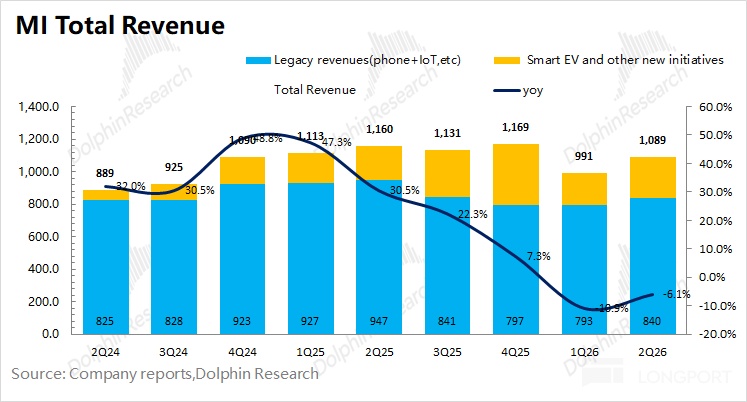
Xiaomi Corp. (1810.HK) released its Q2 2026 results (quarter ended Jun 2026) after the Hong Kong close on Aug 18 Beijing time, with the key takeaways as follows:
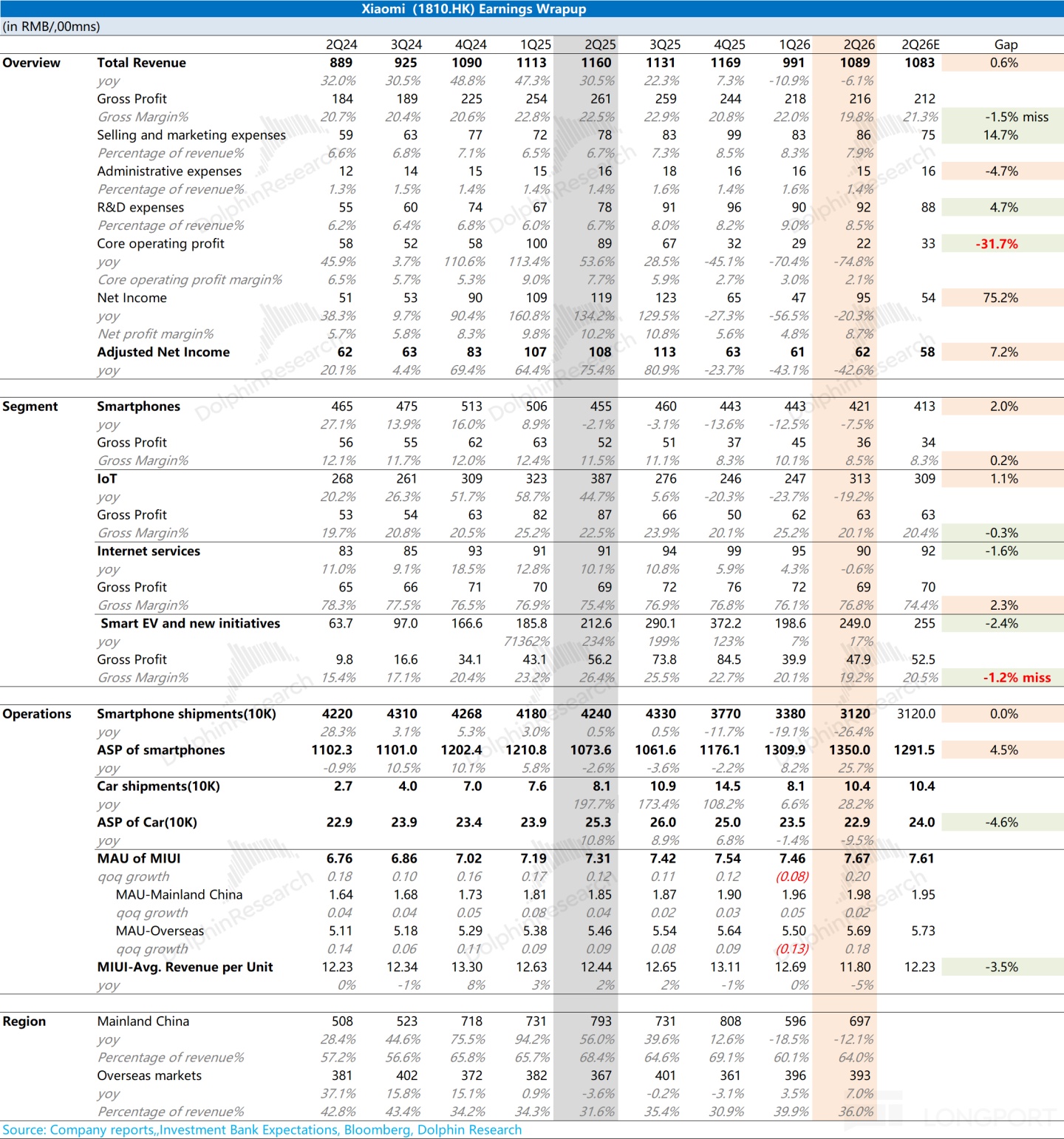
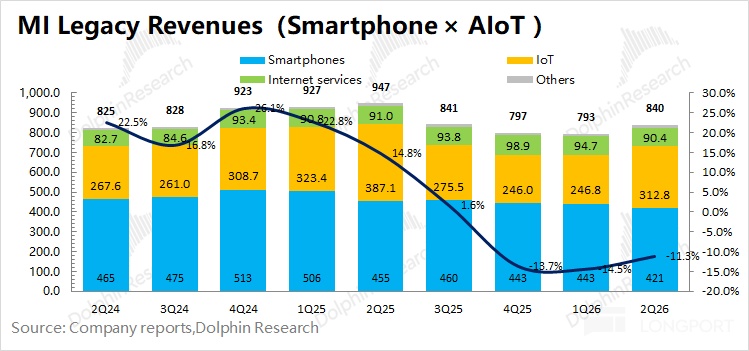
1. Overall results:$XIAOMI-W(01810.HK) revenue was RMB 108.9bn, -6% YoY, mainly weighed by legacy businesses such as smartphones. Traditional businesses (Smartphones x AIoT) fell 11% YoY this quarter.
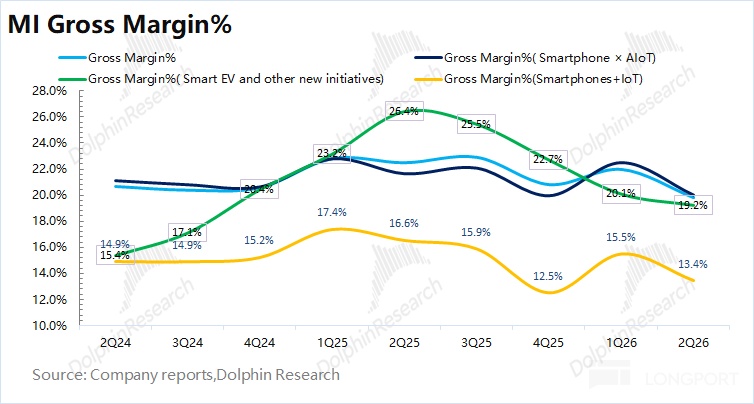
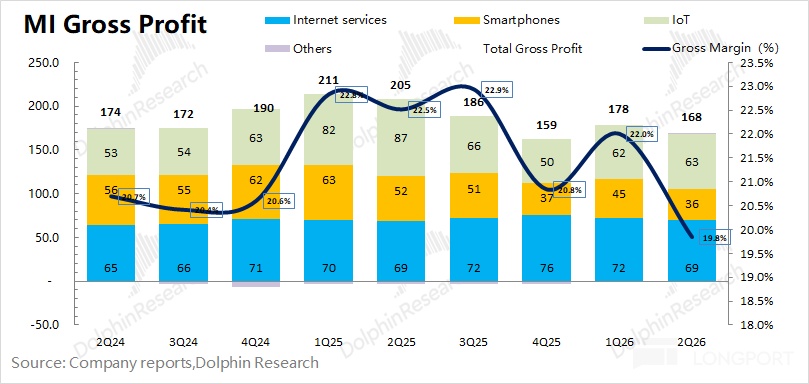
GPM was 20%, down 250bps YoY, pressured by lower margins in both smartphones and autos.
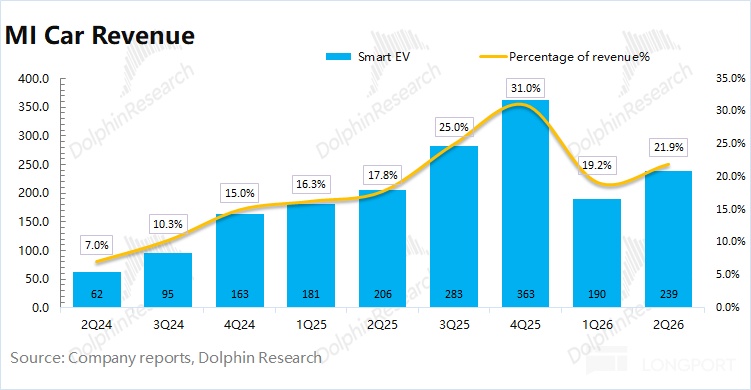
2. Autos: auto-related revenue was RMB 24.9bn, slightly below the Street at RMB 25.5bn. The company shipped 104k vehicles, with ASP down to RMB 229k, the key miss driver, as the refreshed SU7 mix skewed lower.
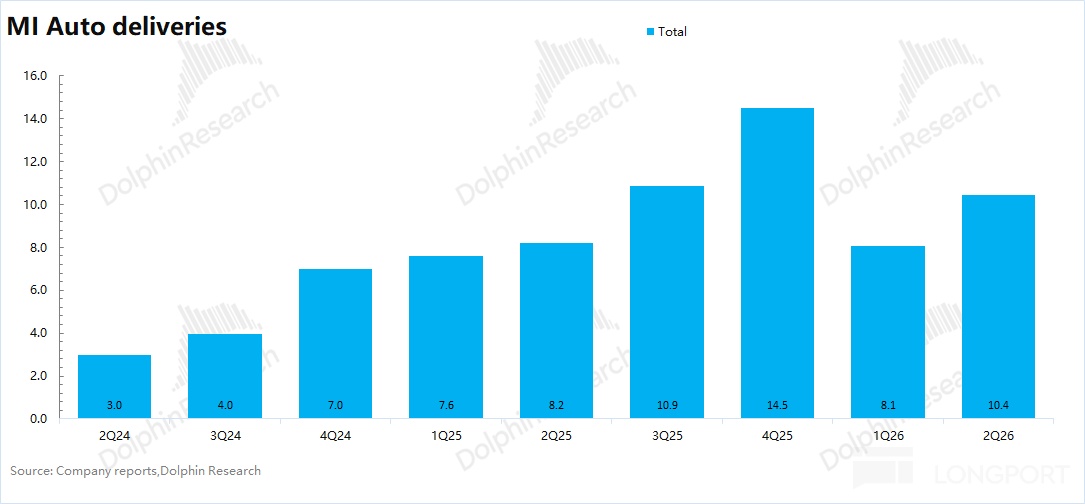
Auto GPM fell to 19.2%, -720bps YoY and below market at 20.5%, driven by continued ASP erosion. The refreshed SU7 carries the lowest starting price among models, structurally dragging blended ASP lower. With margin retreating again, Dolphin Research estimates core OP for Xiaomi Auto swung back to a loss of RMB 2.6bn in the quarter.
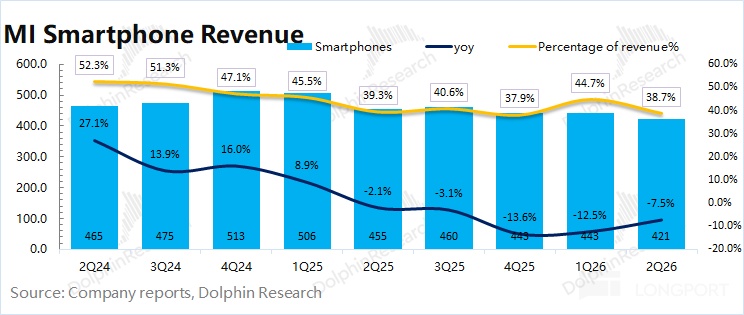
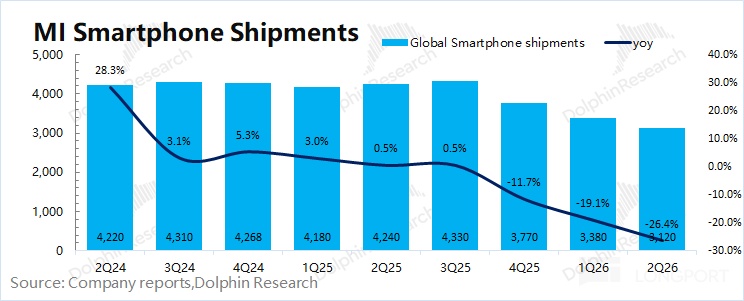
3. Smartphones: RMB 42.1bn, -7.5% YoY, in line with the Street at RMB 41.3bn. Xiaomi smartphone shipments fell 26% YoY, while ASP rose 25% YoY. This clearly follows the stated strategy of prioritizing price over volume.
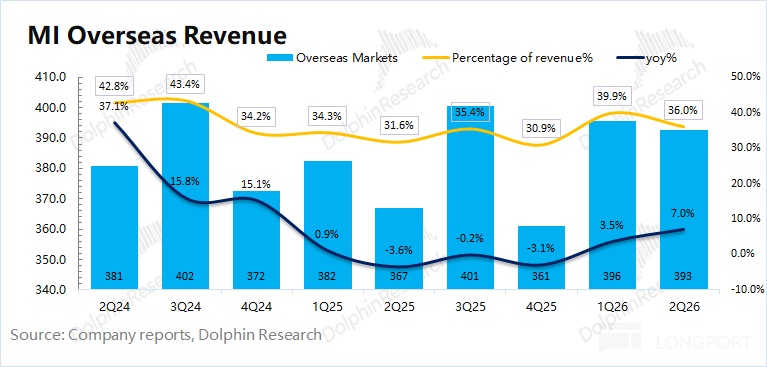
By market,$Xiaomi Corporation(XIACY.US) domestic shipments fell 21% YoY, and overseas shipments declined 28% YoY, indicating share loss both at home and abroad.
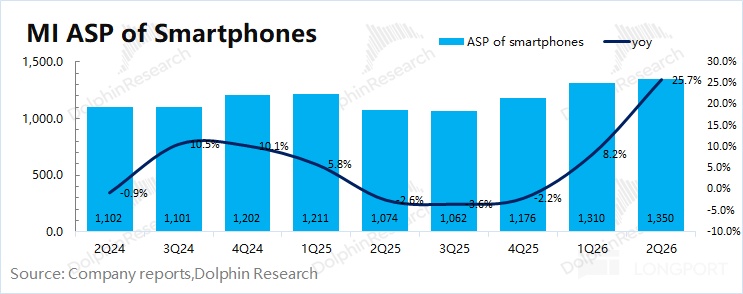
Xiaomi’s higher smartphone ASP this quarter mainly reflects: ① with tight memory supply, the firm prioritized allocation to higher-priced models; ② cost pressures forced price hikes.
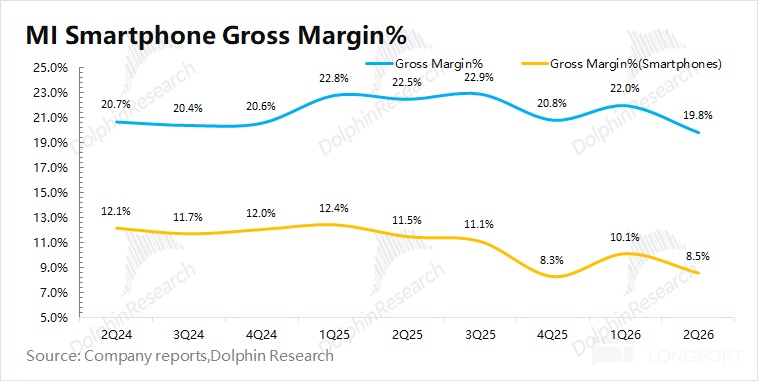
Even with a 25% YoY ASP increase, smartphone GPM still held at a relatively low 8.5%, underscoring significant pressure from memory supply.
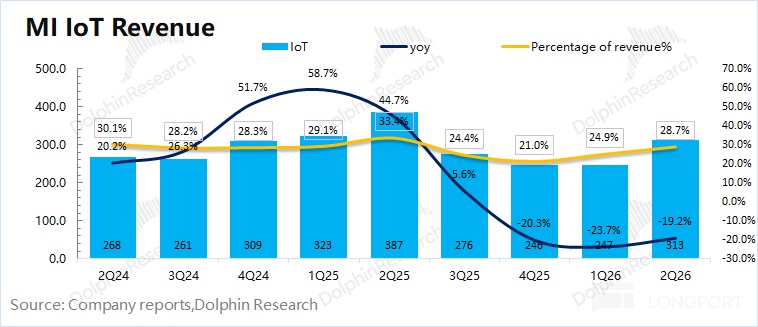
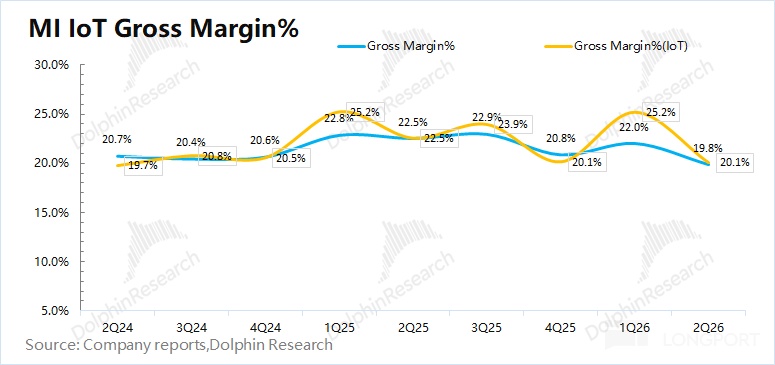
4. IoT: RMB 31.3bn, -19% YoY, broadly in line with the Street at RMB 30.9bn. With state subsidies fading and memory tightness, IoT revenue has declined ~20% YoY for three straight quarters.
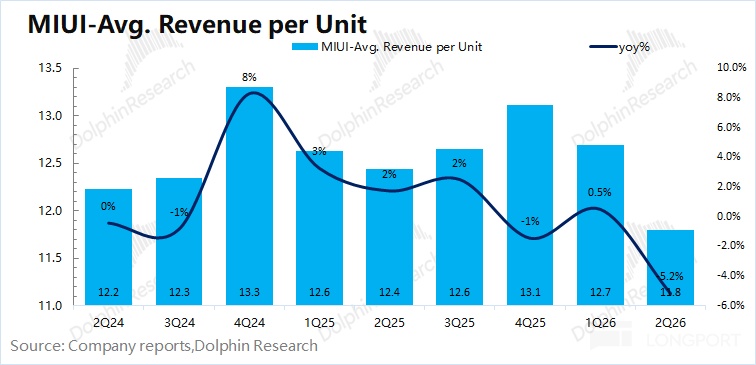
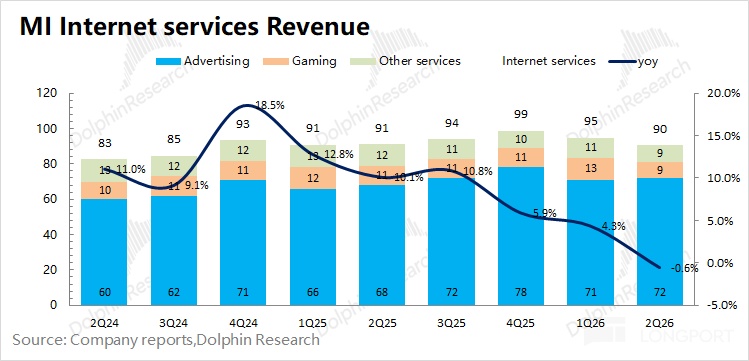
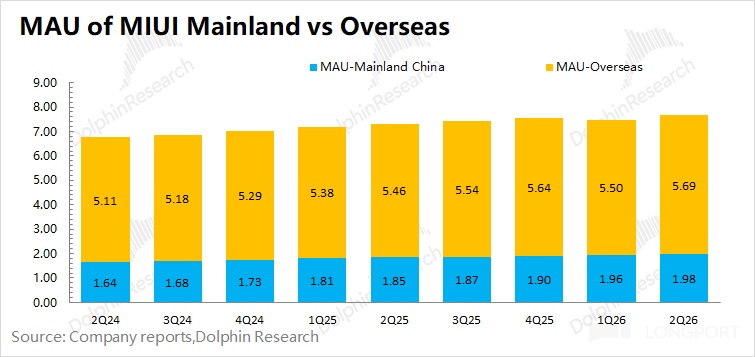
5. Internet services RMB 9.0bn, -0.6% YoY, slightly below market at RMB 9.2bn, dragged by internet value-added services. MIUI users grew 5% YoY, while ARPU fell 5% YoY.
By region: overseas internet revenue was RMB 2.9bn, while domestic was ~RMB 6.14bn. Although user counts rose in both markets, ARPU declined in each.
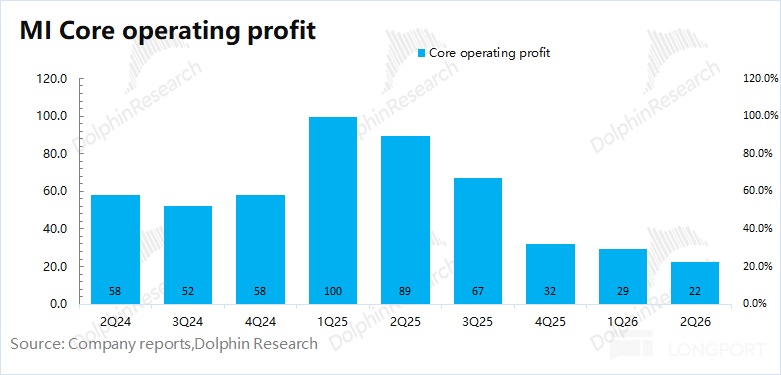
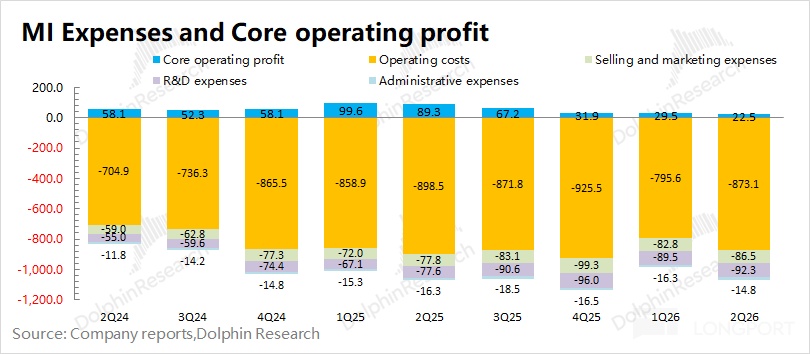
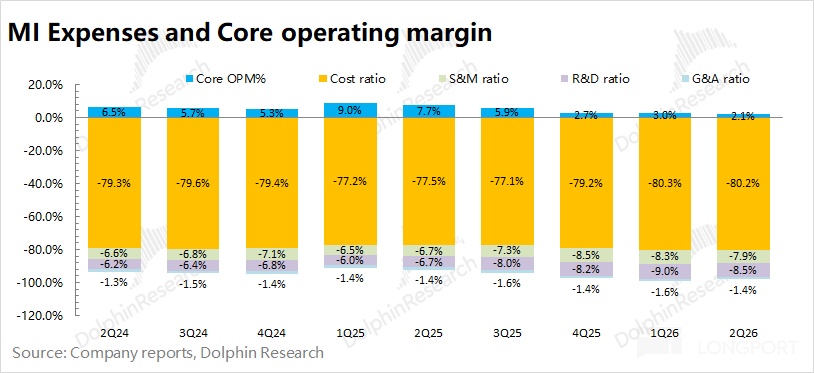
6. Profit: core profit RMB 2.25bn, with adj. net profit at RMB 6.2bn. Core profit for legacy businesses was ~RMB 4.86bn, -47% YoY; autos lost RMB 2.6bn on lower margins.
Dolphin Research view: Core biz stalling, autos cooling, all eyes on 'PENGCHENG' to turn the tide
Most line items were broadly in line with expectations. The YoY revenue decline stemmed from weakness in smartphones and IoT, while the miss on core profit was mainly due to another step-down in auto ASP/GPM.
As the stock fell from HK$61 to below HK$30, the headwinds have been well understood: tight memory supply, state subsidies rolling off, and digestion of auto backlogs.
With shares still depressed, the market focus has shifted to:
① Will legacy businesses get 'worse': could smartphone GPM drop below 8%, and when will IoT return to growth?
② Auto 550k delivery target: with only 216k deliveries in the first seven months, will guidance be cut post-prints?
③ Other watch items (auto exports, AI and robots): limited near-term P&L contribution, but upside progress would lift medium-to-long-term expectations.
Based on this print, legacy businesses have not stabilized in Q2, with smartphone GPM stuck at a relatively low 8.5% and IoT still down a bit over 20% YoY. On autos, the spotlight for SU7 and YU7 has faded, with combined monthly sales back to ~30k, and the market now looks to the upcoming PENGCHENG range-extended models.
Beyond the results, the market is tracking the following:
a) Smartphones: still a sizable decline this quarter, with ongoing impacts from rising memory prices and tighter state subsidies.
China smartphone shipments fell 21% YoY, reflecting supply tightness and fiercer competition. By contrast, Apple iPhone shipments in China rose 24% YoY (market -4.3% YoY).
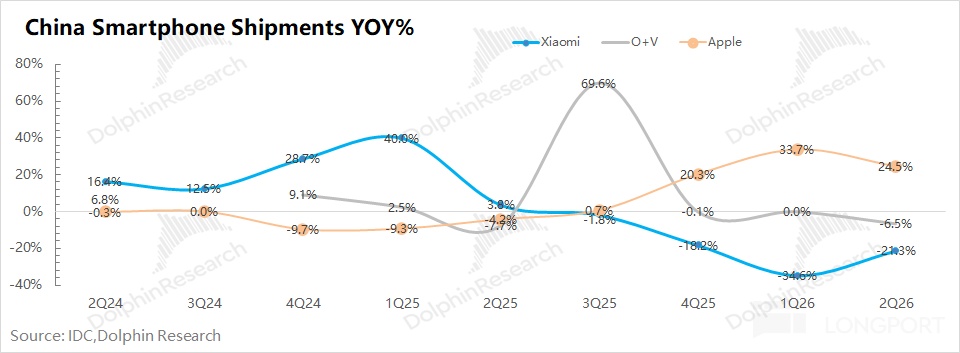
Beyond volume, the key watch is smartphone GPM at 8.5%, -300bps YoY. Memory inflation remains a clear headwind, and even after price hikes, margins are still below 10%. The debate is less about recovery and more about whether margins deteriorate further.
b) Autos: can the 550k full-year target hold?
Xiaomi Auto delivered 104k units in Q2 2026, +28% QoQ. The sharp Q1 dip reflected the SU7 refresh transition. Even with the new SU7, monthly sales in May–Jul were only 30–35k, well below the 50k peak.
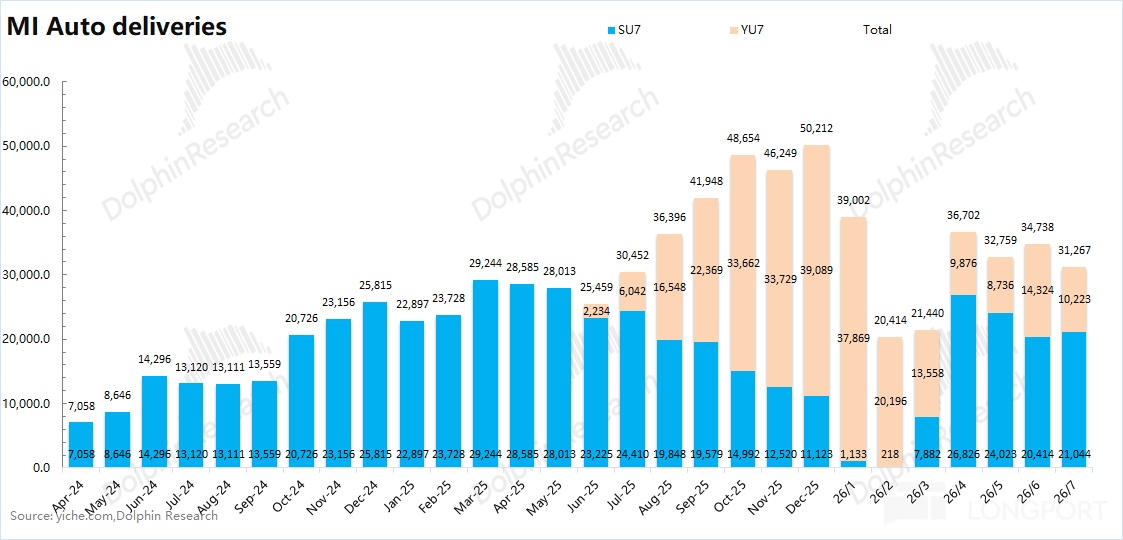
Current website lead times for SU7 and YU7 have shortened to 4–7 weeks, corroborating Dolphin Research’s prior view that most backlogs have been worked through.

Without backlog support, the SU7/YU7 product cycle has largely passed, with combined monthly sales around 30k. The next swing factor is the PENGCHENG range-extended SUVs: two models were unveiled in late Jul with partial specs, with shipments slated to start in Sep. The N70 Max and N90 Max are priced at RMB 259,900 and RMB 299,900, respectively.
Versus peers, PENGCHENG N70 targets the large 5-seat SUV segment similar to Li Auto L7. The N90 Max aims at the Li Auto L9, uses batteries from Sunwoda/ CALB, and is priced ~30% lower.
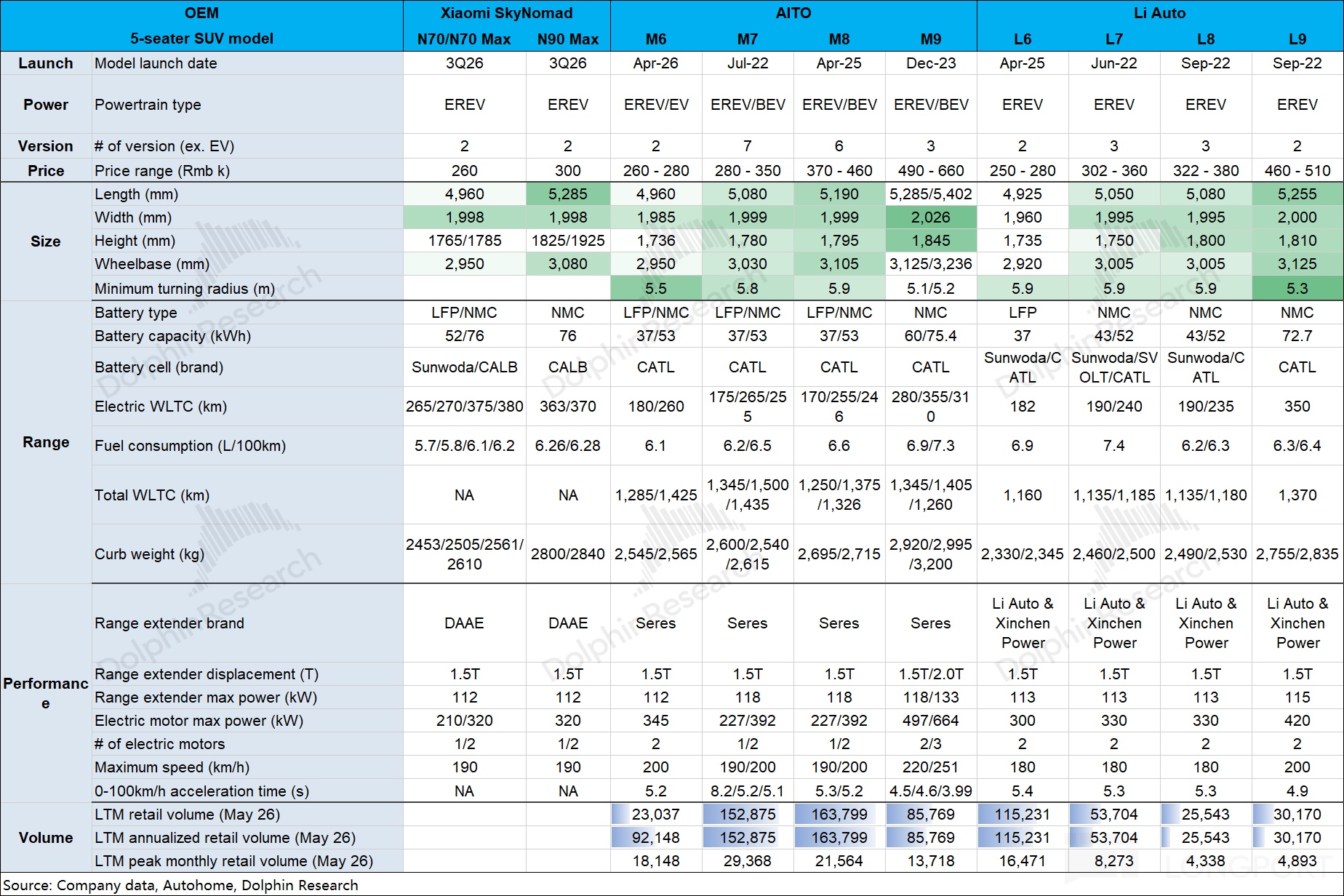
Notably, unlike the SU7/YU7 refresh where locked-order data came within an hour, the PENGCHENG series had no such disclosure before the print, and the RMB 200k–300k SUV segment is China’s most competitive battlefield (BYD, Leapmotor, XPeng, upward brands, plus Li Auto and Aito).
The company guided 550k deliveries for the year, but year-to-date performance suggests a tough path. If SU7/YU7 stay at ~30k per month, full-year would be ~370k, implying the PENGCHENG line must deliver 180k in the last four months (avg. 45k/month, very challenging).
Most brokers now expect 460k–500k units for the year. If management formally lowers guidance on the call, that could mark a clearing event.
Xiaomi’s earnings come from legacy and auto businesses, which differ materially in profile (the former steady, the latter growth). Hence SOTP is more appropriate than a single PE multiple.
① Legacy businesses: a relatively firm floor
Assuming smartphones -7% for the year, IoT slightly down YoY, and smartphone GPM at 9% for the year, 2026 legacy core after-tax OP is ~RMB 17–18bn.
As memory prices corrected sharply earlier, the stock rallied, showing a clear see-saw effect. If hardware margins stabilize, applying 15–20x PE implies HK$300–450bn (HKD/CNY=0.86), or HK$12–18 per share.
② Autos: an uncertain 'blind box' of upside
Auto deliveries were 216k in the first seven months; assuming the next five months see SU7+YU7 steady at ~30k/month, full-year would be ~370k for these two models.
The uncertain piece is the PENGCHENG series from Sep. Based on peer comps, PENGCHENG N70 peers do 10k–30k/month, and PENGCHENG M90 Max peers do 5k–15k/month. We estimate 60k–180k over the next four months.
Assuming full-year auto ASP recovers to RMB 245k, auto revenue would be RMB 105–135bn in 2026. With PENGCHENG traction, we assign 1–2x PS (2x if it sells well), implying HK$122–320bn (HKD/CNY=0.86), or HK$5–12 per share.
Blending both segments, legacy can underwrite a floor if declines halt. With new model uncertainty and SU7/YU7 stabilizing, autos also have some floor value (implying 430k full-year deliveries). If PENGCHENG outperforms and the 550k target is met, autos would contribute more to the stock.
Overall, without a clear rebound in legacy businesses, shares may continue to trade in a HK$17–30 range. Auto exports, AI and robots are future catalysts, but near-term contribution should be limited.
Given the see-saw with memory pricing, absent a clear downtrend in memory, the stock likely stays capped in the current range, and holding near the high end could incur time cost. A pullback toward HK$20 could offer better downside protection and odds.
Below are Dolphin Research’s detailed Xiaomi result tables:
<End of article>
Historical Xiaomi coverage by Dolphin Research:
Product launches
Mar 20, 2026 SU7 launch: 'Xiaomi (Spring Launch): Low-key SU7 refresh; MiMo free trial surges the ranks'
Sep 26, 2025 smartphone launch: 'Xiaomi (with Trans): Full-on iPhone rival; spec bump at same price'
Jul 3, 2025: 'Lei Jun roundtable: Not joining low-price wars; targeting exports in 2027'
Jun 26, 2025 YU7 launch: 'Xiaomi Auto: YU7’s explosive debut — can it dethrone Tesla?'
May 22, 2025 YU7 preview: 'Xiaomi (Trans): 'Father of domestic brands' YU7 arrives; is Model Y at risk?'
Earnings season
May 26, 2026 call: 'Xiaomi (Trans): Paid tokens now over 30%; confident in 550k delivery target'
May 26, 2026 earnings take: 'Xiaomi: Rock bottom? The worst may be over'
Mar 24, 2026 call: 'Xiaomi (Trans): Memory upcycle longer than expected; AI monetization still early'
Mar 24, 2026 earnings take: 'Xiaomi: From heaven to hell — what sustains conviction?'
Nov 18, 2025 call: 'Xiaomi (Trans): Rising memory costs hit low-ASP vendors harder'
Nov 18, 2025 earnings take: 'Xiaomi: Subsidies have faded — can autos carry the mantle?'
Aug 19, 2025 call: 'Xiaomi (Trans): Smartphone target cut to 175mn; no auto price war'
Aug 19, 2025 earnings take: 'Xiaomi: Smartphones in another chill; can autos save the day?'
May 27, 2025 call: 'Xiaomi (Trans): Full-year smartphone target at 180mn units'
May 27, 2025 earnings take: 'Xiaomi: Autos plus state subsidies — time to win big?'
Mar 18, 2025 call: 'Xiaomi (Trans): Smartphone ambition 200mn; no strict profit target for autos'
Mar 18, 2025 earnings take: 'Xiaomi: 'Strongest ever' — does it live up to the hype?'
Risk disclosure and disclaimer: Dolphin Research Disclaimer and General Disclosure



The copyright of this article belongs to the original author/organization.
The views expressed herein are solely those of the author and do not reflect the stance of the platform. The content is intended for investment reference purposes only and shall not be considered as investment advice. Please contact us if you have any questions or suggestions regarding the content services provided by the platform.