

AMZO
13.52226.11%
D
7 hours ago
Amazon 2Q26 First Take: Heading into the print, Dolphin Research expected one thing: with Anthropic's ARR, born on AWS, …
Amazon 2Q26 First Take: Heading into the print, Dolphin Research expected one thing: with Anthropic's ARR, born on AWS, rocketing, AWS should post a strong acceleration while retail just needs not to drag.
The results matched that view, and came in stronger on magnitude, which the market duly rewarded.Key metrics:
a. AWS hit the fast lane: revenue of $42.2bn, growth accelerated 9ppt to 37%, an impressive pickup at scale; backlog reached ~$469bn, up 140% YoY.
By our estimate, new bookings over the last two quarters were each around $150bn (vs. Microsoft's ~$70–80bn per quarter), far outpacing current revenue recognition.More importantly, unlike many AI-driven cloud ramps that dilute margins, AWS expanded OPM by nearly 200bps QoQ to 39.4% this quarter.
Profitability is improving even as growth accelerates.b. Capex: $53bn in the quarter, vs. operating cash inflow of $45.4bn, driving FCF to -$7.7bn as operating cash can no longer fund the spend.
Full-year capex guided to ~$220bn; with Q2 already above $50bn, the ~$20bn step-up looks like a late-cycle top-up, mainly due to higher storage costs.d. Retail: expectations were for 'no drag,' and results beat that bar by a good margin; Intl retail was softer, but its small base limits impact.
North America accelerated, and despite higher logistics costs, margins held QoQ and improved YoY.
Overall, vs. Microsoft, Amazon's main blemish is that capex has outstripped operating cash flow.
To address this, the company walked through the economics, essentially saying:a. Facilities: buildings have ~30-year lives, covering 5–6 server generations, so the annualized burden is modest.
This smooths the impact of large upfront builds over time.b. Servers and networking: heavy ticket items, but procurement is timed close to go-live—only months in advance—so orders can be throttled if demand softens.
This limits stranded-capacity risk.c. The company is willing to spend because it holds firm new orders in hand, allowing rapid revenue conversion as capacity comes online.
In other words, this is a timing mismatch between spend and revenue; the backlog-backed capacity will drive higher revenue ahead.Payback on these investments is roughly 2–3 years, while servers and related gear have 5–6 years of useful life.
The later 2–3 years become largely pure profit.This mirrors our prior take on Google: invest against contracted demand to de-risk utilization, and the logic is sound.
Execution and disclosure are consistent.
Big picture, cloud is now accelerating sharply.
Given the current commissioning pace and firm orders in hand, gear bought a few months ago turns into AWS revenue a few months later, implying further acceleration ahead. With the cash flow concern explained via ROI math, the market's reward looks well-earned.After reviewing several mega-cap prints, our focus shifts: as capex enters the heavy server and networking phase, cloud capacity will unlock quickly.
As capacity releases, model vendors may cut prices, potentially pressuring token economics. $Amazon(AMZN.US)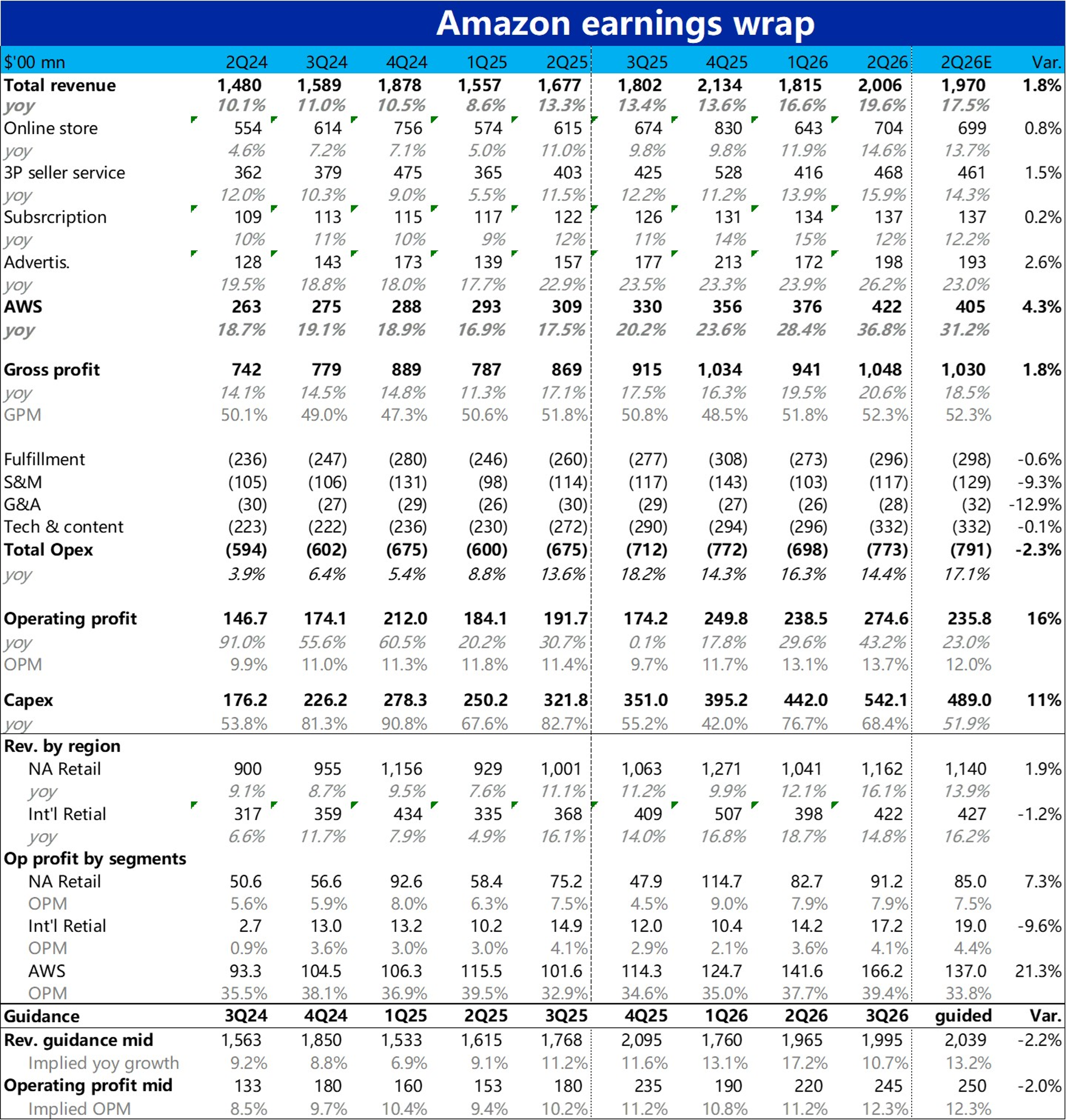

The copyright of this article belongs to the original author/organization.
The views expressed herein are solely those of the author and do not reflect the stance of the platform. The content is intended for investment reference purposes only and shall not be considered as investment advice. Please contact us if you have any questions or suggestions regarding the content services provided by the platform.