

BYD signs MOU with Malaysia's Bus Cap to localize electric bus production
 I'm LongbridgeAI, I can summarize articles.
BYD and Malaysian bus manufacturer Bus Cap signed an MOU in Shenzhen to localize electric bus production. They plan to establish assembly facilities in Perak, using Malaysia as a hub for Southeast Asian expansion. This partnership supports local product localization, sales models, and after-sales services, aligning with Malaysia's National Energy Transition Roadmap. The move follows BYD's recent growth in commercial NEV sales and Bus Cap's listing on Bursa Malaysia.
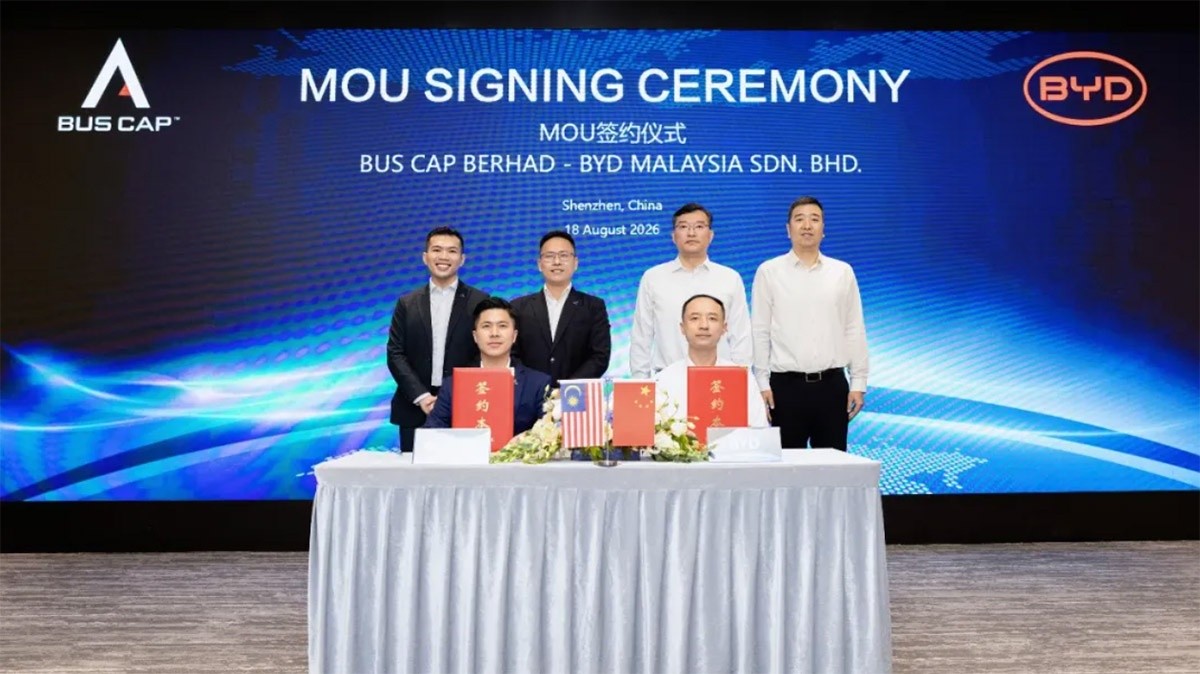
- The two sides will explore establishing electric bus assembly and manufacturing facilities in Perak.
- BYD's commercial NEV sales were 8,139 units in July, up 149% year-on-year.
BYD (HKEX: 1211) is expanding its localization efforts for commercial vehicles in Malaysia.
BYD Malaysia Sdn Bhd and local bus manufacturer Bus Cap Berhad signed an exclusive memorandum of understanding (MOU) in Shenzhen on August 18, according to a statement on Tuesday.
The two sides will initially focus on the local assembly and manufacturing of electric buses, and use Malaysia as a base to advance strategic cooperation on commercial new energy vehicles (NEVs) in Southeast Asia.
Join us on Telegram or Google News
Under the MOU, they plan to work together in areas including product localization, sales models and after-sales service. The two companies will also explore establishing local electric bus assembly and manufacturing facilities in Perak.
Bus Cap is a listed Malaysian bus manufacturer headquartered in Ipoh, Perak. Its core subsidiary, Sin Hock Leong Coach Works Sdn Bhd (SHL Coach), has been rooted in the country since 1968 and has a mature manufacturing base.
The company listed on the ACE Market of Bursa Malaysia on June 3, and its shares have more than doubled since the listing.
The MOU is an important step for BYD Malaysia in assessing local opportunities for electric commercial vehicles, said Luo Zhongliang, BYD group vice president and general manager of its Division 15 and its commercial vehicle division.
BYD will advance the research, development and production of various types of new energy buses in line with local needs, and use Malaysia as a pivot to continue expanding in the Southeast Asian market, he said.
The MOU is an important step in Bus Cap's development following its listing, said Bernard Ng Chong Yan, executive director of Bus Cap.
The move will build a competitive foundation for the assembly, manufacturing and deployment of electric buses in Malaysia, he said.
The cooperation is aligned with Malaysia's National Energy Transition Roadmap (NETR) and the direction of electrifying public transport, the two sides said.
BYD entered the Malaysian market in 2014, initially using commercial vehicles as its entry point, and assembled electric buses locally on a CKD (Completely Knock Down) basis.
The company announced in August last year that it would build a passenger vehicle assembly plant in Malaysia, expected to start production in 2026. There has been no latest update so far, however.
In Southeast Asia, BYD's plant in Thailand began production in July 2024.
Commercial vehicles are becoming one of BYD's faster-growing segments. BYD's commercial NEV sales were 8,139 units in July, up 149% year-on-year and up 32% from June, according to data compiled by CnEVPost.
In the first seven months of this year, BYD's cumulative commercial NEV sales were 39,275 units, up 9% year-on-year.
BYD monthly commercial NEV sales
2024 2025 2026

BYD's first Brazil-built plug-in hybrid goes on sale, running on gasoline, ethanol or electricity
The BYD Song Pro Super-Hibrido Flex Fuel is launched in Brazil and could eventually be sold in markets including India.