

GGLS
58.3681.30%
O

1 day ago, 03:20 PM
Beginner guide to catalyst 🤖🐶 Gemini Desktop App: Is This the Next Catalyst for Alphabet?
 I'm LongbridgeAI, I can summarize articles.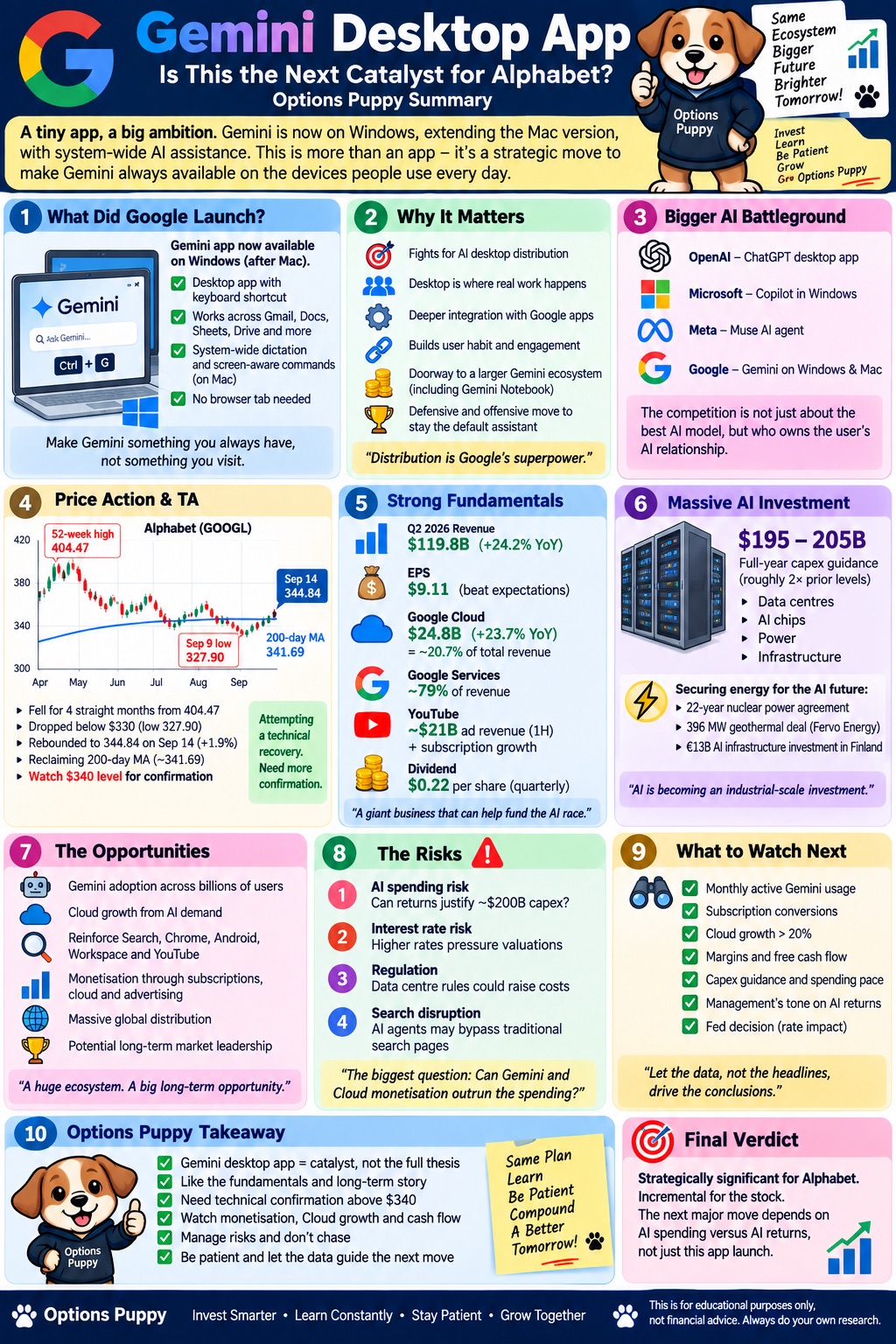
My Options Puppy view: I don’t buy a stock simply because it launches a new app. I look for the combination of catalyst + fundamentals + technical analysis + forward-looking expectations. Google’s latest Gemini desktop push checks several of those boxes — but the huge AI spending bill means investors still need to ask one important question: Can Gemini and Google Cloud generate enough future profits to justify the massive investment?
🚀 1. A Tiny App With a Very Big Ambition
On September 10, Google announced that the Gemini app was now available on Windows, following its earlier Mac launch.
At first glance, it sounds like just another AI application.
But I think there is more to it.
Google wants Gemini to become something that is always available while you work, rather than something you have to open in a browser.
Imagine typing an email in Gmail, working on a spreadsheet, reading a document or writing code — and simply pressing a keyboard shortcut to summon Gemini. 🤖⌨️
That is a very different strategy from asking users to remember to visit an AI website.
The bigger objective is:
Don’t make Gemini somewhere users visit. Make Gemini something users always have with them.
And for Alphabet, that could become strategically very important.
📱 2. Google Is Fighting for the AI Desktop
The AI battle is no longer just about who has the best chatbot.
It is increasingly about distribution.
OpenAI has ChatGPT desktop applications.
Microsoft has Copilot integrated into Windows.
Meta is pushing its own AI agents.
And now Google is putting Gemini directly onto Windows and Mac computers.
Why does this matter?
Because the desktop is where people do a huge amount of valuable work. 💻
They write documents.
They prepare presentations.
They analyse spreadsheets.
They attend meetings.
They write software.
They manage businesses.
They communicate with customers.
If Gemini becomes part of these workflows, Google potentially gets something much more valuable than another standalone app:
habit.
And habit can eventually become revenue.
🧠 3. Gemini Is Becoming More Than a Chatbot
Another interesting development is Google’s decision to bring more of its AI products under the Gemini umbrella.
NotebookLM, Google’s AI research and note-taking product, has been incorporated into the broader Gemini ecosystem as Gemini Notebook.
This suggests Google is trying to create a much larger AI platform.
Instead of having:
Search → one product
Gemini → another product
NotebookLM → another product
Google can potentially build:
One Gemini ecosystem across Search, Chrome, Android, Workspace, Cloud and desktop.
🐶 Options Puppy takeaway: Distribution is one of Alphabet’s biggest advantages.
Google already has billions of users interacting with its ecosystem.
The question isn’t whether Google can put Gemini in front of people.
The question is:
Can Google turn that distribution into meaningful monetisation?
📈 4. Alphabet’s Technical Picture Is Getting Interesting
Now let’s switch from FA to TA.
Alphabet shares had experienced a meaningful pullback after reaching a 52-week high of approximately $404.47.
The stock subsequently fell below $330, reaching an intraday low around $327.90 on September 9 before closing around $330.65.
Then sentiment improved.
The stock recovered toward $340 and, according to the figures provided, reached approximately $344.84 on September 14, with an intraday high around $347.28.
That’s important from a technical perspective.
Why?
Because the stock is attempting to reclaim the 200-day moving average, which was around $341.69 in the supplied market snapshot.
A successful reclaim can potentially indicate that buyers are returning.
📊 5. The $340 Level Is Worth Watching
From an Options Puppy perspective, I would pay particular attention to the $340 area.
Why?
Because price levels can become psychological battlegrounds.
If Alphabet can remain above this area and continue making higher highs and higher lows, the technical picture becomes more constructive.
If it falls back below the 200-day moving average and sellers regain control, the recent rebound could prove to be nothing more than a temporary bounce.
So I wouldn’t say:
“GOOGL went up today, therefore bullish.”
I would say:
“The stock is attempting a technical recovery after a significant pullback. Now we need confirmation.”
That’s a much more disciplined way to read the chart.
💪 6. The FA Behind the Story Is Strong
Here’s where I become more interested.
The Gemini launch isn’t happening at a company with weak fundamentals.
According to the financial figures supplied, Alphabet generated approximately $119.8 billion of revenue in Q2 2026, representing year-over-year growth of about 24.2%.
First-half revenue was approximately $229.7 billion, up about 23.1%.
EPS was approximately $9.11.
These are not the numbers of a stagnant company.
Alphabet is still growing at a substantial rate despite its enormous size.
And one of the biggest engines behind the story is Google Cloud. ☁️
☁️ 7. Google Cloud Is Becoming a Bigger Part of the Story
Google Cloud generated approximately $24.8 billion in Q2 revenue, according to the figures provided.
That represents roughly 23.7% year-over-year growth.
Why do I care about Cloud?
Because AI isn’t just about consumer chatbots.
Companies need:
🖥️ Data centres⚡ Electricity🧠 AI models💾 Computing power☁️ Cloud infrastructure🔧 Developer tools
Google Cloud sits directly in the middle of this AI infrastructure boom.
If businesses increasingly use Google’s AI models and infrastructure, Alphabet can potentially monetise AI through Cloud even if Gemini itself doesn’t immediately become a massive standalone revenue source.
This is why the Gemini + Cloud combination is much more interesting to me than the Gemini desktop app by itself.
📺 8. Don’t Forget the Original Money Machine
Sometimes investors become so excited about AI that they forget Alphabet already has a gigantic business.
Google Services remains the company’s core engine.
Search remains enormously important.
YouTube continues to generate advertising and subscription revenue.
According to the supplied figures, YouTube generated approximately $21 billion of advertising revenue during the first half of the year, alongside subscription growth from products such as YouTube TV and Premium.
This gives Alphabet something many AI startups don’t have:
A giant existing cash-generating ecosystem that can help finance the AI race.
That is a major competitive advantage.
💰 9. Alphabet Is Also Returning Money to Shareholders
Alphabet now pays a quarterly dividend of approximately $0.22 per share, according to the figures supplied.
The dividend isn’t the reason I would buy Alphabet.
The more important question is whether Alphabet can continue generating enough cash to:
✅ Invest in AI✅ Grow Cloud✅ Develop Gemini✅ Maintain Search✅ Support YouTube✅ Repurchase shares✅ Return capital to shareholders
That balancing act is becoming increasingly important.
🏗️ 10. But Here Comes the $200 Billion Problem
Now for the bearish side.
Google’s AI opportunity isn’t cheap.
Not even close.
Alphabet has raised its full-year capital expenditure guidance to approximately $195–205 billion.
That’s an enormous amount of money.
The spending is going toward:
🏢 Data centres🧠 AI chips⚡ Power🌐 Infrastructure🤖 AI capacity
This creates the biggest debate around Alphabet.
The bulls say:
“Invest heavily today and dominate AI tomorrow.”
The bears say:
“What if Alphabet spends $200 billion and the returns aren’t high enough?”
That is the question I would focus on.
⚡ 11. Power Is Becoming the New AI Bottleneck
AI requires enormous amounts of electricity.
Google therefore isn’t just buying GPUs and data centres.
It is also securing energy.
The company has announced major energy-related agreements, including a long-term nuclear power arrangement and a geothermal agreement with Fervo Energy.
Google has also announced a major AI infrastructure investment in Finland.
This tells me something important:
AI infrastructure is becoming an industrial-scale investment.
The next AI winner may not simply be the company with the best model.
It could be the company that can secure:
chips + data centres + electricity + customers + distribution.
Alphabet is attempting to secure all five.
⚔️ 12. The Bear Case: AI Could Disrupt Google Itself
Here’s the irony.
Google is one of the biggest beneficiaries of AI.
But AI could also threaten Google’s traditional Search business.
Historically, people type a question into Google.
Google provides search results.
Advertisers pay Google.
But what happens if consumers increasingly ask an AI agent to perform the entire task?
Instead of:
“Search for the best hotel in Singapore.”
They might say:
“Find me the best hotel, compare prices and book it.”
The AI agent could potentially bypass traditional search pages.
That is why Google’s AI strategy isn’t simply offensive.
It is also defensive.
Google needs Gemini to become part of the future before someone else takes the user relationship away from Search.
🐶 13. This Is Where Meta, Microsoft and OpenAI Matter
The competition is becoming intense.
Microsoft has Copilot.
OpenAI has ChatGPT.
Meta is developing increasingly capable AI assistants and agents.
Google has Gemini.
The competition isn’t simply:
Who has the smartest model?
It is:
Who owns the user’s AI relationship?
If Google wins, Gemini could reinforce Search, Chrome, Android, Workspace and Cloud.
If another company wins, Alphabet could face pressure on its traditional search-advertising model.
That’s why I see Gemini as strategically significant even if the desktop application itself doesn’t immediately produce billions of dollars in revenue.
⚠️ 14. Four Risks I Would Watch
1️⃣ AI Spending Risk
If Alphabet continues spending close to $200 billion annually on infrastructure, investors will demand results.
2️⃣ Interest Rate Risk
Higher interest rates can pressure the valuation of growth and technology companies.
3️⃣ Regulation
Large data centres consume enormous amounts of electricity and place pressure on power grids. New regulations could increase infrastructure costs.
4️⃣ Search Disruption
This is potentially the biggest long-term risk.
If AI agents replace traditional search behaviour faster than Google can adapt, Alphabet’s advertising machine could face structural pressure.
🎯 15. What I Want to See Next
I wouldn’t base my Alphabet thesis on one Gemini announcement.
I want to see the numbers.
👀 Watch these:
Gemini adoptionAre monthly users growing?
SubscriptionsAre users actually paying?
Google CloudCan growth remain above 20%?
MarginsIs AI generating enough revenue to offset infrastructure costs?
Free cash flowCan Alphabet continue funding the AI build-out?
CapexIs spending stabilising or continuing to accelerate?
These numbers will tell me much more than headlines.
🐶📈 Options Puppy Final Take
For me, the Gemini desktop launch is a catalyst, not the entire investment thesis.
The bullish argument is attractive:
🚀 Gemini adoption☁️ Google Cloud growth🔎 Search dominance📺 YouTube🤖 AI agents💰 Huge existing cash-generating businesses🌎 Massive global distribution
But the bearish argument cannot be ignored:
⚠️ Almost $200 billion of annual capex⚡ Huge energy requirements💸 Pressure on free cash flow🤖 Increasing AI competition🔎 Potential disruption to Search🏛️ Regulatory uncertainty
Technically, the rebound from below $330 toward the $340–$347 area is interesting, particularly because the stock is attempting to reclaim its 200-day moving average.
Fundamentally, however, the real story remains AI monetisation versus AI spending.
So my Options Puppy conclusion is:
🐶 Gemini is a strategically important catalyst, but I don’t chase the stock just because of the headline.
📈 I want to see technical confirmation.
💰 I want to see Cloud and Gemini monetisation accelerate.
🏗️ And most importantly, I want Alphabet’s future AI returns to justify today’s enormous infrastructure spending.
If Alphabet can turn its existing ecosystem — Search + YouTube + Chrome + Android + Workspace + Cloud — into a powerful Gemini distribution machine, the long-term opportunity could be substantial.
But the market will eventually ask for proof.
The app is the story.
The adoption is the evidence.
The cash flow is the scoreboard. 🐶📊
This is an educational Options Puppy-style market commentary, not financial advice. Technical levels and market data can change quickly; always do your own research before trading or investing.
$Alphabet - C(GOOG.US)


The copyright of this article belongs to the original author/organization.
The views expressed herein are solely those of the author and do not reflect the stance of the platform. The content is intended for investment reference purposes only and shall not be considered as investment advice. Please contact us if you have any questions or suggestions regarding the content services provided by the platform.