

MSFT
497.1201.64%
O

1 day ago, 02:54 PM
📈 Beginner Guide to QQQ ETFs: QQQ, QQQM and QYLD
 I'm LongbridgeAI, I can summarize articles.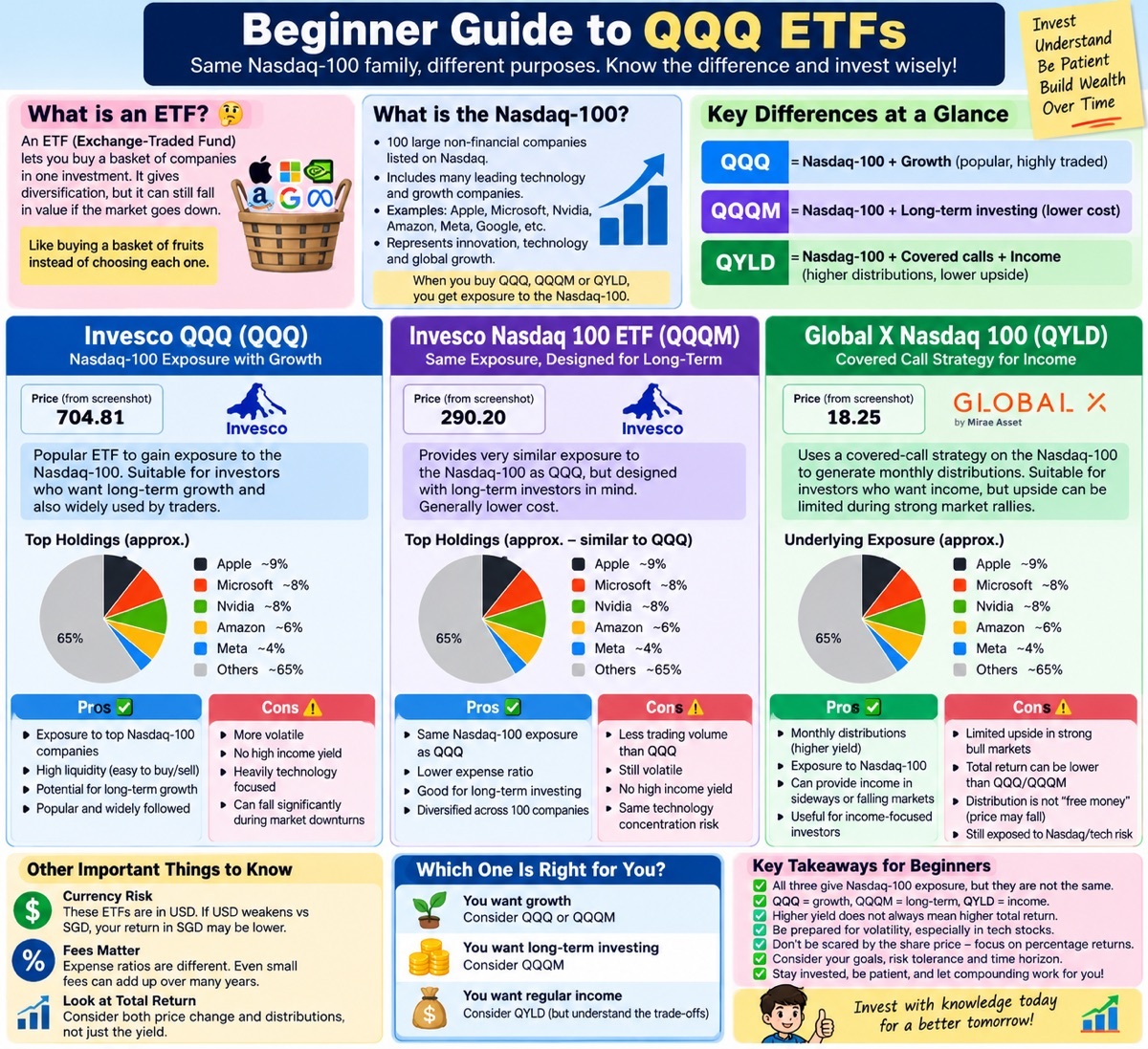
If you are new to investing, you may have come across ETFs such as QQQ, QQQM and QYLD. They can look confusing at first because all three are connected to the Nasdaq-100, but they have very different purposes.
The easiest way to understand them is this:
QQQ = growth and popularityQQQM = similar Nasdaq-100 exposure, designed more for long-term investorsQYLD = Nasdaq-100 exposure combined with an income strategy
The screenshot shows three ETFs: Invesco QQQ, Invesco Nasdaq 100 ETF (QQQM), and Global X Nasdaq 100 Covered Call ETF (QYLD). The prices shown in the screenshot are simply the prices at that particular point in time, so investors should not treat them as permanent prices.
🧺 1. First: What Is an ETF?
ETF stands for Exchange-Traded Fund.
Instead of buying many individual companies yourself, an ETF allows you to buy one investment that holds a basket of companies.
Imagine you have $1,000.
You could try to buy individual shares of Apple, Microsoft, Nvidia, Amazon, Meta and many other companies. This can become complicated.
Instead, you could buy an ETF that already owns many of these companies.
It is similar to buying a basket of stocks rather than choosing every fruit individually. 🍎🍌🍊
This gives beginners an important advantage: diversification.
If one company performs badly, it does not necessarily destroy the entire investment because the ETF owns many companies.
However, diversification does not mean the ETF cannot fall. If technology stocks fall broadly, a Nasdaq-focused ETF can fall significantly.
🔵 2. What Is QQQ?
Invesco QQQ Trust, commonly known as QQQ, is one of the best-known ETFs for gaining exposure to the Nasdaq-100.
The Nasdaq-100 consists of 100 large non-financial companies listed on the Nasdaq exchange.
Some of the major companies represented in the index include large technology and consumer companies.
That means when you buy QQQ, you are not simply betting on one company.
Instead, you are effectively saying:
“I believe many of the large companies in the Nasdaq-100 can grow over the long term.”
This is one reason QQQ is attractive to investors who want exposure to areas such as technology, artificial intelligence, cloud computing, semiconductors, software and digital businesses. 💻🤖
🚀 3. Why Do Investors Like QQQ?
One major reason is growth potential.
Many innovative companies have historically been represented in the Nasdaq-100.
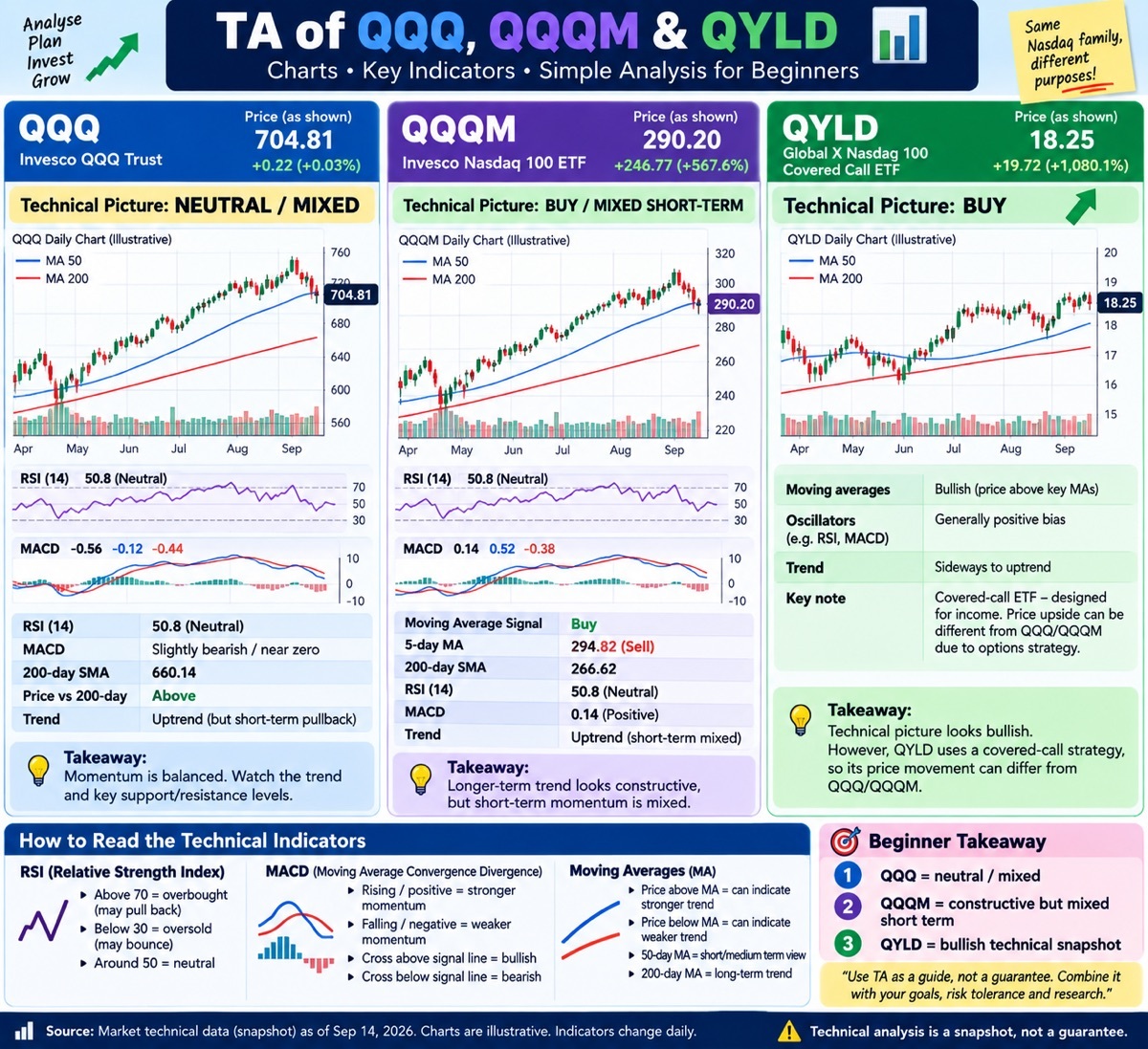
For example, companies involved in computing, advertising, e-commerce, software and semiconductors can benefit from long-term technological changes.
If these companies grow their profits and investors are willing to pay higher prices for their shares, the Nasdaq-100 can rise.
QQQ allows an investor to participate in that broader movement without having to select individual winners.
This can be particularly attractive for a beginner because predicting which single technology company will become the next huge winner is extremely difficult.
Instead of saying:
“I know exactly which company will win.”
you can take the broader approach:
“I believe the biggest innovative companies will continue to grow.”
⚠️ 4. But QQQ Is Not a Safe Investment
A common beginner mistake is thinking that an ETF automatically means low risk.
That is not true.
QQQ is diversified across many companies, but it is still heavily influenced by growth and technology-related businesses.
If interest rates rise, investors may become less willing to pay high valuations for growth companies.
If the economy slows, corporate profits can fall.
If investors become worried about artificial intelligence valuations, semiconductor demand or technology spending, technology stocks can decline.
Therefore, QQQ can experience substantial price movements.
For example, if you invest $10,000 and the ETF falls 20%, your investment would temporarily become approximately $8,000.
You need the psychological ability to hold through these periods.
🟣 5. What Is QQQM?
The second ETF in your screenshot is Invesco Nasdaq 100 ETF, commonly known as QQQM.
QQQM is also designed to provide exposure to the Nasdaq-100.
So why have both QQQ and QQQM?
For a beginner, the important point is that their investment exposure is very similar.
The biggest difference is that QQQ has historically been extremely popular among traders and investors, while QQQM was designed as a lower-cost alternative for investors seeking long-term Nasdaq-100 exposure.
This makes QQQM particularly interesting for someone who wants to build a long-term portfolio.
Think about it like this:
QQQ:📈 Nasdaq-100 exposure💰 Popular and highly traded🔄 Useful for trading and investing
QQQM:📈 Nasdaq-100 exposure💰 Designed with long-term investors in mind🏦 Useful for building a portfolio over many years
The exact expense ratios and fund details can change, so investors should always check the latest fund information before investing.
🆚 6. QQQ vs QQQM
For a beginner, it is useful to simplify the comparison.
Feature | QQQ | QQQM |
Tracks Nasdaq-100 | ✅ | ✅ |
Technology/growth exposure | High | High |
Diversified across many companies | ✅ | ✅ |
Long-term investing | ✅ | ✅ |
Trading popularity | Very high | Lower |
Main purpose | Trading + investing | Long-term investing |
The most important lesson is:
You generally do not need both just because they have different ticker symbols.
If your goal is simply long-term Nasdaq-100 exposure, QQQM can be worth considering.
If you are actively trading and value liquidity and trading activity, QQQ may be more attractive.
🟢 7. What Is QYLD?
Now we come to the most important difference.
QYLD is not simply another version of QQQ.
Global X Nasdaq 100 Covered Call ETF uses a covered-call strategy involving the Nasdaq-100.
This is why QYLD is often associated with income.
A covered call involves owning an asset and selling call options against it.
The investor receives option premiums.
This can create cash distributions for investors.
That sounds attractive, especially if you like dividends or income.
However, there is an important trade-off.
💰 8. Why Does QYLD Pay Income?
Imagine you own a stock worth $100.
You sell someone a call option giving them the right to buy it at $110.
In exchange, you receive an option premium.
Suppose you receive $3.
You have generated $3 of income.
But if the stock suddenly rises from $100 to $150, your upside can be limited because the call option gives the other person the ability to buy at the agreed strike price.
This is the basic idea behind a covered-call strategy.
QYLD applies this concept to Nasdaq-100 exposure.
Therefore, QYLD can produce attractive distributions, but high distributions do not automatically mean high total returns.
This is one of the most important lessons for beginners.
📊 9. High Yield Does Not Mean Free Money
Suppose an ETF pays you a large distribution.
You might think:
“Fantastic! I’m getting paid every month.”
But you need to look at the total return.
Imagine you invest $10,000.
You receive $1,000 in distributions over a period of time.
However, the value of your investment falls to $9,000.
You have not magically made $1,000 of free wealth.
The distribution and the change in the ETF’s price both matter.
This is why investors should examine:
Total return = price change + distributions
rather than looking only at the yield.
🧠 10. QQQ vs QYLD: Growth vs Income
This is perhaps the easiest way to remember the difference.
QQQ 🚀
The main idea is:
“I want growth from the Nasdaq-100.”
If the Nasdaq-100 rises strongly, QQQ can participate in that upside.
However, there is no guarantee of growth, and the price can fall substantially.
QYLD 💰
The main idea is:
“I want Nasdaq-100 exposure while using covered calls to generate income.”
The trade-off is that the covered-call strategy can limit some upside during strong market rallies.
Therefore, QYLD can appeal more to investors who prioritize cash distributions, while QQQ/QQQM may appeal more to investors prioritizing long-term capital growth.
🎯 11. Which One Is Better for a Beginner?
There is no universally best ETF.
It depends on your objective.
If you are young and have a long investment horizon, you might prioritize growth.
In that situation, an ETF such as QQQ or QQQM may be easier to understand because its objective is straightforward: Nasdaq-100 exposure.
If you are more interested in generating regular cash distributions, QYLD may be more interesting.
But you should understand the covered-call strategy before buying it.
A beginner should not simply see a high yield and think:
“Higher yield = better ETF.”
That can be a dangerous assumption.
🏦 12. What About Dividends?
QQQ, QQQM and QYLD can all make distributions, but their purposes are different.
For QQQ and QQQM, distributions are generally not the main reason investors buy them.
The main attraction is exposure to the Nasdaq-100 and potential long-term growth.
For QYLD, distributions are a much more important part of the investment proposition.
Therefore, if your goal is to build wealth over decades, you should think about reinvesting distributions rather than automatically spending them.
For example, if you receive $100 and reinvest it, that $100 can potentially generate future returns.
This is the idea behind compounding. 🔄
📈 13. The Power of Compounding
Suppose you invest consistently every month.
You buy ETF shares.
Those shares potentially increase in value.
You continue adding money.
Any distributions can potentially be reinvested.
Over many years, your portfolio can grow because your previous investment gains remain invested.
This is why time can be more important than trying to find the perfect entry price.
A beginner does not necessarily need to predict whether the market will rise next Tuesday.
Instead, the bigger question can be:
“Can I consistently invest and hold for many years?”
⚠️ 14. Remember Currency Risk
If you are investing from Singapore, there is another issue to understand.
QQQ, QQQM and QYLD are US-listed ETFs and are denominated in US dollars.
If your home currency is Singapore dollars, your actual return is affected by both:
- 📈 The ETF’s performance
- 💵 The USD/SGD exchange rate
For example, the ETF could rise in USD terms, but if the US dollar weakens significantly against the Singapore dollar, your return measured in SGD could be lower.
Currency movements therefore matter for Singapore investors.
💸 15. Fees Matter Too
Every ETF has operating expenses.
You might think:
“What’s the difference between 0.1% and 0.2%?”
For a small portfolio, the difference may appear tiny.
But over decades and with a large portfolio, expenses can compound into meaningful amounts.
Therefore, beginners should compare:
- Expense ratio
- Tracking performance
- Liquidity
- Distributions
- Investment strategy
- Tax considerations
- Long-term total return
Do not choose an ETF solely because its share price looks cheap.
A $20 ETF is not automatically cheaper than a $700 ETF.
The share price tells you the price of one unit, not whether the underlying investment is better value.
🧮 16. Don’t Be Scared by QQQ’s High Share Price
The screenshot shows QQQ at a much higher per-share price than QYLD.
A beginner might think:
“QQQ is expensive, so QYLD must be cheaper.”
Not necessarily.
ETF share price is affected by how the fund is structured and whether it has undergone splits.
What matters more is the percentage return.
If a $700 ETF rises 10%, it gains $70.
If a $20 ETF rises 10%, it gains $2.
Both produced the same 10% percentage return.
So always think in percentages rather than simply looking at the dollar price of one share.
🛡️ 17. Diversification Is Still Important
Another beginner mistake is putting everything into one sector.
Even though QQQ contains many companies, it is still strongly connected to the performance of large Nasdaq companies.
You may therefore want to consider how a Nasdaq ETF fits into your overall portfolio.
For example, an investor could have:
Core portfolio: 🌎Broad-market ETFs
Growth allocation: 🚀Nasdaq-100 exposure
Income allocation: 💰Dividend or covered-call strategies
Cash: 🏦Emergency funds and short-term needs
The correct allocation depends on your financial situation, risk tolerance and investment horizon.
🧘 18. The Biggest Advantage May Be Discipline
The hardest part of investing is often not choosing the ETF.
It is staying invested when markets fall.
Imagine buying QQQ after hearing everyone talk about technology stocks.
Then the Nasdaq falls 20%.
You become scared and sell.
A few months later, the market recovers.
You buy again at a higher price.
This emotional cycle can seriously damage long-term returns.
A good investment strategy therefore needs to be something you can actually follow during both good and bad markets.
📝 19. A Simple Beginner Checklist
Before buying QQQ, QQQM or QYLD, ask yourself five questions:
1️⃣ What is my goal?
Growth or income?
2️⃣ How long am I investing?
Five years is very different from thirty years.
3️⃣ Can I handle a major decline?
If a 30% decline would cause you to panic-sell, you need to consider your risk level carefully.
4️⃣ Do I understand the ETF?
Know what it owns and how it generates returns.
5️⃣ Am I looking at total return?
Don’t judge an ETF purely by its dividend or distribution yield.
🏁 20. Final Beginner Summary
The three ETFs in your screenshot can be remembered very simply:
🔵 QQQ
Nasdaq-100 + growth
QQQ gives investors exposure to many of the major companies in the Nasdaq-100. It can be suitable for investors looking for long-term growth, although it can also be volatile.
🟣 QQQM
Nasdaq-100 + long-term investing
QQQM provides very similar Nasdaq-100 exposure and is particularly relevant to investors who want a long-term holding rather than primarily trading the ETF.
🟢 QYLD
Nasdaq-100 + covered calls + income
QYLD uses a covered-call strategy to generate distributions. It can be attractive for investors seeking income, but the strategy can sacrifice some upside during strong Nasdaq rallies.
The biggest lesson for a beginner is that QQQ, QQQM and QYLD are not interchangeable just because they are all connected to the Nasdaq-100.
If your priority is growth, QQQ or QQQM may make more sense to study.
If your priority is income, QYLD may be worth understanding.
And if your priority is building wealth over many years, focus not only on the headline yield, but also on fees, risk, total return, diversification, taxes and compounding.
Most importantly, don’t buy an ETF simply because its price is rising or because it advertises a high distribution. Understand what you own, how it makes money and what happens when the market goes down.
That knowledge is much more valuable than simply knowing which ticker to press in your brokerage app. 📈💰
I am still keep buying Qyld
$Global X Nasdaq 100 Covered Call ETF(QYLD.US)


The copyright of this article belongs to the original author/organization.
The views expressed herein are solely those of the author and do not reflect the stance of the platform. The content is intended for investment reference purposes only and shall not be considered as investment advice. Please contact us if you have any questions or suggestions regarding the content services provided by the platform.