

UXSD
1.8909.25%
D
7 hours ago
CoreWeave, Nebius: Compute price hikes, sponsor support—how long can NVDA's favorites keep their edge?
 I'm LongbridgeAI, I can summarize articles.
Behind the recent surge in $Nebius(NBIS.US) and $Coreweave(CRWV.US), earnings and call commentary point to a clear, severe shortfall in AI cloud capacity. Demand is running well ahead of supply.
Take Nebius as an example: for 1–3 year mid- to long-term contracts, compute is priced at $20–25bn per GW. To push pricing higher, the company has reserved some retail capacity for auctions, letting customers bid and awarding capacity to the highest bidder. Auction pricing has reached as high as $50bn per GW.
Traditionally, enterprise projects required cloud vendors to bid for contracts. This reversal, aside from the 2x spread between long-term and spot pricing, underscores that AI cloud today is effectively a buyer's market. The auction mechanism itself tells the story.
一、How Long Can AI's Compute Supply-Demand Mismatch Last?
In this setup, both new entrants and incumbent cloud providers share one simple implication: any operator with capacity coming online this year deserves a premium. Capacity in hand is being rewarded.
That is why SpaceX plans to support roughly $200bn of capex off sub-$50bn of 2026 revenue, based on its target compute additions. Meta is doing the same, shifting from building for internal use to renting out capacity, and continuing heavy investment even with in-house models still catching up.
On current pricing, linear extrapolation implies $25–50bn per GW, translating to a 1–2 year payback for cloud operators. Thereafter, rental income and end-of-life salvage become incremental profit.
The core issue is that model training is software engineering, which can advance nonlinearly. AI compute build-out is a physical construction, production and manufacturing problem.
Models can iterate every six months and drive token demand up by 10x. The physical world moves linearly over 1.5–2 years from build to commissioning, so a fast virtual cycle meets hard physical constraints. The outcome is a large supply-demand mismatch.
Therefore, I would not extrapolate 2026 pricing into next year. Based on capex tracks, Meta and SpaceX are targeting 6–8 GW of additions in 2027, and my estimate is that 2027 will see a phase of concentrated capacity release.
From a risk lens, focus on large players that started capex early and at scale, such as Amazon and Microsoft, as they will be booking real revenue during this period of clear mismatch. They have the most visible monetization.
二、NVIDIA, the Sugar Daddy, Steps In
The rally in new-cloud names is not only a reward for their positioning in a buyer's market. It is also backed by Nvidia's proposed $500bn financing platform.
Cloud majors have funded massive capex first with operating cash flow. Once that is consumed, they draw down cash balances, and then turn to external financing.
The usual sequence runs from on-balance-sheet bonds, to off-balance-sheet structures, then convertibles, and finally equity. The more equity-like the instrument, the higher the cost, and incumbents enjoy a lower cost of capital than new-cloud players.
For new clouds like Coreweave, bond coupons can run 8–9% vs. roughly 5% for majors, often secured by purchased GPUs or customer contract cash flows. Nebius has issued convertibles and conducted follow-on equity, resulting in materially higher financing costs.
The problem is that with annual revenue only in the low tens of billions and capex at $30–40bn, asset-backed debt is far from sufficient. Equity that dilutes heavily carries an even higher effective cost.
At this point, Nvidia stepped in and did something big, signing an MoU with Apollo, BlackRock, Blackstone, Brookfield, Goldman Sachs and KKR. The plan is to create a $500bn pool via an independent platform to break the financing bottleneck for new clouds.
Details are pending, but a string of clues suggests a setup similar to Meta's off-balance financing. Key terms, such as Nvidia's residual value support or project guarantees and the payment schedule, may be disclosed around Nvidia's results.
The diagram below was from an earlier analysis of Meta's off-balance structure. Roughly speaking, swap the JV's minority equity to Nvidia plus the neoclouds, and move the residual guarantor from Meta to Nvidia, and you get something close.
The linchpin is residual value support: Nvidia's involvement and backstop are needed to bring in capital like BlackRock and Blackstone that target senior, highly certain yields. This is what unlocks that pool of money.
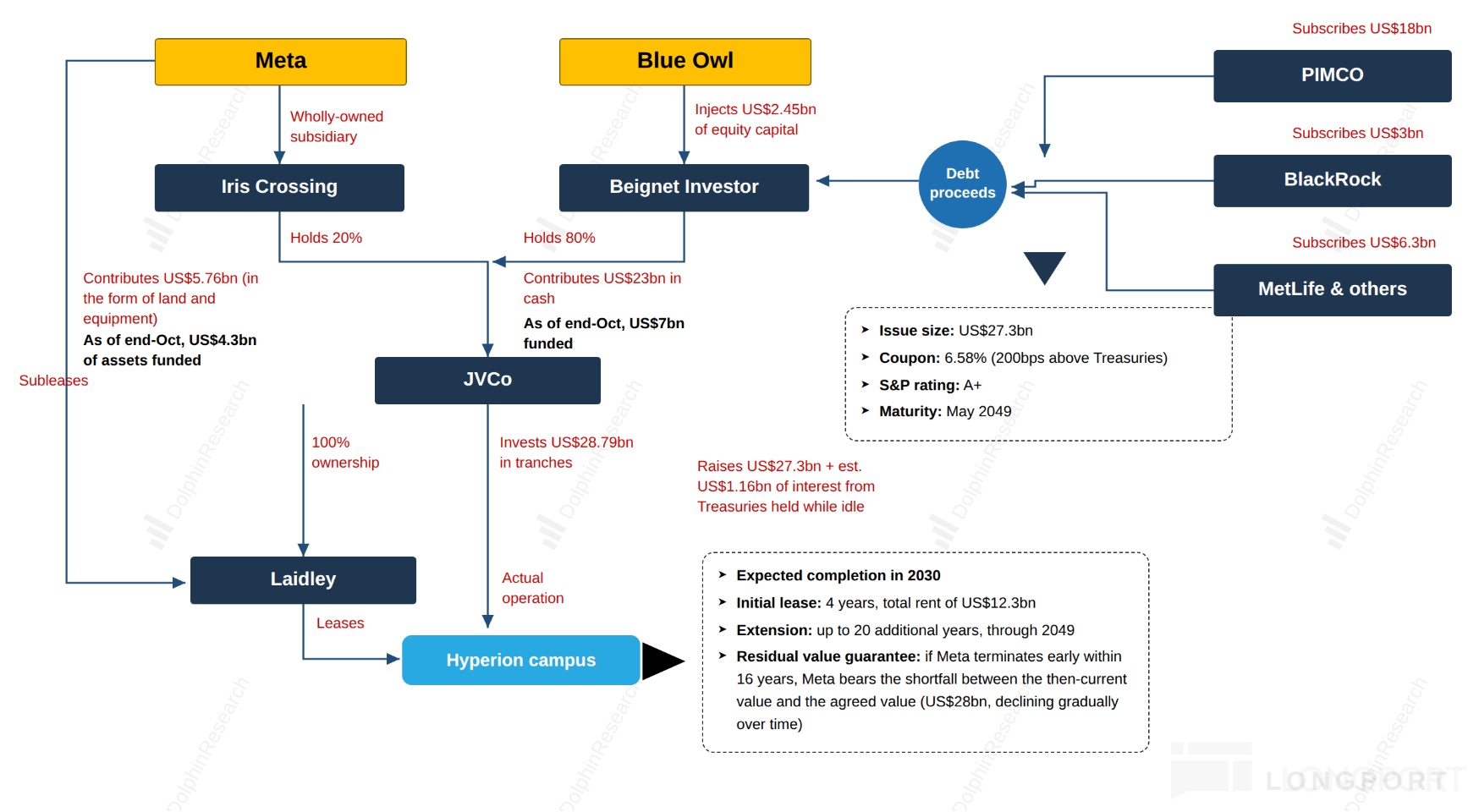
For these investors, returns ultimately come from two places: a) stable rental income once the AI factory is leased, and b) liquidation of the facility and equipment if tenants default. Buildings may not suffer big haircuts, but the swing factor is the IT gear.
The first case poses little risk. In the second, a+b together must at least cover principal and preferably lock in a minimum return.
Because new clouds lack in-house ASICs and rely on Nvidia GPUs and networking, the key liquidation variable is the GPU. Nvidia's residual guarantee ensures enough recovery on equipment sales to protect principal, which is critical to mobilizing $500bn.
For Nvidia, a GPU that costs $25 and sells for $100 was pure revenue. Under this model, revenue and profit recognition will carry an off-balance contingent liability.
As the inference era erodes the GPU moat, Nvidia is effectively paying extra for that $100 of certain revenue. It supports new clouds via financing to defend GPU share against incumbents' ASICs and narrow their cost gap.
Nvidia must ensure guarantees do not eat into the $75 GP on a unit. Its willingness also suggests confidence that CUDA upgrades and software gains can extend the service life of older GPUs, creating resale options even if a single data center underperforms.
In effect, Nvidia is mobilizing private capital to finance GPU-powered compute plants. This expands the neocloud footprint and counters ASIC-led strategies.
Depending on lease payment terms, securing this funding would be rain after a long drought for new clouds. Many hold large backlogs but lack capacity, and on-balance leverage is already high; shifting leverage off balance eases the balance sheet and dilution pressure, a clear positive.
In the contest between new and old clouds, ASIC vs. GPU cost gaps persist, and incumbents still enjoy advantages like multi-region deployments. But on financing, a $500bn platform narrows funding cost differentials, easing pressure and letting new clouds refocus on execution.
<end>
Risk disclosure and statement:Dolphin Research Disclaimer and General Disclosure







The copyright of this article belongs to the original author/organization.
The views expressed herein are solely those of the author and do not reflect the stance of the platform. The content is intended for investment reference purposes only and shall not be considered as investment advice. Please contact us if you have any questions or suggestions regarding the content services provided by the platform.