


The U.S. household debt crisis may erupt:

To begin with, my personal opinion is that the Federal Reserve continues to make mistakes. Next week, the U.S. stock market may still face troubles.
$Tesla(TSLA.US)
Data Analysis and Interpretation
1. Key Data Overview
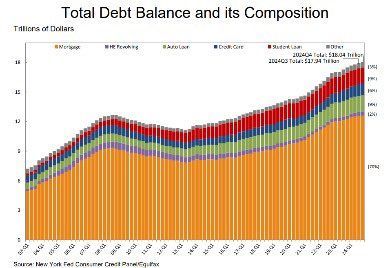
According to data from the New York Federal Reserve, the current household debt situation in the United States presents the following characteristics:
- Total household debt continues to rise: As seen in the chart, total household debt in the U.S. has exceeded $17.5 trillion and shows a long-term growth trend.
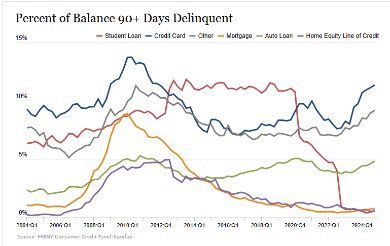
- Default rates by different types of debt (90 days overdue rate):
- Credit card debt default rates are rising rapidly, approaching levels seen during the 2008-2009 financial crisis.
- Default rates on student loans have significantly decreased, possibly related to government policies on student loan deferment and some relief measures.
- Mortgage default rates have recently increased significantly, indicating greater repayment pressure on home loans.
- Auto loan and Home Equity Line of Credit (HELOC) overdue rates remain stable at low levels but are still rising.
2. Major Risk Forecasts
(1) Risk of Soaring Credit Card Default Rates
- Credit card overdue rates are nearing 2008 levels, indicating increased liquidity pressure on consumers.
- In a high-interest rate environment, the burden of credit card debt is heavier, leading to decreased repayment ability.
- Potential impact: Banks may face higher non-performing loan rates, financial institutions will tighten credit policies, and consumer spending will decrease, thereby affecting economic growth.
(2) Rising Mortgage Default Rates
- The Federal Reserve continues to maintain high interest rates, resulting in persistently high mortgage rates and increased repayment pressure on homebuyers.
- The housing market may face adjustments; if default rates continue to rise, it could lead to falling home prices, affecting overall confidence in the financial market.
- Potential impact: The real estate market may undergo adjustments, and falling home prices will affect consumer wealth effects, further impacting consumer spending
(3) Auto Loan Risks
- Although the auto loan default rate has not sharply increased, it shows a slow upward trend.
- Adjustments in the used car market prices may lead to asset depreciation risks, affecting loan recovery rates.
- Potential Impact: The asset quality of auto finance companies and banks is affected, and the auto market may face certain pressures.
(4) Risks from Changes in Student Loan Policies
- Government policies on deferral and forgiveness of student loans have played a role in suppressing default rates, but the uncertainty of future policies remains high.
- If the deferral policy ends, it may lead to a rebound in default rates.
- Potential Impact: If the student loan default rate rebounds, it may affect the consumption and mortgage capacity of the younger population, hindering economic recovery.
3. Summary and Investment Recommendations
Short-term Risks:
- A surge in credit card debt default rates indicates insufficient consumer liquidity.
- In a high-interest rate environment, rising mortgage default rates may affect the stability of the real estate market.
- Attention is needed on the non-performing loan rates in the banking sector and how the financial market prices these risks.
Long-term Risks:
- If economic growth slows and the job market weakens, it may exacerbate debt default issues.
- Changes in student loan policies may lead to new debt pressures.
Investment Recommendations:
- Avoid financial stocks related to high-debt consumer groups, such as credit card issuing banks and consumer finance companies.
- Focus on industries that benefit from a high-interest rate environment, such as insurance and the bond market (higher-yield fixed income assets).
- Real estate investments should be approached with caution; if mortgage default rates continue to rise, the real estate market may face adjustments.
Overall, the debt default situation in the United States is deteriorating, particularly the default rates on credit cards and mortgages, which are worth monitoring. This may impact the financial market and pose challenges to economic recovery. Future attention should be paid to the Federal Reserve's interest rate policies and further changes in consumer credit conditions


The copyright of this article belongs to the original author/organization.
The views expressed herein are solely those of the author and do not reflect the stance of the platform. The content is intended for investment reference purposes only and shall not be considered as investment advice. Please contact us if you have any questions or suggestions regarding the content services provided by the platform.
