
They laugh at me for being crazy, I laugh at them for not seeing through! About Trump.
 I'm LongbridgeAI, I can summarize articles.
Shorting U.S. stocks, fluctuating tariffs, insider trading—U.S. inflation is already on the rise, and even our Mexican amigos have started selling eggs.

As a businessman and politician who was elected U.S. president twice and made six comebacks, why would Trump short his own country? Is he really that dumb?
As the saying goes, "Despise your enemy strategically but respect them tactically." Let’s first assume he’s human and analyze the logic behind his actions.
1. What is dollar hegemony?
First, we need to understand why the U.S. maintains dollar hegemony—it’s not about pride but practical benefits.
The primary manifestation of dollar hegemony is that most global trade transactions, including commodities like oil and grain, are priced and settled in USD. The USD accounts for over 80% of global forex transactions, making it a rigid demand.
With this logic, when the U.S. runs a trade deficit with another country, the scenario often plays out like this:
The U.S. imports $1 trillion worth of goods from Country A, pays $1 trillion, and Country A now holds $1 trillion in reserves. If Country A’s demand for U.S. imports that year is $200 billion, it results in an $800 billion surplus.
That $800 billion can’t just sit idle, so Country A buys U.S. Treasury bonds to earn interest. Thanks to dollar hegemony, Treasury yields are often treated as risk-free returns.
In the end, the U.S. borrows from Country A to buy Country A’s goods—a classic case of getting something for nothing by exporting dollar credit. All of this hinges on dollar hegemony. If Treasury yields are no longer risk-free or if global commodities start trading in RMB, Country A’s $800 billion surplus might go toward Chinese or other sovereign bonds. The U.S. would then be spending a full $1 trillion to buy $1 trillion in goods—a "blood loss" of $800 billion.
Since the Bretton Woods system was established in 1944 post-WWII, the U.S. has been harvesting the world for 60 years. But this also planted a time bomb: U.S. debt.
2. A sword of Damocles hanging over America
By February 2025, U.S. national debt hit $36.22 trillion—about 124.1% of its 2024 GDP ($29.18 trillion).
Take China and Japan for comparison: In 2024, China’s debt was $16.46 trillion against an $18.27 trillion GDP (90.1% ratio); Japan’s debt was $10.22 trillion against a $4.07 trillion GDP (251.2% ratio). At first glance, the U.S. doesn’t seem outrageous.
But remember: By end-2024, China’s 10-year bond yield was 1.72%, Japan’s 0.91%, while the U.S. hiked rates post-pandemic to harvest global capital. It felt great at the time, but now rates are at 4.6%.
Assuming all three countries’ debts are 10-year bonds, rough math shows China’s interest payments equal ~1.5% of GDP, Japan’s ~2.3%, and the U.S. a staggering 5.7%.
To put it another way: In 2024, U.S. federal revenue was $4.9 trillion (17.1% of GDP). A third of that went to interest payments. Add the $1.2 trillion trade deficit, and nearly 60% of revenue is consumed. How much is left for economic development or policy implementation?
If the U.S. keeps issuing debt to plug fiscal holes, it’s drinking poison to quench thirst. Eventually, it’ll face a choice between default and hyperinflation—either way, dollar credibility collapses, hegemony ends, and the "unipolar" world becomes multipolar.
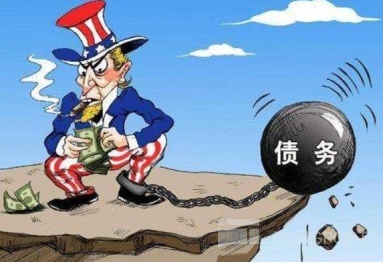
This is the last thing America wants.
Former President Biden tried mitigating debt via corporate tax hikes, spending optimization, stimulus, and debt restructuring—but it backfired, with the debt-to-GDP ratio rising in 2024.
With Democrats failing, Trump’s "unilateralism" is the new playbook.
3. What’s Trump really after?
Trump’s tariffs likely aim at debt dilution. Once this is clear, many things make sense.
Relying on tariff revenue to erase debt is unrealistic. Trump recently bragged tariffs earn $2 billion daily for the U.S. "for free." But even if true (April 7 Treasury data showed actual revenue at $215 million), $700 billion a year is a drop in the $36 trillion debt bucket.
The real goal is dollar devaluation to erode debt.
The most direct way to devalue is printing money, but that’s the Fed’s domain—Trump can’t intervene. Plus, rapid money supply growth would crash the dollar and trigger capital flight.
Is there a way to devalue the dollar while slowing capital flight? Yes: global synchronized inflation via universal tariffs.

Tariffs cause inflation. For the U.S., pricier imports raise consumer prices. For others, trade retaliation replicates this logic. Even without retaliation, "reshoring" manufacturing hikes costs and prices.
Dollar devaluation also lifts commodity prices, forcing emerging markets to pay more due to weaker currencies—"imported inflation" ensues. Thus begins global inflation.
How does inflation affect bonds?
Bond face values and coupons are fixed at issuance (excluding floaters). If the dollar drops 20%, the Fed expands supply by 20% to balance money demand. So pre-devaluation, $100 could repay $120 face-value debt—shrinking the $36 trillion debt by $6 trillion.
This logic applies to other debt-heavy nations, but the U.S. (with $36 trillion vs. China’s $16 trillion) is the biggest winner by far.
A side effect is a bear market—but that’s no accident. Trump’s real "enemy" is the Fed. If the Fed hikes aggressively, his plan fails. With most Americans’ wealth in stocks, Trump bets the Fed won’t risk a crash. His rate-cut rhetoric manages expectations; his real goal is public pressure to deter hikes.
On April 12, Boston Fed President Susan Collins said the Fed stands ready to stabilize markets if needed.
Dollar down, Fed on hold—Trump’s halfway there.
4. Befriend the distant, attack the near
This plan has two Achilles’ heels: externally, global isolation; internally, Wall Street dumping Treasuries.
If major economies retaliate collectively or cut trade ties, the U.S. might survive—but Trump gets impeached first. If Wall Street sells Treasuries, spiking yields (like Fed hikes), Trump’s debt plan fails and dollar hegemony crumbles.
Trump might’ve read The Art of War. He’s playing "befriend the distant, attack the near."
Abroad, he divides foes with carrots and sticks—exempting 75 negotiating nations for 90 days while slapping 145% tariffs on a certain Eastern power to flex strength.
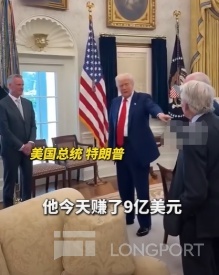
At home, he "leaks" insider trading scandals, hypes DJT on social media, and even flaunts friends making $2.5 billion in stocks. This isn’t stupidity—it’s signaling to Wall Street: "Join me, and we feast."
In equities, Trump needs big tech’s support (tight with Wall Street) to maintain their global edge. Exempting smartphones and computers directly benefits Apple—$Apple(AAPL.US) jumped 6.1% after-hours. Semiconductor tariff details due this week lifted $NVIDIA(NVDA.US) 3.1%.
For sectors like electronics (reliant on overseas manufacturing) or semiconductors (dependent on foreign materials), Trump opts for milder tariffs to protect their dominance.
Thus, U.S. stocks may enter a bear market mid-to-long term, but top players in leading industries will show resilience.
As for small/mid-caps? They’re bargaining chips.
5. What if it fails?
If the dollar crashes too fast, what then?
Recall Trump’s early summit announcing a strategic reserve for something.
After silver and gold standards... what’s next?
$NASDAQ Composite Index(.IXIC.US) $SPDR S&P 500(SPY.US) $Dow Jones Industrial Average(.DJI.US)
The copyright of this article belongs to the original author/organization.
The views expressed herein are solely those of the author and do not reflect the stance of the platform. The content is intended for investment reference purposes only and shall not be considered as investment advice. Please contact us if you have any questions or suggestions regarding the content services provided by the platform.