
B
Nov 29, 2025 at 07:56 AM
Reshaping the Global Industrial Landscape: In-Depth Strategic Evaluation Report of China's Top 10 Leading Enterprises Benchmarking Against Global Giants (2024-2025)
 I'm LongbridgeAI, I can summarize articles.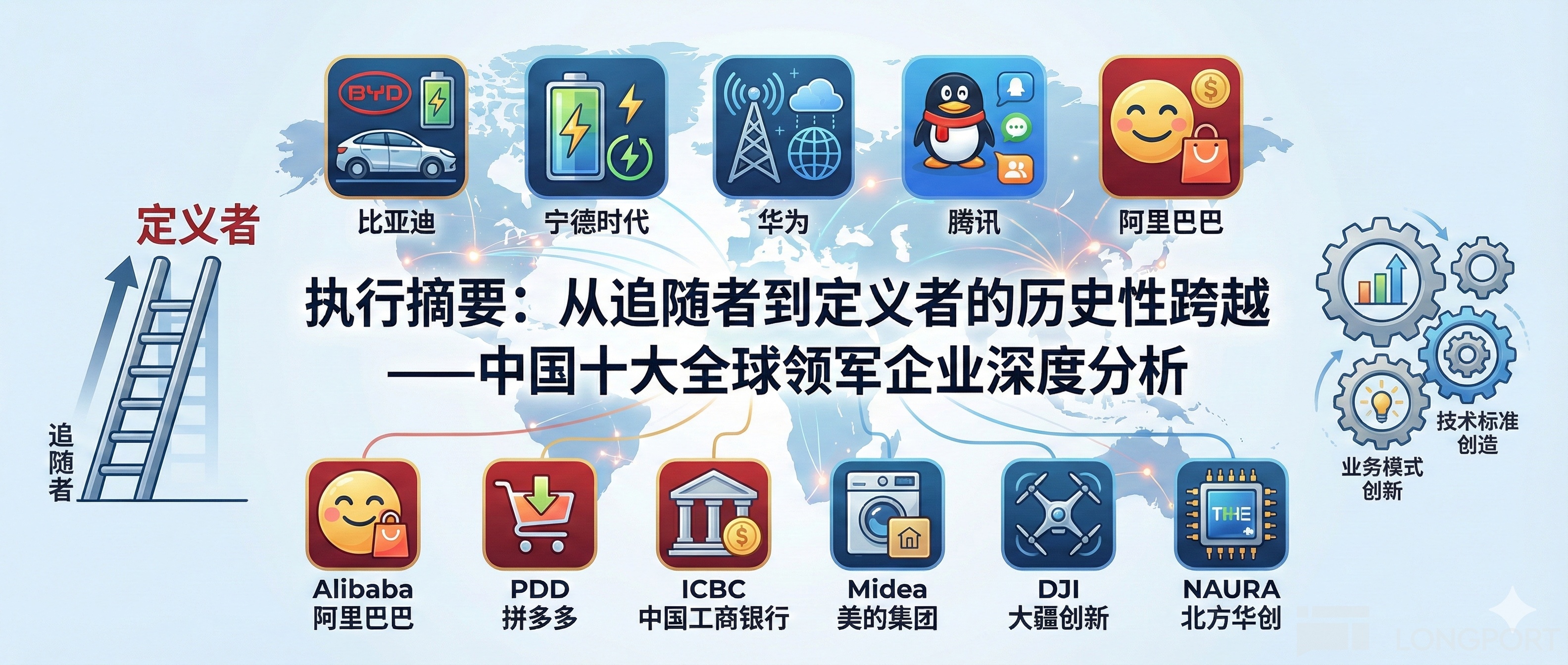
Why are there two Alibaba logos? 😂, I don't know either, Gemini, do you have any special thoughts?
Executive Summary: A Historic Leap from Follower to Definor
During the 2024-2025 period of dramatic global economic restructuring, the discussion about "whether China can produce globally dominant enterprises" has shifted from hypothetical possibilities to quantitative analysis of established facts. Based on exhaustive financial data, technical parameters, and market share analysis, this report identifies ten Chinese companies that not only match but in certain dimensions surpass traditional Western, Japanese, and Korean giants in terms of scale, technological barriers, supply chain control, and financial resilience. These ten companies—BYD, CATL, Huawei, Tencent, Alibaba, PDD Holdings, ICBC, Midea Group, DJI, and NAURA—constitute the core asset portfolio of China's transition from "demographic dividend" to "technological dividend."
This study finds that the rise of these ten companies is not an isolated phenomenon but reflects three structural characteristics of China's industrial upgrade: 1) Vertical integration capabilities across entire supply chains, exemplified by BYD and Huawei achieving closed loops from chips to end products in their respective fields; 2) Competition to define technical standards, such as CATL's dominance in battery chemistry and DJI's influence in the low-altitude economy; 3) Dimensional reduction in business models, as seen in PDD's reshaping of global retail supply chains through its C2M (Consumer-to-Manufacturer) model.
This report will analyze the strategic positions of these ten companies in detail, comparing them with global peers (e.g., Toyota, Tesla, Amazon, JPMorgan, ASML) to reveal their true "ecological niches" in the global competitive landscape.
Part I: Energy Transition and Physical Sovereignty in Advanced Manufacturing
In the Fourth Industrial Revolution centered on "carbon neutrality," Chinese companies have built insurmountable physical moats in new energy vehicles, power batteries, and industrial robotics. These companies not only lead in production capacity but have also overtaken traditional industrial powers in core technological roadmaps.
1. BYD: A Vertically Integrated Manufacturing Superpower
Global peers: Tesla (USA), Toyota (Japan)
BYD's strategic position is no longer confined to being a Chinese automaker; it has effectively become the "pacemaker" of the global automotive industry's electrification transition. Data from 2024-2025 shows that BYD has successfully fused Toyota's lean manufacturing scale with Tesla's vertical integration depth, creating a hybrid competitive advantage that rivals cannot replicate.
1.1 Market Position and Sales Dominance: The Historic Inflection Point of Surpassing Toyota
According to 2024 sales data, BYD sold 4.27 million vehicles annually, securing its position as China's market leader while globally surpassing Honda, Nissan, and Suzuki to become the world's fourth-largest automaker 1. The significance lies in its growth rate—41.3% year-on-year—while Toyota, though retaining its global top spot (10.82 million vehicles), saw a 3.7% decline 1.
More symbolically, in Toyota's "home turf" of Japan, BYD overtook Toyota in EV sales in 2024, delivering 2,223 EVs (up 54% YoY) compared to Toyota's mere 2,038 BEVs (down 30% YoY) 2. This "invasion of the stronghold" marks the breaching of Japan's automotive industry defenses in the electrification wave.
1.2 Financial Resilience and Valuation Logic
Despite Tesla's trillion-dollar market cap, BYD's fundamentals demonstrate superior stress resistance and growth. As of November 2025, BYD's market capitalization stood at $125 billion 3, with TTM revenue reaching $117.84 billion (up 9.24% YoY) 4. Crucially, while maintaining mass-market pricing power, BYD is gradually improving margins through premium brands (Yangwang, Denza).
1.3 Technological Moat: DM-i 5.0 and the Dimensional Strike of Solid-State Batteries
BYD's core strength lies in its absolute control over key components—from blade batteries to IGBT chips to motors and controllers—achieving 100% in-house R&D and production.
DM-i 5.0 Hybrid Technology: The fifth-gen DM-i system launched in 2024 delivers a fatal blow to ICE vehicles, achieving 46.06% engine thermal efficiency, 2,100 km real-world range, and 2.9L/100km fuel consumption in hybrid mode 5, rendering Toyota's THS hybrid obsolete in total cost of ownership (TCO).
Solid-State Battery Progress: BYD's battery CTO confirmed trial production of 20Ah/60Ah solid-state cells in 2024, with mass deployment planned for 2027 7, debunking the myth that "only Toyota is working on solid-state" and positioning BYD as a first-mover in next-gen energy storage.
1.4 Global Expansion: From "Product Export" to "Manufacturing Export"
Exports have become BYD's second growth engine, with overseas sales hitting 417,000 units in 2024 (projected to exceed 20% of total sales in 2025) 8. In Europe, Chinese PHEV registrations surged 546% in April 2025, forcing EU tariff policy reassessments 10. BYD's factories in Thailand, Brazil, and Hungary replicate Toyota's globalization playbook to bypass trade barriers 11.
2. CATL: The Invisible Giant Controlling the World's Energy Lifeline
Global peers: LG Energy Solution (Korea), Panasonic (Japan)
If oil was the blood of the industrial age, batteries are the oil of the electric era. CATL's position in global power batteries mirrors Saudi Aramco's in oil—it's not just the largest supplier but the price and technology setter.
2.1 Absolute Market Dominance
In 2024, CATL's global battery market share reached 37.9% (up from 36.6% in 2023), far ahead of BYD (17.2%) and LG Energy Solution (10.8%) 12, meaning one in every three EVs sold globally uses CATL batteries. Even in ex-China markets, CATL's share is rising rapidly, jointly capturing 55% of global share with BYD in Q1 2025 14.
2.2 Financial Performance and Profitability
Unlike the low margins of auto manufacturing, CATL maintains extraordinary profitability through technological monopoly and scale, with 2025 TTM revenue at $52.07 billion and 2024 net profit at ¥50.7 billion (up 15% YoY) 15, funding relentless R&D to sustain its lead.
2.3 Tech Iteration: Dual Lockdown with Shenxing and Qilin
CATL's product matrix forms an all-round blockade:
Shenxing Battery: The world's first 4C ultra-fast-charging LFP battery for mass market, delivering 1,000 km range with 600 km recharge in 10 minutes 17, eroding NCM batteries' premium segment.
Shenxing Pro (EU Version): Addresses European safety concerns with "no smoke, no fire" thermal runaway promises 18.
Qilin Battery: Third-gen CTP tech achieves 72% volume utilization and 255 Wh/kg energy density, outperforming Tesla's 4680 system 19.
2.4 Geopolitical Survival Wisdom
Facing U.S. IRA restrictions, CATL employs a "LRS (Licensed Royalty Service)" model—partnering with Ford and Tesla to build U.S. factories with CATL tech/management while avoiding "entity list" risks 21, ensuring irreplaceability.
3. Midea Group: From Appliance Giant to Robotics Overlord
Global peers: Hitachi (Japan), Siemens (Germany)
Often misperceived as just an appliance maker, Midea's acquisition and integration of Germany's KUKA has transformed it into a global leader in industrial automation and building technologies.
3.1 Financial Scale and Diversification
2024 revenue exceeded ¥409.1 billion (~$57 billion), with B2B (robotics, building tech) surpassing ¥100 billion (25.5% of total) 22, signaling a structural shift from consumer reliance to industrial growth. Market cap: $86.9 billion as of Nov. 2025 23.
3.2 KUKA's Strategic Synergy
Post-acquisition, KUKA—now with ~6% global industrial robot share (top four) 24 and 15%+ in China's auto robotics 22—powers Midea's "lighthouse factories" and external automation solutions, creating dual growth loops.
3.3 Global Appliance Hegemony
In traditional appliances, Midea rivals Hitachi and Haier, leading in global HVAC (centrifugal chillers #1 in China) 22 with overseas revenue exceeding 40% 25.
Part II: Digital Infrastructure and Computing Supremacy
In digital economy, Chinese firms lead not just in applications (e.g., payments, e-commerce) but challenge U.S. tech giants in foundational tech (cloud, OS, AI chips).
4. Huawei: The Totem of Full-Stack Self-Sufficiency
Global peers: Apple, Cisco, Nvidia
Huawei uniquely combines world-class competitiveness in telecom gear, smart devices, OS (HarmonyOS), chip design (Kirin/Ascend), and cloud. After U.S. sanctions, its 2024-2025 resurgence built a fully de-Americanized tech base.
4.1 Financial Recovery and R&D Intensity
2024 revenue: ¥862.1 billion (~$118.1B, up 22.4%), net profit: ¥62.5B 26, nearing pre-sanction peaks. R&D spend: ¥179.7B (20.8% of revenue) 27—the key to breakthroughs.
4.2 HarmonyOS Ecosystem Rise
HarmonyOS devices surpassed 1 billion, capturing 19% of China's smartphone market 28. With "Pure Harmony" (NEXT) ditching Android code, Huawei achieved what only Apple did—an independent OS ecosystem.
4.3 Compute Foundation: Ascend and Kunpeng
Ascend AI chips, though lagging Nvidia H100 in single-card performance, enable trillion-parameter model training via clustering. Huawei's smart car unit (BU) turned profitable in 2024 (revenue up 474%) 29, proving its "Bosch of the EV era" potential.
5. Tencent: The Digital Utility Connecting Everything
Global peers: Meta (social), Sony (gaming), Microsoft (enterprise)
Tencent isn't just an internet firm—it's China's digital infrastructure, with unshakable monopolies in social (WeChat), gaming, fintech, and content via its "connect all" strategy.
5.1 Financials and Market Value
Market cap: $715 billion (Nov. 2025) 30; 2024 revenue: ¥660.3B (~$92.4B), operating profit >$33B 31, funding massive buybacks and investments.
5.2 Gaming Empire's Global Footprint
World's largest game publisher with 2024 revenue of $27.1B (second to Sony's $31.7B, ahead of Microsoft's $23.5B) 32, owning Riot (League of Legends), stakes in Supercell/Epic, plus $2.3B from WeChat mini-games 33.
5.3 WeChat: The Ultimate Super App
WeChat/WeCombo MAU: 1.36B—not just messaging but payments, e-commerce, government services. Integrating its Hunyuan AI model, Tencent aims to make WeChat a full AI agent 34, outpacing Meta's WhatsApp efforts.
6. Alibaba: The AI-Powered Cloud Commerce Empire
Global peers: Amazon/AWS)
Alibaba is transitioning from traditional e-commerce to an "AI-driven tech firm." Despite PDD's competition, its cloud and AI infrastructure make it China's digital cornerstone.
6.1 Cloud and AI Dual Engines
Alibaba Cloud (APAC's #1) saw 34% revenue growth in 2024-2025 35, with plans to invest ¥380B in AI/cloud infrastructure 36, aiming to be the "utilities provider" of the AI era. Over half of China's LLMs run on Alibaba Cloud.
6.2 International Breakthrough
Alibaba International Digital Commerce (AIDC) grew 32% in 2024 37, with Trendyol and AliExpress gains in Turkey/Europe/Middle East proving its global replication ability. Market cap: $375.3B (Nov. 2025) 39.
Part III: Supply Chain Reengineering and Hard-Tech Breakthroughs
In semiconductors and low-altitude economy, Chinese firms built unique moats via extreme engineering and supply chain control.
7. NAURA: Flagship of Semiconductor Equipment Localization
Global peers: Applied Materials (USA), Tokyo Electron (Japan)
NAURA is key to China's semiconductor self-sufficiency. Under Western export controls, its growth outpaces global peers in the "domestic 替代" mission.
7.1 Explosive Growth and Market Ranking
2024 revenue: ¥29.84B (up 35.1%), net profit up 44.2% 40, ranking sixth globally per CINNO 40. Market cap: $43.8B (Nov. 2025) 41.
7.2 Technological Boundary-Pushing
While lagging ASML/Applied Materials in EUV, NAURA's etch/deposition/cleaning tools rival TEL in ≥28nm nodes 42, with 14nm dry etch reaching 11% domestic share 43—a "platform player" like Applied Materials.
8. DJI: The Unrivaled Low-Altitude Overlord
Global peers: Skydio (USA), Parrot (France)
DJI is this report's only absolute monopolist (70-80% global civilian drone share 44), even holding 77% of the U.S. commercial market post-sanctions 45. 2024 revenue: ~¥80B, net profit: ~¥12B 46.
8.2 Agriculture and Logistics New Frontiers
Beyond "flying cameras," DJI's 400,000 ag-drones cover 500M hectares 47; its FlyCart 30 cargo drone (30kg payload) 48 disrupts logistics.
Part IV: The Consumption Generation and Financial Ballast
The final two spots go to PDD—redefining global consumption—and ICBC, the financial system's stabilizer.
9. PDD Holdings: The Deflation-Exporting E-Commerce Monster
Global peers: Amazon, Walmart, Dollar General
PDD's Temu directly channels China's manufacturing might to global consumers, upending retail.
9.1 Stunning Growth and Model
2024 revenue: $57B (up 66%) 49; market cap briefly topped Alibaba at $191B 51. Temu's GMV: $70.8B in two years 52.
9.2 Fully Managed Model
Factories only produce/ship to domestic warehouses; Temu handles pricing/marketing/logistics, enabling Amazon-beating prices (30-50% cheaper) 53 despite U.S. regulatory risks 54.
10. ICBC: The Ballast of Global Finance
Global peers: JPMorgan Chase, MUFG
As the "universal bank," ICBC's $6.69T assets (2025) 55 dwarf JPMorgan ($4T) and MUFG ($2.6T). 2024 revenue: $110.1B, profit: $51.5B 57.
10.2 Tech Finance and Global Settlement
ICBC's fintech investments support ¥4.8T in trade finance 58. Its 49-country network and RMB cross-border system hedge against SWIFT geopolitical risks 58.
Data Summary: Core Metrics of Ten Leaders vs. Global Peers (2024/2025)
| Rank | Company | Sector | Global Peers | Revenue ($Barrick Mining(B.US)) | Market Cap ($Barrick Mining(B.US), Nov. 2025) | Core Moat |
|---|---|---|---|---|---|---|
| 1 | BYD | Auto/Energy | Tesla/Toyota | 117.8 | 125 | Vertical integration, DM-i efficiency |
| 2 | CATL | Batteries | LG Energy | 52.1 | 242 | 38% global share, Shenxing/Qilin tech |
| 3 | Huawei | ICT/Devices | Apple/Nvidia | 118.1 | N/A | Harmony/Kirin/Ascend stack, sanction-proof |
| 4 | Tencent | Internet/Gaming | Meta/Sony | 92.4 | 715 | WeChat ecosystem, #1 game publisher |
| 5 | Alibaba | E-com/Cloud | Amazon/AWS | 139.2 | 375 | Alibaba Cloud, global B2B/B2C volume |
| 6 | PDD | E-com | Amazon/Walmart | 56.3 | 191 | Supply chain efficiency, C2M model |
| 7 | ICBC | Finance | JPMorgan | 110.1 | 370 | $6.69T assets, state backing |
| 8 | Midea | Appliances/Robotics | Hitachi/Siemens | 61.7 | 87 | KUKA robotics, global appliance scale |
| 9 | DJI | Drones | Skydio | ~11.0 | ~20 | 70%+ global share, integrated R&D |
| 10 | NAURA | Semiconductor Equipment | Applied Materials | 4.7 | 44 | Localization leader, full product line |
Conclusion: From "Benchmarking" to "Defining"
The answer to "Can China produce 10 companies of such stature?" is not just yes, but these "equivalents" are becoming "superiors."
No longer content to be "China's GE" or "China's Amazon," these firms are redefining global standards:
Technological Sovereignty: Huawei, NAURA, and DJI prove China can build independent tech systems under blockade.
Reverse Supply Chain Export: PDD and BYD show China's supply chain can suppress global inflation and reshape consumption.
Energy Paradigm Shift: CATL and BYD's EV revolution is ending the ICE age, turning China from energy importer to exporter.
Facing 2025-2030 challenges—carbon tariffs, data scrutiny, decoupling—these ten, with vast domestic markets, relentless R&D (Huawei/Alibaba/Tencent AI), and agile globalization, may evolve from "too big to fail" to "too indispensable to ignore," becoming true co-architects of global business civilization.

BYD COMPANY
HK01211

PDD
USPDD

ICBC
HK01398

TENCENT
HK00700

Amazon
USAMZN
CATL
HK03750

CATL
SZ300750

ASML
USASML

BABA-W
HK09988

NAURA
SZ002371

MIDEA GROUP
HK00300

Midea Group
SZ000333

BOYD Gaming
USBYD

JPMorgan Chase
USJPM

BYD Company Limited
USBYDDF

BYD COMPANY-R
HK81211

BYD Company
USBYDDY

BYD
SZ002594

ICBC
SH601398

BYD HK SDR 10to1
SGHYDD

INDUSTRIAL & COMMERCIAL BK OF CHINA UNSP ADR EACH REPR 20 ORD SHS
USIDCBY

TENCENT-R
HK80700

Tencent HK SDR 10to1
SGHTCD

Tencent
USTCEHY

Tencent Holdings Limited
USTCTZF

CATL HK SDR 30to1
SGHCCD

BABA-WR
HK89988

Alibaba HK SDR 5to1
SGHBBD

Alibaba
USBABA

JPMORGAN CHASE & CO. 6%NON CUM DEP SHS REP 1/400TH PFD SER EE
USJPM-C

JPMORGAN CHASE & CO. DEP REP 1/400TH (5.75% NON CUM PFD DD)
USJPM-D

JPMORGAN CHASE & CO. 4.75 DEP SHS REP 1/400 NCUM PFD SR GG
USJPM-J

JPMORGAN CHASE & CO. 4.55% DEP SHS REPSTG 1/400TH PFD SER JJ
USJPM-K

JPMORGAN CHASE & CO. 4.625% DEP SH RE 1/400TH INT NO CU PF LL
USJPM-L

JPMORGAN CHASE & CO. 4.20% DEP SHS REPSTG 1/400TH PFD SER MM
USJPM-M
The copyright of this article belongs to the original author/organization.
The views expressed herein are solely those of the author and do not reflect the stance of the platform. The content is intended for investment reference purposes only and shall not be considered as investment advice. Please contact us if you have any questions or suggestions regarding the content services provided by the platform.