
SpaceX offering 30% of shares to retail investors: a benefit or a trade-off?
 I'm LongbridgeAI, I can summarize articles.
Everyone online is hyping: Elon Musk is so kind, leaving 30% of SpaceX's IPO for retail investors.
This narrative is wrong from start to finish. It's not the conclusion that's wrong, but the entire framework.
The Essence of IPO Allocation: Who Sets the Price, Who Takes the Shares
First, let's get a basic logic straight.
An IPO allocation is, in essence, a distribution of pricing power. Institutions get shares, which is the right to arbitrage by "buying at a low price and selling on the secondary market." Retail investors get shares, usually the leftovers after institutions have picked.
The US IPO convention allocates only 5%-10% to retail. Why? Because underwriters need institutions to "discover the price." Institutional bids determine the offering price, and their holdings determine post-listing stability.
But SpaceX wants to give 30% to retail.
This isn't three times the convention; it's a complete restructuring of the entire IPO pricing logic.
Here's the question: Why would Musk bypass institutions and push shares to retail investors?
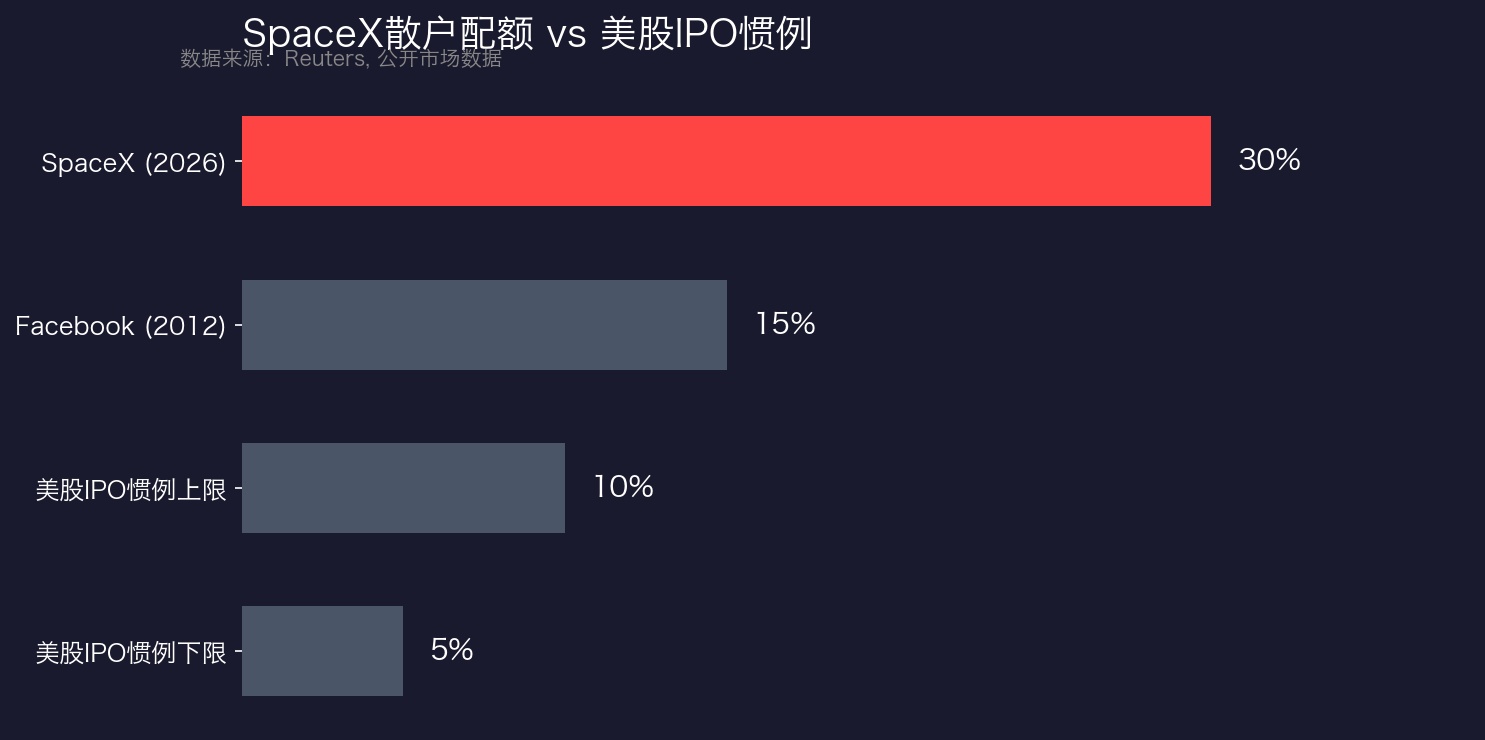
SpaceX's 30% quota is 3-6 times the US IPO convention.
Retail Investors Are Not Beneficiaries, They Are Liquidity Anchors
The answer lies in a logic that institutional investors understand but won't say publicly:
The first thing institutions do after getting a hot IPO is sell.
It's called pop-and-dump in the industry—the stock price soars on the first day, and institutions immediately cash out to lock in profits. This is standard practice, nothing wrong with it. But for the company, a script where the stock soars on day one and then falls for three consecutive months is the worst.
Musk's retail fans won't do that.
Tesla's data has already proven it: retail ownership is 35%-40%, ranking in the top 3% of the S&P 500. In the 2024 compensation plan vote, 90% of retail investors voted in favor. The stock price fell over 50% from its high, and retail didn't flee.
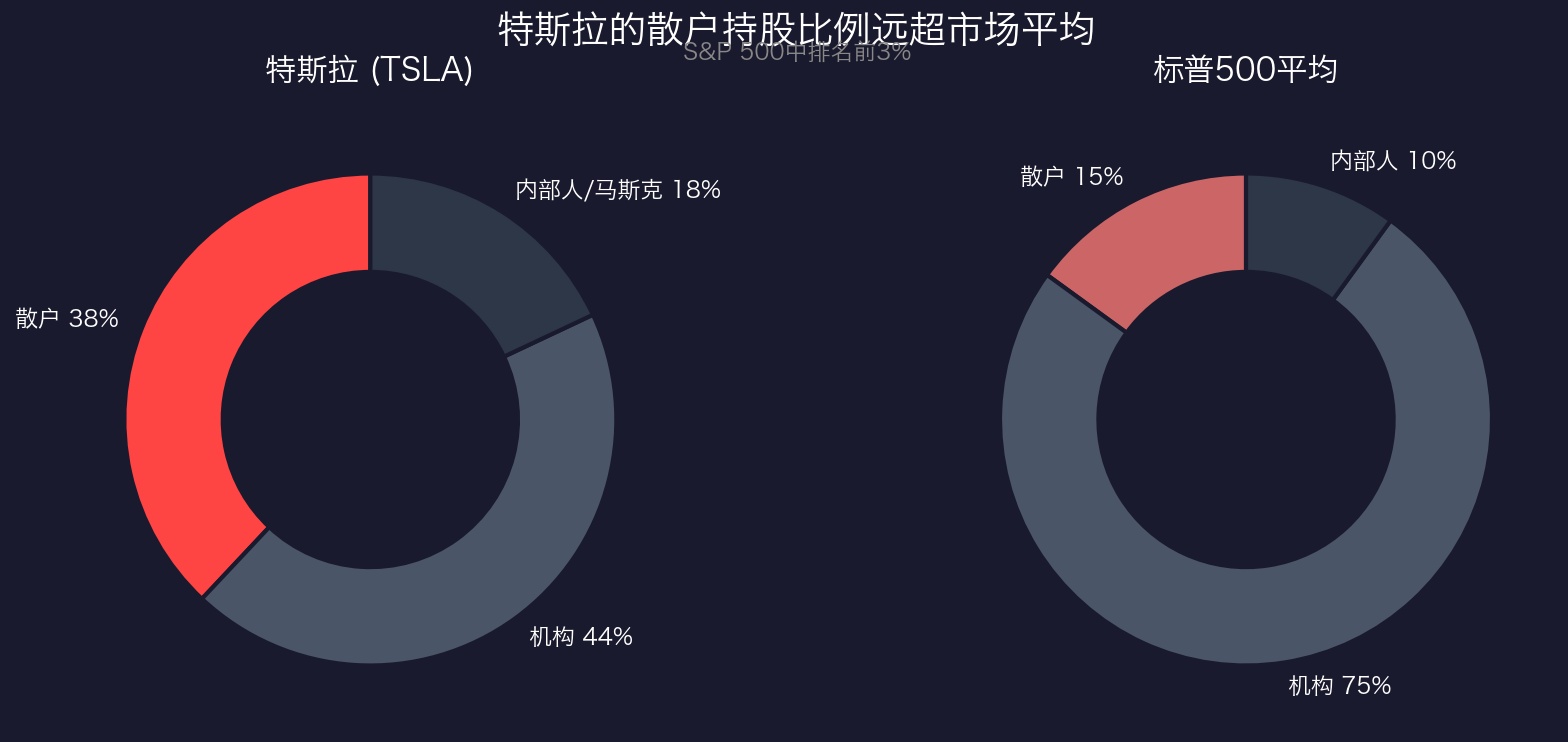
Tesla's retail ownership is 38%, while the S&P 500 average is only 15%.
In plain English: These people are not investors; they are believers. Believers don't sell just because they lose money.
So, the 30% retail quota is not about "letting retail share the gains."
It's about using retail investors as a liquidity anchor after listing to suppress volatility and stabilize the stock price's foundation.
This isn't gratitude; it's control theory.
Deeper Level: Bypassing Institutions = Preserving Control
The logic doesn't end here.
The higher the institutional ownership, the greater the governance pressure the company faces. Institutions will vote against, send open letters, and demand CEO changes.
Retail investors won't.
Retail investors are dispersed, silent, and loyal. At shareholder meetings, they either don't vote or vote along with management. Musk has already validated this path with Tesla—using retail investors to dilute institutional influence and preserve his absolute control.
SpaceX is valued at $1.75 trillion, raising up to $75 billion. If institutions led an IPO of this scale, every decision Musk makes would be scrutinized by the board.
But if 30% of the shareholders are retail—individual investors who believe in colonizing Mars and Starlink changing the world—Musk's decision-making space becomes much larger.
A $75 billion IPO, with 30% for retail, is essentially buying a $22.5 billion insurance policy against "institutional interference."
Conclusion
To put it bluntly, the essence of this matter is not "whether Musk is good to retail investors."
It's that Musk has found a more elegant control scheme than a dual-class share structure: using loyalty to replace voting power.
Retail investors got SpaceX shares. Happy? Of course. But understand your role in this structure—you are not a partner; you are ballast.
That's not a bad thing. Ballast can make money too.
But don't mistake a business strategy for sentiment. In capital markets, the most expensive cognitive error is called "mistaking exploitation for respect."
$SPACEX #美股#IPO#Musk#RetailInvestors
Data sources: Reuters, The Motley Fool, Seeking Alpha, public market data. The above content represents personal views only and does not constitute investment advice.

Tesla
USTSLA

Destiny Tech100
USDXYZ

TSLA 2X Short ETF
USTSDD

TSLA 2X Long ETF
USTSLL

AXS TSLA Bear Daily ETF
USTSLQ

XI2CSOPTSLA-U
HK09366

XL2CSOPTSLA
HK07766

XI2CSOPTSLA
HK07366

GraniteShares 2x Long TSLA Daily ETF
USTSLR

Direxion S&P 500 Bear 1X
USSPDN

.SPX
US.SPX

SPY
USSPY

IVV
USIVV

SDS
USSDS

SH
USSH

SPXL
USSPXL

SPLG
USSPLG

SPXU
USSPXU

SPXS
USSPXS

SSO
USSSO
The copyright of this article belongs to the original author/organization.
The views expressed herein are solely those of the author and do not reflect the stance of the platform. The content is intended for investment reference purposes only and shall not be considered as investment advice. Please contact us if you have any questions or suggestions regarding the content services provided by the platform.