
新
Apr 20 at 11:58 AM
Has the Bitcoin bear market bottomed out?
 I'm LongbridgeAI, I can summarize articles.
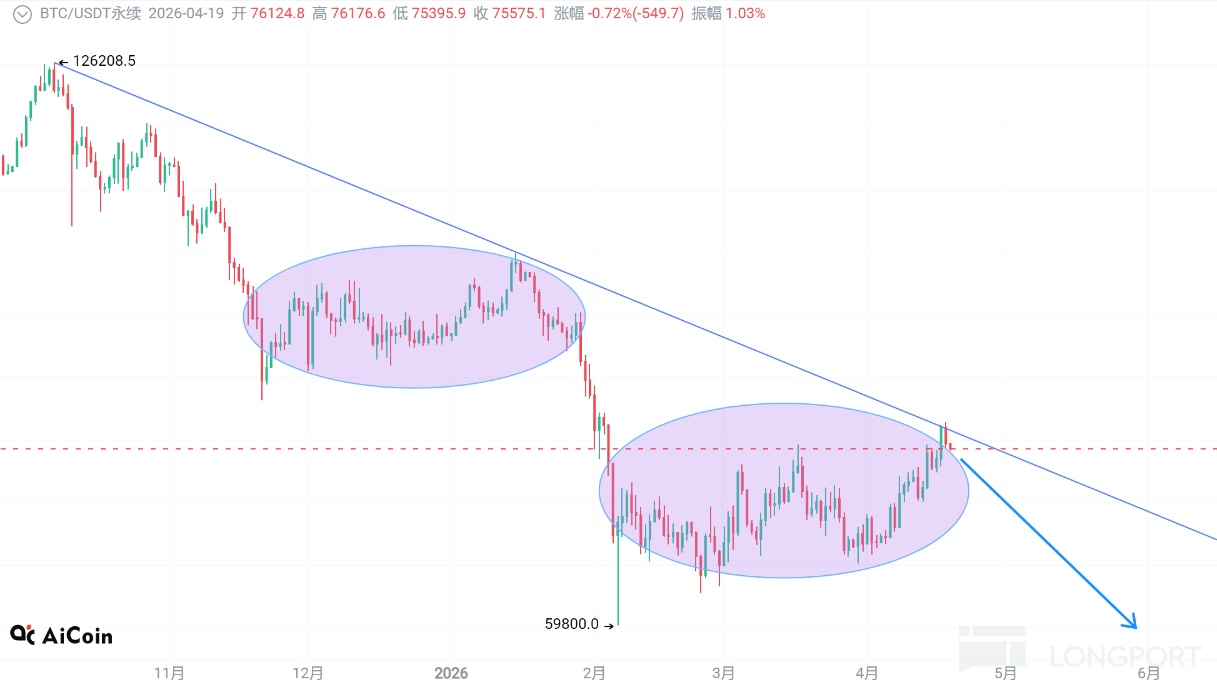
Recently, Bitcoin rebounded to 78k, and I noticed that some people are starting to be bullish again, focusing only on short-term trends, which seems like a bottoming process, but it's actually a bull trap.

Every time I see comments like this, I want to say, if you always see a bull market when it goes up and a bear market when it goes down, it's hard to make money.
Why is 60k not the bottom? The reason is that neither time nor space is sufficient.
From a time perspective, historical bear markets have lasted a year. Did this one bottom out after just six months? That doesn't quite fit past patterns.
From a price perspective, this bear market has only fallen 50%, far less than the 75% drop in the last bear market, which also doesn't fit the pattern.
I believe the next move is very likely to repeat what happened in January this year: a false breakout at the end of the consolidation period, making people mistakenly think a bottom has been reached and a rebound has begun, only to then reverse downward and start a new round of decline.
Now let's expand on how we understand the various stages of Bitcoin's transition from a bull to a bear market. The following content references the blogger Dr. Profit, which I personally find quite credible.
The transition from a bull market top to a bear market bottom is divided into 6 stages, numbered below.
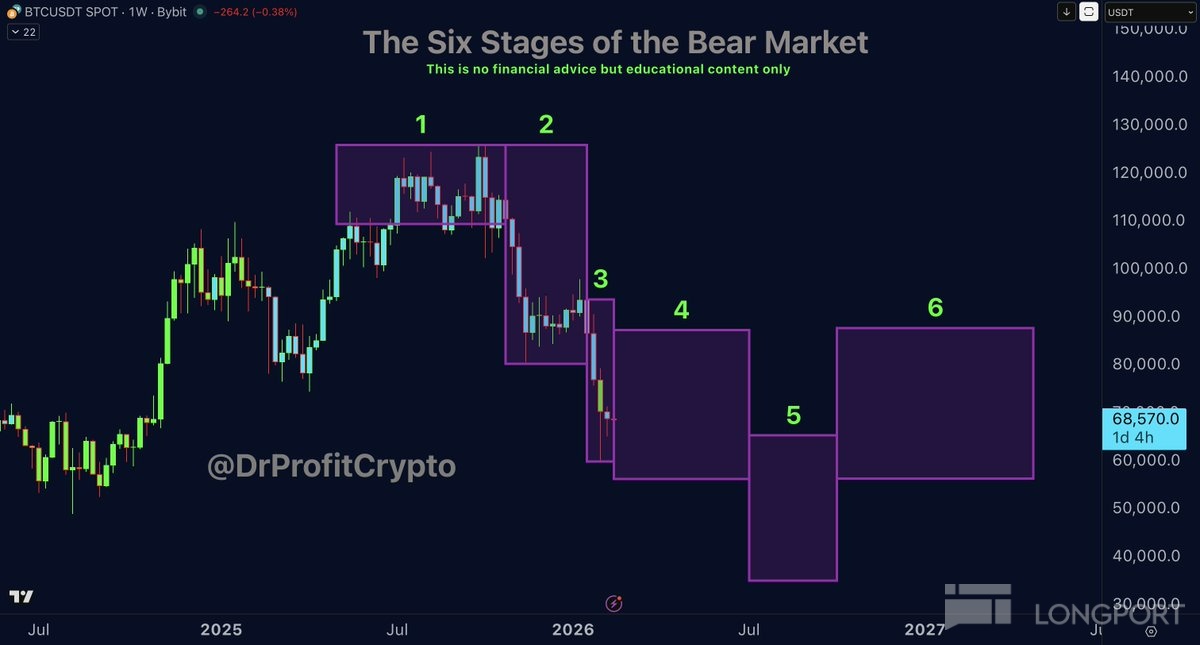
Stage 1: The market is thriving.
From July to October 2025, Bitcoin was in the 110k-120k range, constantly hitting new highs, creating an illusion of a perpetual bull market. The mainstream view at the time was that Bitcoin would have a long bull run similar to US stocks, rising to $200,000.
At that time, the market was in a prolonged sideways consolidation at high levels. On the surface, everything seemed strong, but in reality, the market was overloaded and over-leveraged. Looking at the K-line chart, it became increasingly difficult to rise, with each new high showing smaller gains.
Many who entered the market later believed the risk had disappeared. Crazy price predictions were everywhere, and people's greed reached its peak.
Stage 2: Breaking through an important psychological level.
Once Bitcoin breaks below a key psychological level (100k for this cycle), Stage 2 begins.
This psychological level is crucial because its breach puts pressure on short-term investors and forces leveraged traders to exit, making them realize the dream of Stage 1 is shattered.
The Stage 2 move happens very quickly; retail investors have no time to rethink.
A typical example is the big crash on October 11, 2025, which triggered the largest liquidation event in crypto history. It all happened in just a few hours, declaring the start of the bear market.
Stage 3: Bear market confirmation, rapid decline.
After Stage 2, the market needs accelerated volatility, so an even more brutal decline follows. Bitcoin fell from $97,000 in January to $60,000 in February, a 40% plunge in just 30 days.
Stage 3 is the fastest of all stages. With its extreme and rapid decline, it completely confirms the arrival of the bear market. Investors fall into deep frustration and panic, suffering losses they never anticipated.
Stage 4: Sideways movement.
We are currently in this stage. Stage 4, while not highly volatile, is exhausting. Prices will consolidate sideways for a long time, usually months.
The current consolidation range is the selling zone for weak investors. Retail investors start saying Bitcoin will fall another 30-40%, and it's better to sell now. They missed the exit opportunities in the earlier stages and can only sell at a loss now.
Stage 5: Extreme fear and capitulation.
This stage is also called the capitulation stage. Only at this point is the real bear market bottom reached.
This stage is the most emotional. Clear panic emerges in the market, and panic leads to forced selling. This stage is usually associated with the collapse of large institutions, exchange failures, or black swan events.
And surprisingly, panic selling still occurs even after Bitcoin has fallen 50% to 70% from its all-time high. This phenomenon repeats every cycle.
For example, in the 2018 bear market, when Bitcoin fell from 20k to 6k, everyone thought 6k was the bottom.
Then, over the next month, due to the BCH fork event, Bitcoin fell from 6k to 3k, the market fell into extreme panic, and the bear market bottom was finally established.
And in the 2022 bear market, with the FTX exchange collapse, Bitcoin fell from 20k to 15k, the market fell into despair again, and the bear market bottom was finally established.
So, what black swan event will cause Bitcoin's final drop in this bear market? We don't know yet.
Stage 6: Stabilization and reversal.
This is the final stage. Selling pressure gradually disappears, and the market begins to lay the foundation for the next bull cycle.
At this time, institutions start buying heavily during the market's panic selling, while retail investors keep shouting for lower prices, even proposing extreme target prices like $10,000 or lower. Retail investors greedily chase lower prices again, ultimately missing the bear market bottom and the subsequent bull market.
To date, the above pattern has repeated in every Bitcoin cycle. Although the narratives and backgrounds of each cycle are different, human nature never changes, so there are repeated, predictable patterns.
Once you understand the trading patterns of retail investors and the market structure, buying at the bear market bottom and selling at the bull market top is no longer an unattainable dream.
Buying Bitcoin on October 6, 2026, will be your closest chance to financial freedom. The crypto bear market is here. There are 170 days left until the bottom of this Bitcoin bear market.
Bitcoin price at time of posting: $75,300









The copyright of this article belongs to the original author/organization.
The views expressed herein are solely those of the author and do not reflect the stance of the platform. The content is intended for investment reference purposes only and shall not be considered as investment advice. Please contact us if you have any questions or suggestions regarding the content services provided by the platform.