
D
Jul 15 at 06:03 AM
ASML: AI Frenzy, Picks-and-Shovels On Fire?
 I'm LongbridgeAI, I can summarize articles.
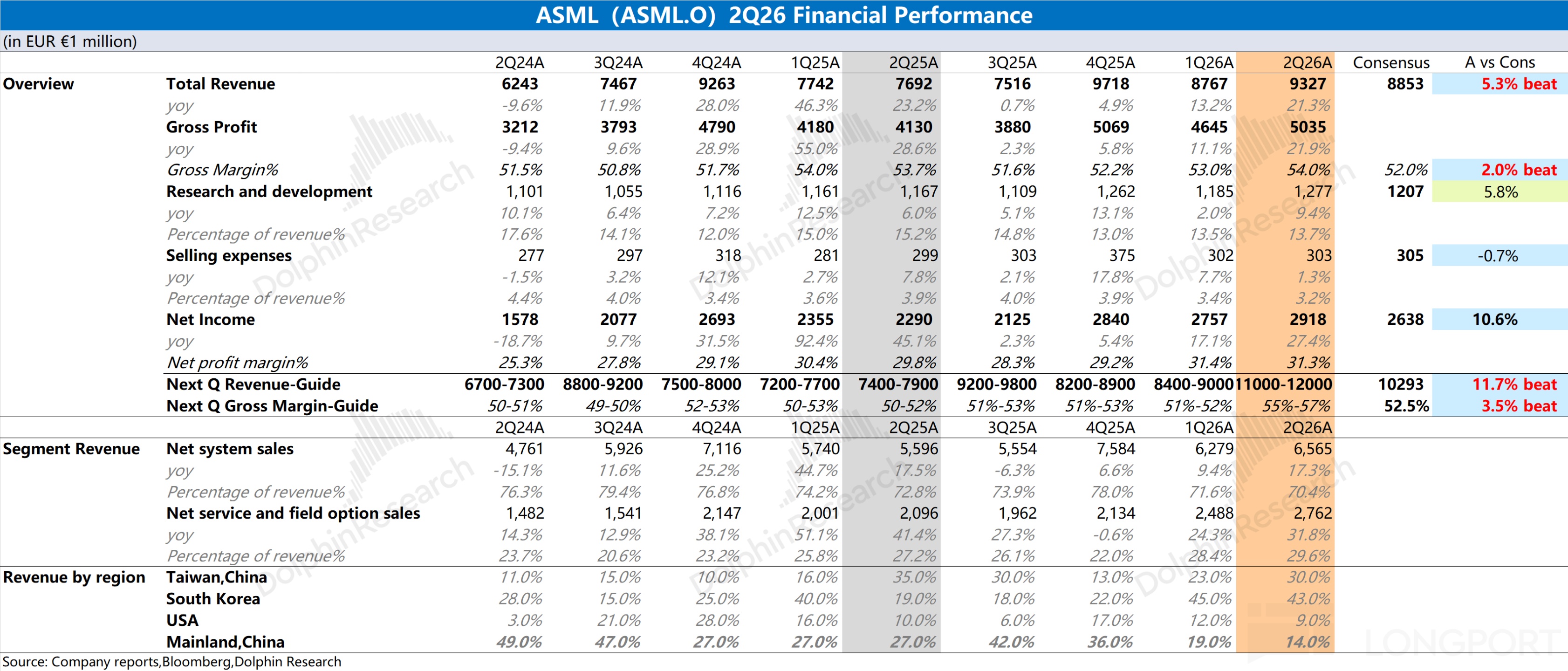
ASML released its Q2 2026 results (through Jun-2026) pre-market in the U.S. on the afternoon of Jul 15 Beijing time. Key takeaways:
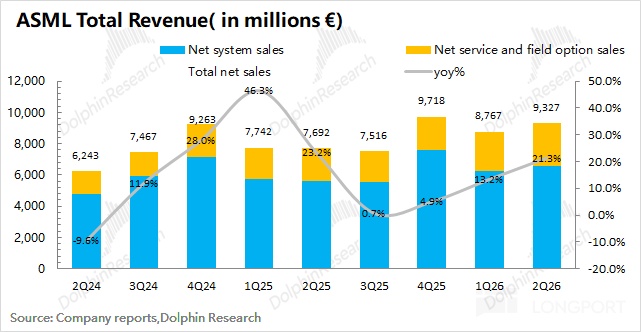
1) Revenue & GPM: a) Q2 revenue €9.3bn (+21% YoY), above street (€8.9bn), driven by pull-ins of lithography systems from TSMC and Korean customers and higher service revenue. b) GPM 54%, clearly above prior guide (51–52%), supported by mix shift toward higher-margin services.
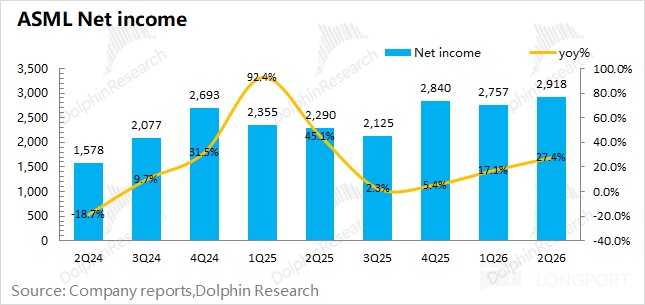
2) Expenses & profit: Net profit was €2.9bn (+27% YoY), with NPM at 31%. Profit growth was driven by revenue expansion and margin improvement.
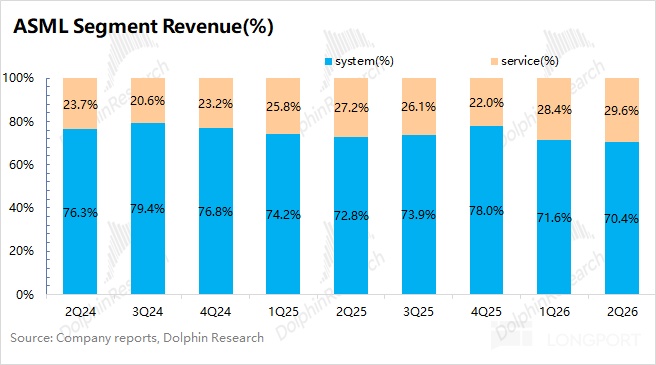
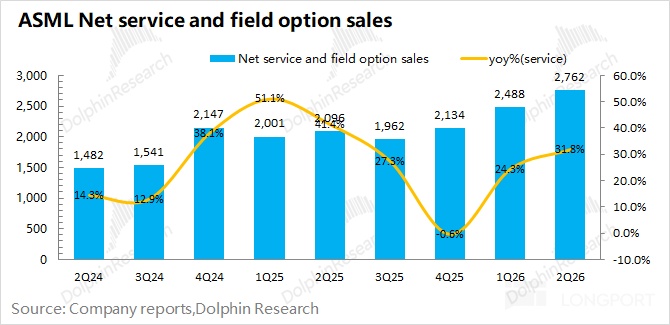
3) Segment detail: System revenue €6.56bn (+17% YoY); Service revenue €2.76bn (+32% YoY). The two segments are roughly at a 7:3 split.
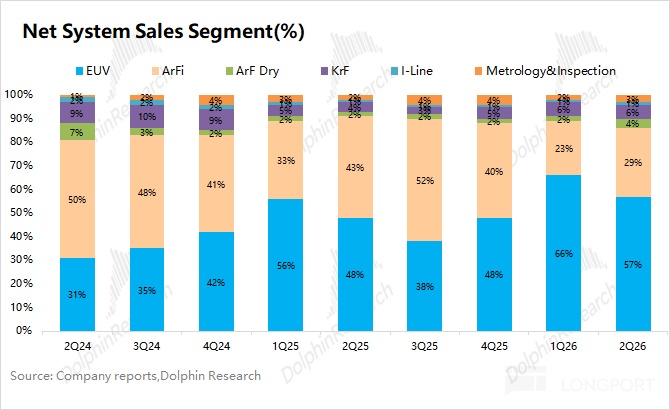
1) System revenue: EUV and ArFi are the main contributors, together accounting for 60% of total revenue. EUV revenue was ~€3.7bn this quarter, while immersion DUV-ArFi revenue was ~€1.9bn.
2) System shipments: $ASML(ASML.US) shipped 16 EUV tools in Q2, flat QoQ and better than market expectations of 14, driven by pull-ins from TSMC and Korean customers. ArFi shipments were 23, up 6 QoQ, as purchases from China slowed.
3) System ASPs: EUV ASP is markedly higher than ArFi. Dolphin estimates EUV ASP at ~€230mn and ArFi at ~€83mn, keeping the price ratio near 3:1.
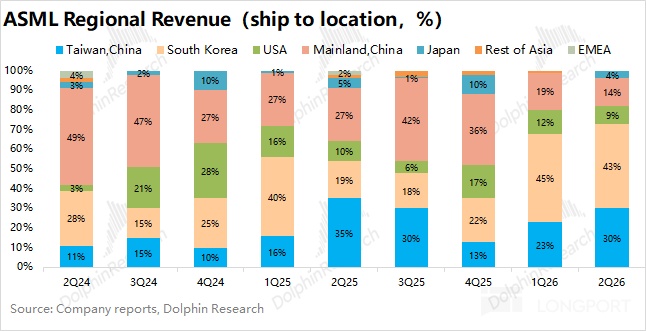
4) ASML focus points: a. Regional mix: Korea was the largest contributor this quarter (43%), or ~€4.0bn. Mainland China contributed ~€1.3bn (14%), notably below management’s prior ‘~20%’ comment. b. Orders: ASML stopped disclosing order data starting last quarter. Watch for management commentary on the earnings call.
5) Guidance: Q3 revenue guided to €11–12bn (above street €10.3bn) and GAAP GPM to 55–57% (well above street ~52.5%).
Management raised full-year 2026 guidance to €43–45bn (+31–37% YoY) with GPM at 54–56%.
The new guide implies H2 revenue growth of ~45–55% YoY, far above Q2’s 21%, suggesting ASML enters a high-growth phase in H2.
Dolphin view: Guidance blows away expectations
ASML delivered a strong print, with both revenue and GPM beating estimates. Growth re-accelerated on pull-ins from TSMC and Korean memory customers.
Guidance was the standout: management guides Q3 revenue to €11–12bn, well above street (€10.3bn). Meanwhile, the team again raised 2026 full-year guidance to €43–45bn (vs. prior €36–40bn), +31–37% YoY.
Consensus for full-year had largely sat around €39.5–40.0bn, so the new guide beats across the board and reinforces confidence. Combining the guide, Q4 revenue could rise further to ~€14–15bn, implying core fabs will begin large-scale pull-ins in H2.
On orders, the market is focused on the trajectory. ASML no longer discloses order intake, so watch if management shares specifics on the call (cf. Dolphin’s post-call summary).
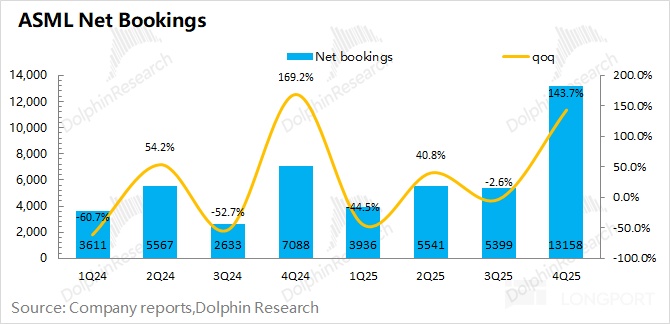
Despite the recent broad AI selloff, ASML’s drawdown was relatively small (~15%). With downstream fab capex clearly on the rise, such as Micron’s latest capex hike, ASML has tangible earnings support.
Beyond the print, the market’s focus is on two areas: customer capex and the progress of new technologies. a) Downstream capex: a forward-looking indicator.
TSMC, Intel, and Samsung are core customers, and their capex outlook leads ASML’s earnings trajectory. Based on core players’ outlooks, Dolphin estimates 2026 capex growth of >20% for logic and ~40% for memory. Growth stems from continued investment by TSMC and memory makers.
Micron again raised full-year capex in its latest results (from $25bn to $27bn). TSMC had raised full-year capex to $54–56bn, and the market now expects >$56bn.
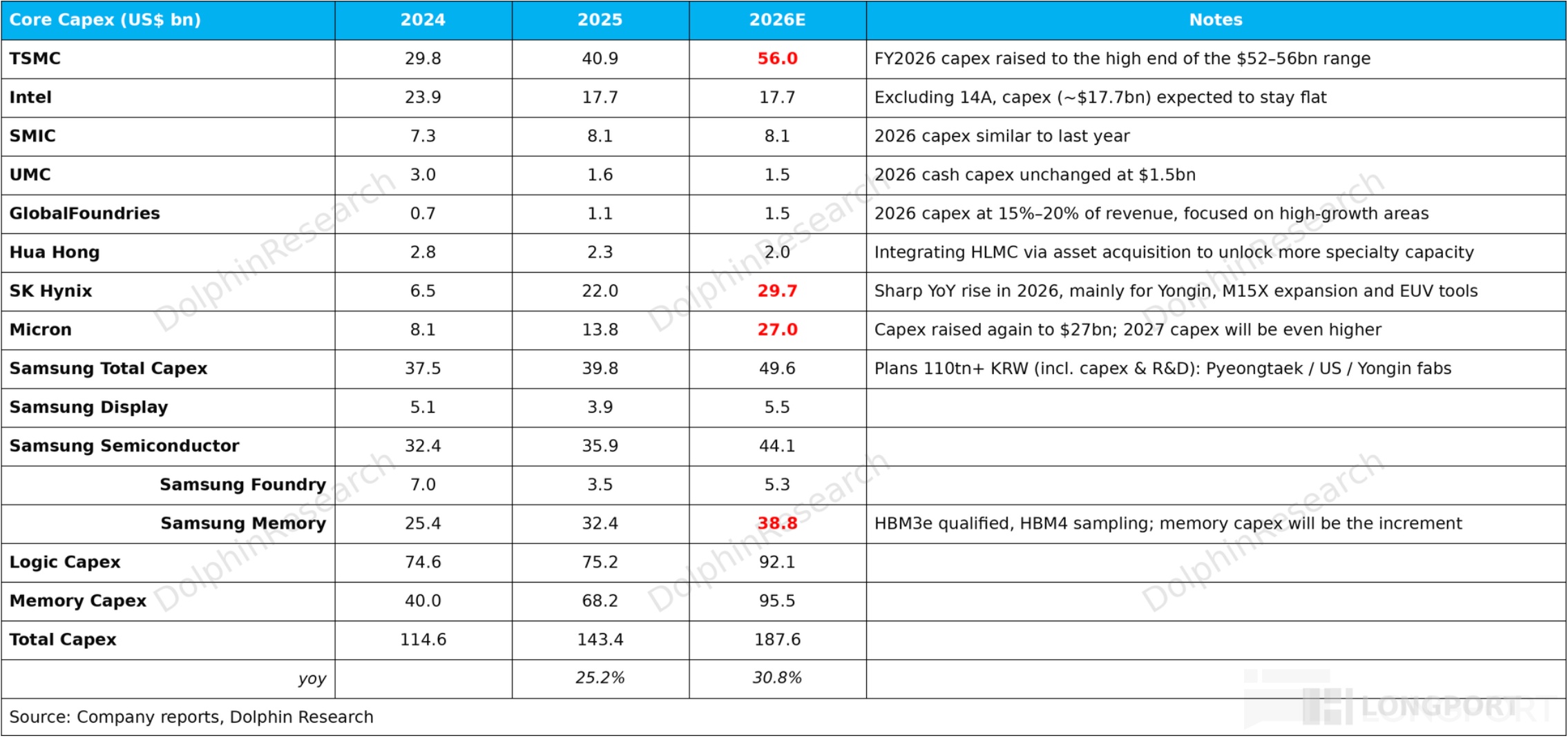
By comparison, ASML’s FY guide last quarter was €36–40bn, now lifted to €43–45bn. Dolphin believes this urgent incremental demand largely comes from additional orders by memory makers.
On one hand, memory makers earned substantial profits this cycle and have ample funds to buy or upgrade tools. On the other, EUV dramatically simplifies memory manufacturing. In key DRAM layers (cell array / storage nodes), DUV requires multi-patterning, whereas EUV can complete patterning with a single exposure, reducing steps, shortening cycle time, and improving yield.
Micron also announced a multi-year EUV supply agreement with ASML in its latest call. This is Micron’s first large-scale EUV order, signaling full adoption of EUV DRAM manufacturing. It relied on DUV multi-patterning before 1β, while 1γ is Micron’s first EUV node.
b) High-NA EUV progress: core tools for sub-2nm
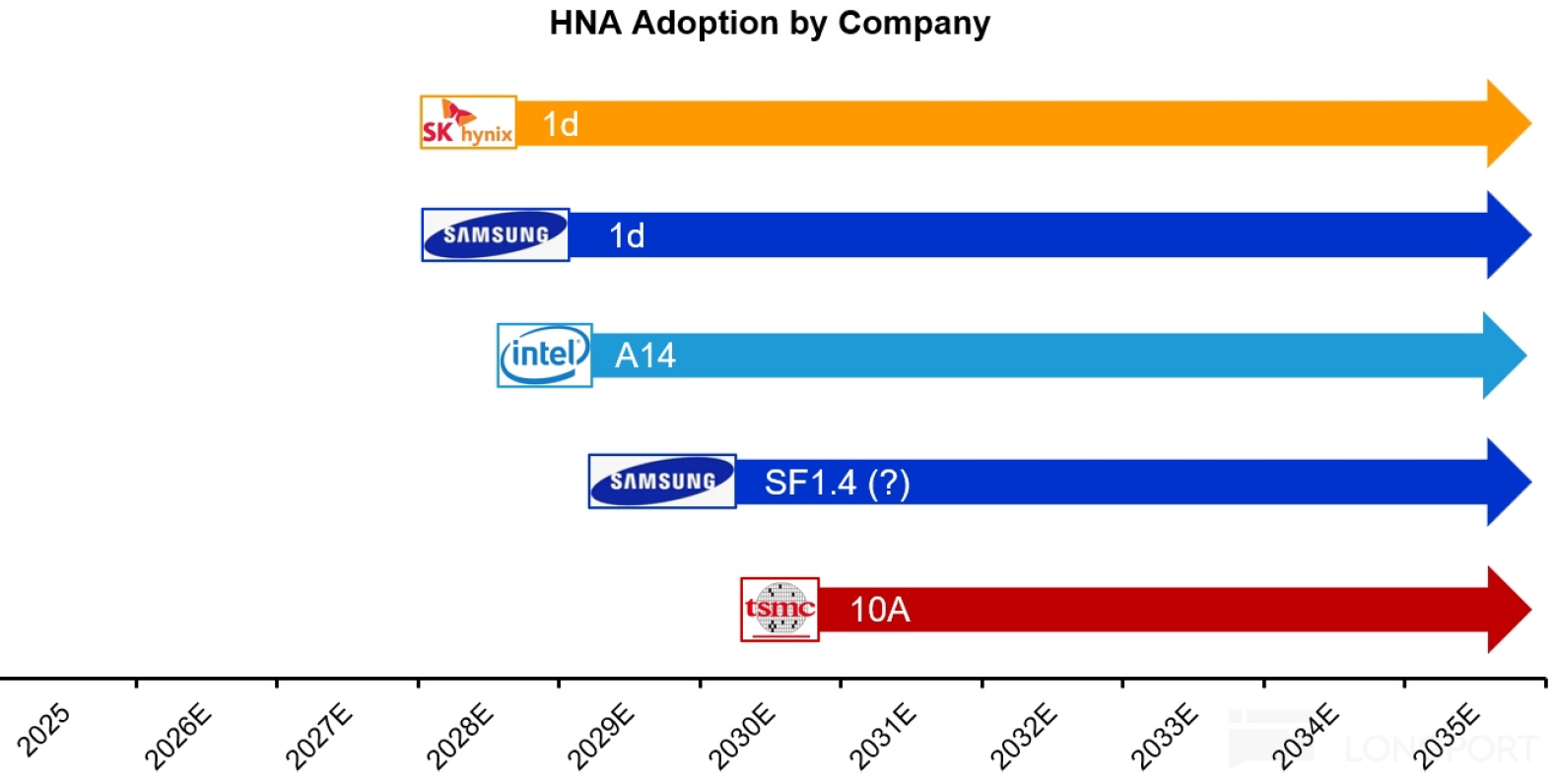
As nodes advance below 2nm, High-NA EUV will become the key equipment for the next phase. TSMC and Intel have already purchased ASML’s top-end High-NA EUV for R&D and future production.
High-NA EUV enables end-to-end process simplification, reduces non-litho costs, and improves yield, thereby increasing litho intensity. Layers previously requiring Low-NA EUV multi-patterning can now be completed with single exposure, simplifying the flow.
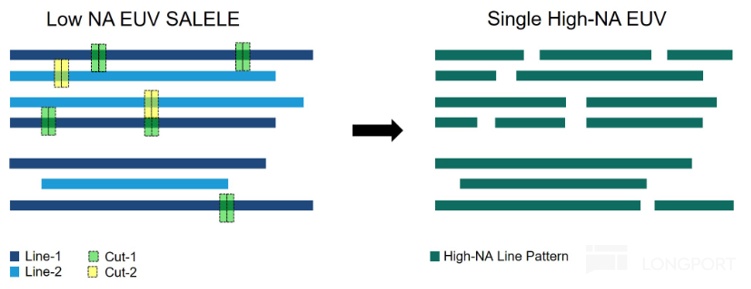
Given each company’s stance, Dolphin expects TSMC’s initial 2nm and Intel’s 18A to still use Low-NA EUV, primarily to secure better yields. This approach helps mitigate yield risk during ramp.
Considering cost and yield, TSMC has explicitly signaled delayed High-NA adoption. Dolphin expects ASML’s High-NA EUV shipment peak in 2028 and beyond. With TSMC still lifting capex, funds likely skew toward Low-NA EUV purchases.
ASML’s current mkt cap (~$684.3bn) implies ~27x 2027 post-tax core earnings on assumptions of ~35% revenue CAGR, 57.3% GPM, 18% tax, and EUR/USD at 1.14. Historically, ASML’s PE has largely ranged 30x–45x, placing the current PE near the low end.
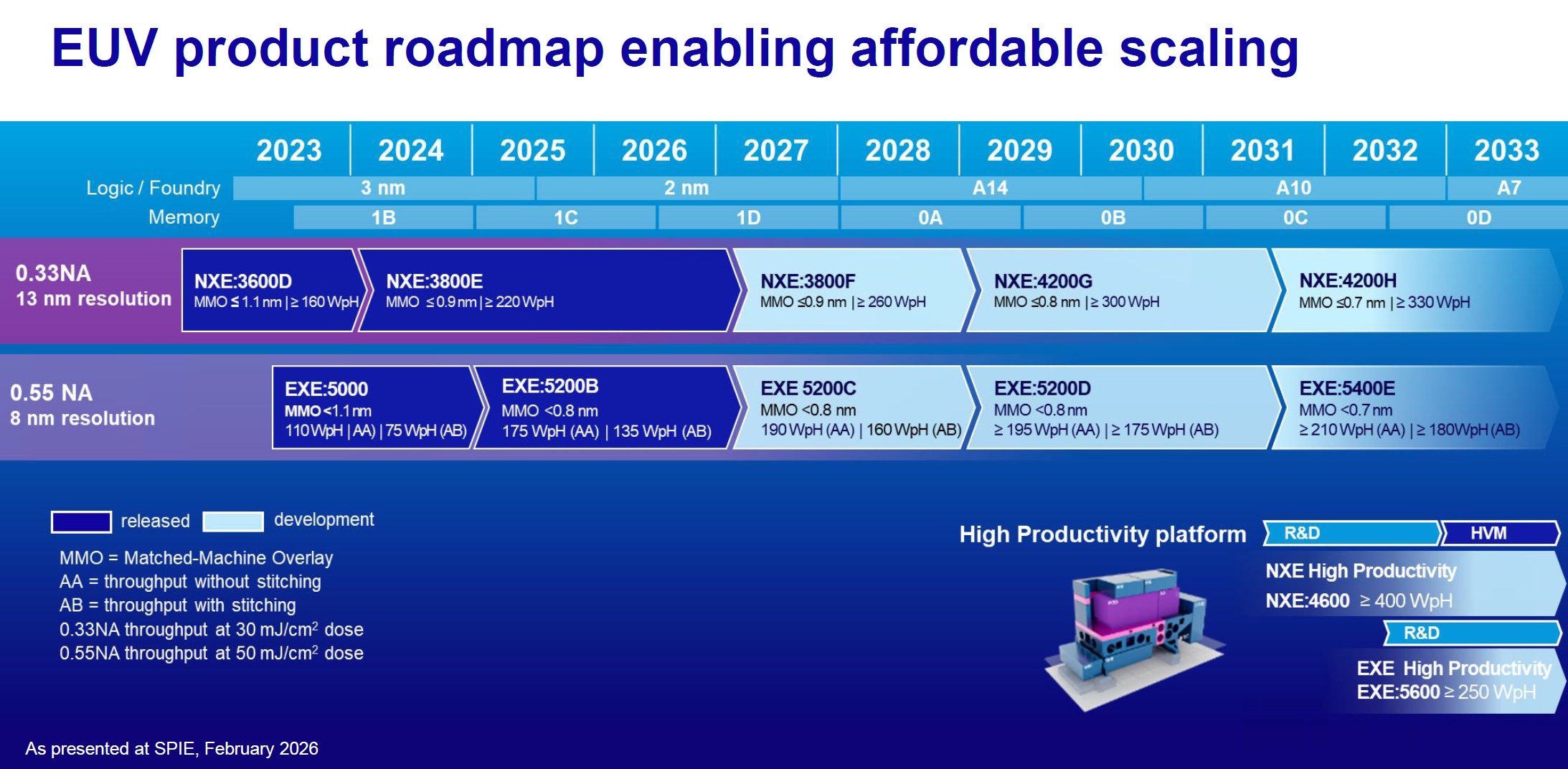
ASML has laid out its EUV roadmap and launched High-NA EUV products. Mass shipments of High-NA EUV are expected in 2028+. With High-NA EUV ASP near €400mn per tool (vs. ~€200mn for Low-NA EUV), upgrades become a new growth driver.
With core fabs expanding capex, ASML’s growth visibility is relatively high. Even amid the AI chain’s correction, ASML’s share decline has been modest.
ASML stopped disclosing order data since early this year. Watch whether management updates the current order situation during the call (cf. Dolphin’s later summary), which can inject direct ‘confidence’ for the company and market.
Overall, major fabs remain highly decisive on capacity expansion, and ASML’s high growth over the next two years is relatively certain. The latest step-up in full-year revenue outlook (€43–45bn) exceeds all market expectations.
Key risk: the proposed U.S. MATCH Act. The act explicitly adds immersion DUV tools and related services to the export control list, mainly targeting capacity expansion of sub-7nm advanced logic and memory fabs in China. It remains under Congressional review and is not yet effective, and will affect procurement plans in China.
The recent share pullback is largely beta from the AI sector, with ASML showing resilience. The ‘blowout’ guidance should be a direct stock catalyst, and once the sector overhang is digested, valuation could re-rate toward the 30–35x band.
Below is Dolphin’s detailed analysis on ASML:
I. Core metrics: substantial FY guide hike reinforces confidence
1.1 Revenue: ASML delivered Q2 2026 revenue of €9.3bn (+21% YoY), beating street (€8.9bn). Growth was driven by demand from TSMC and Korean customers for lithography systems and services.
Management again raised FY guidance to €43–45bn (vs. prior €36–40bn), materially above consensus (€39.5–40.0bn).
Based on guidance, ASML’s Q3 and Q4 revenue are ~€11–12bn and ~€14–15bn, with downstream pull-ins concentrated in H2.
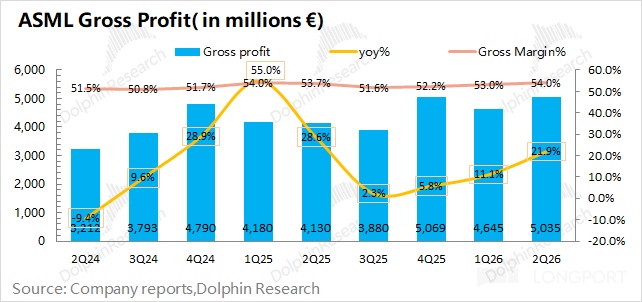
1.2 GP & GPM: Q2 2026 GP was €5.0bn (+22% YoY). GPM reached 54%, up ~100bps QoQ and above the 51–52% guide, mainly due to the higher-margin service mix.
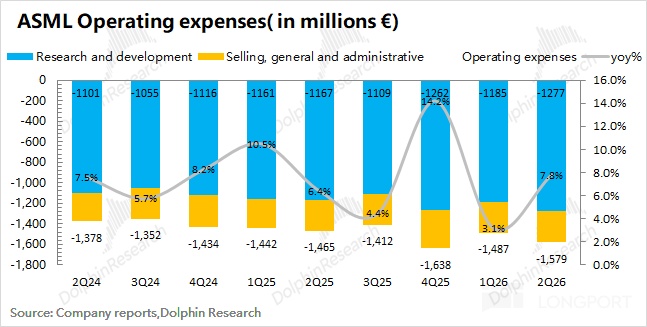
1.3 Net income: Q2 2026 net profit was €2.9bn (+27% YoY), with NPM at 31%. Opex increased, with opex ratio around 17%.
ASML again raised FY 2026 guidance to €43–45bn revenue and 54–56% GPM. Management also plans to lift capacity for EUV and other core products by >30% in 2027, underpinning next year’s high growth and a step-up from H2.
II. Segment detail: TSMC and Korean customers drive growth
ASML’s business consists of system sales and services. Lithography systems account for 70–80% of revenue, while services have posted stronger growth over the past two quarters.
2.1 Segment performance
1) System sales
ASML’s system sales reached €6.56bn in Q2 2026 (+17% YoY), mainly driven by increased pull-ins of lithography tools from TSMC and Korean customers.
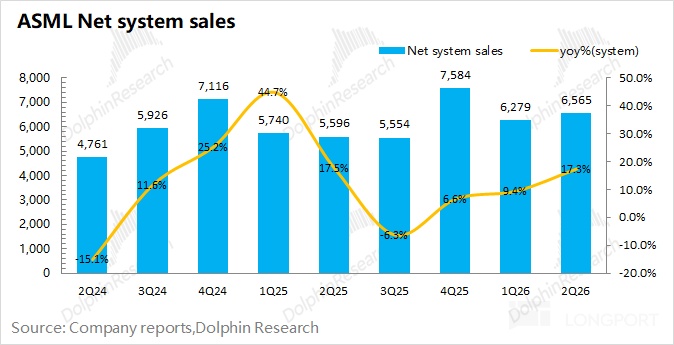
System sales correspond to the ‘lithography systems’. The largest contributors are EUV and ArFi, together close to 90% of system revenue.
Details:
a) EUV: Q2 revenue €3.7bn (+39% YoY). Shipments were 16 units, with ASP around €230mn.
By product: ① Low-NA EUV (NXE:3800E) has matured, with throughput raised from 220 to 230 wafers/hour. NXE:3800F further lifts to 260 wafers/hour, with shipments expected from 2027; ② High-NA EUV (EXE series): customer purchases are primarily for R&D, with large-scale shipments expected 2028+.
b) ArFi: Q2 revenue €1.9bn (-21% YoY), mainly from Mainland China. Shipments were 23 units, with ASP around €83mn, impacted by reduced purchasing in China.
Current growth is primarily driven by capacity expansions at TSMC and the three major memory makers. With core customers continuing to raise capex, high growth is relatively certain and should accelerate in H2.
2) Service revenue
Service revenue reached €2.76bn in Q2 2026 (+32% YoY). Services mainly include tool maintenance and are less cyclical.
Service revenue had been relatively stable at €2.0–2.5bn per quarter. With higher tool shipments currently, services also rose.
2.2 Regional revenue
Q2 revenue was concentrated in Taiwan, Mainland China, Korea, and the U.S., with the four regions together exceeding 90% of total.
Korea was the largest contributor at 43%, driven by Samsung and SK Hynix’s increased memory capex and stronger EUV demand. Mainland China delivered ~€1.3bn or 14%, below management’s prior ‘~20%’ comment, and the proposed MATCH Act is expected to influence DUV pull-in timing.
Amid the AI capex cycle, ASML’s revenue is increasingly concentrated in TSMC and Korean customers, while Mainland China and other regions have a smaller impact on results. As long as TSMC and the major memory makers keep lifting capex, ASML’s high growth remains well supported.
<End of article>
Dolphin Research on ASML
Apr 15, 2026 call transcript ‘ASML (Trans): No order data provided; 2028 visibility too distant’
Apr 15, 2026 earnings take ‘ASML: With AI fever raging, are litho tools just faking a fall?’
Jan 28, 2026 call transcript ‘ASML (Trans): Guidance affected by customer fab build; most new orders are for 2027’
Jan 28, 2026 earnings take ‘ASML: Memory orders surge; a super-cycle for litho tools!’
Oct 15, 2025 call transcript ‘ASML (Trans): Maintain 2030 targets; next quarter to update next year outlook’
Oct 15, 2025 earnings take ‘ASML: AI Capex adds buff; the worst is over!’
Jul 16, 2025 call transcript ‘ASML (Trans): Focus on improving tool efficiency rather than tool count’
Jul 16, 2025 earnings take ‘ASML: NVDA is hot, litho tools still lukewarm?’
Apr 16, 2025 call transcript ‘ASML (Trans): Even if tariffs land, we shouldn’t be the main bearer’
Apr 16, 2025 earnings take ‘ASML: Orders slide triggers alarm; will tariffs strike again?’
Jan 29, 2025 call transcript ‘ASML (Trans): Mainland China revenue to fall back to ~20% (4Q24 call)’
Jan 29, 2025 earnings take ‘ASML: The leader returns’
Risk disclosure and statement: Dolphin disclaimer and general disclosures





The copyright of this article belongs to the original author/organization.
The views expressed herein are solely those of the author and do not reflect the stance of the platform. The content is intended for investment reference purposes only and shall not be considered as investment advice. Please contact us if you have any questions or suggestions regarding the content services provided by the platform.