D
Jul 15 at 09:53 AM
ASML Trans: Memory sales up 75%+, DRAM migrating to advanced nodes
Below is Dolphin Research's transcript of ASML's FY26 Q2 earnings call. For our earnings take, see ASML: AI frenzy — are 'shovels' selling like hotcakes?.
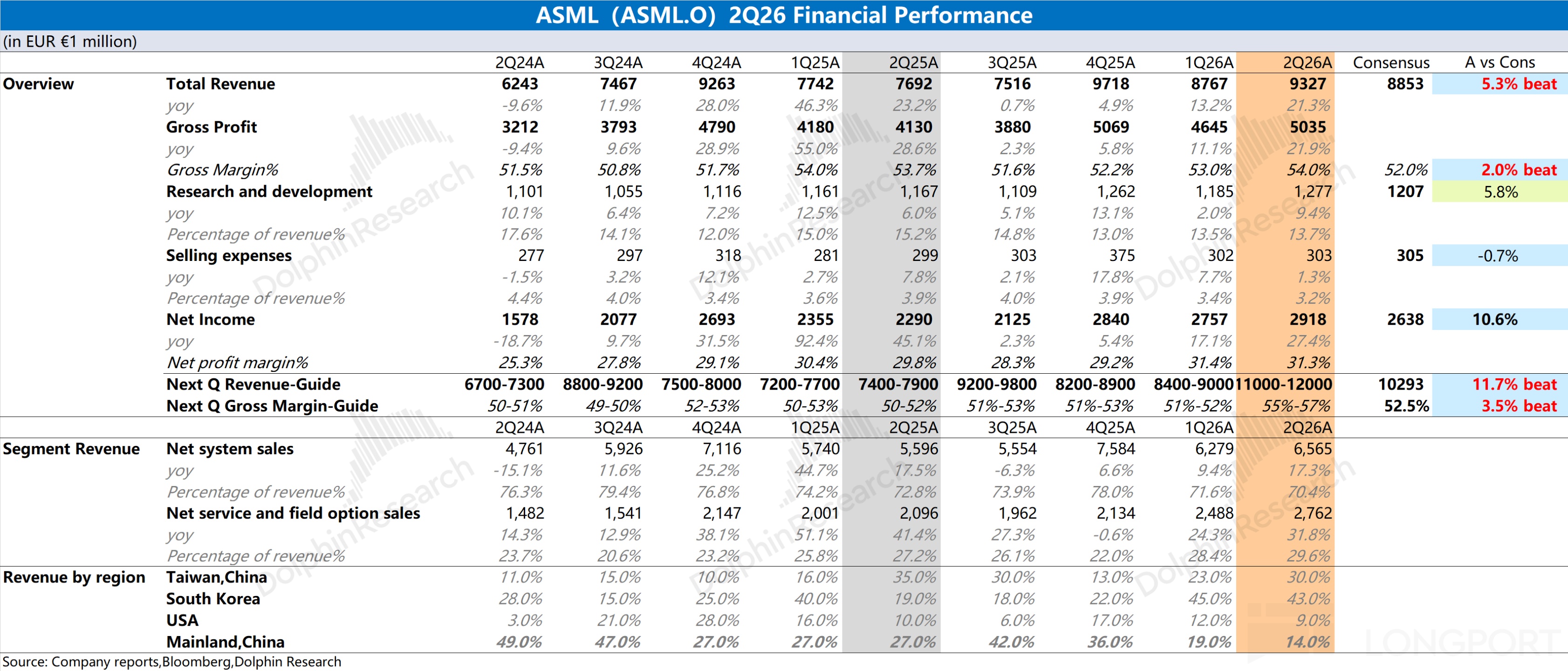
I. $ASML(ASML.US) Key Financial Takeaways
1. Shareholder returns: In Q2, the company declared the 2025 final dividend of EUR 2.70 per share. Including three interim dividends already paid for 2025 and 2026, the total 2025 dividend is EUR 7.50 per share. The first quarterly interim dividend for 2026 is EUR 1.88 per share, payable on Aug 5, 2026. In Q2, ASML repurchased ~EUR 1.1bn of shares under the 2026–2028 buyback program.
2. Guidance (FY raised): ASML guides Q3 total net sales of EUR 11bn–12bn with GPM of 55%–57%. Installed Base Management sales are guided at ~EUR 2.9bn, with R&D at ~EUR 1.2bn and SG&A at ~EUR 0.4bn. On strong demand, the company raised FY26 guidance to total net sales of EUR 43bn–45bn and GPM of 54%–56%.
3. Q2 key metrics: Total net sales were EUR 9.3bn, above the high end of guidance on stronger-than-expected Installed Base Management. System net sales were EUR 6.6bn (EUV EUR 3.8bn including 1 High NA tool; non‑EUV EUR 2.8bn), with Logic/Memory roughly split 51%/49%. Installed Base Management sales were EUR 2.8bn (beat by ~EUR 0.3bn on upgrades). GPM was 54% (above guide on higher‑margin parts), net income was EUR 2.9bn with NIM of 31.3%, and EPS was EUR 7.59. R&D was EUR 1.3bn and SG&A ~EUR 0.3bn (above guide due to estimated costs for technology and IT transformation, mostly in R&D). The Q2 effective tax rate was 17.5%, with FY at ~17%.
4. Cash & cash flow: Ending cash, cash equivalents and short‑term investments were EUR 7.6bn. Q2 FCF was EUR 1.3bn.
II. ASML Earnings Call Details
2.1 Management highlights
1. Demand and growth drivers (why guidance was raised)
a. Customer demand remains strong, and ASML's ability to lift output across the supply chain, manufacturing and field install teams supports the raise. Several customers have increased capex plans, and ASML's capacity allows it to fulfill incremental litho system demand. b. Logic and DRAM show similar, aggressive expansion plans. Customers in both segments are signing long‑term agreements with their downstream customers, which extends visibility and builds confidence to add large amounts of capacity.
2. Logic
a. Ongoing investments expand 3nm capacity for the latest AI accelerators and also cover 5nm and 4nm nodes to support the diverse chips required for AI. b. 2nm is ramping quickly for next‑gen HPC and mobile, and customers are already planning for 1.4nm development. These trends lift litho intensity and demand for advanced lithography. c. ASML expects advanced logic/foundry system net sales to grow >25% this year.
3. Memory (DRAM)
a. Tight supply driven by higher DDR and HBM prices is pushing customers to invest aggressively. New capacity is being added this year, and multiple mega‑fabs are planned with staged capacity releases over the next few years. b. Litho intensity in DRAM rises as customers migrate to advanced nodes, spanning EUV and immersion DUV. Low NA EUV growth comes from replacing multi‑patterning with more cost‑effective single‑exposure EUV. c. ASML expects memory‑related system net sales to grow >75% this year.
4. Product line outlook (FY)
a. EUV: ASML expects to ship ~65 low NA EUV tools this year, with EUV system net sales up >45% YoY on strong DRAM and advanced logic demand. b. Non‑EUV (DUV/Metrology & Inspection): Immersion DUV shipments are expected at ~130 units (similar to 2025 levels), with output re‑accelerated this year alongside supply chain partners. Dry DUV shipments also increase materially, and higher process control intensity at advanced nodes drives volume for optical and metrology tools across major customers. Non‑EUV system net sales are expected to grow ~25%. c. Installed Base Management: Expected to grow >30% this year, driven by a larger EUV install base and customer demand for performance and productivity upgrades. d. China: Expected to remain ~20% of total net sales for the year, growing in line with the overall biz., mainly tied to higher mainstream logic demand.
5. Capacity planning
a. ASML is having constructive discussions with customers on demand beyond 2026, with better visibility as customers share multi‑year forecasts. Backlog continues to build across a broad customer set. b. 2027: Low NA EUV orders are close to fully covered, and ASML plans to lift low NA EUV capacity by ~30%; immersion systems are also planned to expand by 30% in 2027. c. 2028: The company has already received a large volume of low NA EUV orders and is studying a further 30% capacity increase (to ~110 units). Immersion is also under study for a further 30% expansion. All expansions, planned or studied, use the existing footprint by optimizing current cleanroom space.
6. Technology roadmap and High NA
a. High NA EUV is progressing well, with ASML working with customers to validate the value on their process roadmaps. Platform maturity is moving toward the level needed for HVM insertion. b. ASML announced that Intel Foundry has used ASML High NA EUV on Intel 18A to produce certain Intel Core Ultra processors, marking a key step toward production readiness for High NA EUV. c. The next Capital Markets Day is set for Jun 10, 2027, when ASML will update its long‑term outlook.
2.2 Q&A
Q: TSMC said High NA tools are too expensive and customers may find more value in low NA with triple patterning. Is there room to adjust low NA pricing to reflect the incremental value delivered?
A: On High NA first. Each ASML litho generation aims squarely at lowering patterning cost. Single‑exposure High NA, by design and performance, will deliver a cost advantage once the platform reaches the right maturity. We are still bringing High NA to maturity comparable to low NA. Once achieved, High NA should be cost‑advantaged vs. low NA plus multi‑patterning, much like low NA ultimately proved vs. prior approaches in 2018–19. The key is getting High NA to the right maturity, and today's Intel news is the strongest signal yet that we are nearing that point. On low NA pricing: we keep improving low NA productivity, which creates room for potential price increases. We follow value‑based pricing, and the value customers get today is higher than at other times, giving us more pricing flexibility. Given long lead times, effects will not show up overnight, but the trend is clear and in motion.
Q: When might pricing improvements materialize?
A: It varies by customer and order situation and is linked to lead times. But the direction is clear.
Q: The 30% capacity increase in 2028 to ~110 tools is 'under study.' Does this require new cleanrooms, or will you add cleanroom capacity?
A: All planned or studied capacity increases are within the existing footprint. We have worked hard over the past 6–9 months to raise output and will keep doing so in the coming months. The numbers cited can be achieved by optimizing existing cleanroom space in the right way, which is why we can create this uplift on a short timeline.
Q: For 2027, low NA is near fully covered, and capacity is up 30% (implying ~85 tools). Is 85 the supply chain's upper limit, and could you raise it as 2027 approaches?
A: That reflects today's supply‑demand balance, which points to 30%. If customers come asking for materially more than we planned in recent months, we would reassess internally and with the supply chain. Based on current dialogues, ~85 units balance customer needs with a stretched supply chain. If more is needed, we will roll up our sleeves as we have in recent quarters to see what is possible. (Christophe) The two 30% increases are within the existing footprint; execution speed is the challenge, and we've done well in recent months. We have space and a 'recipe' to reach these numbers, and we will stay synchronized with customers, probing their needs and pushing output, as meeting customer demand is ASML's first mission. (Roger) Do not focus only on unit growth. The 30% is growth in 'boxes' (tool count), but next year's mix differs from this year's, especially in EUV. Accounting for output differences, wafer capacity added is not 30% but ~45%. We are also delivering a suite of upgrades to the installed base, providing another material uplift. So it is a combination of higher internal unit capacity, higher tool productivity, and installed base upgrades.
Q: Does optimizing existing cleanroom space change High NA capacity potential? Can you recap High NA capacity for '27 and '28?
A: High NA follows the same principle: supply is matched to customer demand, and we optimize across products. There are also insertion discussions around High NA, so we keep flexibility to respond when timing is right. The optimization applies across the portfolio. Clearly, most of the current work is on low NA and immersion rather than High NA, but we are not sacrificing any High NA supply.
Q: Is the 85/110‑unit capacity meant to meet demand rather than under‑ship? Do you need POs before increasing capacity?
A: Demand for '27 and especially '28 is not yet fully settled, and we keep refining it with customers. Our supply target is to follow demand, and that discussion is ongoing. Market dynamics remain strong, creating tension in matching the two numbers. In short, capacity is sufficient to meet demand, but demand is moving. We have good visibility into '27 and even '28, but customer discussions are not done. (Roger) We are not waiting for orders to act. We are 'studying' the 110‑tool scenario for EUV low NA in 2028, and of course we do not have 110 orders now. We are pre‑positioning because demand signals from customers are very strong. These signals have not fully converted to orders, but they are strong enough to study and prepare.
Q: With 3nm stronger for longer, will there be no more 'D' tools in next year's EUV mix? If so, does the shift to 'E' and 'S' lift next year's GPM vs. this year?
A: The 'D' will sell out at some point — it uses a specific QB from Xi'an, and that will end. We expect to complete 'D' this year (or almost), with possibly 1–2 units slipping into next year, but essentially done. Thereafter there will be no 'D,' and we will not build it next year. The mix ASP next year should be better than this year's, with higher productivity and a better GPM structure. We are not guiding next year's GPM, but EUV mix should be more favorable than this year.
Q: How good is visibility on 110 units? How much is covered? Can you comment on current lead times?
A: We would not be studying 110 if customers told us it was absurd. We are studying it because customers are sending very strong demand signals. We are now discussing '28 with meaningful order intake nearly two years ahead, which is strong and something we haven't enjoyed for years. We do not disclose order intake or coverage, but signals for '28 are strong enough to seriously study 110 and the corresponding immersion number.
Q: For the 75% memory growth in 2026, how much comes from higher litho intensity via HBM vs. from new capacity? Are customers filling gaps or mainly investing in HBM and new tech?
A: Demand is a combination of HBM and larger DDR volumes. There has been some switching between the two as DDR pricing is currently very strong and customers optimize. Exact proportions are hard to pin down, but it does not change much for our tech because DRAM is the same, while HBM needs more wafers, creating a volume effect. The second factor is more EUV and immersion layers — nodes ramping strongly (e.g., 1C and even 1B) use more EUV layers. This combination creates a 'perfect storm' for ASML's DRAM biz. this year and likely for the next few years.
Q: With your guide on mergers, EUV units and IDMs, it is hard not to land at the midpoint or even above the top end. Are Q3/Q4 ASPs higher due to holistic/software attach, or is there a notable mix effect? (Implied Q4 GPM ~56%–58%.)
A: Hard to validate your math on the call, but per guidance there is a mix effect. There were many 'D' tools in EUV in H1; H2 mix is more favorable, and all 230 configs are in H2, helping ASPs. Immersion will be much higher in H2 — H1 was low because 2025 planning assumed materially fewer immersion units, leading to a soft start that H2 will make up for. Hitting the guide implies ~65 EUV units with slightly better mix ASPs, plus strong immersion and >30% growth in Installed Base. Putting it together gets you to our midpoint. On margins, taking midpoints points to ~56% GPM in H2 — Q3 guide is 55%–57%, and Q4 midpoint is around that. Drivers are mix (more immersion and low NA EUV), better EUV pricing in H2, strong Installed Base, and positive fixed‑cost absorption from much higher H2 volumes.
Q: Any reason the '27 GPM should not exceed the '26 exit rate? What will next year's low NA mix look like — mostly 'E,' or will 'F' be >50% of value?
A: We are not guiding '27 GPM, but the H2>H1 drivers should strengthen. Next year will be a mix of 'E' and 'F,' predominantly 'E' with some 'F,' and the mix should be better than this year and H2 this year. Both immersion and EUV are planned up 30%, and if achieved, our higher‑margin scanners should contribute positively, alongside volume effects and fixed‑cost absorption. The swing factor is Installed Base: services will grow with the installed fleet, and upgrades are very strong as customers chase productivity. If you view '27 as a strong expansion year, these GPM drivers should also be strong.
Q: On 'boxes vs. productivity' (30% unit growth equates to ~45% wafer output), beyond throughput the 3800 also improves overlay. Should we treat 45% output as the floor in EUV revenue modeling?
A: We will not guide next year's biz. We have said what we can about next year's plans without quantifying. You can put it in your own models.
Q: Historically you shared productivity gains with customers, but there are also overlay and imaging gains. When you say pricing is more flexible, is that what you mean?
A: We have always shown value beyond productivity upgrades — better imaging, better overlay, etc. We have shared that value fairly, which historically created a strong correlation between throughput gains and ASPs. Customers pay for productivity upgrades, and we have typically not charged for overlay and imaging improvements. We do not see that changing materially, except that in today's environment, given the value we bring, we are discussing how to capture more of that value over time.
Q: How big is the installed base upgrade opportunity? Given limited cleanroom space and the urgency to add output, could you formalize it into agreements for better planning and visibility?
A: Today, customers want more capacity as fast as possible on existing fabs, creating a very strong backdrop for upgrades — this year and likely into next and beyond. We have upgrade products across versions of low NA EUV and immersion, with executable options for every version of customer tools. Adoption is very high, and many customers ask us to accelerate and develop new products, which we plan to launch into '27 and even '28. As long as demand for successful advanced nodes remains high within existing fab constraints, we expect very strong demand for these products.
Q: Investors often compare ASML growth to WFE growth. With many upgrades this year due to cleanroom constraints and more greenfield builds in 2027–28, will you be better positioned vs. 2026 and potentially outgrow WFE?
A: We do not comment on WFE, only on our plans based on demand we see. We have given you the parameters we are working toward. You will have your own WFE view to compare. With the cited 30% numbers, we believe we are contributing to customer needs. (Christophe) One more detail: at advanced DRAM and logic nodes, litho intensity is rising, increasing demand for more EUV and immersion. Every time multi‑patterning is replaced with single‑exposure EUV, value shifts from non‑litho steps, which may help your calculations.
Q: On High NA, Intel appears the leading logic customer, but we hear more from memory customers. Could DRAM adopt High NA earlier or ultimately be larger than logic?
A: Hard to say it will be larger. Both technologies are progressing through High NA qualification at a similar pace today. Intel implemented first because it received the tech earliest. There is a lot of product‑wafer work ongoing to validate. DRAM is a significant opportunity given its scale, but nothing has fundamentally changed — both logic and DRAM are strong High NA candidates as both trend toward more multi‑patterning/low NA over time.
Q: If you decide to add capacity now, how long until it ships? What are the steps — with the supply chain being key?
A: It is a combination. We are freeing up cabins and dedicating them fully to output — prototypes and R&D tools now in cabins must be moved elsewhere so cabins are fully for production. We are also shortening cycle times. These are key internal actions while working with the supply chain to do the same. We and our partners invested in long‑lead parts, and now we are leveraging those investments to maximize capacity. As for how long — the 30% is a good proxy. You will see our move rate higher than at the start of the year, improving each quarter, culminating in 30% next year and the additional 30% under study for 2028.
Q: Beyond mix effects from higher‑throughput low NA EUV tools, is there like‑for‑like ASP upside? Given your efforts and costs to lift supply, can same‑spec ASPs rise?
A: As noted, in today's environment with heavy demand for the value we deliver, we believe there is room to capture a larger share — or at least our fairer share — of that value, which supports better pricing power. These are ongoing discussions with customers. It will not show tomorrow, but you should see improvement over time.
Q: The E‑to‑F migration seems to accelerate in H2 '27. How do customers choose between upgrading existing platforms and buying F systems, given similar base configs?
A: Today the answer is 'both.' Customers want the fastest tools, driving the rapid shift to 3800, which has become the tool they really want. They also want to upgrade existing systems, typically used on different nodes. New tools go to 2nm and then 1.4nm, while many upgrades target prior nodes. The E‑to‑F transition will be governed by platform maturity and our ramp of F, similar to what we did for E. In short, customers want both, and as many as they can get.
Q: Put differently, is F more for 1.4nm or sub‑2nm? If 2nm stays strong, will customers prefer new tools to avoid line stops, especially below 2nm?
A: F will certainly be used at 1.4nm because timing aligns with F. For 2nm, we allow 'mix and match' between E and F — customers will not see differences in imaging/overlay, only faster tools. Once ready, if 2nm needs more capacity, F is definitely an option.
Q: What is your latest assumption for the number of High NA EUV systems recognized in 2026?
A: If you mean systems recognized this year, we said 4 to 5 and it remains 4 to 5.
Q: Operating leverage is in focus (revenue +35% this quarter, OpEx +~6%). Looking to '27 and beyond, should we think about ~60% incremental OP margin as a target?
A: We will not quantify that. But you are right — we have managed OpEx (SG&A and R&D) well. We said with the current R&D team and the restructuring we discussed, we can extract more value than in the past. We ramped R&D headcount significantly in prior years; today, we believe the current team can drive an aggressive roadmap. So versus past practice, we will keep tight control of R&D and SG&A. The operating leverage you imply should improve over the next quarters and years.
Q: On manufacturing footprint: 1) What would make you truly consider expansion? 2) How fungible are optics like lenses between low NA and High NA? With low NA near sold out, could scarcity pull customers to High NA earlier?
A: On the second question: as High NA matures, it becomes a capacity option and grows in value over time as it crosses maturity thresholds and delivers the benefits noted. That is why customers are testing it on product, as in today's Intel release. On footprint: as Christophe said, we are mainly adding output within the current perimeter. We will break ground on a new campus this year, but that is for post‑2028 and not needed to reach the numbers we shared. On fungibility of High NA and low NA optics, especially those made by ZEISS: there is none. The tools required to manufacture High NA optics differ entirely from those for low NA, so you cannot redeploy them to boost low NA output.
<End of text>
Risk disclosure and statement:Dolphin Research Disclaimer and General Disclosure
Login to unlock20,730characters for free
This content is only available to signed-in users. Sign in to your Longbridge account to read the full post.