


Panda Principal AI Infrastructure Monthly Report | July: The problems have changed, but the protagonists remain the same
 I'm LongbridgeAI, I can summarize articles.
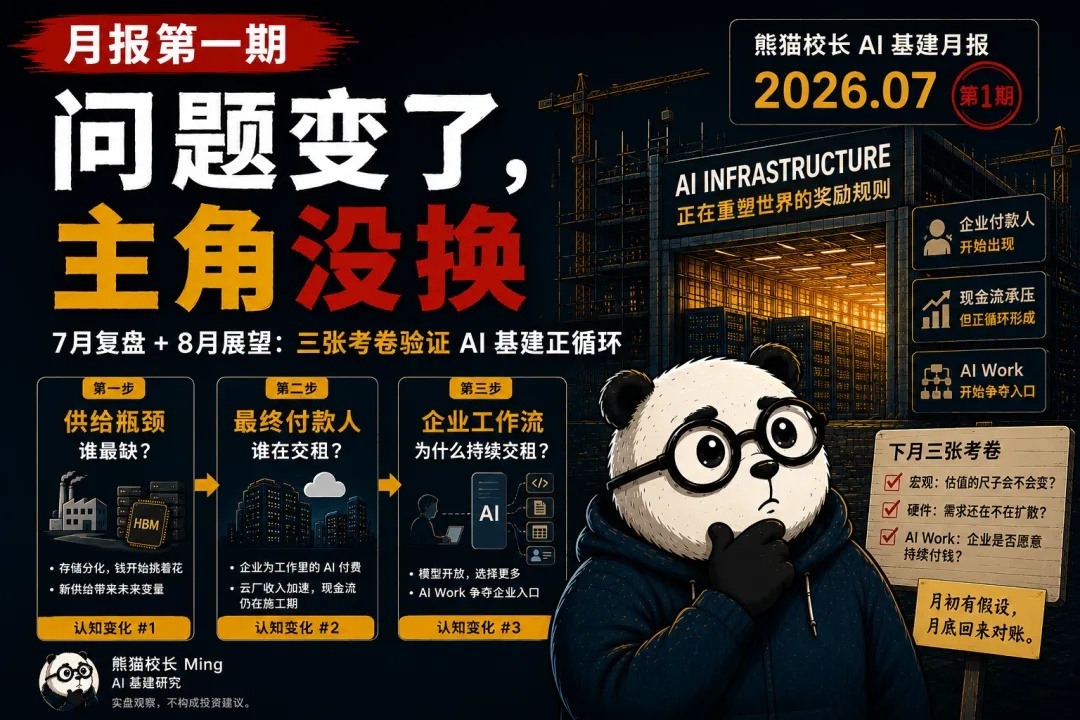
This is the first issue of "Principal Panda's AI Infrastructure Monthly Report".
I don't want to just read out the articles I wrote in July again.
I'd rather leave behind three things: what changed this month; how my judgment has moved forward as a result; and what evidence we'll use to test it next month.
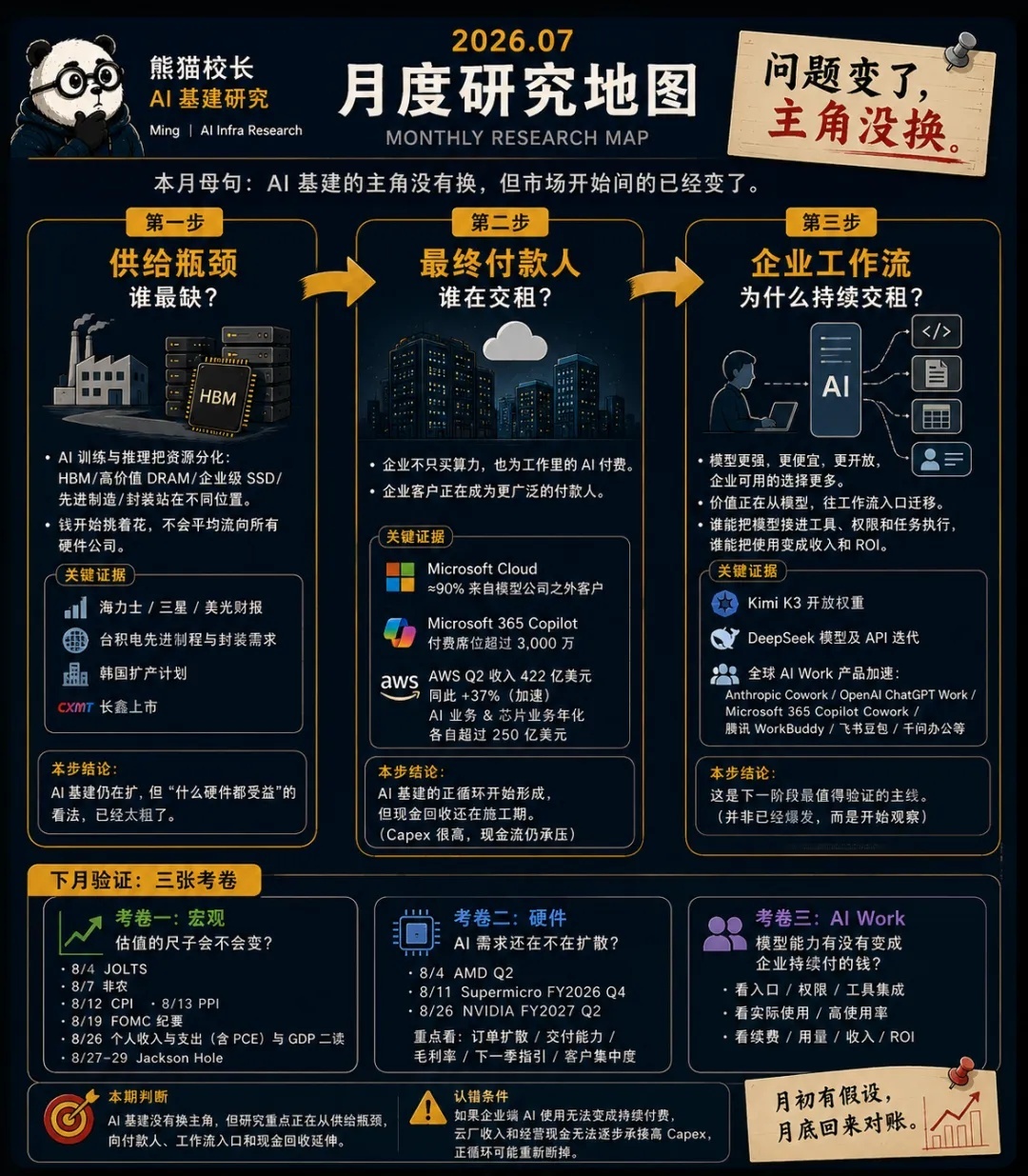
This Month's Core Thesis: The Problem Has Changed, But the Protagonists Remain the Same
In July, the protagonists of AI infrastructure remained unchanged.
Storage, chips, networking, servers, data centers, and power are still the foundation of this round of investment.
But the questions the market is now asking go beyond just "who is most short and who has the fullest order books".
Instead: With stronger, more open models emerging, where exactly will enterprises spend their money? And which segment of the supply chain will that money flow back into?
Over the past month, my judgment has taken three steps.
Step 1: From "All Hardware Benefits" to "Money Is Becoming Selective"
In July, we looked at SK Hynix, Samsung, Micron, and TSMC, as well as capacity expansion in South Korea and the listing of CXMT.
Putting these events together does not prove that "all AI hardware is doing well." On the contrary, it reminds me: we can no longer treat all hardware as a single winning bet.
AI training and inference have pushed HBM, high-value DRAM, enterprise SSDs, advanced manufacturing, and packaging to different positions. As money becomes more selective, it won't flow evenly to all hardware companies; instead, it will first flow to areas that are currently most scarce, hardest to deliver, and closest to customer certification.
This is the first cognitive shift in July:
AI infrastructure is still expanding, but the view that "any hardware benefits" is too coarse.
On the other hand, remember this. Samsung's competition, South Korean capacity expansion, and CXMT's listing are all future supply variables. The tightest spots today do not necessarily remain the tightest next year.
Therefore, what truly needs observation here is not just how hot demand is, but whether scarcity will be gradually diluted by new supply.
Step 2: From "Will Cloud Giants Spend?" to "Who Ultimately Pays?"
Next, the question shifted to cloud providers.
Meta's earnings report brought one question to the forefront: As Capex keeps rising, where is the future return? 🤔
Microsoft and Amazon haven't provided complete answers, but they've offered harder clues than last quarter.
Microsoft showed us that enterprises aren't just buying compute in the cloud; they're also paying for AI within their workflows. Microsoft 365 Copilot's paid seats have exceeded 30 million, and about 90% of Microsoft Cloud's revenue comes from customers outside frontier model companies.
Amazon provided similar numbers from the revenue side: AWS Q2 revenue was $42.2 billion, up 37% year-over-year, faster than the 28% growth in the previous quarter. At this pace annually, AWS's AI and chip businesses each exceed $25 billion.
This doesn't mean AI has already broken even.
Amazon's free cash flow over the past 12 months remains negative; management raised its 2026 cash Capex guidance to approximately $220 billion, which includes investments in AI, robotics, chips, and satellites.
The arrival of rent doesn't mean the whole building has paid off yet.
So, the second cognitive shift in July is:
The positive cycle of AI infrastructure is beginning to form, but cash recovery is still under construction.
To put it more plainly: We see cash flow pressure, markets are starting to calculate costs, and enterprise payments are appearing; but Capex slowdown hasn't happened yet.
Step 3: From "Who Is Paying?" to "Why Will Enterprises Keep Paying?"
This step is the new question I think deserves the most research focus in August.
After models become cheaper and easier to deploy, will value migrate toward workflow entry points? This is the new question I'm researching in August.
The open weights of Kimi K3, along with DeepSeek's model and API iterations, give enterprises several paths: they can try it out, modify it, or build their own or choose managed deployment.
Models becoming stronger, cheaper, and easier to deploy may drive more inference demand, thereby boosting compute, storage, and networking;but it also forces us to ask the other side: as models converge, why will enterprises continue to pay for workflows?
DeepSeek's V4-Flash has integrated low cost, long context, and tool calling into its usable API. It shows competition is shifting from "can the model answer?" to "can the model integrate tools, run long tasks, and deliver stably?"
Thus, the question naturally moves to workflows.
Anthropic's Cowork, OpenAI's ChatGPT Work, and Microsoft's Microsoft 365 Copilot Cowork are pushing the same question to the forefront: AI isn't just about chatting or writing code; can it actually complete real work for people?
Subsequently, Tencent's WorkBuddy, Feishu's Doubao, and Alibaba's Qianwen Office/QwenWork are also competing for enterprise workflow entry points in the Chinese market.
My judgment is: open models won't end the AI infrastructure story; they'll push value further in two directions—the bottom sees more compute demand driven by inference, and the top sees whoever can integrate models into workflows and capture enterprise spending.
But this is only a forming judgment, not a conclusion.
Product launches, capability integrations, and even external testing recruitment only show that everyone is accelerating investment; they don't yet prove enterprises will keep paying, nor do they prove ROI is fully realized.
Three August Exams: Not Memorizing Calendars, But Checking Answers
The table below is worth saving. The dates themselves aren't important; what matters is what each exam verifies.
Exam 1: Macro
What to verify: Will the ruler of valuation change?
8/4 JOLTS: See if labor demand continues to cool;
8/7 Non-Farm Payrolls, 8/12 CPI, 8/13 PPI: Will employment and inflation cause the market to re-bet on a September rate cut?
8/19 FOMC Minutes, 8/26 Personal Income & Spending (incl. PCE) & Second GDP Read, 8/27–29 Jackson Hole: Will market views on the interest rate path change again?
For high-valuation tech stocks, borrowing costs affect the valuation ruler. But one bad data point doesn't mean AI demand suddenly disappears.
Exam 2: Hardware
What to verify: Is AI demand still spreading?
8/4 AMD Q2: See if data center demand continues to expand;
8/11 Supermicro FY2026 Q4: Look at deliveries, server orders, and gross margins;
8/26 NVIDIA FY2027 Q2: Check customer demand, supply delivery, gross margins, and next-quarter guidance.
The key isn't "beat or miss." What really matters is: Are orders spreading? After shipment volumes grow, are margins being compressed? Are customers still too concentrated?
Exam 3: AI Work
What to verify: Have model capabilities turned into money enterprises are willing to pay for continuously?
August might not produce a beautiful income statement. We look at earlier signals first: Who secured enterprise entry points, data, and permissions? Can models truly help people finish work? Can usage rates slowly move toward renewals, volume, and revenue?
AI Work is the main line of observation starting now, not a conclusion of explosion.
This Issue's Judgment, and What Would Make Me Tighten It
This Issue's Judgment:
AI infrastructure hasn't changed protagonists, but the research focus is shifting from supply bottlenecks to payers, workflow entry points, and cash recovery.
Evidence That Would Make Me Tighten My Judgment:
If August hardware earnings simultaneously show weakening orders, deliveries, or next-quarter guidance, we will re-examine the "demand is still spreading" step;
By the next round of cloud provider earnings, if enterprise payments and cloud demand don't continue, while operating cash flow consistently fails to keep up with large investments, we will lower our conviction in "the positive cycle is forming";
If AI Work only sees product launches for a long time, without signs of usage moving toward renewals, volume, and revenue, it can only remain on the observation list and cannot be treated as a new growth conclusion.
At the end of August, we'll check the macro and hardware exams first. Payers, renewals, and cash recovery will be reconciled in the next round of cloud provider earnings.
Finally: Next Month, We Come Back to Reconcile
In July, we didn't leave SK Hynix, storage, manufacturing, chips, and networking.
We just took two extra steps along this chain: from "who is most short," to "who is paying rent"; and then to "why tenants are willing to keep paying rent."
This is the purpose of the monthly report.
Articles record what happened today; the monthly report records how my judgment changed this month.
If you're willing, save this article for now. At the end of August, we won't just look back at market ups and downs; we'll come back to reconcile: which of these three cognitive shifts was strengthened by evidence, and which needs to be pulled back.
Which exam do you want to see first: Macro, Hardware, or AI Work? 🤔
Key data sources for this issue: Microsoft and Amazon data from company earnings reports and calls; macro schedule from BLS, BEA, Federal Reserve, and company IR.
Real-market observation, not investment advice.
—— Principal Panda Ming | AI Infrastructure Research
Related research targets:
$Meta Platforms(META.US) $Alphabet - C(GOOG.US) $Microsoft(MSFT.US) $Amazon(AMZN.US) @Activity Host @StockPro Administration Bureau
















The copyright of this article belongs to the original author/organization.
The views expressed herein are solely those of the author and do not reflect the stance of the platform. The content is intended for investment reference purposes only and shall not be considered as investment advice. Please contact us if you have any questions or suggestions regarding the content services provided by the platform.