
Community AI Notes | 11 CLI commands, and a fully autonomous trading Agent was built
 I'm LongbridgeAI, I can summarize articles.
What happens over a month if you let an AI watch the market and place its own orders?
Fellow investor qwq actually did it. In his spare time he built an autonomous trading Agent called "Flint" and let it run unattended on Longbridge paper trading — by the end of July it had been running for 101 days. Claude reads the tape and the news and decides whether to act; the code handles risk control, order placement and reconciliation. All of it on one Mac mini. Across July, it completed 69 trades on its own.
How it "reads the market"
Flint runs two signal sources at once:
- The technical loop: sweeps the watchlist every 30 minutes, scoring each name 0–8 on VWAP, EMA20, MACD, RSI and volume ratio, then hands the score and the market data to Claude to judge whether it's worth acting on.
- The event loop: digests the news feed every 60 seconds, catching earnings, macro and geopolitical catalysts.
The watchlist holds 12 names: the US Magnificent Seven (NVDA, GOOGL, AAPL, MSFT, AMZN, META, TSLA) plus three commodity ETFs — gold, silver and oil.
One boundary matters a great deal:
Claude only judges "whether to act, and long or short". It cannot set position size, and it never touches the order button.
Position size is computed by hard rules; the model cannot size a trade by how confident it feels.
Risk parameters are all hard-coded in a config file the model cannot edit. For example:
- a single trade may lose at most 2% of total equity;
- at most 3 positions open at once, to avoid concentrating exposure;
- a 5% intraday drawdown trips the circuit breaker — no new positions that day;
- after closing a losing trade in a name, that name is on a 60-minute cooldown, to prevent back-to-back revenge trades…
Everyone knows reviewing your trades matters, yet almost nobody manages it every single day — Flint reviews itself after every close.
A reflection thread walks back through the day's closed trades, grading both "was the thesis right" and "was the entry/exit timing right", then distils the scattered notes into lessons carrying a confidence level, which get injected into the next day's decision context: where yesterday's judgement went wrong becomes tomorrow's precedent.
The author calls this page the Dream Journal.
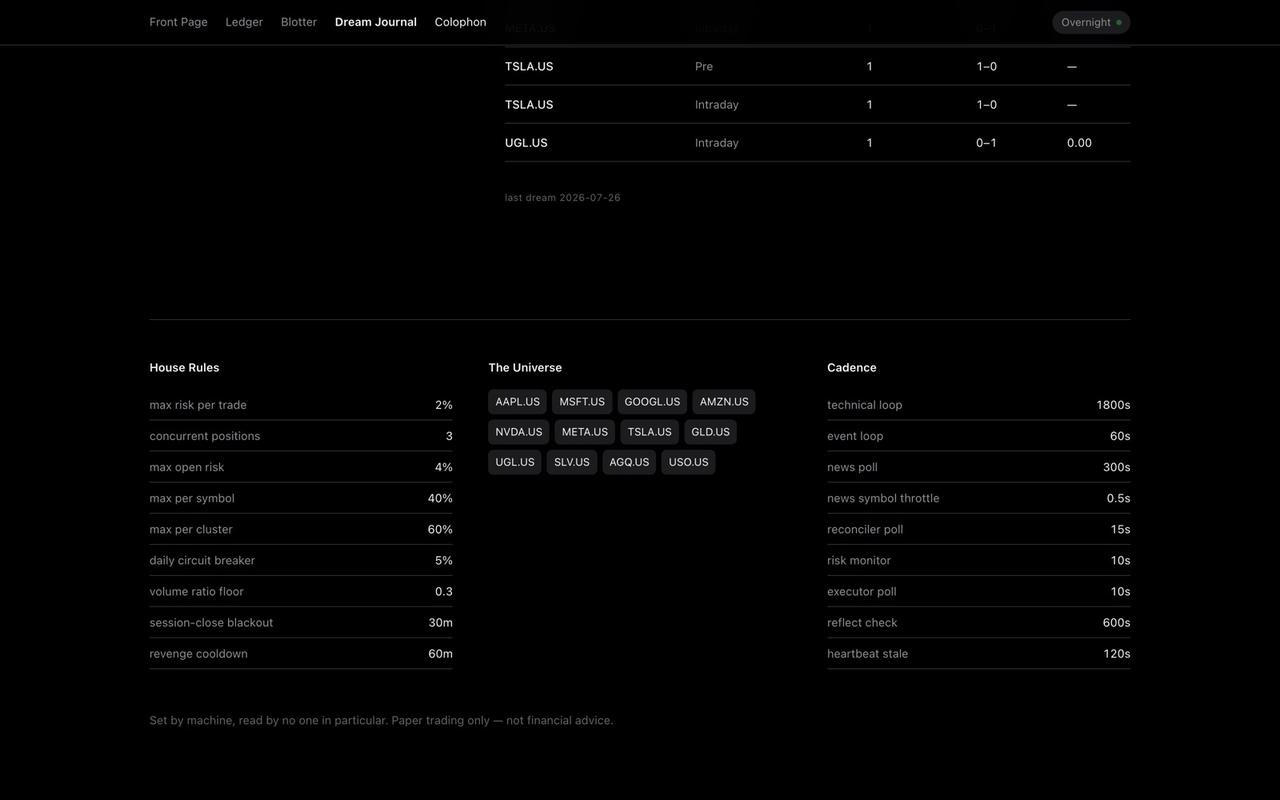
Risk parameters hard-coded in the config file, the 12 watchlist names, and each thread's cadence
How it gets Longbridge data and places orders automatically: 11 CLI commands
Flint doesn't contain a single HTTP request, and doesn't use any language SDK
Every interaction with the broker is a subprocess running Longbridge CLI, always with --format json for structured output.
From quotes, candlesticks and news through to orders, cancellations and reconciliation — every broker-side action a fully automated trading Agent needs is carried by these 11 CLI commands:
| Stage | CLI command |
|---|---|
| Live quotes | longbridge quote |
| Candlesticks | longbridge kline --period 1h --count 50 |
News (input for the event loop) | longbridge news <SYMBOL> --count 20 |
Telling pre-market / regular hours / after-hours apart | longbridge trading session |
| Account equity | longbridge assets |
Actual broker positions (reconciliation) | longbridge positions |
| Placing orders | longbridge order buy / order sell |
| Cancelling orders | longbridge order cancel |
| Same-day execution reports | longbridge order executions |
Whether a single order is in flight / filled / cancelled | longbridge order detail <order_id> |
A full month of autonomous AI trading: 69 trades, 124 intents, 31 self-rejections
Across July, Flint traded on 17 sessions and produced 124 trading intents, of which 31 were rejected by its own risk control (25%), ending with 69 fills and 35 closed round trips. Realised P&L was +US$292.51 (about +3.0%), with month-end equity of US$10,063.87 (starting from US$10,000).
15 wins, 20 losses — a win rate of 42.9%.
More losses than wins, by the look of it. But the wins averaged +US$78.17 while the losses averaged only −US$44.00, for a profit factor of 1.78 — thanks to code-enforced stops that keep every loss small.
That said, qwq gets ahead of the obvious objection himself: "+3% has no statistical significance on its own (one month, 35 samples)."
Short-run numbers say nothing about long-run skill. What this month really proves isn't "AI can make money" — it's that "this engineering architecture holds up, and can correct itself": the "model proposes, code enforces discipline" split ran continuously inside real market structure without going off the rails. Impulses got blocked by its own risk gate; incidents got written down as new rules. That's what makes it worth keeping alive.
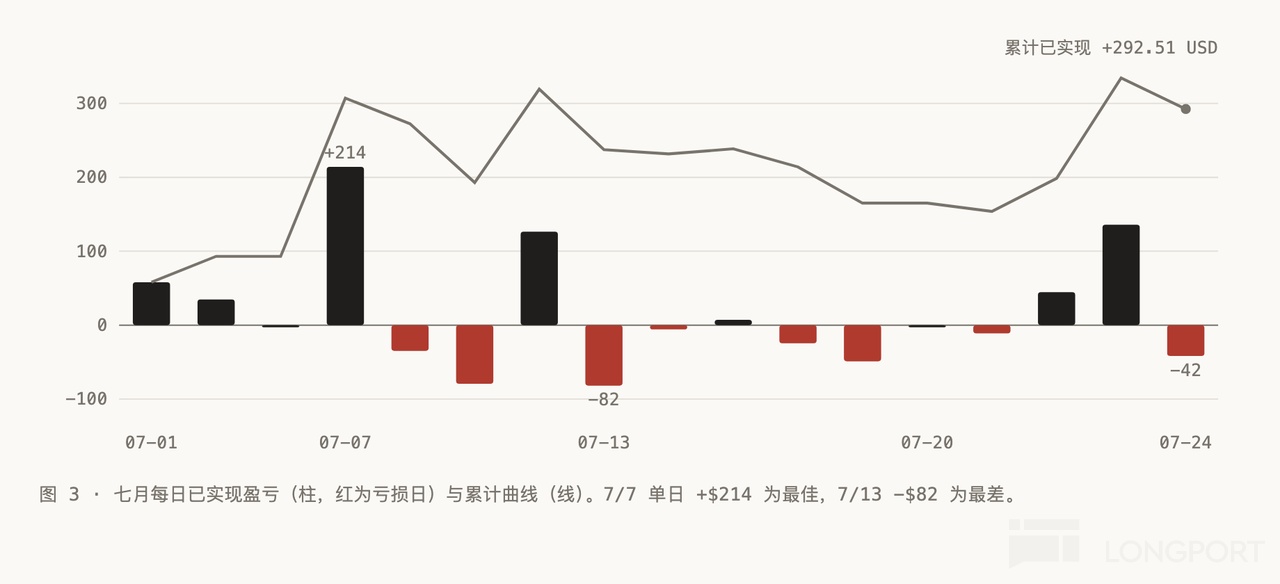
July daily realised P&L (bars; red = losing day) and the cumulative curve (line)
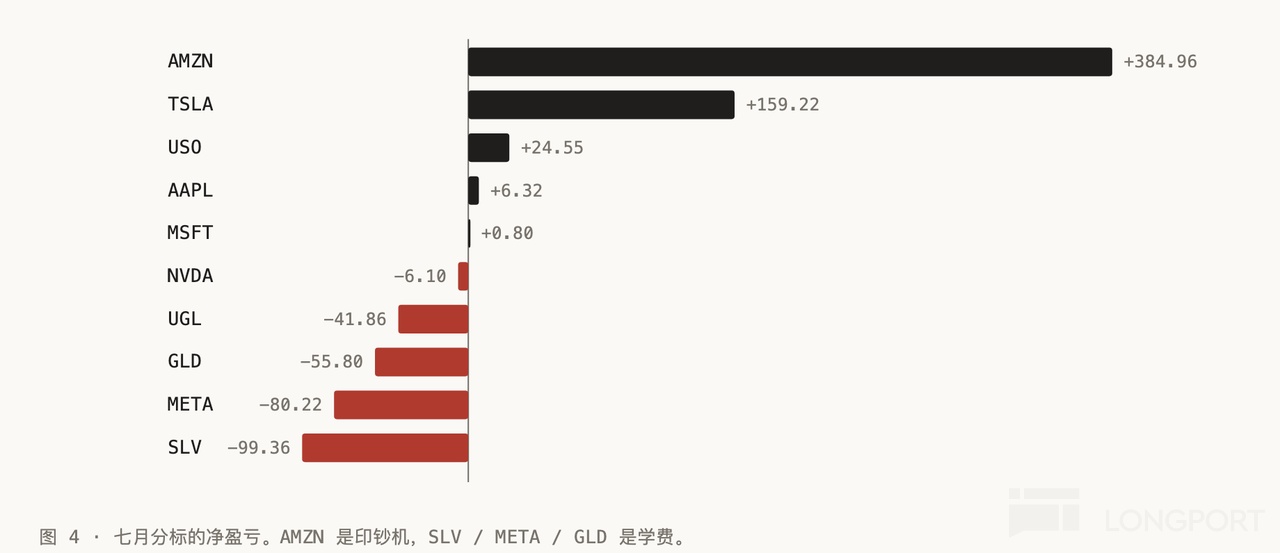
July net P&L by symbol
Case studies
1. The best trade: same earnings report, shorted twice without hesitating (+US$244)
Tesla reported Q2 after the close on 22 July: revenue beat, EPS missed, net profit down year on year, and management's tone on robotaxi turned noticeably more cautious. Flint judged the market would read it as a net negative and shorted 11 shares at 360.89 right there in the after-hours session, covering at 353.20 pre-market the next day for a gain of 84.37. When the slide accelerated after the open, it didn't hesitate — shorting another 6 shares at 351.60. Tesla fell 13% that day, and once price broke through the target it covered at 325.00 for another 159.48.
What's interesting: the event-driven trades it made money on were all against the sentiment, while everything that chased the news long lost — chasing the precious-metals narrative cost 99 on SLV, chasing analyst expectations cost 80 on META.
For the month, the event source lost 89.28 across 14 round trips at a win rate of just 25%, while the technical source made 381.79 across 21.
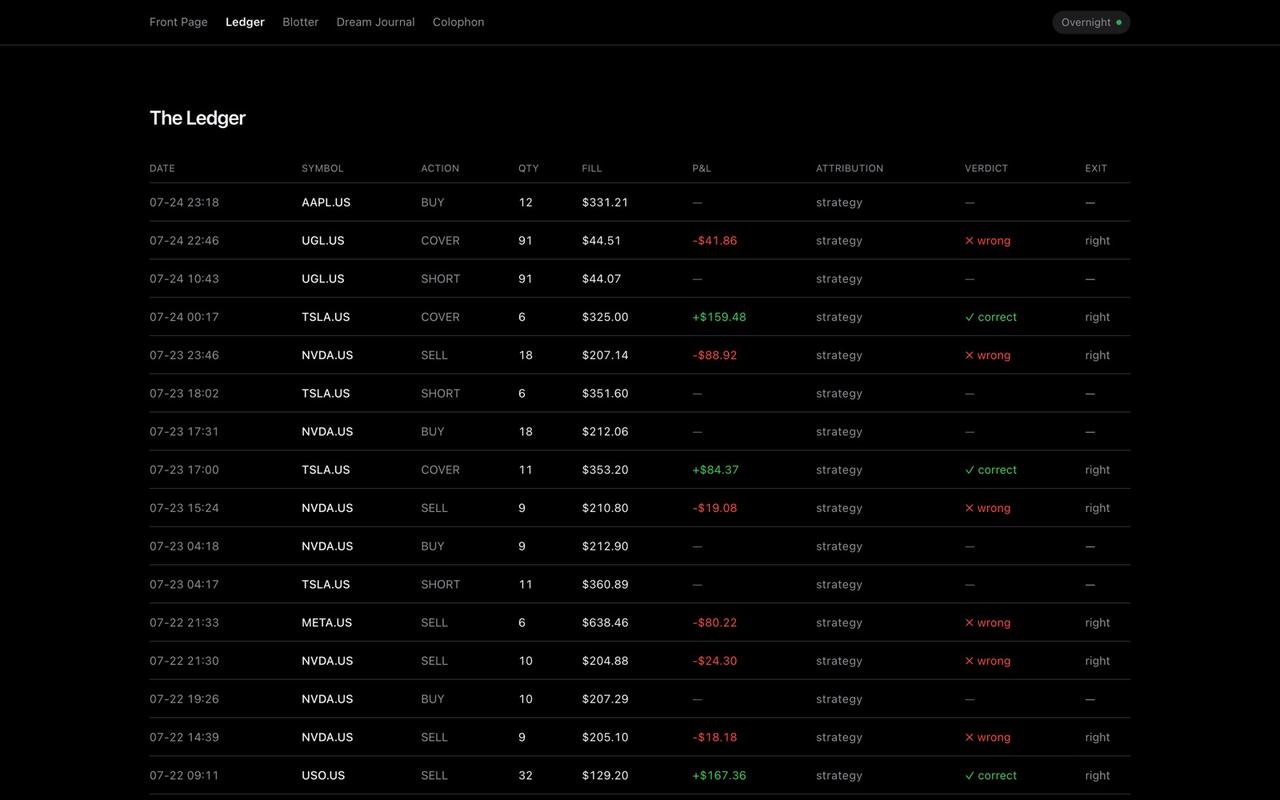
The Ledger: every fill carries P&L, attribution and a post-hoc verdict — the two consecutive shorts stand out at a glance
2. The scariest moment: the "five-in-a-row buy" of 6 July
The market closed early on 3 July for Independence Day, and within two hours the technical loop fired five consecutive intents on AMZN — which the risk gate approved one by one, because at the time it only checked filled positions and ignored orders still in flight. Five limit orders sat there across the long weekend, all filling at Monday's open: suddenly 80 shares of AMZN, roughly US$19,400 of exposure — close to twice the equity.
Luck was on his side; AMZN rose the next day and taking the five fills off in tranches actually made 344. But he writes it plainly:
Money made on luck doesn't cover up a hole. I found the gate's exposure definition was missing the time dimension: it was counting how much I hold right now, when it should have counted how much I've already committed. A resting limit order is a commitment already sent out — it just hasn't landed yet.
That week he folded in-flight orders into every exposure calculation: concurrent position count is now the union of held names and in-flight names, and total, single-name and sector limits all add the notional value of resting orders into the denominator. In the rejection logs from late July, this new rule blocked 3 duplicate orders outright.
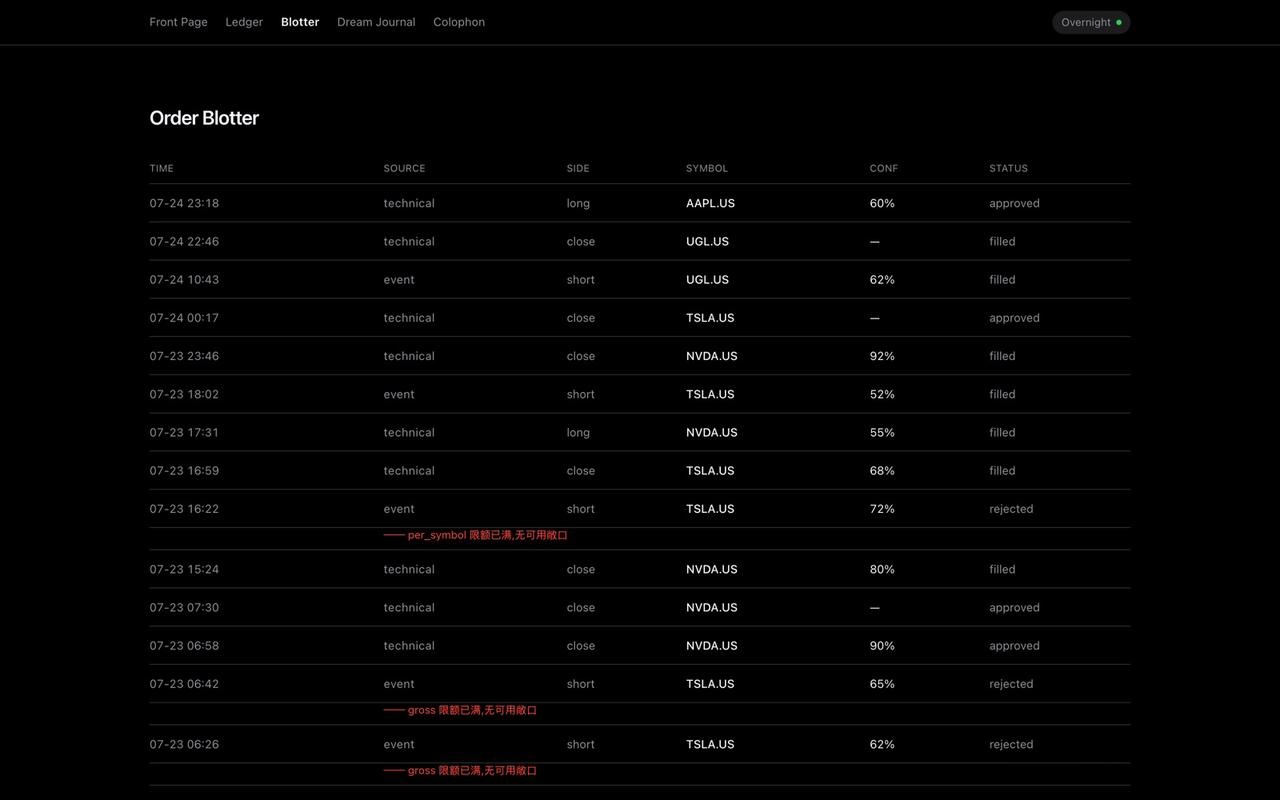
Order Blotter: the full audit trail of the intent queue; the red text is risk control's rejection reason
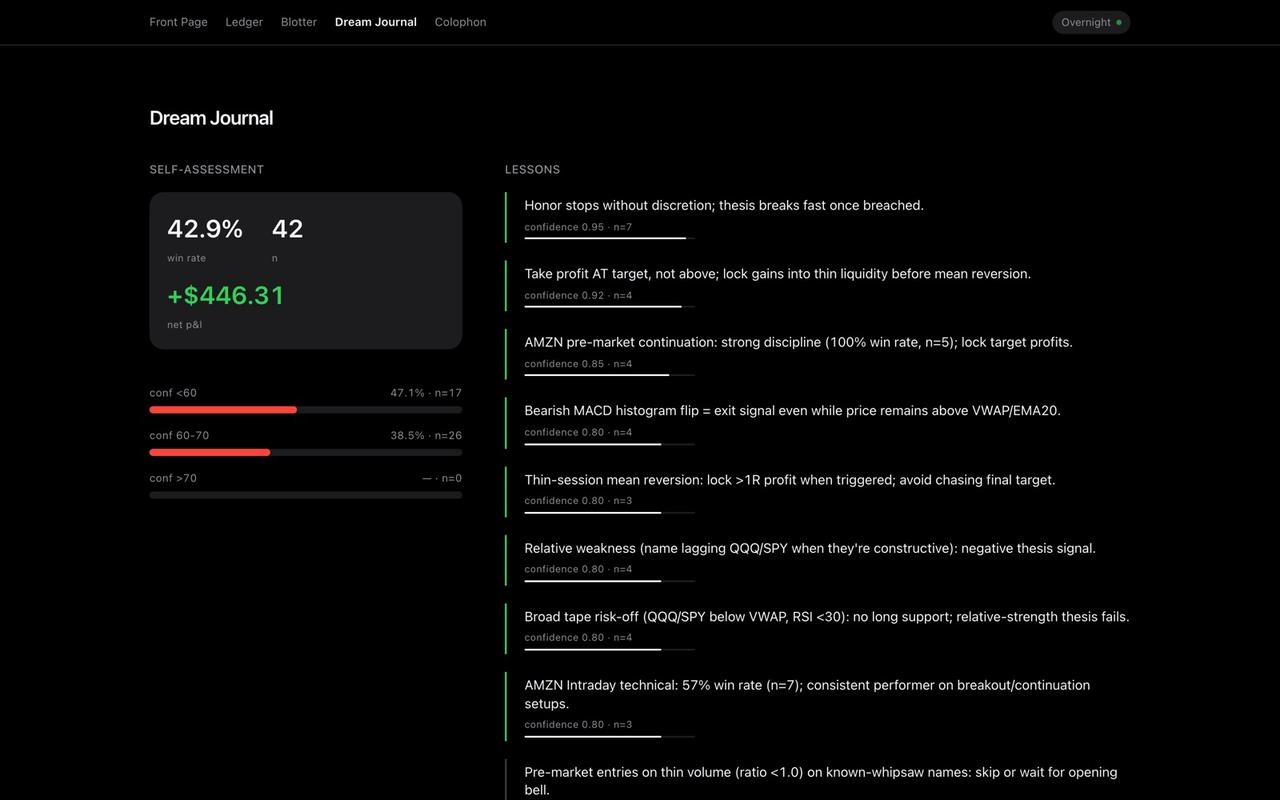
Dream Journal: self-assessed win rate by confidence band, alongside the lessons distilled overnight
Paper-trading disclosure
Flint runs entirely on Longbridge paper trading. Every P&L figure above is a paper-trading number, involves no real money, and does not constitute investment advice.
The author's goal is eventually to go live and be profitable, but that comes after paper-trading validation — it does not represent any form of expected return today. This is an educational project studying whether a constrained LLM can survive long-term inside real market structure. It is not a trading product.
Join in: try it, build on it, submit your own
- 👉 Try it & build on it: Flint is open-sourced on GitHub (Apache-2.0, still iterating). You're welcome to try it, file issues, or contribute: https://github.com/UncertaintyDeterminesYou4ndMe/flintrade
- 👉 Show us what you've built: there are more ways than ever to turn an idea into something real — Longbridge API, CLI, Skills, the Agent Platform — one of them will fit.
Got an idea? Build it!
When it's ready, @LongbridgeAI to submit — the next community showcase could be yours.


The copyright of this article belongs to the original author/organization.
The views expressed herein are solely those of the author and do not reflect the stance of the platform. The content is intended for investment reference purposes only and shall not be considered as investment advice. Please contact us if you have any questions or suggestions regarding the content services provided by the platform.