

The Most Expensive IPO Ever: Musk Left Three Hidden Catches

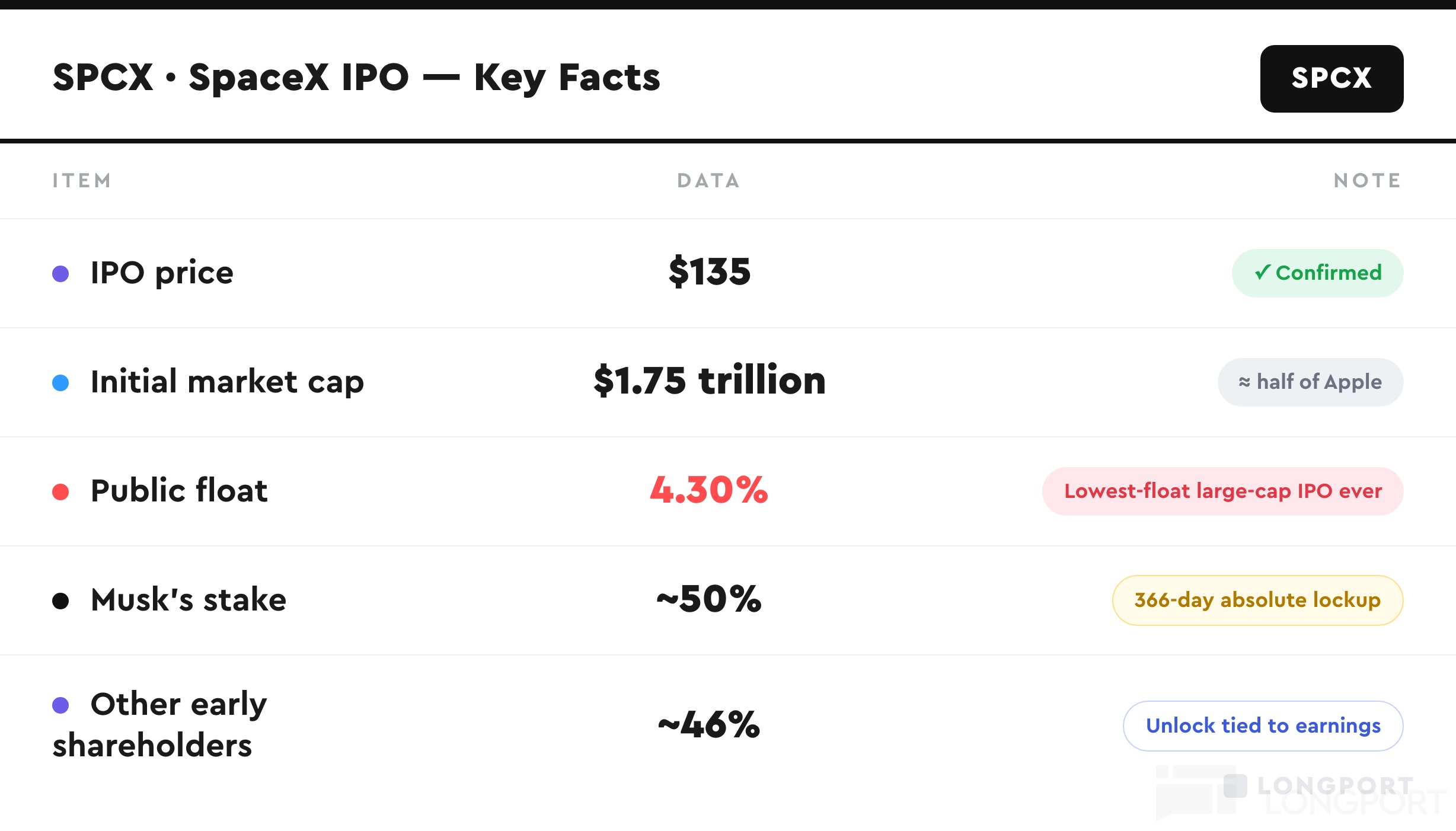
Beijing time, June 12 — SpaceX officially went public, ticker SPCX, IPO price $135, market cap $1.75 trillion, the largest IPO in history.
A quick heads-up: the listing day itself actually isn't the most important thing. What really drives this stock's short-term logic are the next three key dates. Understand these three dates and you understand this stock.
1. First, grasp one premise: chips are extremely scarce
$SpaceX (SPCX.US) issued 555 million Class A shares — only 4.3% of total shares outstanding.
Think of it as a cake of 100 slices: SpaceX cut only 4.3 slices to sell, while the other 95.7 are all locked and can't move. Meaning: very little is actually available to buy, but lots of people want in — supply and demand are wildly out of balance.
2. The three key dates, in one table
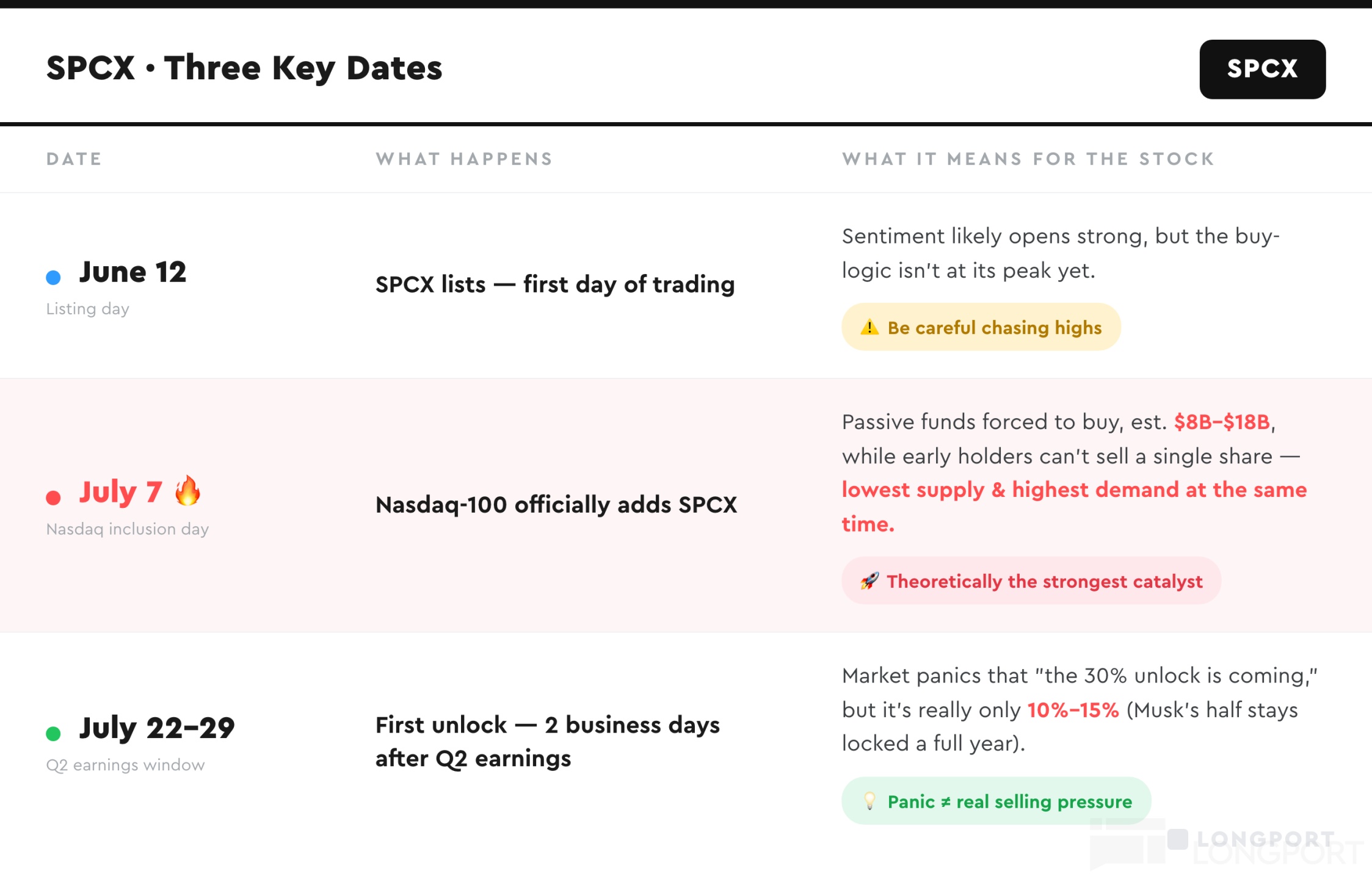
Why July 7 is special: the Nasdaq-100 has a "15th-trading-day" fast-track inclusion channel. FTSE Russell issued new fast-entry rules for exactly this, and MSCI confirmed it will include large IPOs early under current rules. Listing June 12 — and skipping the June 19 Juneteenth holiday and the July 3 Independence Day close — the 15th trading day lands precisely on July 7.
From that day, every global fund tracking these indices must unconditionally buy SPCX; the market estimates passive buying of $8B–$18B.
One important exception: S&P explicitly refused to fast-track SpaceX, keeping its old "listed 12 months + GAAP-profitable" rule — so SPY won't buy until mid-2027 at the earliest. Don't mix this up.
Meanwhile, none of the early shareholders' lockups have expired — not one share can be sold. So: tens of billions in must-buy orders on one side, almost no supply on the other — this is the "chip vacuum window."
3. The "30% big unlock" isn't that scary
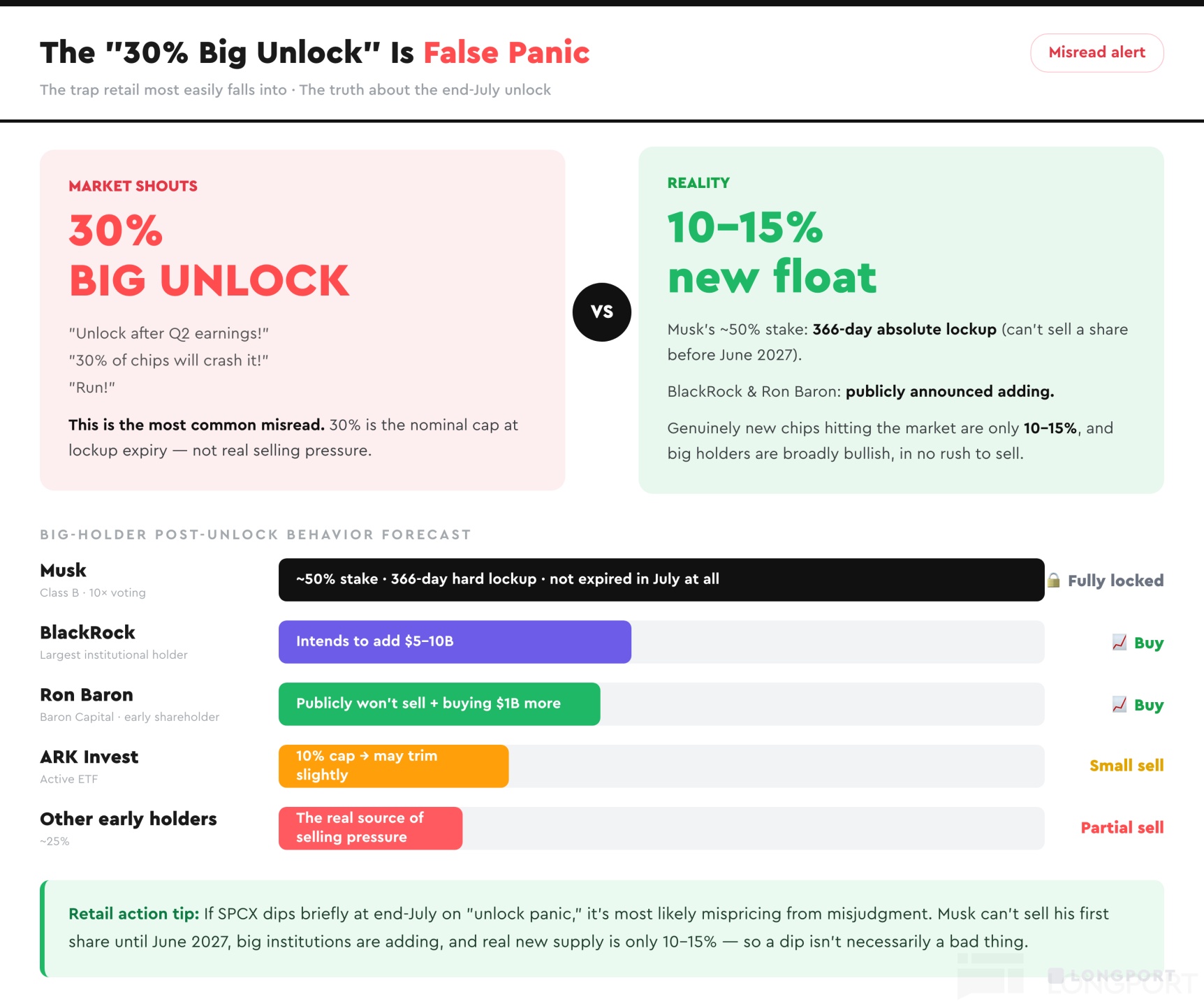
Many people panic the moment they hear "30% unlocks at end of July" — but that number is badly misread.
The real structure: the 30% is not unconditional. 20% can be sold 2 days after the first earnings report; the other 10% only unlocks early if the price is 30% above the IPO price and holds there for 5 of 10 trading days.
Breaking down the early shareholders:
- Musk himself (~42% stake, per the S-1): 366-day absolute lockup — can't touch it at end of July
- BlackRock: reportedly considering subscribing $5B–$10B at the IPO — a buyer, not a seller
- Ron Baron: explicitly said "won't sell a single share, and will buy another $1B"
- ARK Invest: capped by its 10% single-stock limit, will sell a little, but adds in its other funds
Strip out Musk's 40%+, and the unlock shares that could actually hit the market are only about 10%–15% of total — and the big holders lean toward adding, not selling. This "unlock" is more noise than crisis.
4. Why is TSLA falling this week?
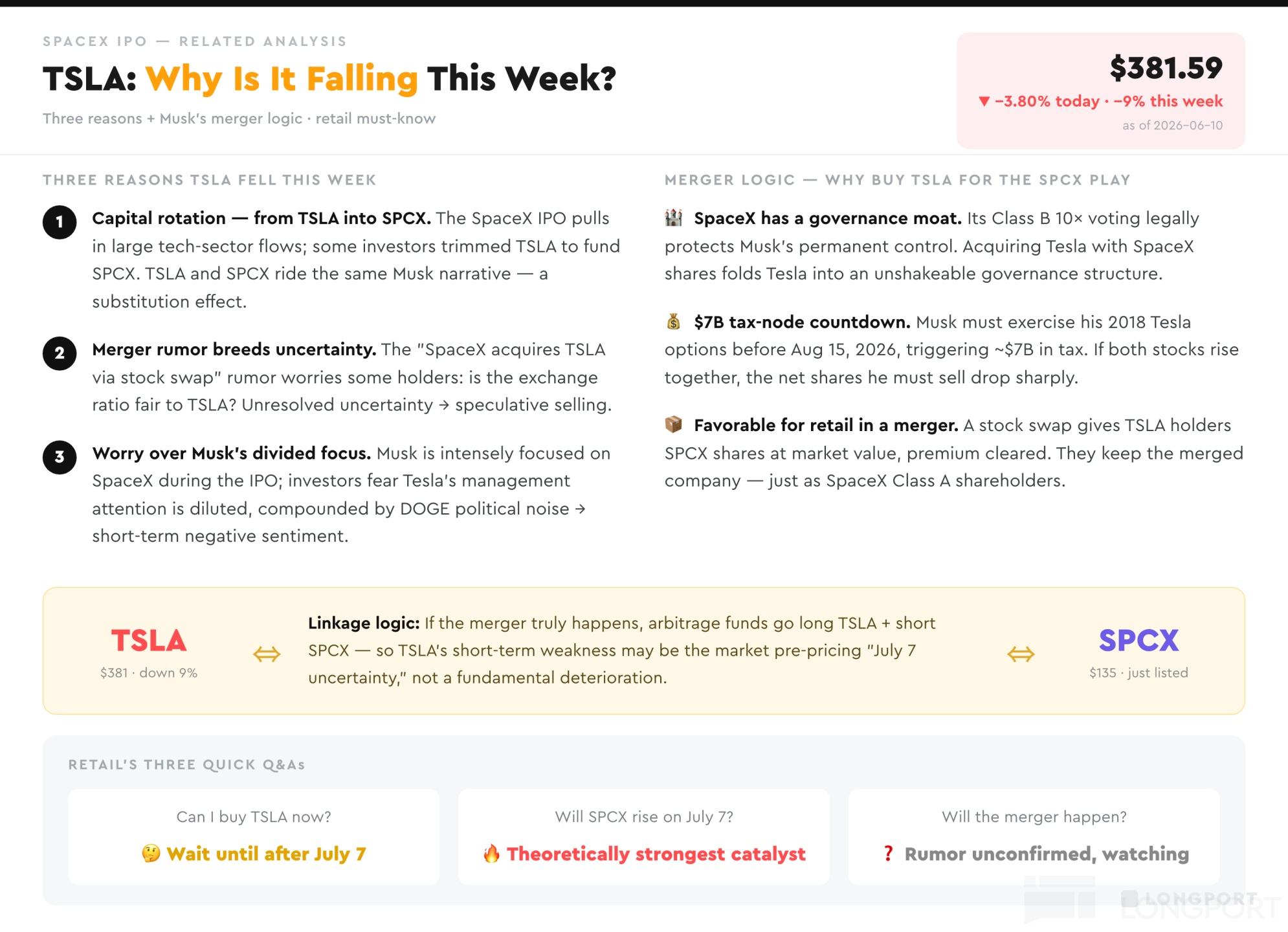
On June 10, $特斯拉(TSLA.US) closed at $381.59, down ~4% on the day, ~6.6% on the week, and ~9% off its recent high of $418.
Short-term reason: the SpaceX IPO siphoned off capital that would otherwise have gone to TSLA — many sold TSLA to free up cash for SPCX.
But there's a bigger story: merger speculation is heating up — and it's not just gossip:
- CNBC reported Musk has discussed combining SpaceX and Tesla with colleagues
- SpaceX's amended prospectus added the language: "may issue a large number of shares for future transactions"
- Prediction market Kalshi puts the odds of a merger before March 2027 at ~51%; Wedbush's Dan Ives goes as high as 80%
If it's a stock-for-stock merger, then once announced, arbitrage capital would lock TSLA to "exchange ratio × SPCX" pricing, and the two stocks would move in a linked orbit.
But two buckets of cold water: First, a stock-swap merger means SpaceX issues a large amount of new stock, which directly kills the "chip scarcity" logic above — and an acquirer's stock typically comes under pressure after the announcement. Second, this is a related-party transaction with the controlling shareholder on both sides, requiring an independent committee and a minority-shareholder vote (recall the SolarCity acquisition, which was litigated for seven years) — so a near-term announcement is unlikely.
This is speculation, not fact. Both the timing and the structure are undetermined.
Summary: How should retail investors read each time point?
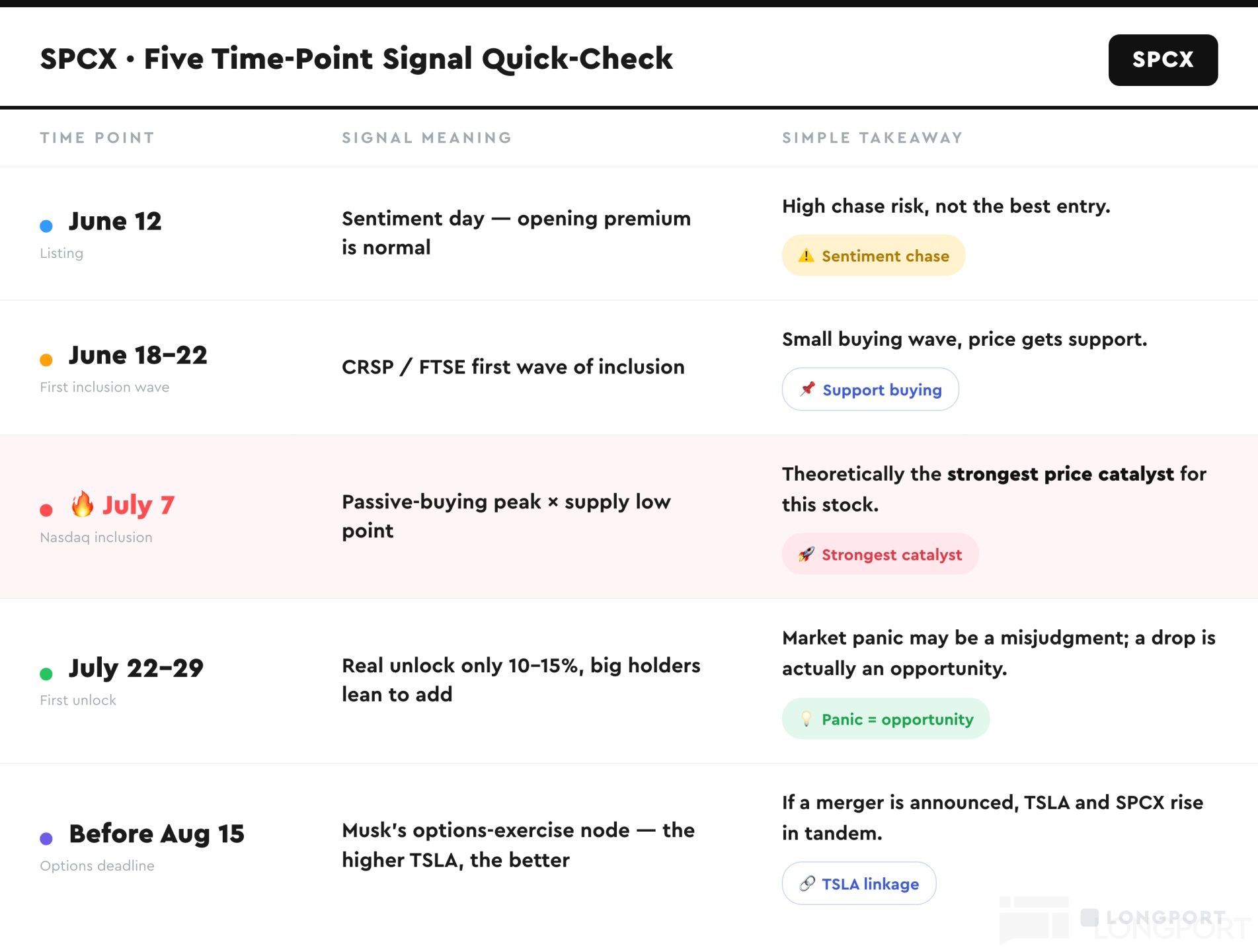
Bottom line:
- SPCX early days (June 12 – July 6): chip scarcity + sentiment premium — price will likely sit above the IPO price, but very volatile. Don't chase highs.
- Around July 7: the most certain passive-buying peak of the whole IPO — the window most worth watching.
- End-July unlock: don't be spooked by the "30% unlock" headline; actual selling pressure is limited.
- TSLA: short-term pressured by IPO capital diversion, but a beneficiary if the merger narrative plays out. At the current ~$381, holders can keep watching and wait for signals around July 7.
Related tickers:
- $特斯拉(TSLA.US) — main merger-speculation line / after-hours $378.80
- $纳指 100 ETF - Invesco(QQQ.US) — automatically holds SPCX after the July 7 inclusion
- $大盘指数 MSCI ETF - Vanguard(VTI.US) / $全美成长股指数 MSCI ETF - Vanguard(VUG.US) — Vanguard CRSP, first inclusion wave
- $SpaceX(SPCX.US)
- $2 倍做多SpaceX ETF(SPCH.US)
- $AST SpaceMobile(ASTS.US)
- $Rocket Lab(RKLB.US)
Risk disclaimer: The above is reasoning based on public information and market analysis. The merger is speculation and unconfirmed; price movements can't be predicted. Make decisions according to your own risk tolerance.
本文版权归属原作者/机构所有。
当前内容仅代表作者观点,与本平台立场无关。内容仅供投资者参考,亦不构成任何投资建议。如对本平台提供的内容服务有任何疑问或建议,请联系我们。
