

UOB Earnings Imminent! What’s next for the stock price? These Are the Core Drivers.

On 7 May, United Overseas Bank ($大華銀行(U11.SG) , SGX: U11) will release its Q1 2026 results. As one of Singapore's Big Three banks, UOB's earnings have a direct bearing on share price direction — but how should we actually read a bank's results and position ourselves ahead?
First, let's bust a common misconception. Many investors look at whether net profit went up or down and call it a day. But for banks, net profit alone is actually a poor predictor of share price movement. Don't believe it? Let's look at the data:
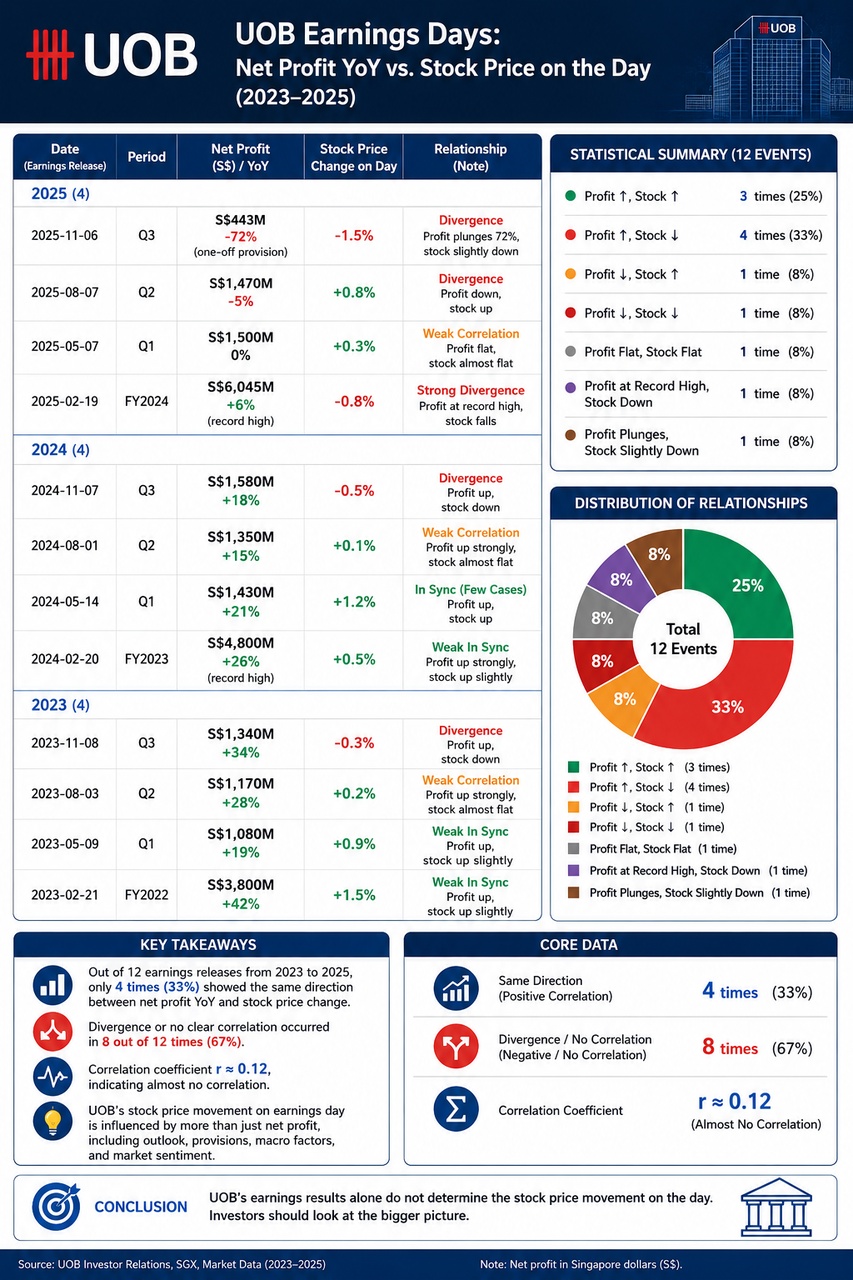
Longbridge Academy tracked 12 UOB earnings releases from 2023 to 2025, comparing net profit direction with same-day share price movement:
Profit up, share price up: 3 times
Profit up, share price DOWN: 4 times
Profit down, share price up: 1 time
Profit down, share price down: 1 time
Profit flat, share price flat: 1 time
Record profit, share price fell: 1 time
Profit plunged, share price barely moved: 1 time
Out of 12 instances, profit and share price moved in the same direction only 4 times — and diverged 8 times. The correlation coefficient is just r ≈ 0.12 (very weak). Why? Banking is a mature industry with relatively stable market share and valuations. Without a structural breakthrough, banks rarely deliver massive earnings surprises. The disconnect on results day usually comes down to one thing: expectations gap — what the market had already priced in versus what actually came out.
So bank stocks require a different analytical framework. Let's use this UOB earnings season to walk through the three indicators that actually matter.
Indicator 1: NIM (Net Interest Margin) — The Bank's "Profit Margin"
NIM = the spread between what a bank earns on its loans and what it pays on its deposits, expressed as a percentage.
Why does it matter? NIM is the single biggest driver of a bank's core earnings power. When rates are high, banks charge more on loans and NIM widens; in a rate-cutting cycle, NIM gets squeezed.
Real example: In early 2025, the market expected fewer rate cuts than previously feared, meaning NIM could hold up better. OCBC's analysts explicitly flagged that "the NIM environment is better than expected — UOB earnings could be revised up to mid-single-digit growth." UOB's share price subsequently rallied from S$33.50 to S$37.50 — a 12% gain in just two months.
But by Q3 2025, NIM slid from 1.91% in Q2 to 1.82%, dragging net interest income down 8% year-on-year and weighing heavily on results.
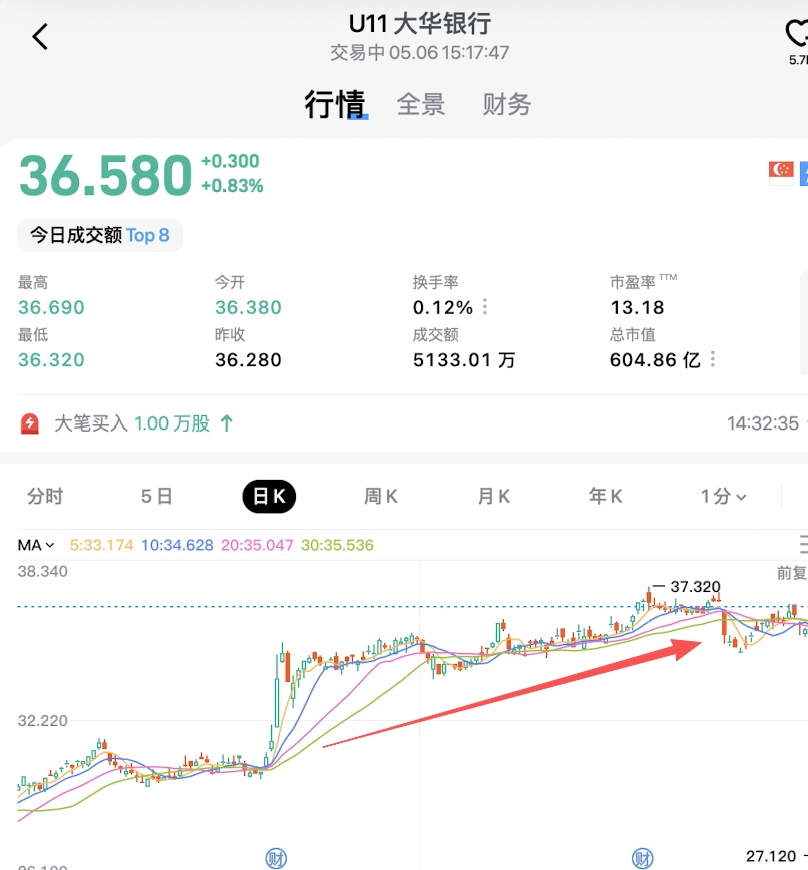
Where UOB stands now: Q4 2025 NIM came in at 1.84%, and management has guided 1.75%–1.80% for full-year 2026 — signalling further compression ahead. Whether Q1 NIM holds above or dips below that range will directly shape the market's full-year earnings expectations.
How to read it on results day:
NIM rises QoQ → Bullish — margin pressure is easing
NIM flat or slightly lower within guidance → Neutral — in line with the rate-cut cycle
NIM drops well below 1.75% → Bearish — likely triggers earnings downgrades
Indicator 2: Credit Cost — The Bank's "Risk Thermometer"
Credit cost is what a bank sets aside for potential bad loans, typically expressed in basis points (bps).
Why does it matter? A bank can earn plenty of interest income on paper — but if borrowers can't repay, provisions eat into the bottom line. Higher credit costs signal that management is more worried about asset quality ahead.
📌 Real example: This one hit close to home. On 6 November 2025, UOB reported Q3 results including a whopping S$615 million in pre-emptive general provisions — mainly for US and Greater China commercial real estate exposure. Total credit impairment charges hit S$1.36 billion for the quarter. The result? Net profit collapsed 72% YoY to just S$443 million, badly missing the consensus estimate of ~S$1.34 billion. UOB shares fell 3% on the day, closing at S$33.90. Meanwhile, DBS — reporting the same week — posted record profits and its share price hit an all-time high. Same sector, vastly different provisioning strategies, completely opposite share price reactions.
Where UOB stands now: Management has guided 25–30 bps credit cost for 2026, suggesting a return to normalised levels. Last quarter's EPS beat estimates by 6%, though revenue came in slightly light — a reminder to look beyond the headline number. With ongoing US tariff uncertainty and geopolitical tensions, this indicator deserves extra attention.
How to read it on results day:
Credit cost below 25 bps → Bullish — asset quality is solid
Credit cost within 25–30 bps → Neutral — in line with guidance
Credit cost spikes above guidance → Bearish — possible new NPL exposure. Remember the Q3 lesson.
Indicator 3: Fee Income — The Bank's "Second Engine"
Fee income covers wealth management fees, credit card fees, trade finance, investment banking revenue, and more. Crucially, it is not tied to interest rate movements — making it the key to earnings diversification.
Why does it matter? When NIM is shrinking, whether fee income can pick up the slack determines if a bank is merely riding the rate cycle or genuinely building durable revenue streams. UOB's acquisition of Citibank's consumer banking operations across four Southeast Asian markets has been a strategic game-changer, significantly expanding its wealth management and retail footprint — and this is a major structural driver of fee income growth.
Real example: In that same brutal Q3 2025, UOB's fee income actually hit S$892 million — up 10% YoY and 8% QoQ, a record high. It was this line item that kept the results from being even worse. OCBC told a similar story: net interest income fell 9% YoY, but non-interest income (including fee income) surged 15% to S$1.57 billion, effectively cushioning the NIM squeeze. OCBC's share price held up notably better than UOB's that quarter. That's the value of the "second engine" — when rates turn against you, whoever has stronger fee income is more resilient.
Where UOB stands now: Q1 2025 fee income hit an all-time high, with AUM crossing S$179 billion. Management has guided for high single-digit to double-digit fee income growth in 2026, with the Citi integration benefits still flowing through.
How to read it on results day:
Fee income up 10%+ YoY → Strong — Citi integration dividends are materialising
Fee income up single digits → Okay — but momentum may be fading
Fee income declining YoY → Bearish — weakness in wealth management or trading
Putting It All Together: How to Analyse Tomorrow's Results
With all three indicators in mind, here's the scorecard for UOB's Q1 2026 results:
Did NIM hold above 1.80%? → Determines whether interest income beats expectations
Did credit cost rise due to tariff or macro risks? → Determines whether profits got "eaten" by provisions
Did fee income sustain double-digit growth? → Determines whether UOB's diversification story holds up
If all three come in solid, expect a positive market reaction. If we get the dreaded "triple whammy" — NIM compression + higher provisions + slowing fee income — short-term share price pressure is very likely.
UOB at a Glance: Key Financials & Valuation
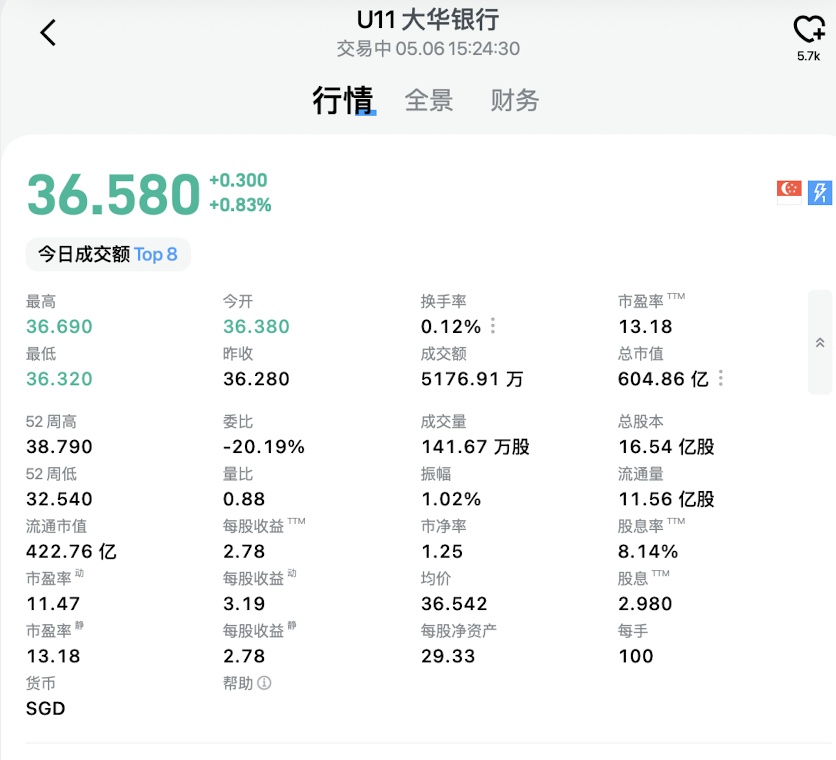
Current price: SGD 36.58 (as of 5 May 2026 close)
52-week range: SGD 32.54 – 38.579
Forward P/E: ~11x (implying roughly 10% pure financial return on investment, excluding market price movements)
Dividend yield: 8.14%
Payout ratio: 93% — a proper cash cow
Analyst consensus target: SGD 38.27 (potential upside ~5.3%)
Most UOB shareholders are in it for the reliable dividends and the safety profile that comes with owning one of Singapore's Big Three — and arguably the standout performer of the trio in recent years. For long-term income investors, UOB is a solid pick. From an asset allocation perspective, it fits squarely in the defensive bucket.
Final Thoughts
Bank stocks are a core holding for many SG investors — but "buy and collect dividends" doesn't mean you can skip understanding what you own. Investing is a dynamic process. Learning to read NIM, credit cost, and fee income empowers you to make your own call every earnings season: is this a good result or a bad one? Should I be adding or trimming?
If you'd like to learn more practical investment analysis methods, check out the Longbridge Financials & Valuation class — from indicator fundamentals to real-world case studies, it's designed to help you build your own analytical framework, step by step.
Disclaimer
Stock market investments are subject to market risks. You shall fully understand the risks involved and invest at your own discretion and responsibility
本文版權歸屬原作者/機構所有。
當前內容僅代表作者觀點,與本平台立場無關。內容僅供投資者參考,亦不構成任何投資建議。如對本平台提供的內容服務有任何疑問或建議,請聯絡我們。
