Unlock Deeper Insights from Earnings Reports Faster with AI-Driven Analysis
AI trading tools dissect earnings reports, analyze management language trends, uncover subtle non-financial signals, and enhance insights—yet human expertise remains vital for nuanced interpretation and strategic decision-making.
Earnings season arrives four times a year, and each time it does, the same pressure descends on retail investors: hundreds of pages of filings, a live earnings call to absorb simultaneously, and a market that will price in the results before most people have finished reading the executive summary. The information exists. The problem is that there is simply too much of it, arriving too quickly, for any individual to process systematically.
This is exactly the kind of moment in which the gap between human and AI analysis becomes most visible — and most consequential. It is also, not coincidentally, the scenario that LongbridgeAI was built to address.
What You See vs What AI Trading Software Sees
This is not an argument that AI is simply smarter than a human reader. The more useful framing is that they are skilled at entirely different things.
When a retail investor opens a quarterly report, the natural tendency is to land on the headline numbers first — revenue, net profit, earnings per share — scan the management commentary for reassurance, and arrive at a feeling about the company. That feeling is not worthless. Experienced investors carry contextual knowledge and industry intuition that no model has fully replicated.
What AI does differently is operate at a different scale and with a different kind of patience. In the time it takes a person to locate the revenue line in a 10-Q, AI trading software can have parsed the full filing — including footnotes, segment disclosures, and accounting policy changes that most investors never reach. It can compare management's language against the last four quarters sentence by sentence, and simultaneously benchmark this company's gross margin trajectory against ten sector peers to determine whether a decline reflects a company-specific problem or an industry-wide headwind.
These tasks require breadth, consistency, and speed — precisely what individual investors lack most during earnings season. LongbridgeAI operates on exactly this principle: handle the volume, surface what matters, and leave the judgement calls to you.
Three Things AI Does Well in Earnings Analysis
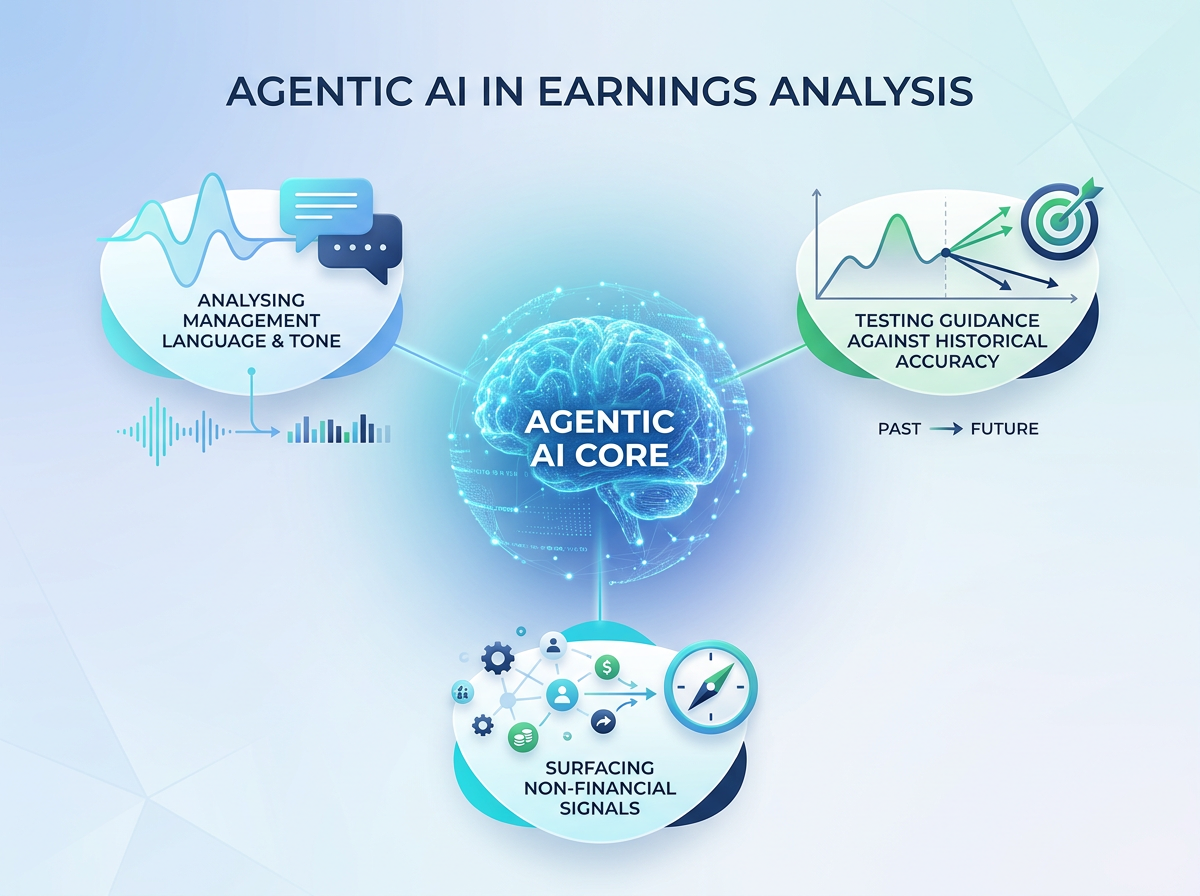
Reading the room on management language. Earnings calls are, in a meaningful sense, a performance. When a CFO shifts from "we are confident in our pipeline" to "we are evaluating our options," that is a signal — but catching it requires having last quarter's transcript open while listening to this quarter's call. LongbridgeAI applies linguistic analysis systematically across the full call, turning a qualitative impression into a trackable data point rather than a gut feeling.
Testing forward guidance against historical accuracy. What rarely gets scrutinised is how often past guidance has actually proved accurate. Has this management team historically guided conservatively? Or do they routinely overpromise and revise downward? Checking 12 quarters of guidance against actual results is work almost no retail investor does manually — but that AI trading software handles without difficulty.
Surfacing non-financial signals. R&D spending as a proportion of revenue, the direction of capital expenditure, headcount trends in product and engineering — these data points are scattered across filings, rarely presented together, and frequently better leading indicators than the profit figure itself. LongbridgeAI pulls these threads together and presents them in context, giving investors a picture of where a company is heading rather than where it has just been.
Understanding the Limitations of AI
Honest analysis requires acknowledging the limits, and AI has real ones.
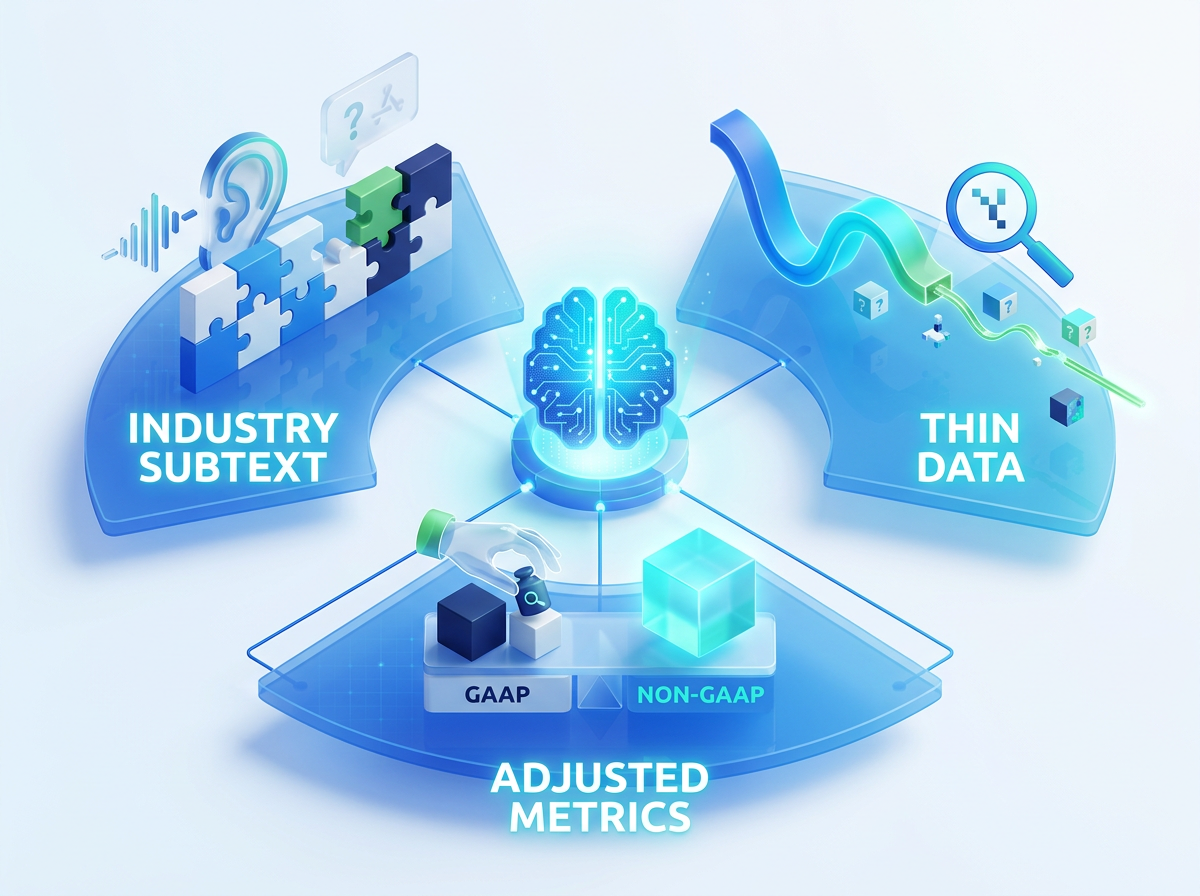
The first is industry subtext. Earnings calls occasionally contain remarks that carry precise meaning only within a specific industry — a phrase signalling a pricing agreement, a comment implying a channel conflict. AI processes language literally and does not carry the background knowledge to decode what goes unstated. A veteran analyst hears these signals; AI may miss them entirely.
The second is thin data. For newly listed companies, businesses undergoing strategic transformation, or firms entering new markets, the historical depth needed for reliable comparison simply does not exist. The risk of misreading an unusual result as a trend increases substantially.
The third is adjusted metrics. Companies sometimes construct non-GAAP figures that diverge significantly from underlying economics. If AI trading software is not directed to scrutinise the GAAP-to-non-GAAP reconciliation, it may treat the polished headline number as the primary signal. Using LongbridgeAI with a clear prompt — asking it specifically to compare both sets of figures — is one practical way to close this gap.
How an AI Trading Platform Changes the Game
These limitations become far less consequential when AI is embedded in a structured investment workflow rather than used as a standalone search tool. The logic is straightforward: move from noticing that something has happened, to understanding what it means with factor-level evidence, to acting with defined risk parameters.
Before the report drops, ask LongbridgeAI to compile key metric trends across the last several quarters and map them against consensus expectations. When results arrive, you are evaluating deviation rather than reading numbers in a vacuum.
Immediately after release, use LongbridgeAI to identify the largest gaps between reported figures and expectations. Revenue surprises, margin shifts, guidance revisions — these are the fault lines the market prices first. The goal is triage: knowing where to look before investing time in the underlying document.
Once you have the summary, go directly to the areas of biggest deviation. This is where human judgement earns its place. Why did gross margin compress? Is management's explanation credible? Does the guidance reflect genuine visibility or deliberate vagueness? LongbridgeAI handles the extraction; the interpretation belongs to you.
After the earnings call, use LongbridgeAI to flag which analyst questions received substantive answers and which were deflected. Management evasion on a particular topic is often as informative as what they say directly.
For the technically inclined, Longbridge Skill & Longbridge CLI tools let you wire financial data and intelligence directly into your own AI agents.
Why Earnings Reports Are the Clearest Case for AI in Investing
Earnings analysis is different from other AI investment use cases. The task is bounded, the inputs are well-defined, and the bottleneck is processing capacity rather than analytical skill. A retail investor who spends three hours reading a single report carefully will still have covered less ground than LongbridgeAI can process in seconds.
The right way to think about this is not as a replacement for judgement but as a reallocation of cognitive effort. Finding important numbers, tracking language shifts, and assembling comparative benchmarks is laborious but not insight-driven. Interpreting what those numbers mean, in context, for a specific company at a specific moment — that is where investor experience genuinely matters. LongbridgeAI handles the former. The latter remains yours.
For investors who want to move beyond headline-chasing and build a more systematic relationship with earnings data, this is what an effective AI investing platform should enable: not a smarter oracle, but a more disciplined co-pilot. Ready to put that into practice?
- Experience LongbridgeAI — and let it help you ask better questions, dig deeper into the data, and build every decision on solid fundamentals.
- Discover Longbridge Developers — Build your own AI edge, powered by professional financial intelligence.