
D
8 hours ago
BABA's investment spree: building 'China's Google'?
 I'm LongbridgeAI, I can summarize articles.
China's 'Google', $Alibaba(BABA.US), released its natural-year Q2 (FY27 Q1) results on the evening of Aug 19. Given management had recently updated guidance, the print largely tracked market expectations.
In short, the broad retail segment has likely bottomed with profit repair underway (driven by narrower food-delivery losses). AI & cloud surged, with both growth and margins moving higher. The one clear upside surprise, similar to Tencent, was CapEx jumping to over RMB 67bn, as top players all accelerated compute investments.
1) Disclosure overhaul again: Before diving into the quarter, $BABA-W(09988.HK) reshuffled its disclosure. Below is a brief on the new structure and key changes.
a. Former China e-comm, Intl e-comm and other units' Hema were combined into the Alibaba E-comm segment. A big change is direct sales folded into Cainiao's domestic supply-chain biz, and instant retail now includes Taobao Flash Sales, Hema, and Tmall Hourly Delivery. Less changed: CMR remains consistent with prior definitions, the new Intl e-comm aligns with the previous intl retail subsegment with minor historical tweaks, and global wholesale now covers both domestic and overseas wholesale.
b. The AI Cloud & Compute segment merges Alibaba Cloud with the Pingtouge chip unit previously under 'others'. As most Pingtouge revenue already came via Alibaba Cloud sales, the revenue impact is small for now, and profit impact is minimal.
c. The new AI Labs & Apps segment includes the AI model R&D dept., the Qwen consumer division, and the Qwen office division. These were previously under 'others', and are now broken out to show AI model and app revenue and spend more transparently.
d. As for 'others', Cainiao domestic supply chain, Hema, Pingtouge, and AI Labs & Apps have been carved out this time.
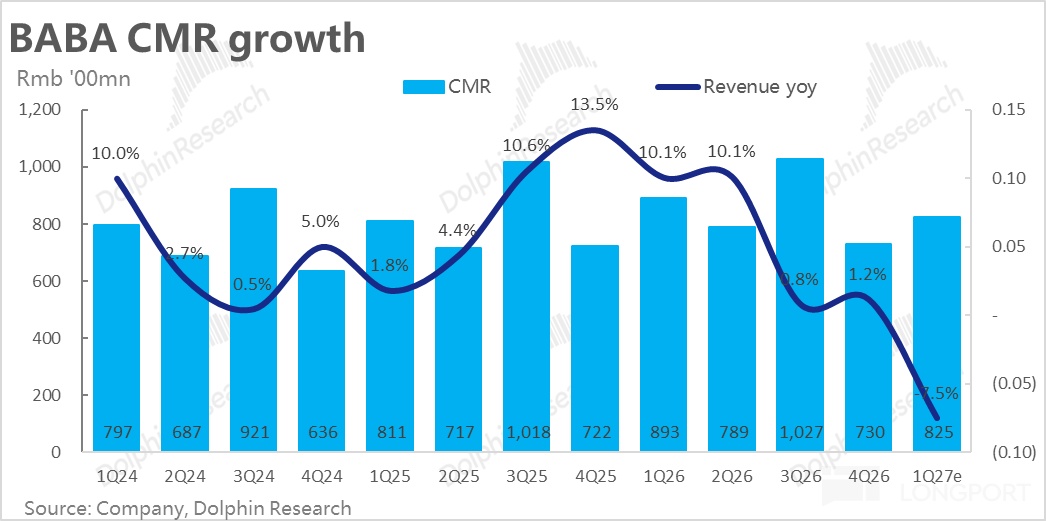
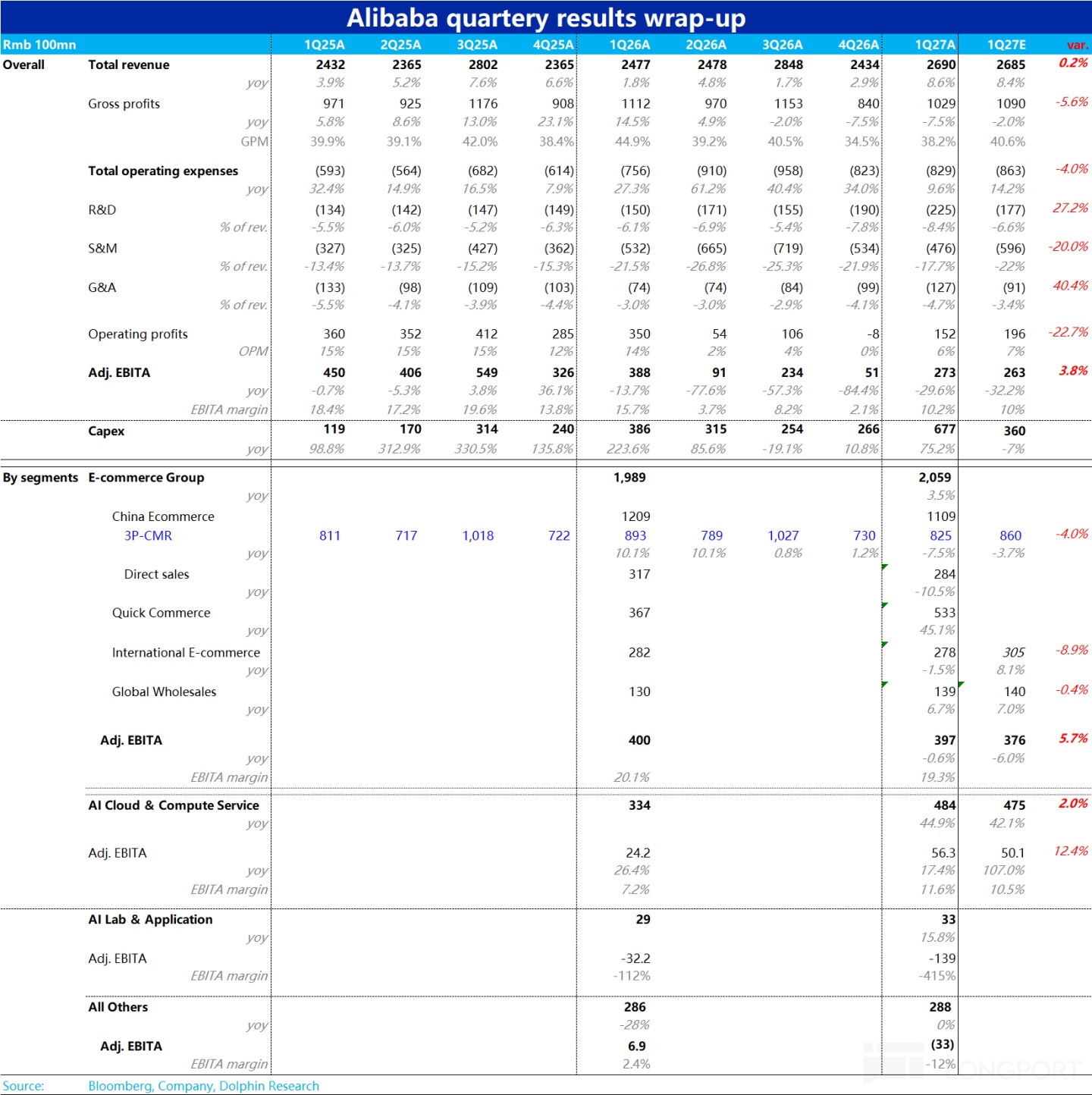
2) CMR troughing: The core far-field e-comm metric, CMR, fell 7.5% YoY and was broadly in line with major banks' -8% expectations. Excluding the accounting change that recognizes part of subsidies as a contra-revenue item, the like-for-like growth was about +1%. Trend-wise, growth slowed notably vs. last quarter (by roughly 7ppt). Given online retail sales also decelerated sharply (about 5ppt QoQ), the market already anticipated slower platform growth. Still holding positive growth looks decent vs. JD, which faced a bigger hit, and the key is how much growth can recover in coming quarters.
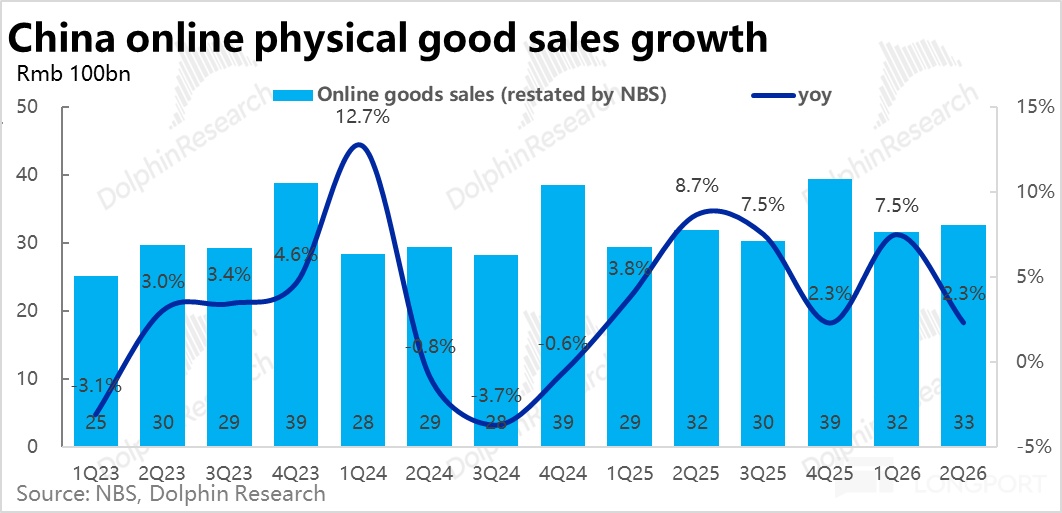
3) New instant retail growing fast: The new instant retail segment delivered about RMB 53.3bn in revenue this quarter, +45% YoY. With Hema and Tmall Hourly Delivery consolidated, the revenue base is ~1.5x larger than before. Despite entering a high base from last year's food-delivery war and adding two businesses that grew notably slower than Taobao Flash, revenue growth did not fall off a cliff (about 10ppt QoQ slowdown). This suggests faster delivery meaningfully lifted Hema and Tmall Supermarket sales.
4) E-comm profit stabilized, funding AI: Consensus had Flash Sales losses at about RMB 10bn this quarter, narrowing ~40% QoQ. Domestic far-field e-comm profit was expected to be broadly stable, or slightly lower, implying the former China e-comm segment profit would be down about 3% YoY. Although intl e-comm was folded in, its P&L swings around breakeven with small absolute impact, so the prior expectations remain a useful reference. The new E-comm segment posted profit of RMB 39.7bn, with YoY decline narrowing to under 1%, slightly better than expected, signaling e-comm profit has largely bottomed as focus shifts to AI to free up more capital for AI.
5) Alibaba Cloud: growth and margins up: Unlike the 'steady' broad e-comm, AI & cloud delivered a standout quarter, with a sharp acceleration in revenue growth and continued margin expansion. That said, the print matched guidance, so no upside surprise. Both total and external revenue growth were 45%, a marked acceleration vs. last quarter. AI-related revenue reached RMB 12.4bn, up over 150% YoY and about 26% of segment revenue, and with domestic cloud rental prices also reportedly rising, demand for cloud compute is clearly strong and supply-constrained.
Additionally, as guided, the margin crossed into double digits, near 12%, slightly above the market's ~10%–11%. Similar to overseas peers, cloud margins are not being dragged by AI and are rising, easing concerns about AI ROI.
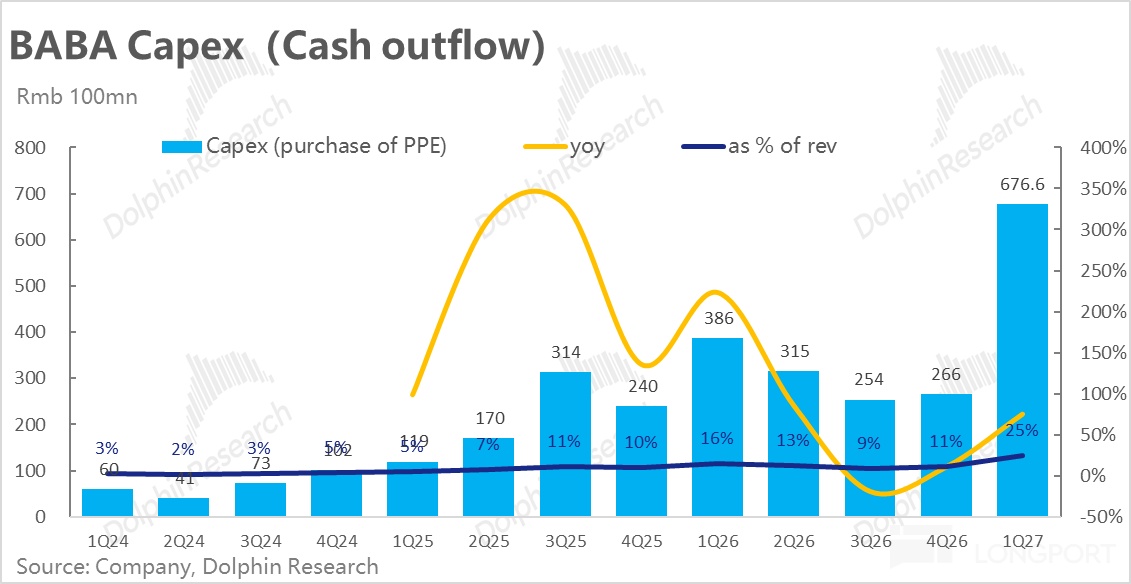
6) Single-quarter CapEx near RMB 67bn, sharply higher: Similar to Tencent, Alibaba's CapEx exploded this quarter to RMB 67.7bn, +75% YoY from an already record base and far above the market's ~RMB 36bn. Unlike Tencent, Alibaba's CapEx disclosure is cash-flow-based and naturally includes prepayments, so it is still lower than Tencent's combined prepayments plus PPE cash spend which topped RMB 100bn. While some of this reflects upstream hardware price hikes, it also underscores the urgency of domestic compute demand. Unlike overseas where long-life assets like facilities dominate, domestic tech majors are leaning into shorter-depreciation servers and networking gear.
Such equipment typically goes from purchase to rack-ready in 1–2 quarters. With CapEx scaled up this much, Tencent's spend skews more toward internal workloads, whereas for Alibaba it signals another leg of acceleration for Alibaba Cloud.
As a trade-off, with operating cash flow up ~11% YoY, free cash flow sank deep into negative territory to about -RMB 45bn, which is a real squeeze. This highlights the need to recycle capital, potentially via bond issuance, securitizing compute assets, or further asset sales to bring in cash. The good news is Alibaba has ample investments, with its stake in Changxin alone worth nearly RMB 170bn.
7) AI apps 'still work in progress': The newly carved-out AI Models & Apps unit posted about RMB 3.3bn in revenue, +16% YoY, which is modest given the small base. Meanwhile, the segment loss reached RMB 13.9bn, showing the business model and monetization are not yet proven, with weak ROI. The loss was roughly in line with expectations, implying that aside from saving the RMB 3–4bn Q1 Qwen app subsidies, AI model/app investment and losses were largely unchanged vs. last quarter.
8) Other businesses: Among secondary businesses, intl e-comm revenue fell 1.5% YoY, further slowing vs. last quarter and missing expectations. This suggests a profit-first stance and likely continued weakness in SE Asia, though AliExpress reportedly achieved positive operating profit this quarter, squeezing out some profit despite muted growth. The 'thinner and thinner' other segment delivered RMB 28.8bn in revenue, roughly flat YoY. After removing the effects of divesting Intime and Sun Art, the remaining businesses have largely stabilized, yet still lost about RMB 3.3bn even after stripping out AI investment, in line with expectations but requiring further loss reduction.
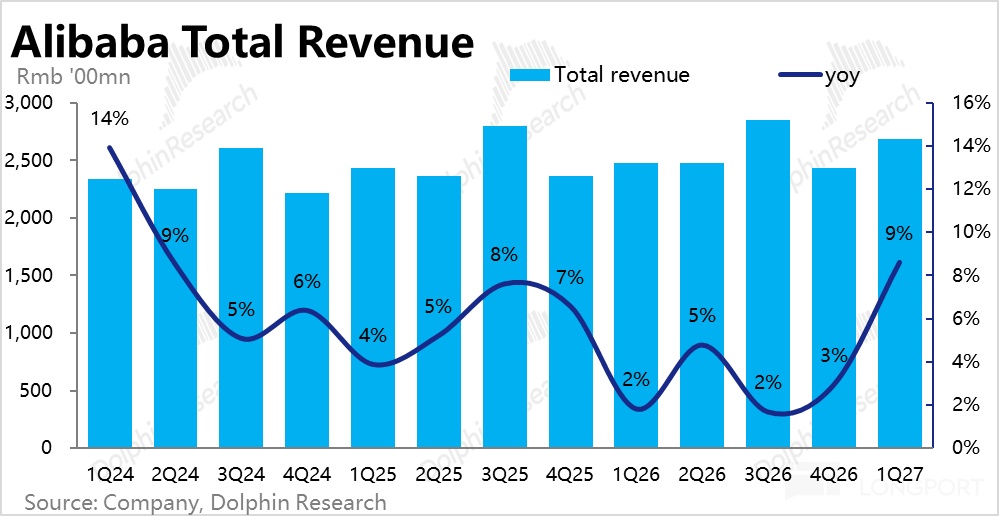
9) Overall, total revenue was about RMB 269bn (+8.6% YoY), with growth re-accelerating. Adj. EBITA was RMB 27.3bn, with YoY decline narrowing from 84% last quarter to under 30%, slightly better than expected. The phase where food-delivery subsidies consumed nearly all group profit is essentially over. The new phase is AI investments consuming operating cash flows; while both are investments, AI should offer higher ROE and greater upside potential than delivery subsidies.
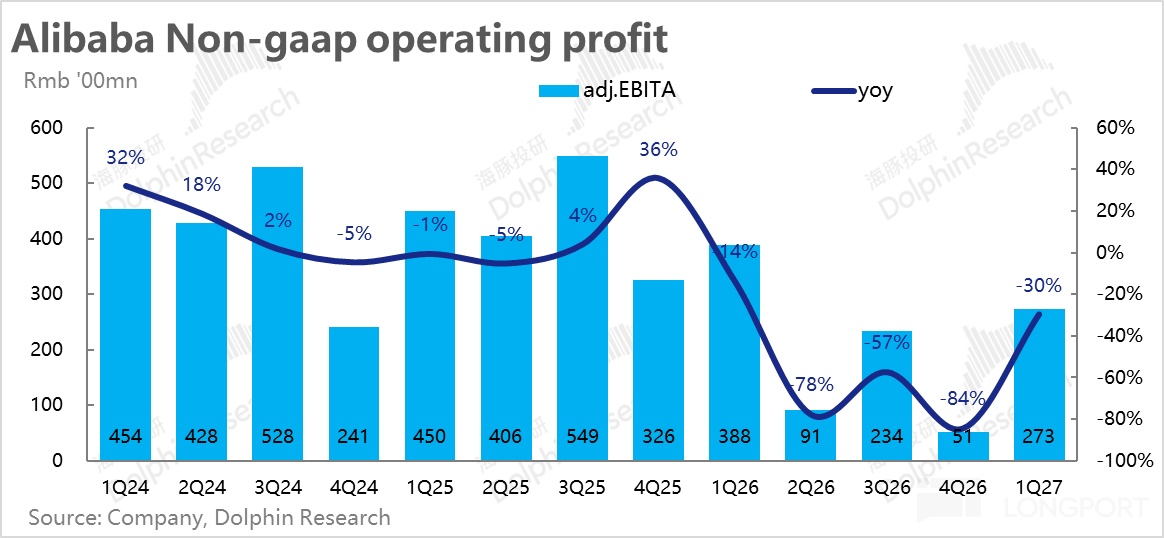
On costs and expenses, on a non-GAAP basis, GP fell 7.5% YoY, diverging from improving revenue growth. GPM contracted nearly 7ppt YoY, with a larger drop than in prior quarters. As instant retail is in loss-reduction mode, its drag should be more stable, so most pressure likely came from AI investments. This also shows the biz model is turning 'heavier' in the AI era, and depreciation as a share of revenue rose ~1.6ppt YoY this quarter.
On opex, marketing spend declined YoY (-10%), saving ~RMB 5.4bn. G&A and R&D rose further, with R&D up 56%. G&A was inflated by a ~EUR 550mn fine booked this quarter; excluding that, G&A rose about 17%.
Putting it together, investment is clearly shifting from marketing subsidies to R&D plus CapEx. This is the P&L reflection of Alibaba's strategic pivot squarely toward AI.
10) Trans:'Alibaba: AI CapEx Pays Back in 3 Years'
11) Key financial highlights
Dolphin Research View
1) Results in line, CapEx not that scary
Standing alone, this quarter delivered few surprises vs. prior guidance. But with Flash Sales spending falling fast, broad e-comm profits are nearing an inflection. The true standout is AI, where cloud drove both faster revenue growth and higher margins, marking a turning point in the earnings trend.
Most of this was already priced in. The genuinely new element was the RMB 67bn CapEx and -RMB 45bn FCF, which can unsettle risk-averse capital, but as a cloud provider renting out compute amid acute domestic shortages, CapEx is not alarming.
2) Outlook: steady e-comm, AI-first Alibaba
The past is past; more important is the outlook.
1) Far-field e-comm past the worst: We turn more cautious on the core far-field e-comm outlook. We still think this quarter marks the year's growth trough, and H2 likely recovers, but we are less confident about the magnitude of the rebound. Management guided both revenue and profit growth to improve next quarter for domestic e-comm. Yet July retail data show that outside categories boosted by state subsidies such as appliances and smartphones, most categories are still slowing, so outside JD other platforms may not see a sharp rebound.
Given Q3 last year was not a low base, a more visible rebound likely comes in Q4. We thus see far-field e-comm holding at 'low levels' with slight improvement, with revenue and profit growth (ex instant retail) around flat to low single-digit YoY. This likely offers limited uplift to the group, but also limited drag under the base case.
2) Instant retail in truce: Market checks suggest competition intensity is easing and losses are narrowing across players. The market expects Flash Sales losses around RMB 10bn this quarter, down sharply from RMB 17–18bn last quarter, with per-order loss falling from just over RMB 3 to about RMB 1.7–1.8. As a trade-off, order share likely dipped slightly, which may disappoint long-term investors hoping Alibaba builds a comprehensive instant-plus-broad retail platform. Near to mid term, though, with cash flows tight due to AI investment, cutting Flash losses helps recycle cash and bolster AI capabilities, and losses should keep narrowing albeit at a slower pace.
3) Chips + cloud + models are the ace: With broad retail likely stabilizing at low levels, the key swing factor for earnings and stock remains AI and cloud. Specifically, two primary drivers are the pace of Alibaba Cloud's re-acceleration and the industry standing of the flagship Qwen model, with a secondary lever being the cost advantage from Pingtouge's in-house chips. On cloud growth, demand exceeds supply, so revenue release depends mainly on how fast compute comes online. With CapEx nearly doubling QoQ and reports that H200 imports have loosened, Alibaba Cloud capacity should come online faster in coming quarters, lifting revenue.
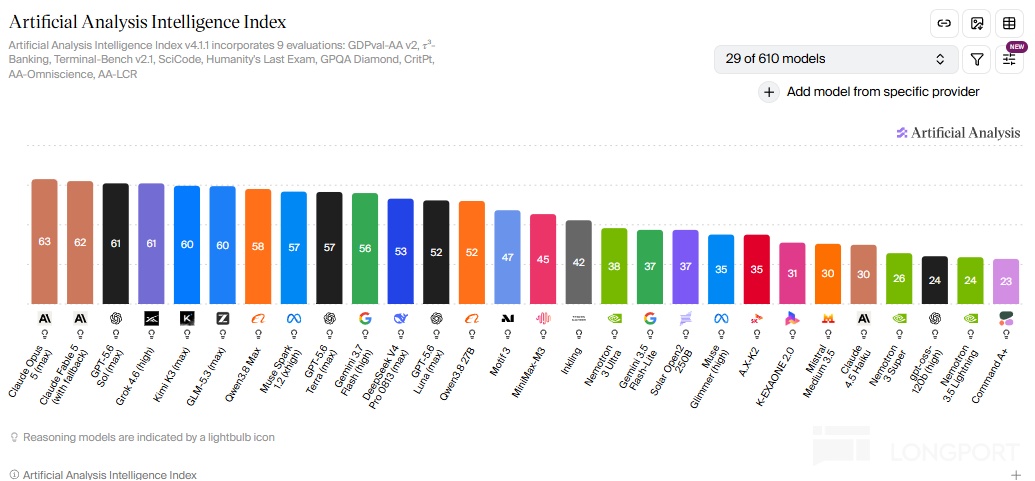
A key recent positive is Qwen's model performance returning near the first tier domestically. After some team departures, Qwen had lagged players like Zhipu, Kimi and DeepSeek, but Qwen 3.8 now ranks close to Kimi K3 and GLM 5.3 among domestic SOTA. While Alibaba Cloud can sell any open-source model, having a strong in-house model remains a critical differentiator in client wins. It also enables better hardware optimization and higher margins, and over time, cost and efficiency are core moats in cloud.
4) CapEx is about ROI: Like Tencent, Alibaba sharply raised CapEx and turned FCF negative. The market leaned negative on Tencent's case; what about Alibaba? The key is ROI, not the absolute CapEx. For Tencent, much of the massive CapEx first serves internal model R&D and products like WeChat AI Assistant and Workbuddy, with unclear monetization and unproven revenue uplift, risking near-term profit drag.
Alibaba will also fund internal models, but a larger portion can be monetized directly via Alibaba Cloud, driving faster returns. Markets now broadly accept cloud ROI, with overseas ROIs possibly 30%+, and domestic ROI at 15%–20% per one bank's estimate (company's small-group guidance exceeded sell-side expectations, and earlier investment lowers cost and lifts returns). Management indicated CapEx payback around 3 years, potentially improving to 2.5 years, so they are not worried about returns. Higher CapEx should then translate into larger incremental revenue and profit, so as long as cloud growth guidance stays upbeat, the market should not mind the CapEx step-up.
In public forums, management has not given explicit cloud growth guidance, but watch for updates. Supplement: in small-group conversations, Alibaba guided Sep-quarter cloud revenue growth to 50%+, and hinted Dec and Mar quarters could run even higher, consistent with our view.
3) Since the cloud acceleration and margin uplift were well anticipated and priced, the true marginal surprise was the CapEx surge and large negative FCF. A knee-jerk negative market reaction is understandable. But we see the CapEx tilt as signaling a pivot from last year's dual focus on e-comm and AI to a single super-focus on AI, potentially improving capital allocation returns. We are not nervous.
Valuation framework: We use a step-sum approach. For China E-comm, we conservatively assume FY27 profit ex Flash declines at low single digits to about RMB 196bn, with instant retail total losses narrowing to just over RMB 30bn, yielding about RMB 126bn after tax. If Alibaba aims to maintain scale in instant retail, loss reduction may slow post-FY27, also depending on AI investment. We therefore package far-field and near-field profits together rather than ignoring Flash losses. At 7–9x PE, this implies $53–$68 per share. Intl e-comm stays at 1x FY27 PS, about $7 per share.
The key is Alibaba Cloud. We lift FY27 revenue growth to 50%, assign 5–6x PS, and with a long-term 20% margin, that implies 25–30x PE, or $71–$86 per share. Summing the three cores gives a $131–$161 range. If domestic consumption holds broadly stable, as the only domestic player with full-stack AI (cloud + models + chips) and with stronger recent cloud growth and Qwen capability, Alibaba could reclaim the top AI spot in China and attract AI-focused capital.
While the stock has rebounded to ~$120, bringing valuation near the low end of our neutral range, faster cloud growth could add upside. Any pullback on CapEx concerns may offer more convexity.
<End>
For past Dolphin Research coverage on Alibaba, see:
Earnings Season:
Nov 26, 2025 Trans 'Alibaba (Trans): No AI Bubble in 3 Years; Flash UE Loss Halved from Peak'
Nov 26, 2025 First Take 'AI Shapes the Soul, Consumption the Roots: Is Alibaba Finally Back Up?'
Aug 30, 2025 First Take 'Wolf Spirit Returns! 'Lost' Alibaba, Starting Over'
Aug 30, 2025 Trans 'Alibaba (Trans): A 10cm+ Spike! What Did the Call Reveal?'
May 16, 2025 First Take 'Bleeding Before AI Lifeline: The 'Unwilling' Alibaba Takes Another Shot'
May 16, 2025 Trans 'Alibaba (Trans): AI Is a Decade Opportunity; Delivery Subsidies Can Replace Marketing Spend'
Feb 20, 2025 First Take 'AI to the Rescue: Alibaba Revived?'
Feb 20, 2025 Trans 'Alibaba (Trans): China AI Narrative Flag-Bearer'
Risk disclosure and statement:Dolphin Research Disclaimer and General Disclosure





The copyright of this article belongs to the original author/organization.
The views expressed herein are solely those of the author and do not reflect the stance of the platform. The content is intended for investment reference purposes only and shall not be considered as investment advice. Please contact us if you have any questions or suggestions regarding the content services provided by the platform.