
D
Nov 25, 2025 at 04:09 PM
Alibaba (Minutes): No AI bubble within three years, Flash Sale UE losses have halved from the peak
The following is compiled by Dolphin Research $Alibaba(BABA.US) FY26Q2 Earnings Call Minutes, for earnings interpretation please refer to "AI Shapes the Soul, Consumption Shapes the Root, Has Alibaba Finally Stood Up?"
I. Review of Core Financial Information
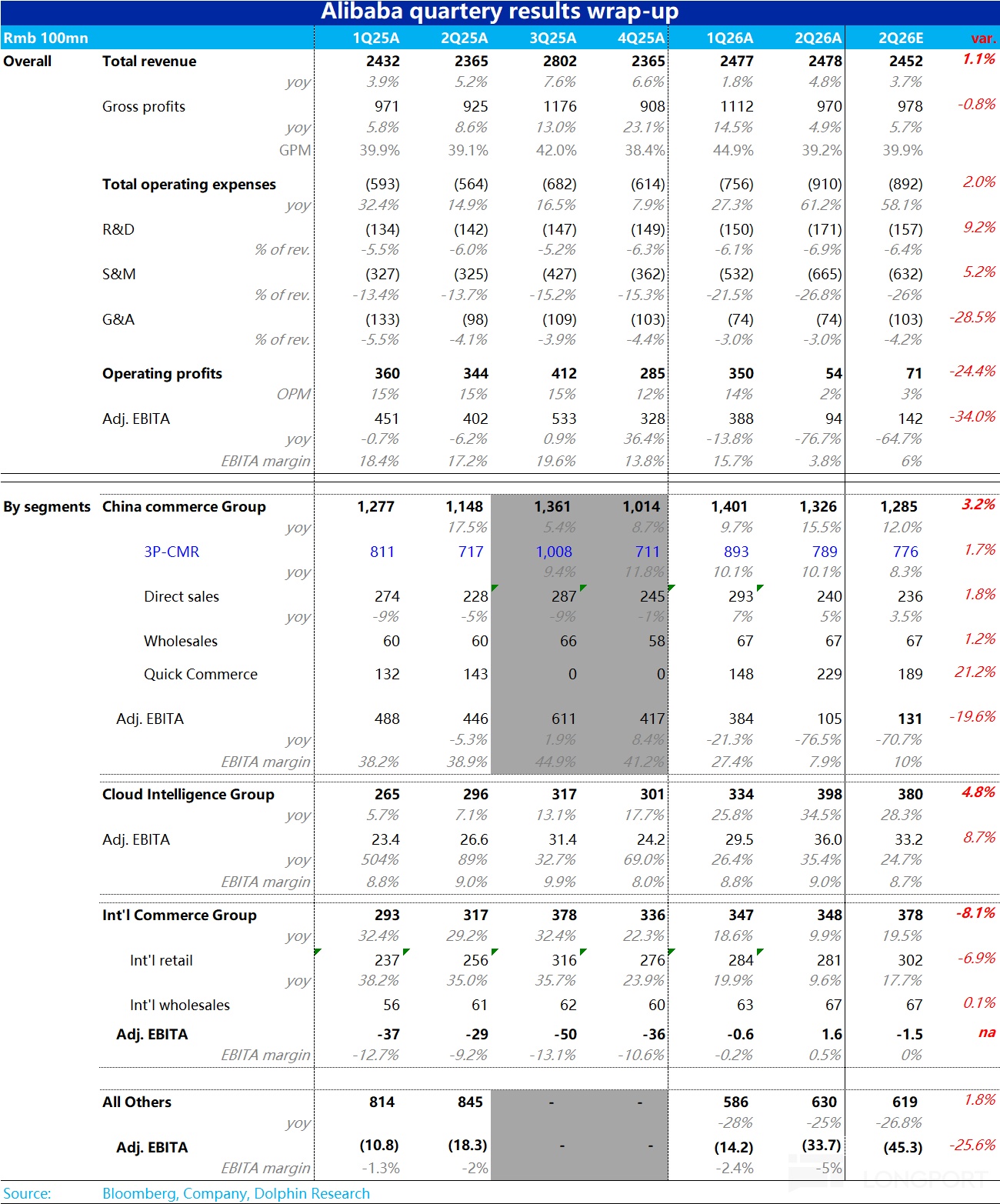
II. Detailed Content of the Earnings Call
Key Information from Executive Statements
1. Progress of "AI + Cloud" Strategy
a. Performance: Driven by strong AI demand, Alibaba Cloud's external commercialization revenue accelerated growth to 29%. AI-related product revenue achieved triple-digit year-on-year growth for nine consecutive quarters. Market share has comprehensively increased in multiple subfields (hybrid cloud, financial cloud), with hybrid cloud growth exceeding 20%.
b. Market Trend Insights:
- Full-stack demand: As AI applications are implemented, customers tend to choose cloud providers with full-stack technical capabilities.
- Driving effect: The depth and breadth of AI usage have significantly boosted demand for traditional cloud products such as computing, storage, and databases.
c. Technological Breakthroughs and Strategic Layout:
- A complete system has been built from infrastructure to foundational models to development frameworks. The flagship model "Tongyi Qianwen 3-Max" ranks among the global top tier in capabilities such as code and Agent tool invocation.
- Dual-wheel drive: AI to B aims to become the world's leading full-stack AI service provider, serving thousands of industries. AI to C Tongyi Qianwen downloads have exceeded 10 million, with a significant increase in user retention rate. In the future, it will combine with Alibaba's ecosystem (e-commerce, maps, local life) to create an AI life portal.
2. Progress of the Large Consumption Platform
a. E-commerce retail: Taobao's instant retail business UE (unit economic efficiency) has significantly improved, with enhancements in fulfillment efficiency, user retention, and average transaction value. As of October 31, approximately 3,500 Tmall brands have integrated into Taotian's instant retail business (offline store integration), continuously promoting synergy between instant retail and the ecosystem.
b. Local life (Gaode):
- On October 1, Gaode's DAU peak exceeded 360 million, setting a historical high.
- "Gaode Miao Street List" had an average daily DAU of over 70 million in October, with comment volume tripling year-on-year, constructing an offline service credit system based on user behavior to promote consumer trust.
3. Future Outlook and Strategic Focus: Continue to firmly invest in the two core businesses of "AI+Cloud" and "Large Consumption Platform." In the AI field, efforts are made simultaneously towards the 2B and 2C markets, stimulating synergy between core businesses and driving the group to new heights.
Q&A
Q: How do you foresee the future growth prospects of the cloud business? Will the trend of accelerated growth continue? On the demand side, what are the key drivers for Alibaba Cloud's external revenue growth in the future?
A: Currently, customer demand is extremely strong, and our AI server deployment speed cannot keep up with order growth, with backlog orders continuously expanding, indicating that future growth potential will continue to accelerate. On the demand side, AI is rapidly penetrating the entire lifecycle of enterprise product development, manufacturing, and end-user usage. Whether it's model training, inference, or terminal applications, they drive strong demand for cloud computing power. Based on these tangible enterprise payment demands, we are very confident in the future growth prospects of the AI business.
Q: Can you share the current progress of the instant retail business and what synergies it has generated with the core e-commerce business?
A: In recent months, we have focused on optimizing unit economic efficiency (UE) while maintaining market share, and have made significant progress. Specifically, since October, the loss per order in flash sales has halved compared to July and August, and order share remains stable, with GMV share steadily increasing, significantly driving related physical e-commerce categories. This is mainly due to two aspects: one is order structure optimization, with non-catering orders accounting for over 75%, average transaction value achieving double-digit growth month-on-month compared to August; the second is the scale effect, with delivery timeliness better than the same period last year, average logistics cost per order significantly reduced and below the level before large-scale investment. Additionally, during the process of loss convergence, user retention and frequency performance have also exceeded expectations.
We firmly believe that the flash sales model has great synergy potential with the Alibaba ecosystem. After completing the first phase of scale expansion, the current second phase of UE optimization meets expectations, laying the foundation for long-term sustainable business development and strengthening our determination for long-term investment. In the next phase, we will continue to deepen user experience, focus on high-value user management and retail category development. As the core strategy of Taotian platform upgrade, our goal is to bring trillion-scale transaction volume to the platform in three years, thereby driving the overall market share improvement of related categories.
Q: Considering these synergies, what are the management's expectations for core e-commerce CMR (Customer Management Revenue) and EBITA for the December quarter?
A: Regarding the outlook for CMR and EBITA, the flash sales business has a significant driving effect on user activity and related category transactions, thus having a positive impact on CMR, with the next focus on deepening near-far field synergy to reflect value. Regarding the EBITA of the China e-commerce group, the investment in flash sales business reached its peak in the September quarter. With improved efficiency, significant UE improvement, and stable scale, it is expected that the investment in this part will significantly shrink next quarter. Of course, we will dynamically adjust investment strategies based on market competition.
E-commerce CMR is mainly affected by payment fees and site-wide promotion technology. Due to the high base effect brought by the collection of payment fees starting in September last year, it is expected that CMR growth rate will slow down next quarter. We emphasize the primary goal of long-term market share, and will firmly invest in consumer, merchant growth, and platform model upgrades, during which CMR and EBITA may experience short-term fluctuations.
Q: As the flash sales business enters the efficiency optimization stage, how does management plan to allocate strategies among the three stakeholders: consumers (subsidy intensity), merchants (incentive ratio), and platform financial performance? Assuming no reduction in consumer subsidies, how much space is there to further expand competitive advantage through the current efficiency optimization path?
A: Logistics efficiency has significantly optimized with scale improvement, and there is still considerable room for future enhancement. On the consumer side, as new customers convert to high-sticky users, we will further improve efficiency by increasing average transaction value and optimizing subsidy methods. Additionally, the daily visitors of Taobao flash sales channel have exceeded 100 million, and the huge traffic base contains vast commercialization space, which is also a key opportunity for future UE optimization. Of course, facing fierce market environment, we will dynamically adjust strategies based on competitive situation.
Q: Can you share the capital expenditure (CapEx) plan for the next three years? Considering the previously mentioned investment scale, how does management foresee future expenditure levels, and how much incremental revenue is expected from CapEx investment?
A: The previously mentioned 380 billion CapEx is a three-year plan figure. Currently, server deployment speed is far behind order growth, and we will overcome supply chain challenges to deploy as quickly as possible to meet customer demand, actual investment scale may exceed the original figure. Regarding the ratio of CapEx to incremental revenue, given that the AI industry is still in its early stages and includes various usage scenarios such as external rental (training/inference), internal BaiLian inference, and commercialization conversion of various businesses (such as Gaode, Taobao, Quark), resulting in complex revenue and gross profit structures. At the current stage, it is difficult to accurately estimate the input-output ratio, and this ratio is still unstable. In the long term, we focus on whether the base infrastructure (i.e., computing power) can efficiently serve high-quality demand and bring high-quality revenue (and profit).
Q: As a full-stack AI service provider in a critical investment period, how does management consider resource allocation?
A: In terms of resource allocation priorities, the primary guarantee is foundational model training, because only continuous iteration of model capabilities can unlock more high-value scenarios and enhance customer payment willingness. Secondly, the priority of BaiLian platform's inference services is also high, we are committed to building a global, high-efficiency resource pool, achieving 24-hour full load of servers through peak shaving and valley filling. For external demand, we will prioritize supporting deep customers using Alibaba Cloud's comprehensive services (covering storage, big data, CPU, etc.) rather than those only renting GPUs.
Q: How do you view the return on investment (ROIC) in AI, including both training and inference perspectives?
A: This can be viewed from two aspects. First, from the demand side, the capabilities of various models still have room for improvement, and the Scaling Law is still ongoing, as model capabilities (such as video generation, full modality) improve, application scenarios and industry penetration rates will grow doubly, ensuring extremely high certainty of AI demand for at least the next three years.
From the supply side, constrained by the expansion cycle (at least about two to three years) of the industry chain (Fab, DRAM, storage, etc.), the supply side is difficult to improve quickly, leading to a continuous shortage of global AI computing power. Currently, not only new GPUs in the industry, but also GPUs from three to five years ago are fully loaded. Therefore, we believe there is no AI bubble in the next three years.
Q: Besides Quick Commerce, which sub-sectors in the consumption field does Alibaba see potential in, and may increase investment to enhance market share in the future?
A: We also have layouts in fields such as Gaode and local life. The current strategic core is to deepen the integration and connection of existing businesses, releasing synergy between businesses, thereby promoting our continuous improvement in market share in the entire large consumption field.
<End here>
Risk Disclosure and Statement of this Article:Dolphin Research Disclaimer and General Disclosure
Login to unlock11,234characters for free
This content is only available to signed-in users. Sign in to your Longbridge account to read the full post.


