
D
4 hours ago
WMT: Solid results; stretched valuation is the problem.
 I'm LongbridgeAI, I can summarize articles.
Before the U.S. market opened on Aug 20, 2026 (Beijing time), Walmart (WMT) reported Q2 of FY2027 (covering May 1–Jul 31, 2026). Most of the upside vs. estimates came from a one-off tariff rebate, while softer underlying ops intensified market concerns.
Key takeaways:$Walmart(WMT.US) Details follow.
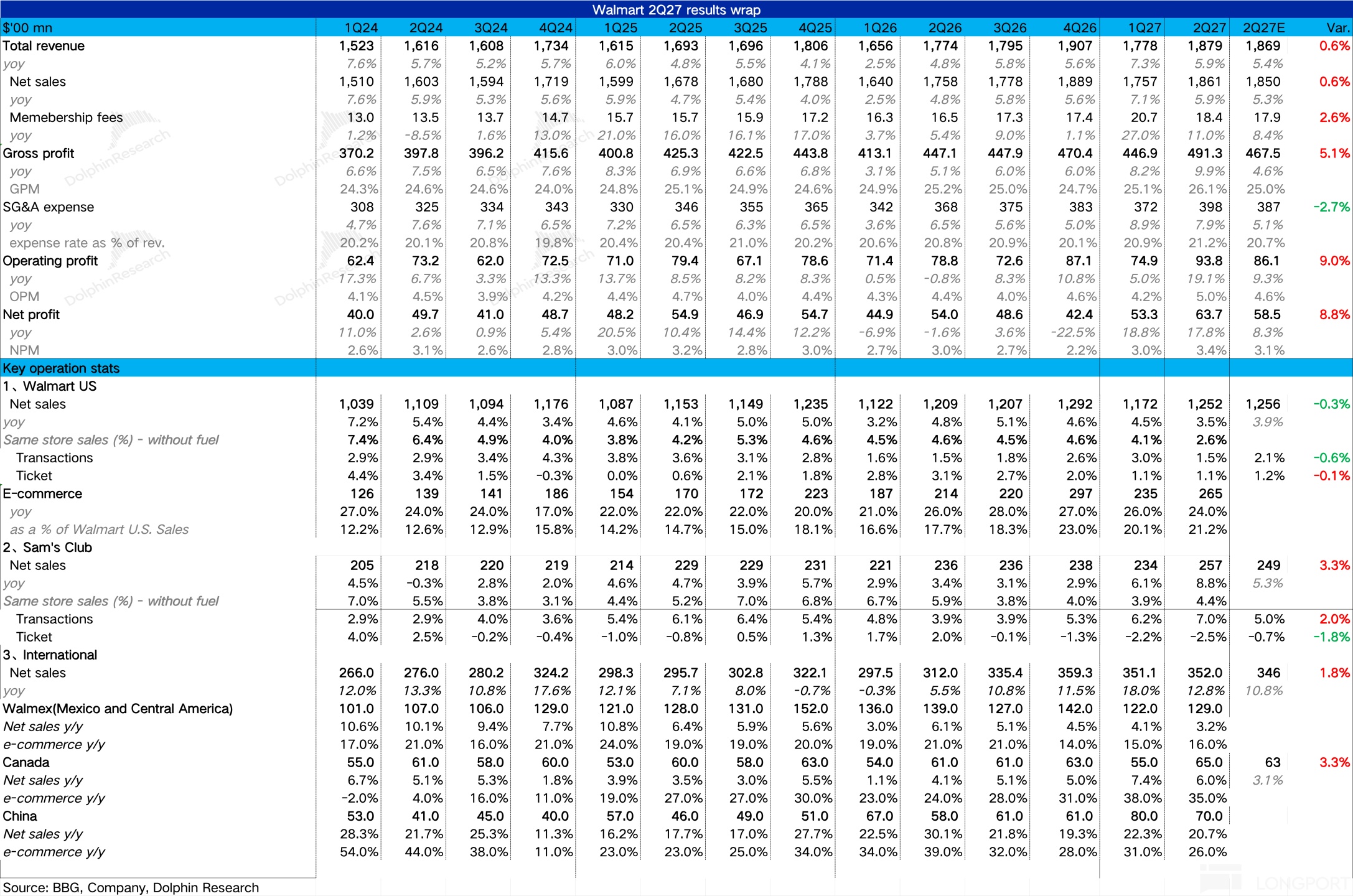
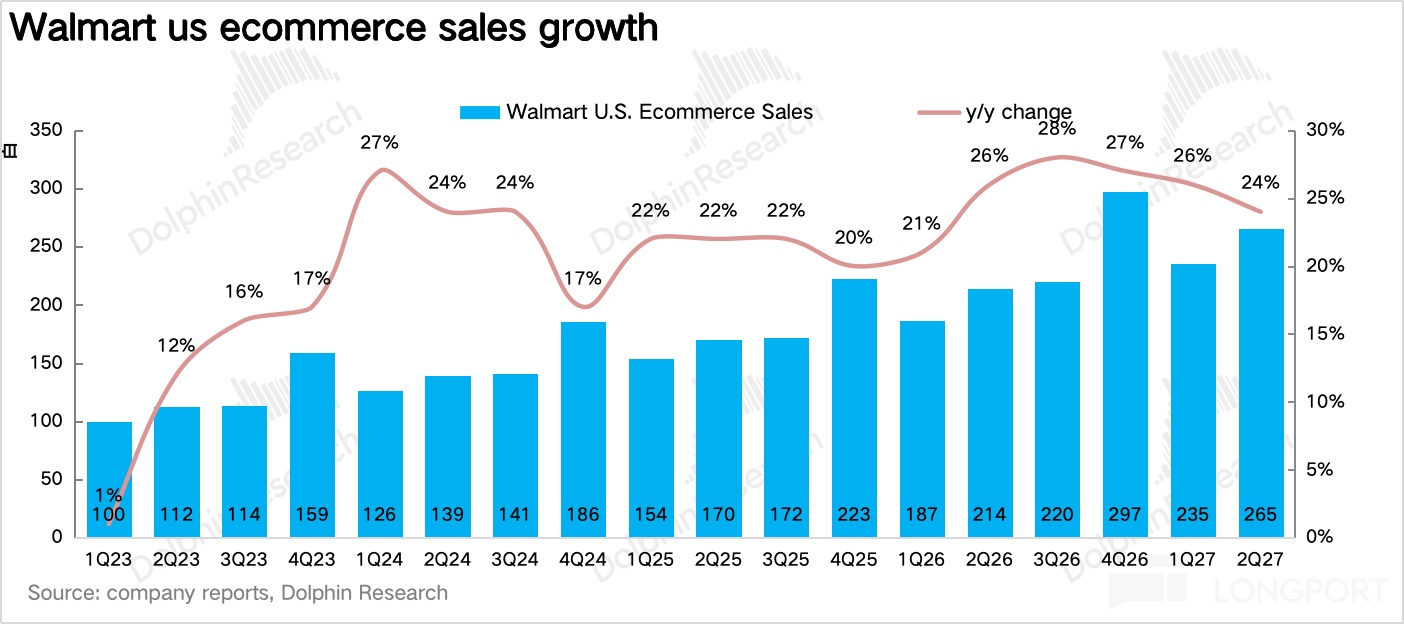
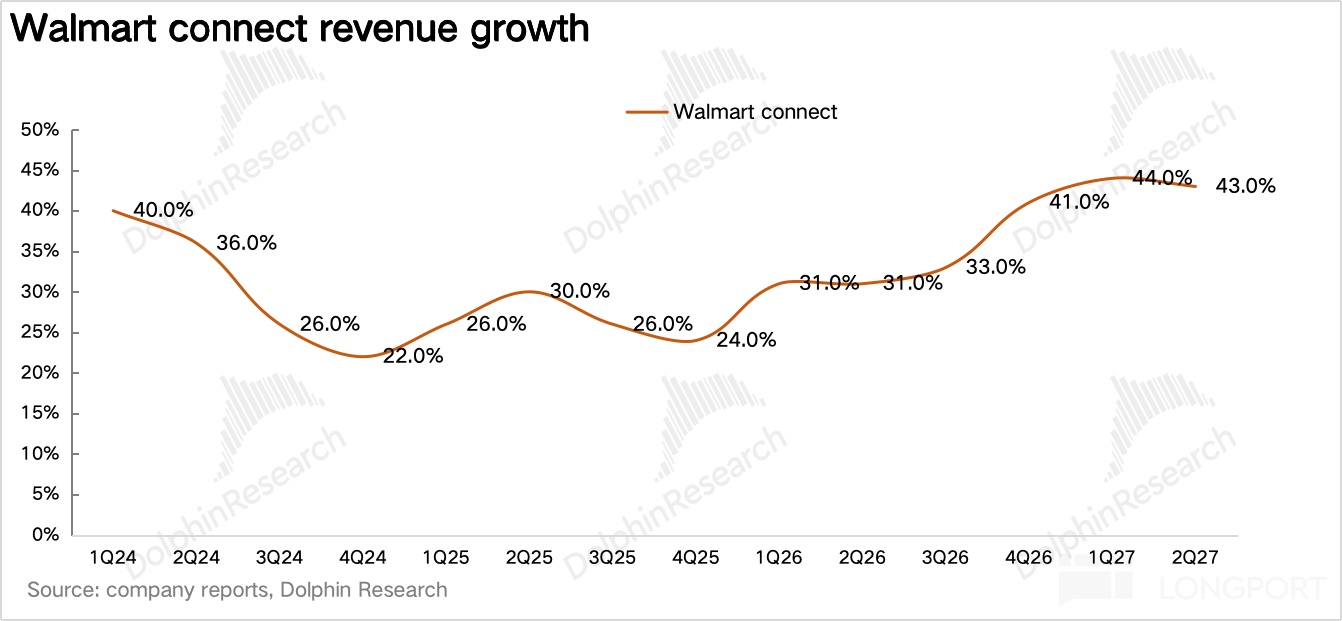
1) Walmart U.S.: Traffic decline weighed on comps. Core ops in North America saw comps +2.6% YoY, with a clear QoQ decel. Transactions rose just +1.5% (Q1: +3.0%), the main drag, while average ticket was +1.1% (flat vs. Q1).E-comm remained the strongest driver at +24%, contributing ~510bps to comps; store-fulfilled delivery +43%, ads +38% (Walmart Connect ex-VIZIO +43%), Marketplace +52% (Q1: +50%, further accelerating).
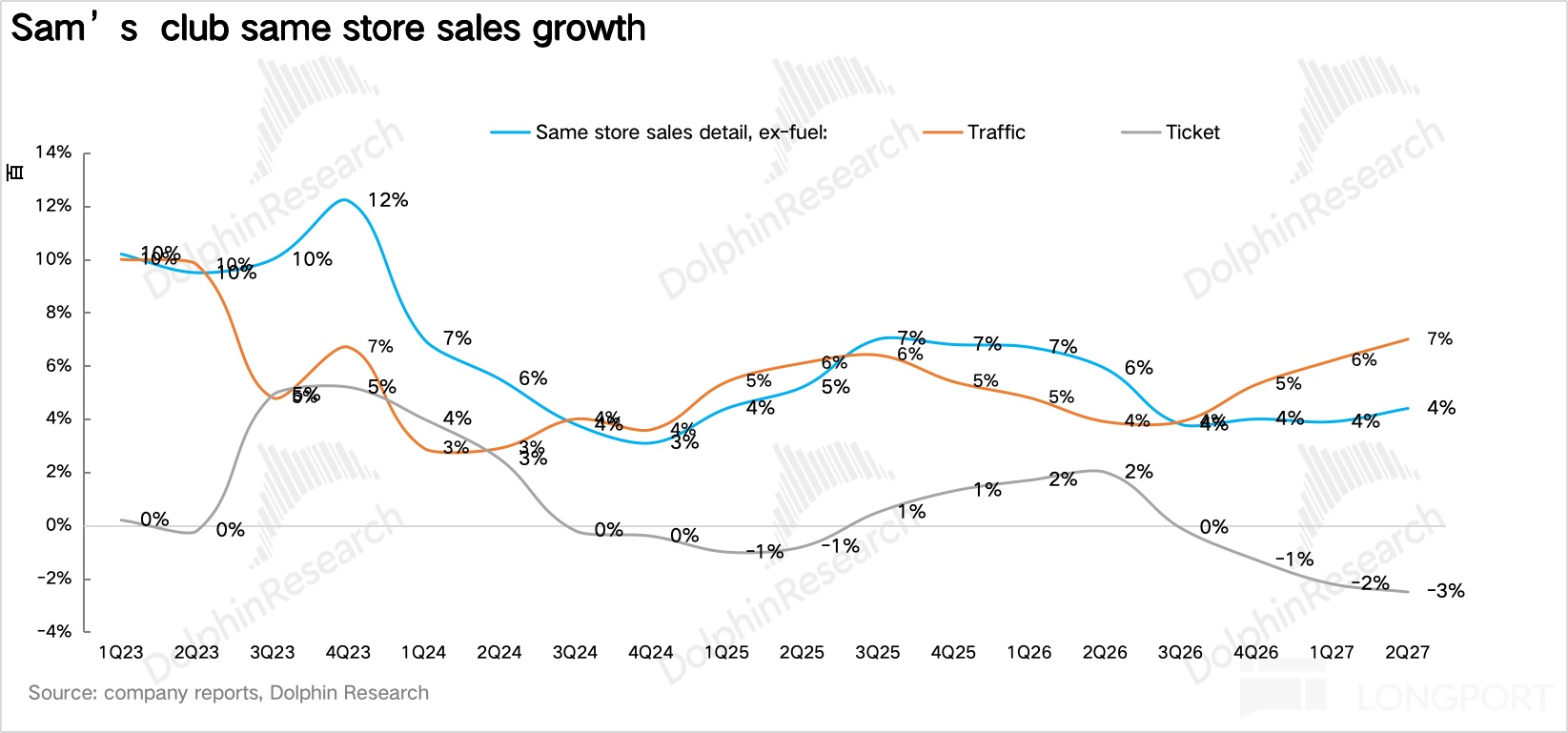
2) Sam's Club (U.S.): Outperformed, with faster transactions. Ex-fuel comps were +4.4% (Q1: +3.9%), the only segment with accelerating comps among the three.Transactions rose +7.0%, improving QoQ. Management cited high gas prices as a powerful traffic funnel: Sam's fuel volumes rose +12% YoY in May vs. industry -5%, and fuel members spend 1.6x that of non-fuel members across other categories, while average ticket fell 2.5%, mainly as mix shifted toward lower-ticket, high-frequency groceries and Member's Mark private label substituting higher-priced brands.
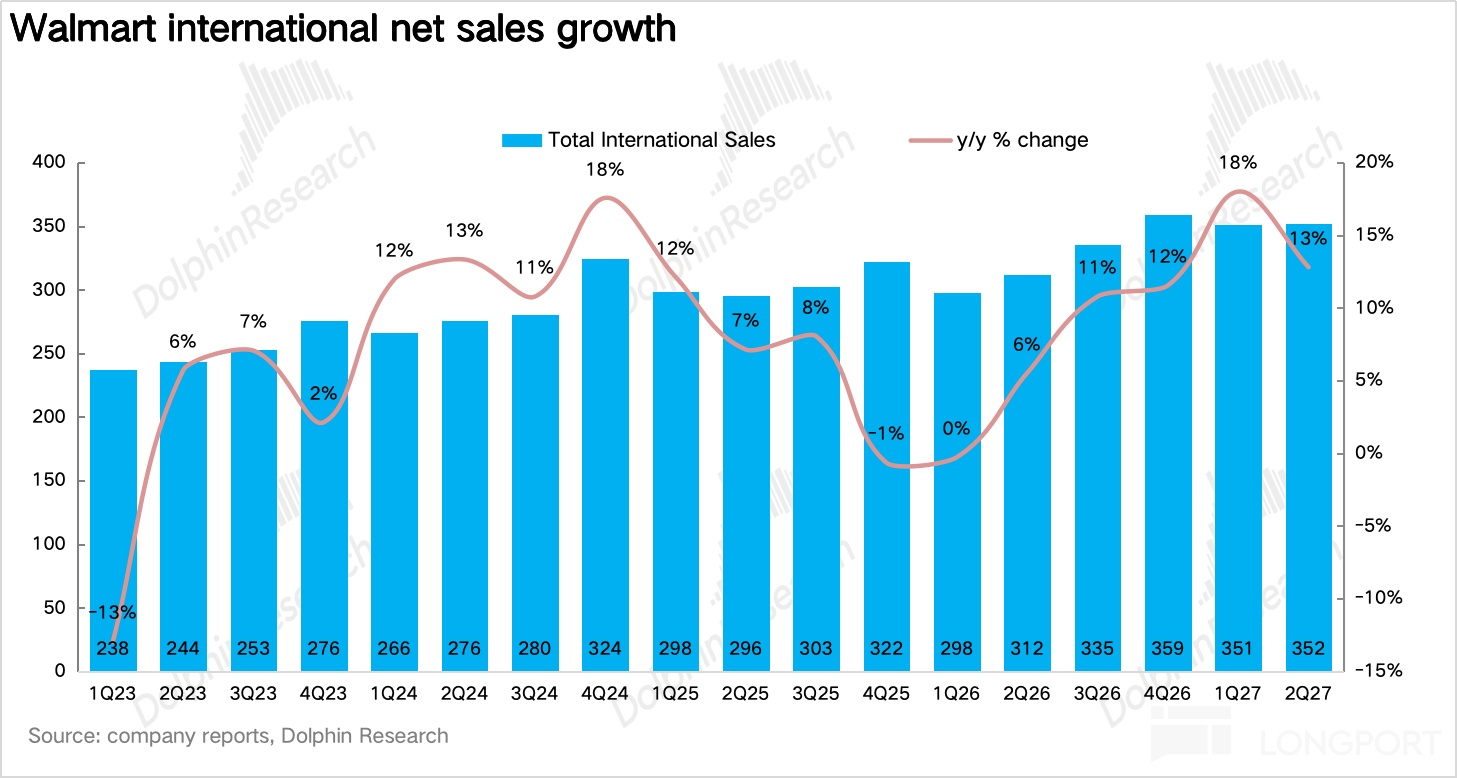
3) Walmart Intl: China was the only growth engine. Q2 Intl revenue was $35.2bn, +12.8% YoY. Key markets China, Mexico, and Canada all slowed vs. Q1 and, on profits, higher local wages and e-comm investment drove OP declines outside China.
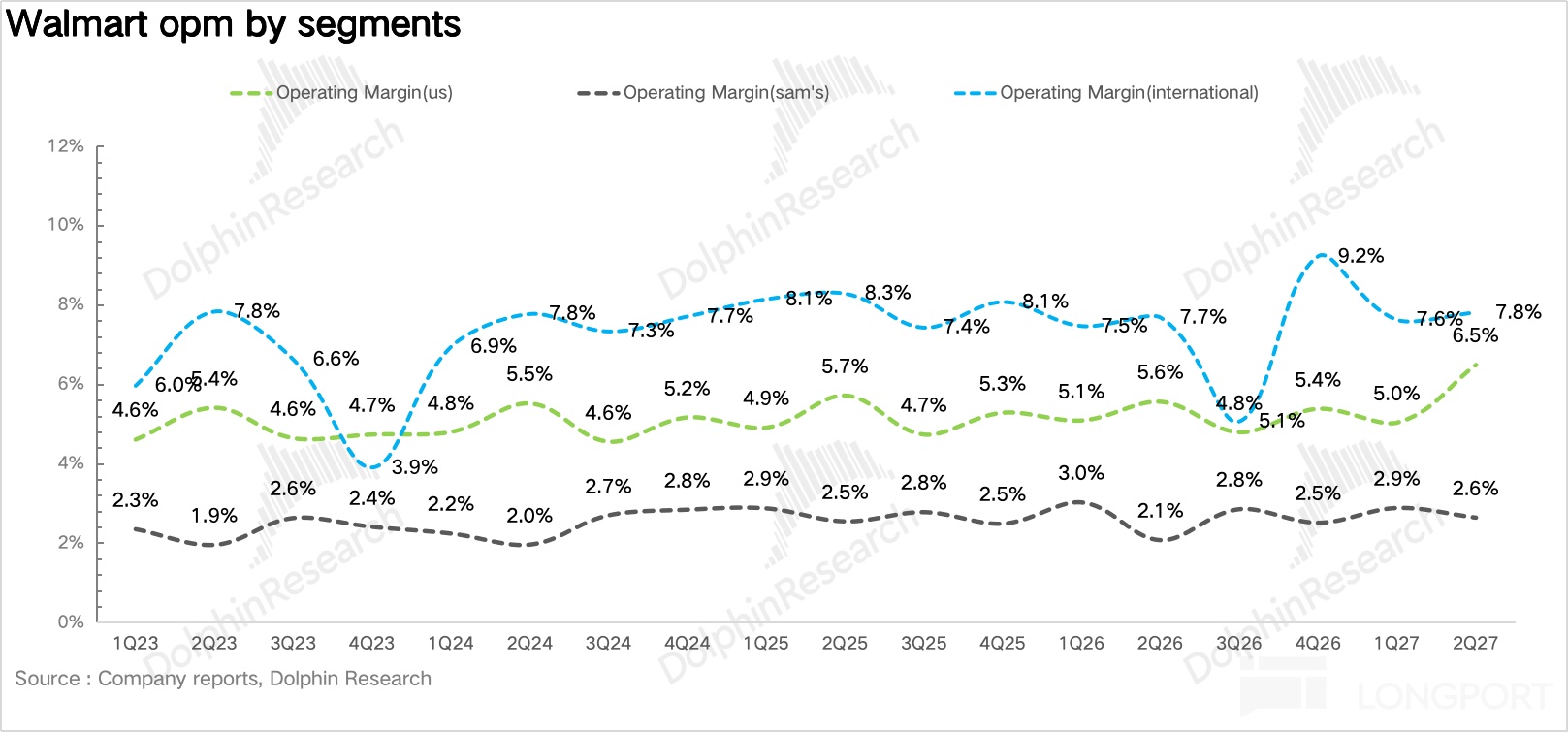
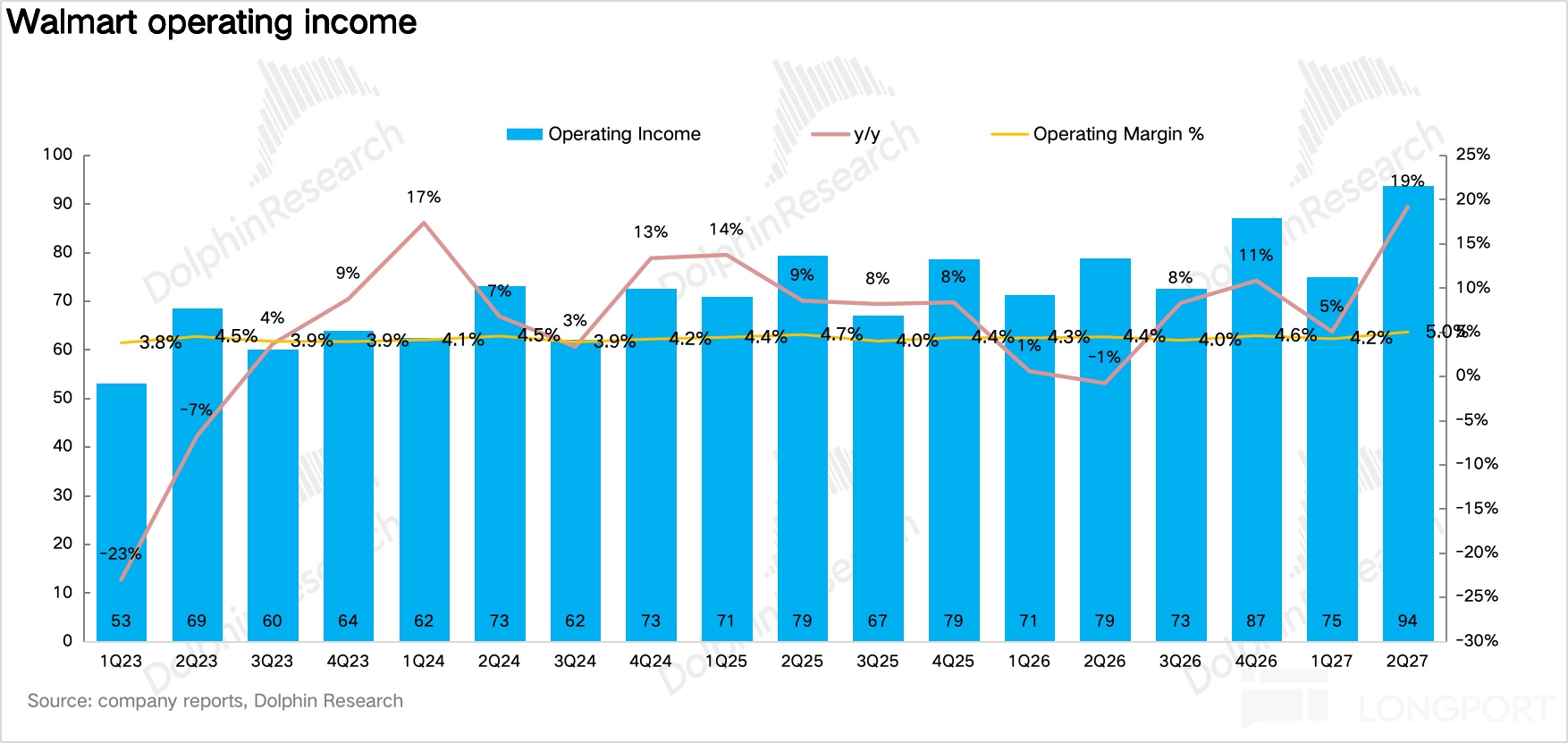
4) High-margin, asset-light 3P lifted overall profitability. On opex, higher self-insurance claims, D&A from capex, and employee healthcare costs pushed SG&A up 40bps YoY to 21.2%.With a rising mix of 3P + ads + membership, and excluding the one-off rebate ($2.9bn, ~0.5% of annual U.S. sales), OP grew 9.9% YoY, again outpacing revenue growth.
5) Guidance nudged up, but below expectations. FY constant-FX net sales growth was raised to 4.0%–5.0% (from 3.5%–4.5%); Adj. OP to 7.0%–8.5% (from 6.0%–8.0%). As most rebate dollars only flowed into pricing late in Q2, the full cost impact hits Q3; plus Flipkart’s promo timing creates a >100bps sales headwind, so the full-year raise trailed Street expectations.
6) Key financials at a glance:
Dolphin Research view:
On Q2 prints alone, results were solid. The core market concern is softer 2H guidance, with debate centered on the one-off $2.9bn tariff rebate in Q2.In such cases, companies typically have two choices: book it to the P&L and post a pretty EPS, or spend it for strategic gains. Walmart chose the latter — from Jul 6 it rolled out one-time price cuts on 250+ SKUs, with reductions up to 25%.
Dolphin Research sees this as reasonable: using off-P&L one-time funds, Walmart effectively launched a price war without consuming current profits, while traditional grocers lack comparable funding and, per checks, explicitly will not match these temporary cuts. This creates a short window: Walmart can widen the price gap while rivals cannot retaliate. Given Walmart already holds 24% share in U.S. grocery (Kroger 10%, Costco 9%, Albertsons 6%, Publix 5%), this window looks high-ROI for Walmart.
Thus, despite Q3 OP guidance of just 2.0%–4.0%, Dolphin Research believes the strategy is sound if the next few quarters show clear traffic recovery and further share gains in core grocery. The company is in a key phase of accelerating share capture among higher-income cohorts.
On the stock, using the mid-point of the raised full-year Adj. EPS guide at $2.85, 2026E P/E has eased to 36x. While ads + membership + Marketplace continue to grow at double-digit rates underpinning the mid/long-term thesis, near-term pressure could build in FY2028 once the tariff rebate is spent, SNAP cuts fully flow through, and this year's price cuts create a tough traffic base. We would wait for sub-30x, ~$86, to add.
Detailed earnings analysis below
Details:
I. Investment framework
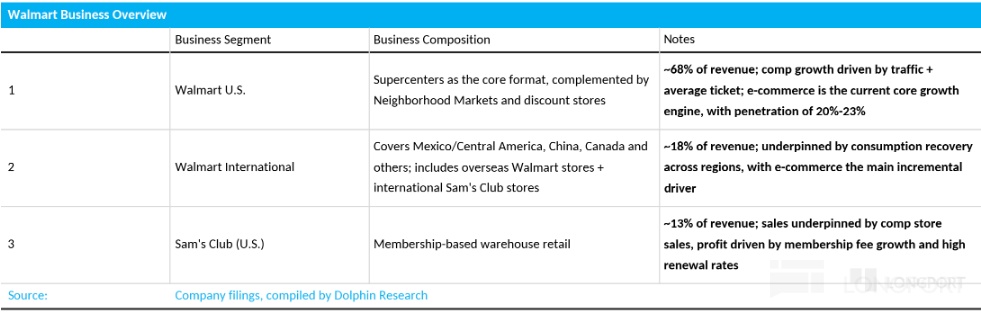
Per Walmart disclosures, revenue growth breaks down into three segments — Walmart U.S., Walmart Intl, and Sam's Club U.S. — with each driven by comps (volume × price), new/closed stores, and e-comm contribution.
(1) Walmart U.S. is the core franchise, FY26 revenue of ~$483.0bn (~68% of total). The format is led by Supercenters, with Neighborhood Markets and Discount Stores as complements. Comps further split into transactions and average ticket as key drivers.
E-comm is the segment's main engine, now ~20%–23% of segment sales. Within e-comm, 1P, 3P Marketplace, Walmart Connect (retail media), and Walmart+ (paid membership) form four pillars, with ads and membership as the core profit drivers.
(2) Walmart Intl spans Mexico & Central America (Walmex), China, Canada, etc., across Walmart stores and Sam's Clubs overseas, with FY26 revenue of ~$130.0bn (~18% of total). E-comm penetration varies: China is >50% (largely Sam's online), India’s Flipkart is a leading platform under Walmart control, run independently and still loss-making but narrowing; Walmex e-comm penetration is ~8%–9%, replicating the U.S. ads + Marketplace model and in early fast-scaling.
(3) Sam's Club U.S. is a membership warehouse club, FY26 revenue of ~$93.0bn (~13% of total). Topline relies on steady comps, while profits leverage membership fee scale and high renewal, with Scan & Go and Club Pickup lifting e-comm penetration. Against Costco, Sam's is more aggressive on pricing, though it still lags in curation and in-club member experience.
II. Walmart U.S.: Traffic decelerated QoQ
1) Volume and price both softened; low-income cohort under pressure.
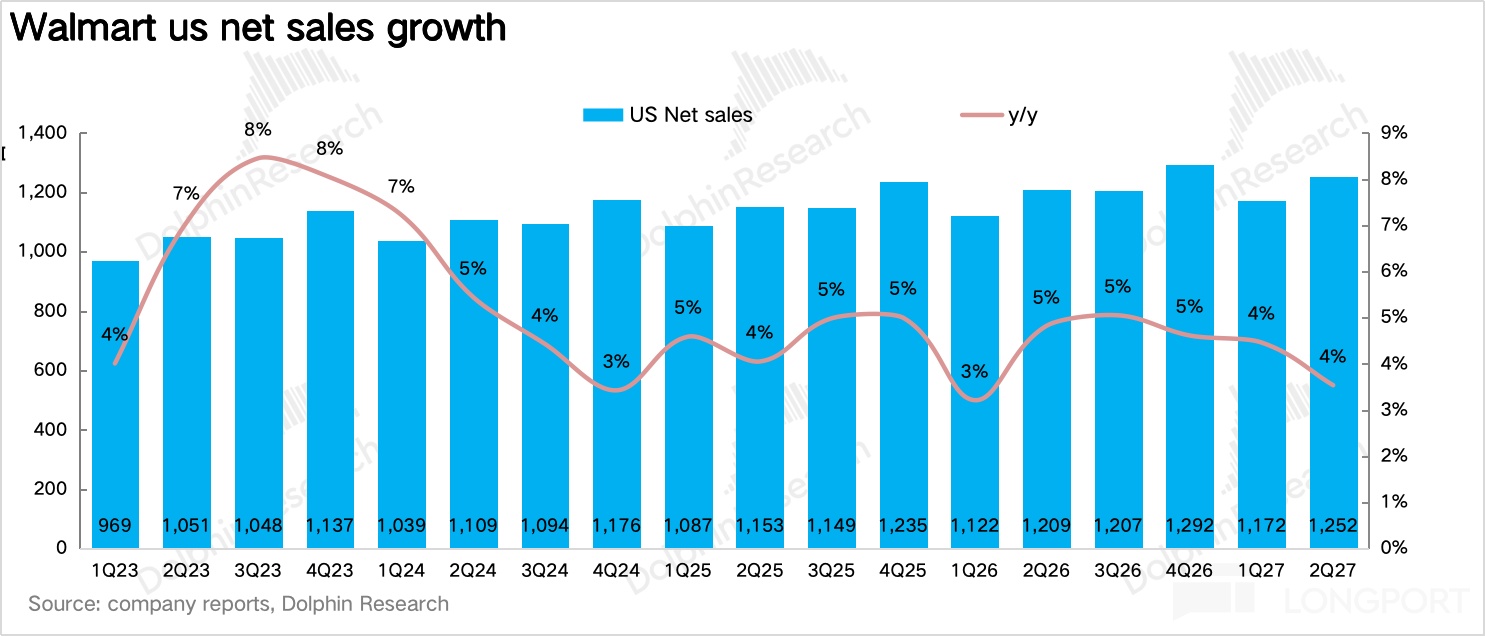
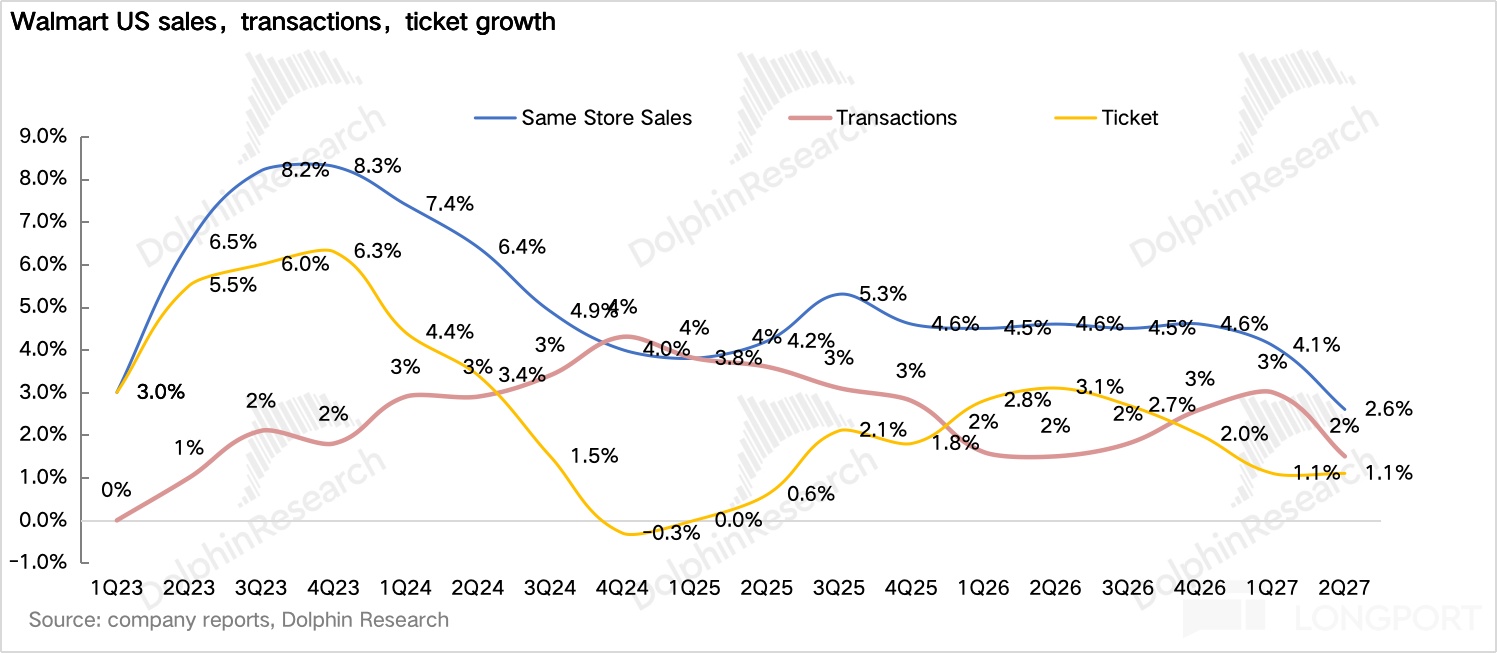
Walmart U.S. delivered $125.2bn in sales, +3.5% YoY. Ex-fuel comps rose 2.6%, down sharply from Q1's 4.1% and below consensus (3.8%).
By mix, transactions grew just +1.5% (Q1: +3.0%), a clear QoQ slowdown, and Dolphin Research believes persistent high prices in North America, rising fuel costs, and higher rates led lower-income cohorts to cut trips. The $100k+ income cohort continues to trade down into Walmart, but not enough to fully offset weaker low-income traffic. Average ticket was +1.1% (flat vs. Q1).
By category: grocery grew low single digits, with egg deflation a ~60bps drag; growth came from pantry, fresh, and 'better-for-you' innovation. Consumables were led by personal care, beauty, and pets; general merchandise grew low single digits on toys and apparel, with private label mix up 130bps.
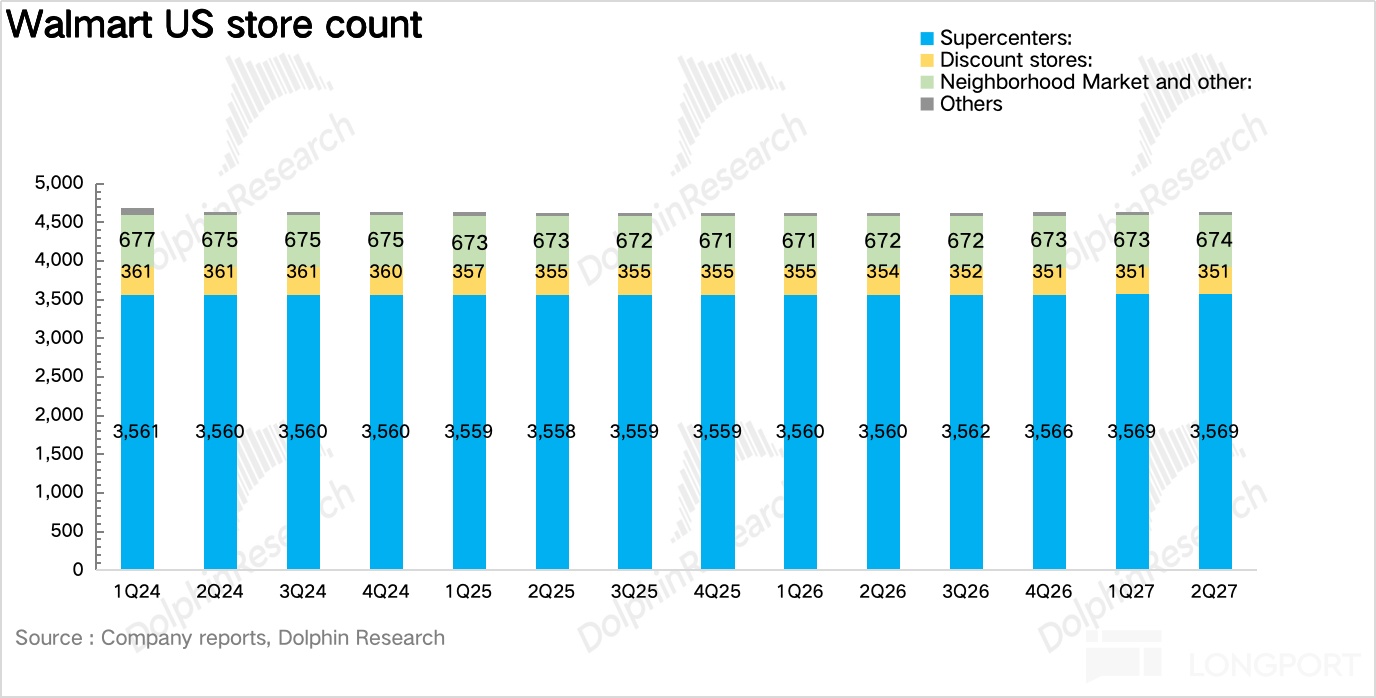
On stores, Walmart opened 1 Neighborhood Market and completed ~220 remodels this quarter. YTD, it opened 3 Supercenters and 1 Neighborhood Market, and completed ~280 remodels.
1.2 E-comm and high-margin businesses remained strong.
E-comm was again the standout at +24% (Q1: +26%), contributing ~510bps to comps. Mix-wise, store-fulfilled delivery grew ~43%, with sub-3-hour express now ~37% of store-fulfilled orders.
Dolphin Research believes speed has shifted from a fulfillment KPI to a customer acquisition tool. Fast-delivery users shop more frequently, are more engaged, and are more likely to become Walmart+ members, while Walmart is expanding use cases from grocery/GM into meal solutions (announced a prepared-foods tie-up with Subway this quarter).
3P Marketplace beat expectations, up 52%, accelerating vs. Q1's 50% (already a ~10-quarter high).
Dolphin Research views Marketplace's value not in revenue, but in tilting mix toward higher-margin GM. GM margins are well above grocery, and Walmart avoids inventory risk via 3P vs. 1P in GM — a core lever in management's multi-year margin expansion path.
Ads: Walmart U.S. ads rose 38%, with Walmart Connect (ex-VIZIO) +43%; global ads +38%. An important strategic move this quarter: on Jun 23, Walmart announced a ~$1.4bn acquisition of Vibe.co, its largest M&A in nearly two years.
Vibe.co is a self-serve CTV ad platform focused on SMBs and mid-sized brands. The strategic rationale: Walmart Connect still skews to large advertisers, while SMB long-tail is its most obvious gap vs. Amazon.
With Vibe.co plus VIZIO smart TV assets and recent integrations with Magnite, Yahoo DSP, and Google DV360, Walmart is stitching together 'self-serve + CTV inventory + closed-loop attribution.' If SMB self-serve scales, the ad TAM rises structurally — Walmart's only realistic path to narrow the gap with Amazon on mix.
Membership: U.S. 'membership and other income' rose 15.6%; Walmart+ posted double-digit membership fee growth, with Q2 net adds at a record for the period. On AI, users of Sparky rose ~70% YoY, and Sparky-assisted orders carry ~40% higher basket size than non-assisted. Membership plus ads now contribute roughly one-third of company OP, with subscription-like, recurring characteristics, underpinning profit resilience amid high fuel and softer consumption.
III. Sam's Club: Higher gas prices boosted appeal
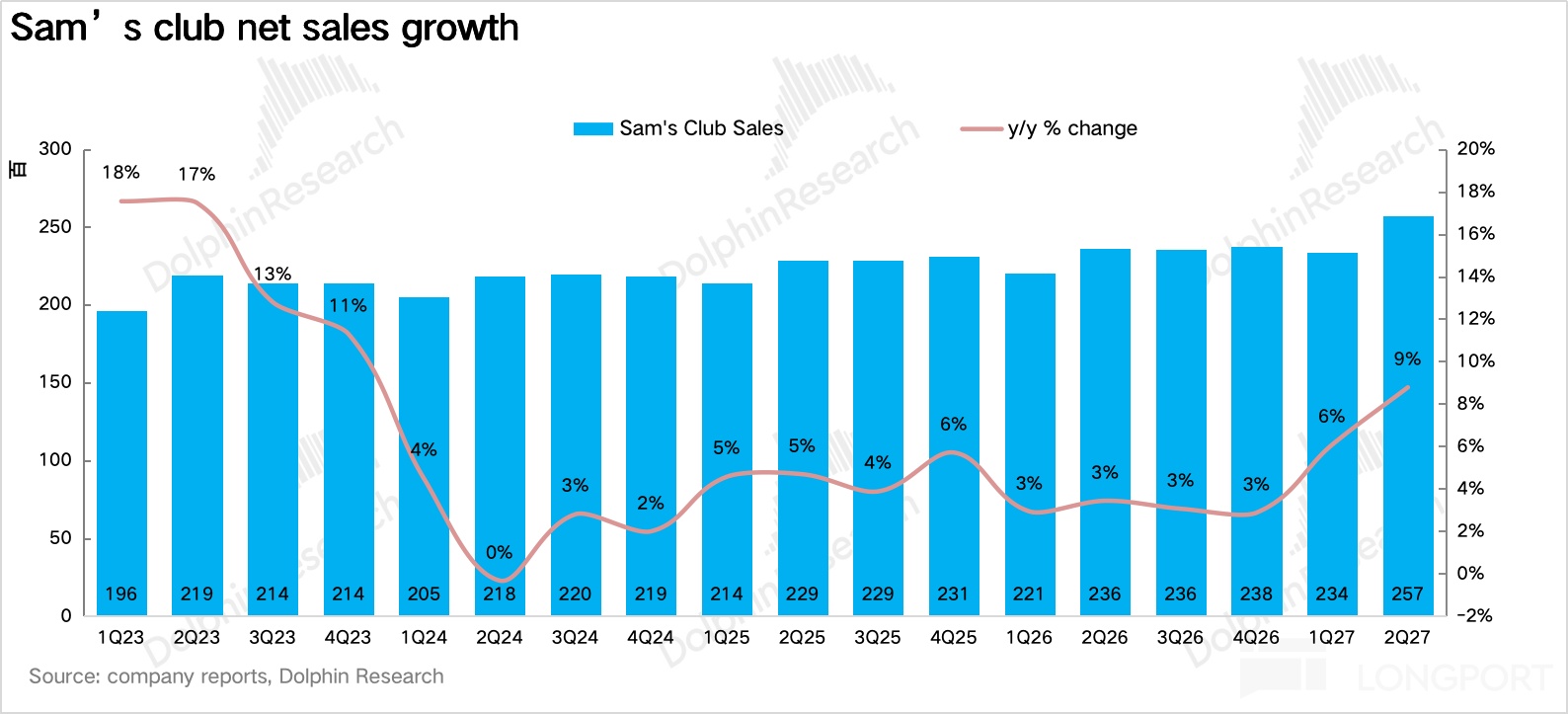
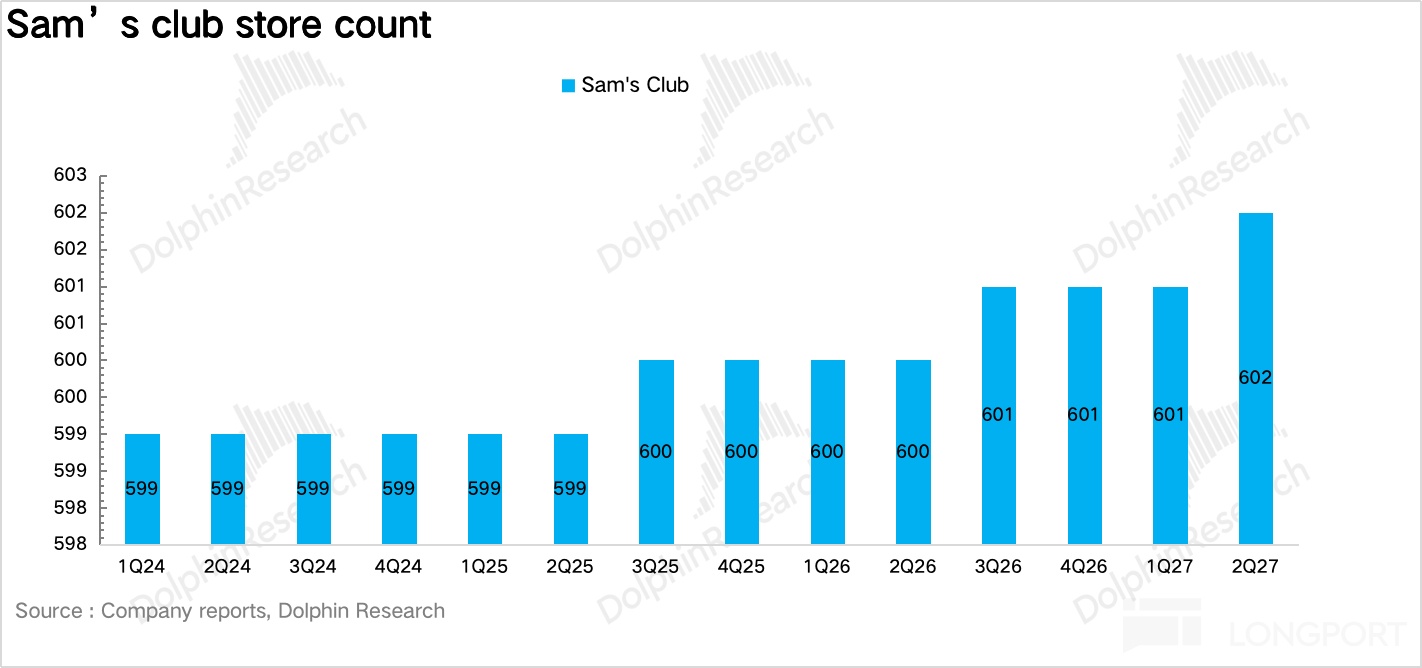
Sam's Club (U.S.) posted net sales of $25.7bn, +8.8% YoY, +4.5% ex fuel.
Transactions: +7.0%, accelerating from Q1's +6.2%, and the highest across Walmart segments. Dolphin Research sees two drivers: (1) fuel stations funneled strong traffic in a high gas price environment; (2) continued push on rapid fulfillment — after launching 1-hour delivery in Apr, club fulfillment grew triple digits, now covering 65% of U.S. households within 3 hours, with >25% of fast orders delivered within 1 hour.
Average ticket: -2.5% (Q1: -2.2%). This is not a negative in the club model — it signals 'members buy more for less,' and with profits driven by membership fees rather than product margin, stronger value perception supports renewals.
IV. Intl: Wider divergence; China is the only growth engine
Intl net sales were $35.2bn, +12.8% YoY, including:
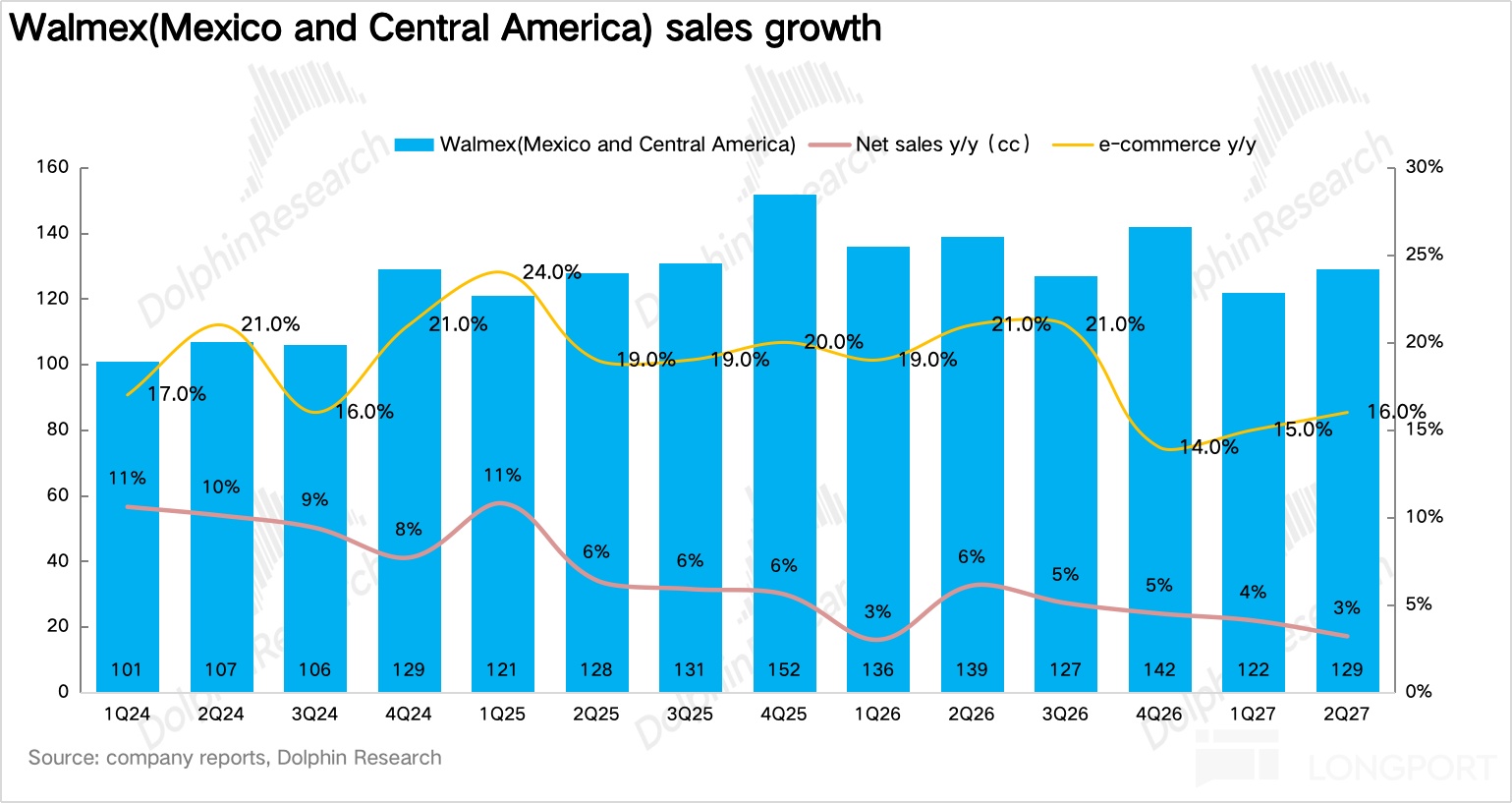
Walmex (Mexico & Central America): Price investment failed to drive growth. As pre-disclosed by listed Walmex, Q2 revenue rose 1.9% YoY (+3.2% at constant FX). Mexico comps +1.8% — decomposed into average ticket +2.9% and traffic -1.1%; Central America comps +2.4%. 23 new stores opened in Q2 (21 Mexico, 1 Costa Rica, 1 Guatemala). Walmex also cut its FY constant-FX sales growth guide to 3.5%–4.5%, citing a slower-than-expected consumption recovery.
Dolphin Research highlights two points. First, Mexico traffic weakened further from -0.9% in Q1 to -1.1% in Q2, with comps slowing from 3.1% to 1.8%, suggesting 'price cuts for traffic' has not worked in Mexico. The core reason, in our view, is Mexico's macro purchasing power is contracting, whereas U.S. low-income pressure is being offset by trade-down from higher-income cohorts.
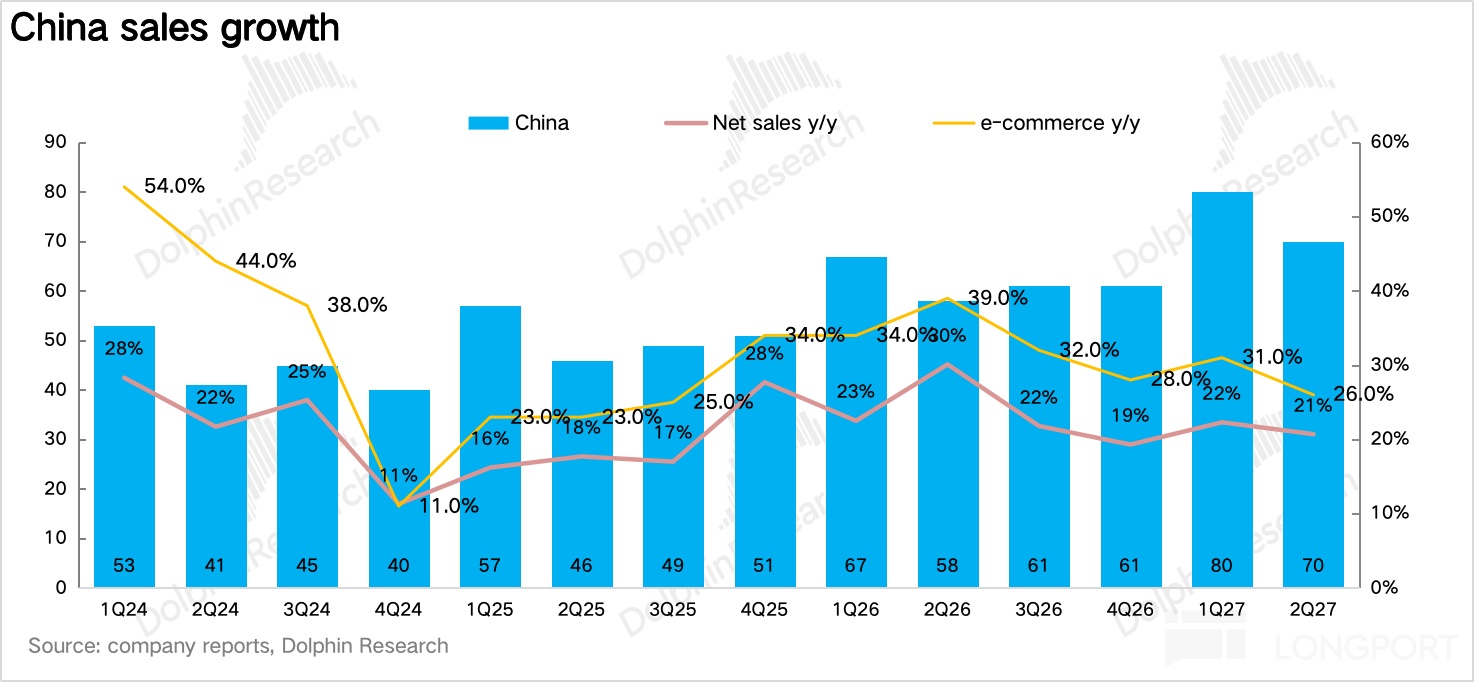
China: Sam's continued to perform well. China constant-FX net sales were $7.0bn, +20.7% YoY, with comps +9.7% (gradually slowing), the fastest within Intl. E-comm grew 26%, and digital sales penetration reached 55%, indicating the model is proven — dark stores, rapid delivery, in-app ordering, and membership have been deeply integrated. Next-leg growth should come more from store expansion and steady same-store compounding rather than a one-off penetration jump.
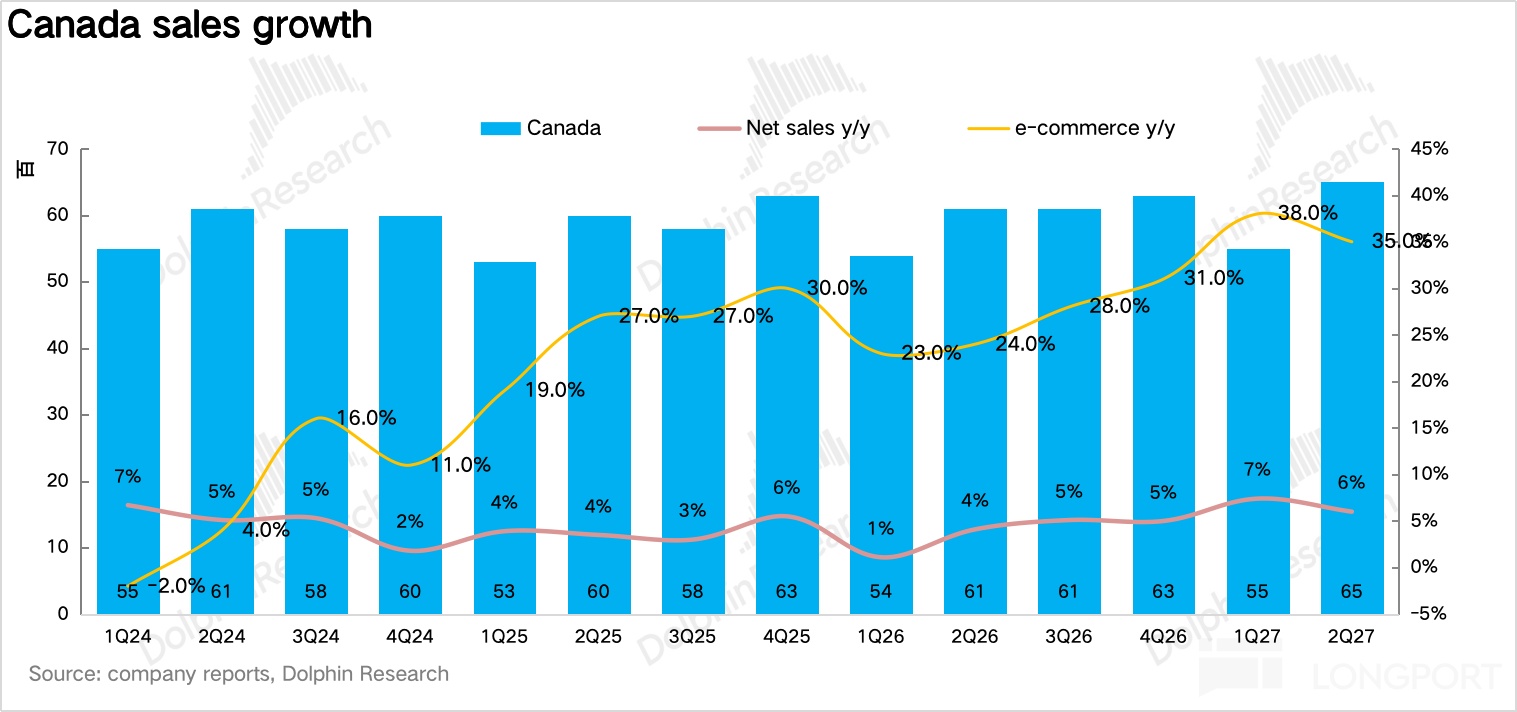
Canada: E-comm investment phase; profits down. Canada constant-FX net sales were $6.5bn, +6.0%, with comps +4.0%, but OP declined on strategic wage investments. Canada is in a 'profit for penetration' phase — Walmart+ just launched and e-comm grew 35%, both requiring upfront spend, so near-term margin pressure is understandable.
V. Rising high-margin mix continues to lift margins
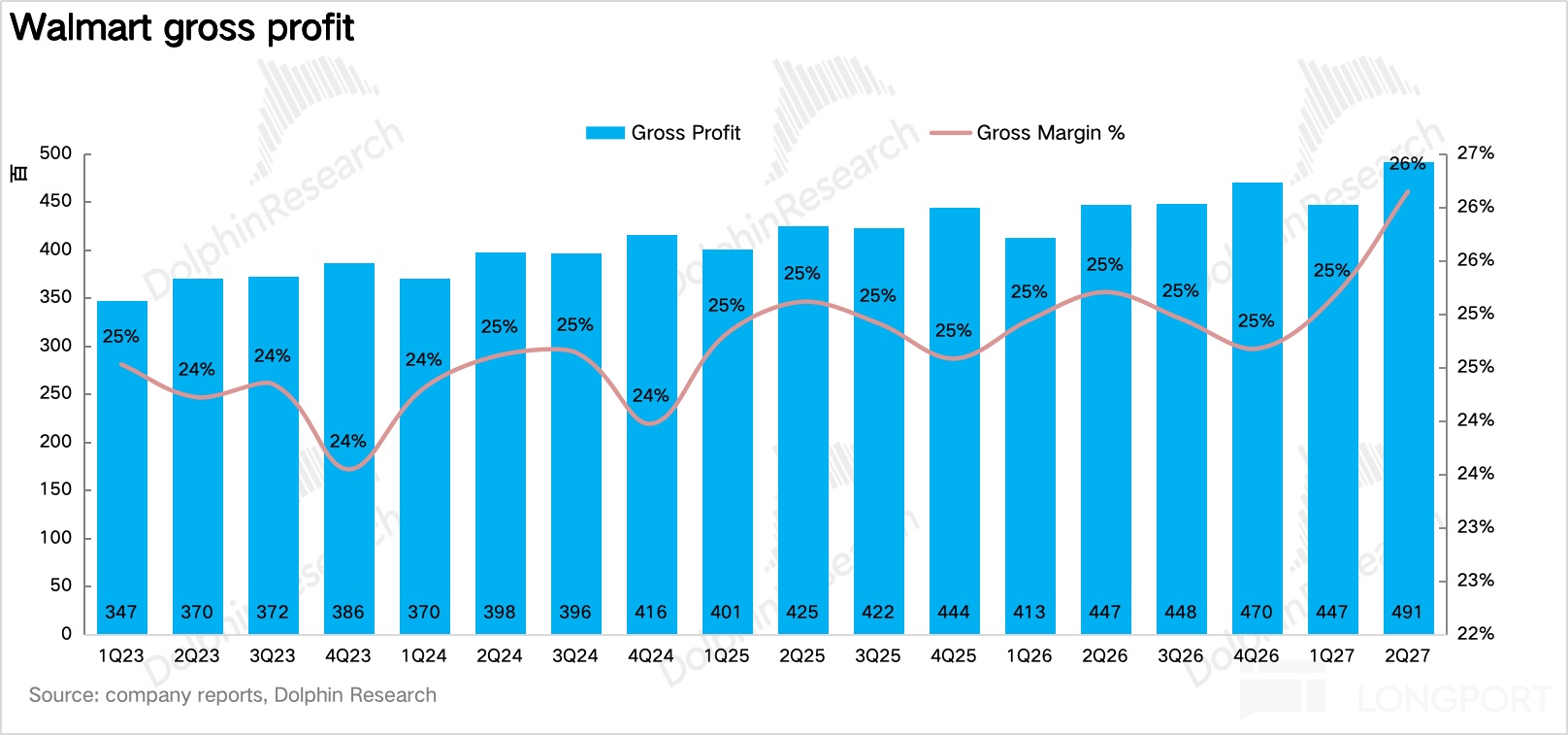
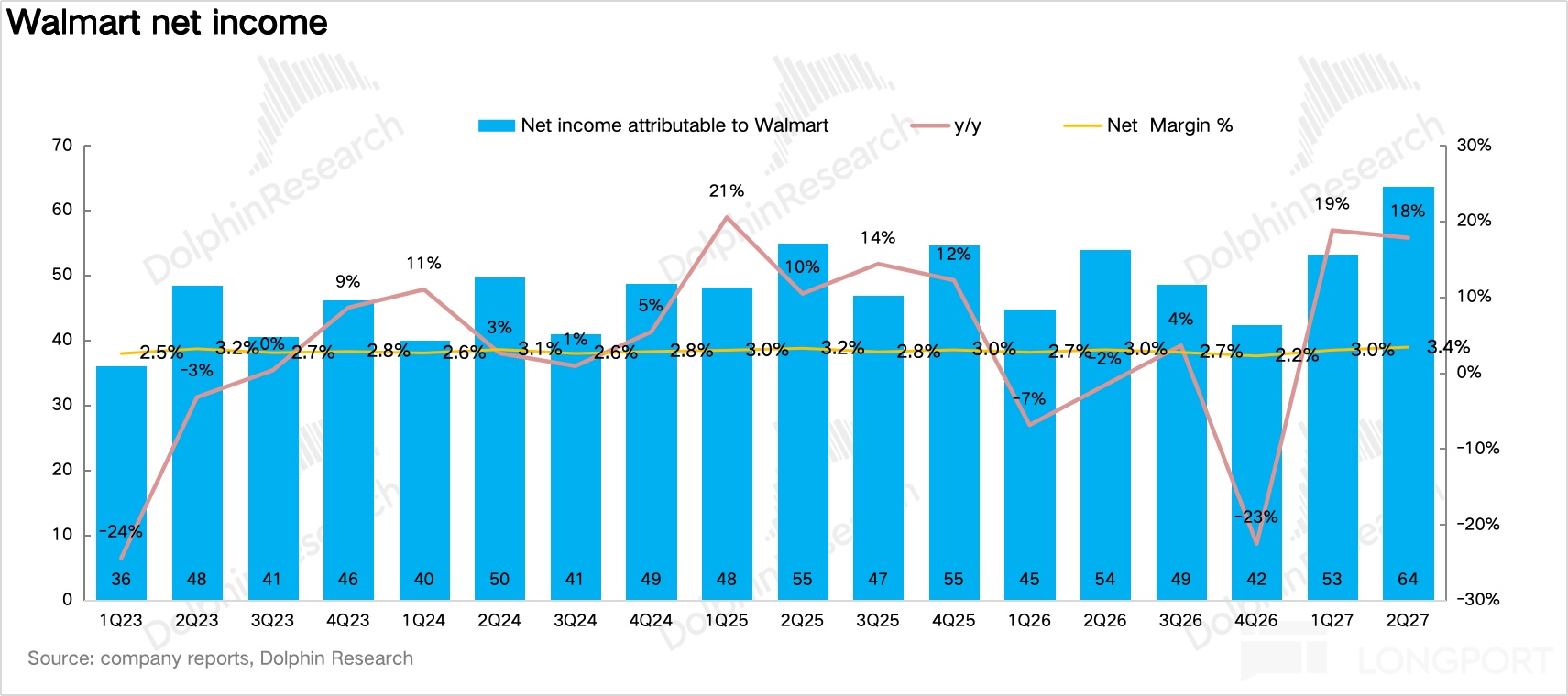
Q2 GPM expanded 90bps YoY to 26.1%, driven by tariff rebate benefits and mix improvement (notably digital ads).On opex, higher self-insurance, D&A from capex, and employee healthcare all rose, lifting SG&A by 40bps YoY to 21.2%. With the higher-margin mix from 3P + ads + membership, and excluding the one-off rebate ($2.9bn, ~0.5% of annual U.S. sales), OP grew 9.9% YoY, again outpacing revenue.
<End>
Dolphin Research on 'Walmart' — prior analyses:
Earnings take:
May 22, 2026: 'Walmart: Gas Spike! Can the Retail King Hold Up?'
Deep dive:
Apr 21, 2026: 'Walmart: How the $1tn Retail Titan Was Forged'
Risk disclosure and disclaimer: Dolphin Research Disclaimer & General Disclosure





The copyright of this article belongs to the original author/organization.
The views expressed herein are solely those of the author and do not reflect the stance of the platform. The content is intended for investment reference purposes only and shall not be considered as investment advice. Please contact us if you have any questions or suggestions regarding the content services provided by the platform.