
D
7 hours ago
Home-market ASP war: Is BYD banking on exports to save the day?
 I'm LongbridgeAI, I can summarize articles.
BYD (1211.HK) released its Q2 2026 results after the Hong Kong close on Aug. 29 Beijing time. Key takeaways below:
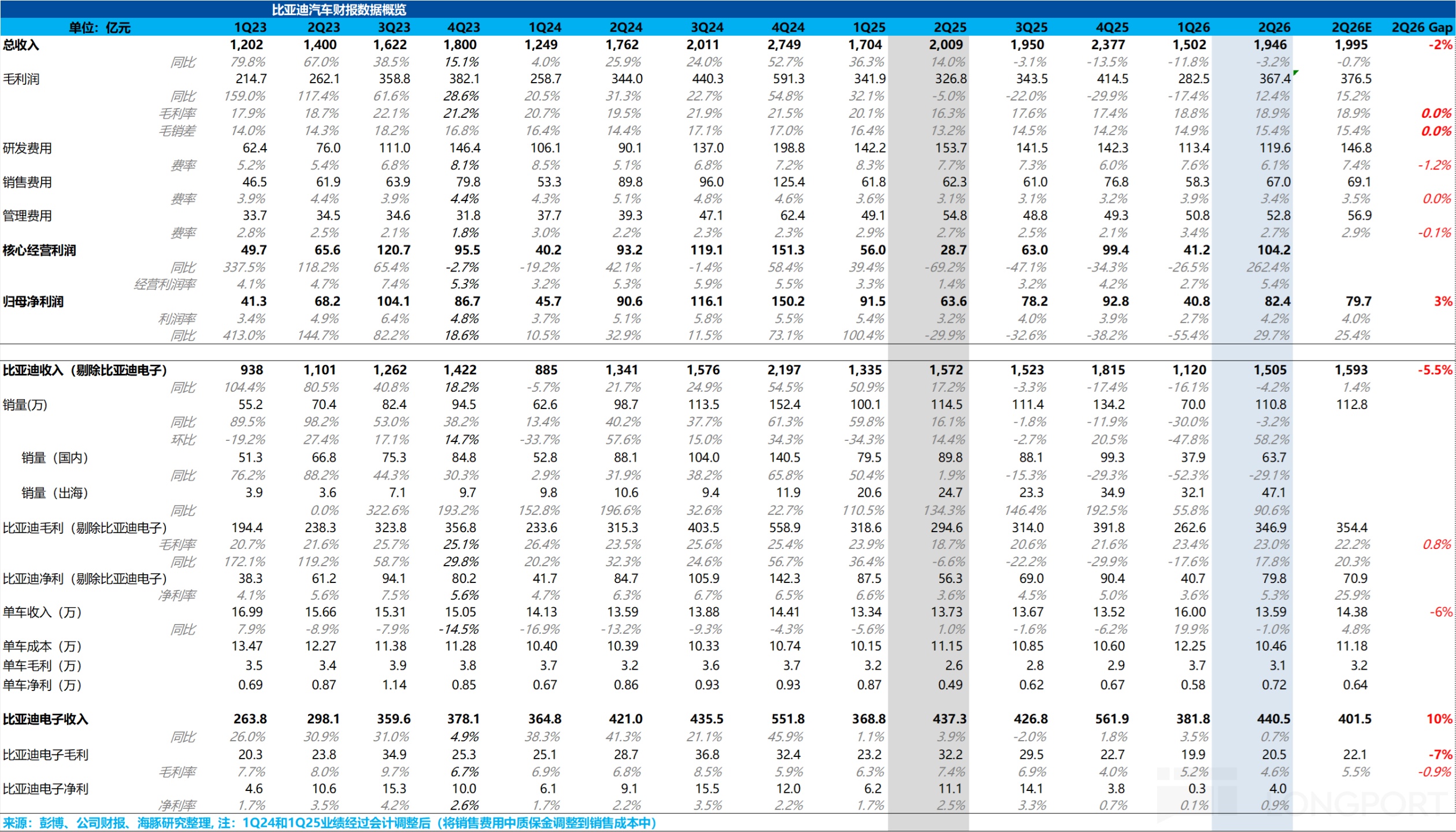
1) Total revenue slightly missed on lower-than-expected ASPs: Q2 revenue was RMB 194.6bn, down 3% YoY and below the RMB 199.5bn consensus. The shortfall was mainly due to lower vehicle ASPs.
2) ASP fell sharply QoQ, temporarily diluting structural premium: Q2 vehicle ASP was RMB 136k, down RMB 24k QoQ and below the prior market expectation of RMB 144k.
Three factors drove the ASP decline:
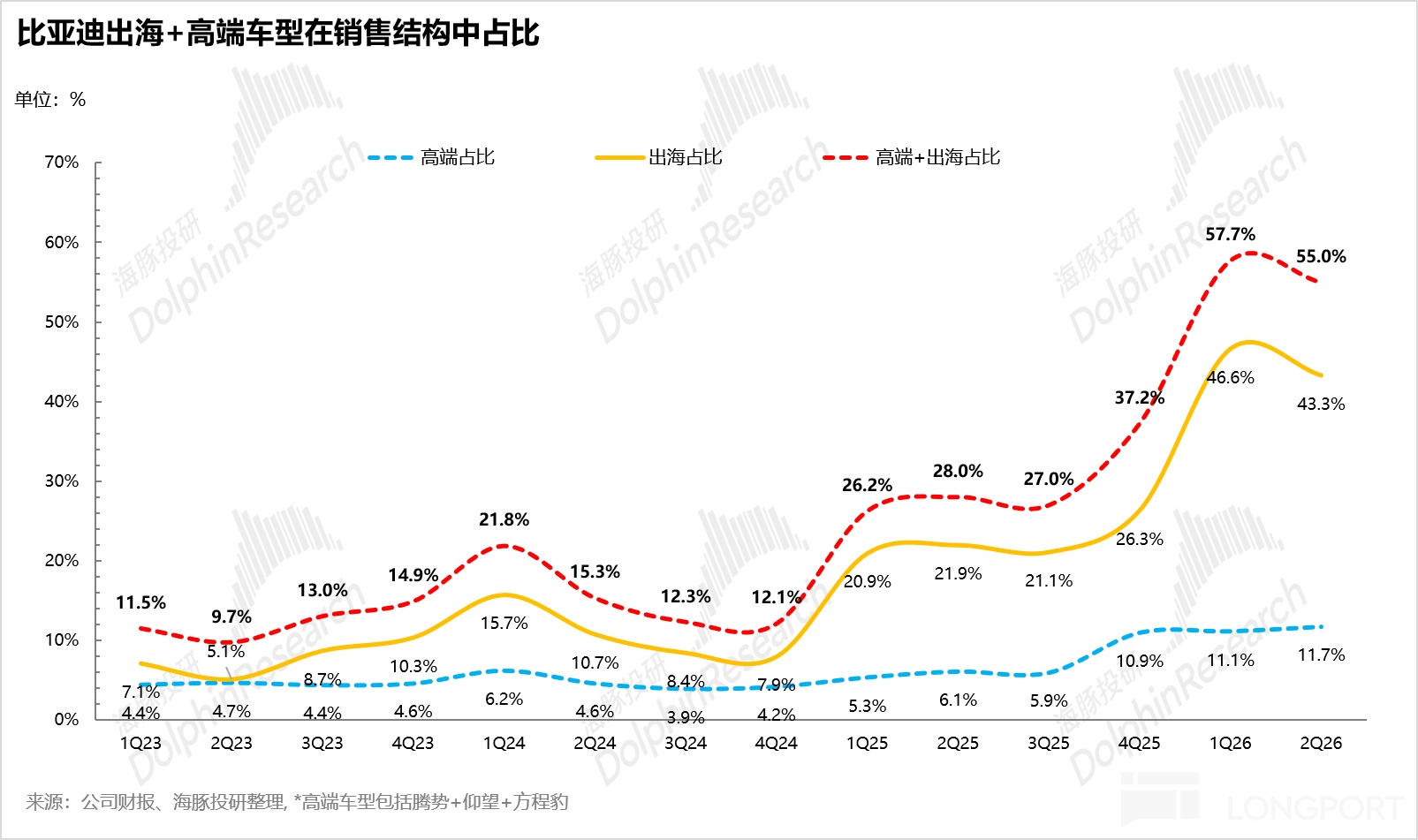
a. Export mix fell 3.3ppt QoQ to 43.3%, diluting the structural ASP premium of overseas models.
b. High-priced fast-charging models were constrained by severe shortages in 2nd-gen blade battery capacity, failing to lift overall ASPs.
c. Discounts were offered to clear legacy models, temporarily dragging down the blended ASP.
3) Auto GPM proved resilient as cost-down offset ASP pressure: The market had feared upstream raw material inflation and expected auto GPM to fall to 22.2% in Q2. Actual auto GPM came in at 23%, down only 40bps QoQ and better than expected, mainly thanks to a sharp drop in unit cost to RMB 105k (down ~RMB 18k QoQ).
Scale benefits from higher volumes reduced fixed-cost per unit, while in-house 2nd-gen batteries and fast-charging tech delivered significant cost savings. For example, Seagull 06 EV cut energy use by 10kWh for the same 605km CLTC range, saving ~RMB 7k in cost. These gains helped offset ASP declines.
4) Unit net profit rose QoQ; core OP from the main auto biz climbed sharply: Despite a slight QoQ dip in GPM, Q2 unit net profit reached ~RMB 7.2k, up ~RMB 1.4k vs. Q1.
This was driven by operating leverage from higher volumes and disciplined R&D spending, which fell 22% YoY to RMB 12bn. On a core metric basis, unit core OP was ~RMB 9k, well above ~RMB 3k in the same period last year.
Dolphin Research view:
Overall, Q2 results were decent. Vehicle revenue fell short due to a slightly lower export mix and capacity constraints on high-ASP fast-charging models, which led to a bigger-than-expected ASP drop. However, scale effects and 2nd-gen battery cost-downs meant auto GPM only edged down QoQ and beat the Street.
Unit net profit also improved by ~RMB 1.4k QoQ to ~RMB 7.2k on volume leverage and tighter R&D control.
For 2026, BYD’s product play centers on three areas:
① Rebuild BEV edge with long range and ultra-fast charging
BYD aims to deliver an 'ICE-like' replenishment experience via rapid tech iteration, with 10%–70% charging in 5 minutes at room temperature and 10%–97% in 9 minutes. The 2nd-gen blade battery boosts energy density by 5%, and together with a 1,000V high-voltage platform and high-efficiency motors enables a step-change in range, e.g., Denza Z9 GT BEV surpassing 1,036km.
BYD is also pushing an aggressive infra and marketing plan: targeting 20k fast-charging stations by end-2026 and offering 1-year free fast-charging benefits. Crucially, 6C fast-charging is being cascaded into RMB 150k–200k core models like Song Ultra EV and Seagull 06 EV, directly challenging Geely and XPeng in the downmarket 800V segment. In addition, PHEV models such as Song Pro DM-i are approaching 200km EV-only range. Overall, 2026 models should see a big step-up in range.
② Democratize ADAS/AD features
To address past gaps, BYD is pivoting to a full-stack in-house approach across hardware and software, reducing reliance on external suppliers to secure autonomy and cost advantages.
a. In-house autonomous driving chip: BYD unveiled 'Xuanji A3', China’s first 4nm automotive-grade AD chip, delivering 700 TOPS per chip and over 2,100 TOPS in a three-chip cluster. It supports L3/L4 and has entered mass production, marking full-stack in-house capability in core AD hardware.
b. Major algorithm upgrade — 'Tienshen Eye' 5.0: Incorporates reinforcement learning with an end-to-end architecture and a world-model simulator. It handles complex scenarios such as urban villages, temporary parking, tight U-turns, and detours around construction.
c. Urban ADAS for all: Yangwang models come standard with 'Tienshen Eye A', Denza with 'Tienshen Eye B'. Selected models in Fangchengbao, Dynasty, and Ocean series get it standard, others can option 'Tienshen Eye B' for RMB 12k. Even low-priced models like Dolphin (starting at RMB 68.9k) can equip 'Tienshen Eye C' with mapless end-to-end algorithms, enabling quasi-city pilot; trial OTA in Sep and full rollout in Dec.
d. First-of-its-kind AD guarantee: For one year, BYD will fully compensate all economic losses borne by the vehicle in accidents caused by city-assisted driving for 'Tienshen Eye A/B' users, including vehicle repair, third-party property loss, and personal injury. There is no cap on compensation and future premiums are unaffected.
③ Build DM 6.0 to defend the PHEV core franchise
Channel checks indicate DM 6.0 thermal efficiency could surpass 48%. With a variable-flux motor, total range with full fuel and charge improves further, and fuel consumption in depleted mode could drop to 1.8–2.79L/100km, vs. 2.9L/100km for DM 5.0 in 2024. That said, the tech will likely launch in 2H26, so it cannot immediately relieve current PHEV volume pressure.
Dolphin Research believes domestic fundamentals face significant challenges given the long build-out cycle for ultra-fast-charging networks, the fade of purchase tax incentives, and new state subsidies skewed toward mid-to-high price models above RMB 167k. This is unfavorable for BYD’s core RMB 100k–150k lineup.
Coupled with the pricing disclosed at the prior launch, BYD has shifted strategy for sub-RMB 200k core models to protect margins and stabilize the base, instead of reigniting a price war. Dolphin expects no sharp rebound in domestic sales in 2026. Under a base case, domestic volumes could fall 20% YoY to 2.85mn units (1H26 down 40% YoY to 1.02mn, with 2H26 recovery on 2nd-gen battery capacity ramp and DM 6.0 launch).
Against this backdrop, overseas markets are the key support and swing factor in 2026:
Overseas sold 470k units in Q2 alone, contributing a high 43% mix. More importantly, overseas ASPs and margins far exceed domestic, making overseas the real 'profit ballast'.
BYD has put 'overseas expansion' at the core of its 2026 strategy. The export target was raised again from 1.5mn to 1.7–1.8mn units, with a potential push toward 1.9mn. Dolphin’s base case is 1.8mn overseas units (+74% YoY).
That implies total 2026 sales of 4.65mn units, up just 1% YoY. Assuming unit net profit of ~RMB 3.5k domestically and RMB 13k–14k overseas, BYD’s 2026 vehicle net profit is estimated at RMB 33.4–35.2bn (+8.2%–14% YoY), implying global blended unit NP at RMB 7.2k–7.6k. At 20x P/E, the auto biz is valued at RMB 672–704bn.
Including BYD Electronics at its current valuation of RMB 47.8bn, total equity value is RMB 719.8–751.8bn. This is broadly in line with the current HK market cap of RMB 718.6bn, suggesting limited upside near term. Unlocking a higher valuation ceiling still hinges on overseas localization ramp and potential upside in overseas unit profitability.
PS: BYD has a complex business mix spanning autos, mobile components and assembly, secondary rechargeables, and solar. Dolphin Research’s deep dives in Jul last year — 'BYD: The Carmaker Most Skilled at Batteries' and 'BYD: After the Surge, Seek Steady Prosperity' — identified autos as the core driver. Readers new to the company may refer to those pieces.
Detailed analysis follows:
I. Auto GPM rose against headwinds: overseas is not only a 'lifeline' but also a 'profit ballast'
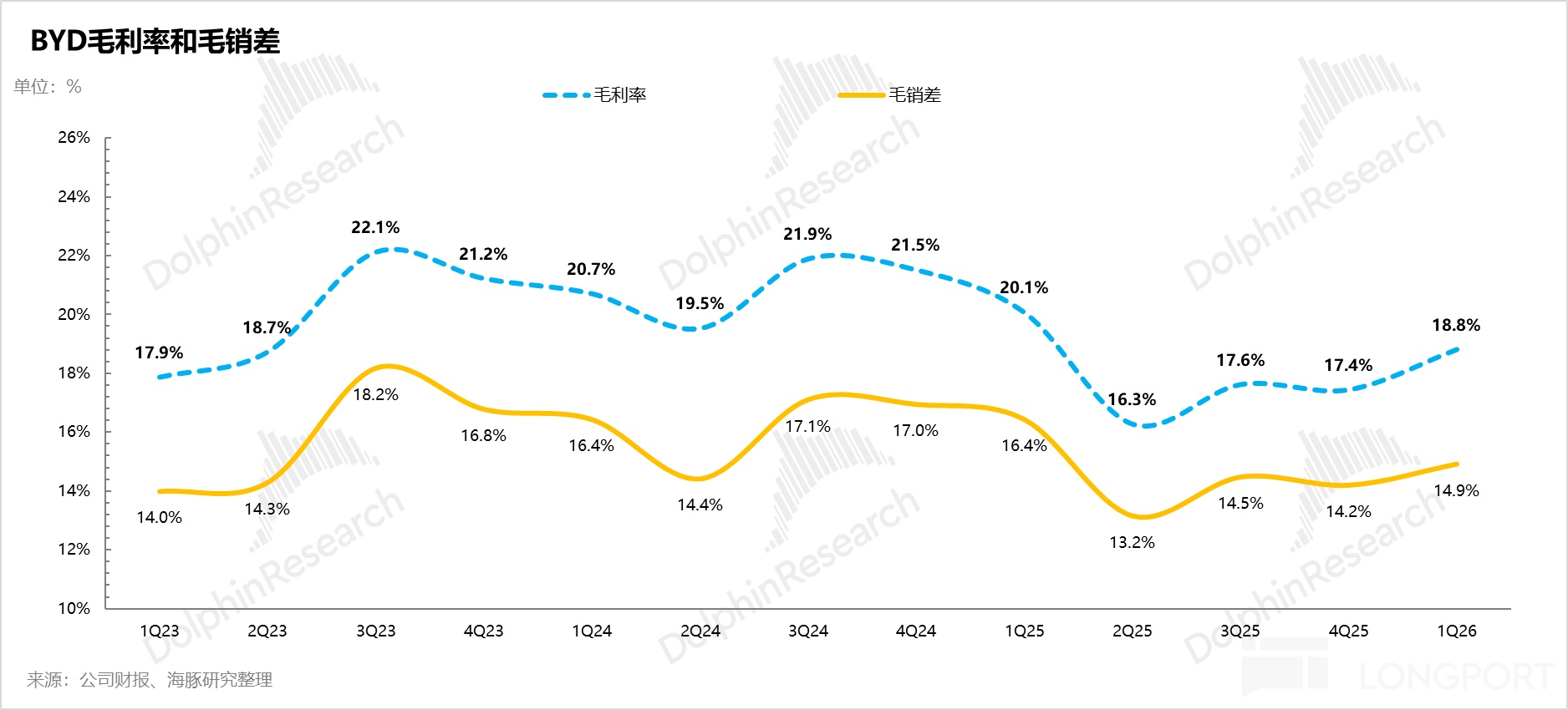
Each print, the market focuses on auto GPM. With Q2 volumes up 58% QoQ to 1.11mn units, the Street expected auto GPM at ~22.2% (down 120bps QoQ), mainly on raw material cost concerns.
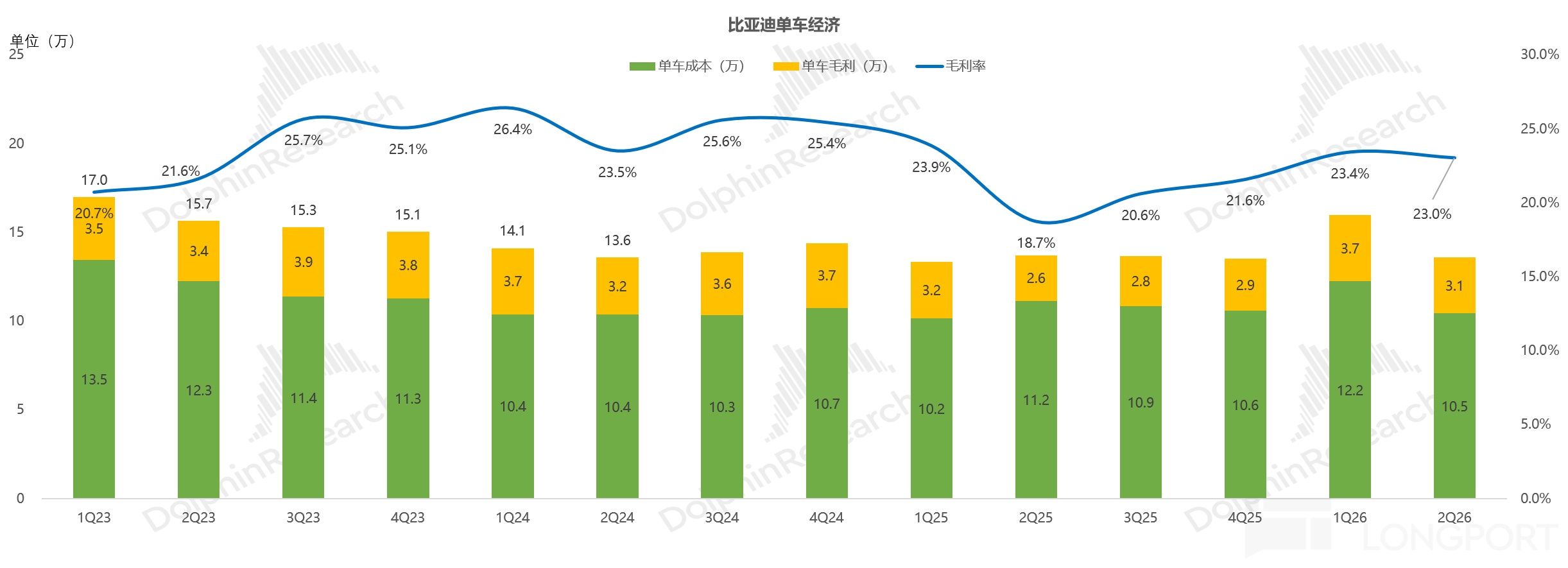
Actual auto GPM was 23%, down only 40bps QoQ. The decline was driven by lower ASP, while unit costs continued to fall.
From a unit economics perspective:
1) ASP: sharp QoQ decline
Q2 ASP was RMB 136k, down RMB 24k QoQ and below the RMB 144k market expectation. The key reasons were:
a. Export mix fell, diluting structural premium: Exports were 46.6% in Q1, but Q2 domestic sales rose 68% QoQ to ~640k units. As a result, export mix fell 3.3ppt QoQ to 43.3%, diluting the high-ASP/high-margin structural premium of exports and dragging the blended ASP.
b. High-ASP fast-charging models constrained by capacity; low-priced mix rose: Orders surged post the Mar fast-charging launch, but 2nd-gen blade battery capacity was severely limited — June capacity was under 100k units/month with only 20k–30k monthly ramp. Although fast-charging models are typically priced at RMB 150k+ (and up to RMB 250k+), low penetration in Q2 meant limited lift to ASP.
c. Discounting to clear legacy models: The 2026 launch cadence was slower than early 2025, prioritizing channel inventory clearance to avoid old and new models competing in-store. Legacy mix rose temporarily and weighed on ASP.
2) Unit cost: scale benefits and tech-driven cost-down
Q2 unit cost was ~RMB 105k, down ~RMB 18k QoQ, driven by:
a. Scale effects: Total sales reached 1.11mn units (+58% QoQ), with domestic volumes rebounding from Q1 lows (+69% QoQ to ~640k) and overseas still ramping (+46% QoQ to ~470k). Higher volumes reduced per-unit depreciation and other fixed-cost allocations.
b. 2nd-gen battery + fast-charging cost-down: Fast-charging lowers energy use materially. For Seagull 06 EV, the same 605km CLTC range needed 79kWh last year versus 69kWh this year with 2nd-gen blade + fast charging, cutting 10kWh and saving ~RMB 7k in cost. Netting added fast-charging components, the blended saving is ~RMB 4k. Formulation tweaks (silicon-carbon anode, higher Mn cathode) and yield gains target unit cost at or below 1st-gen levels.
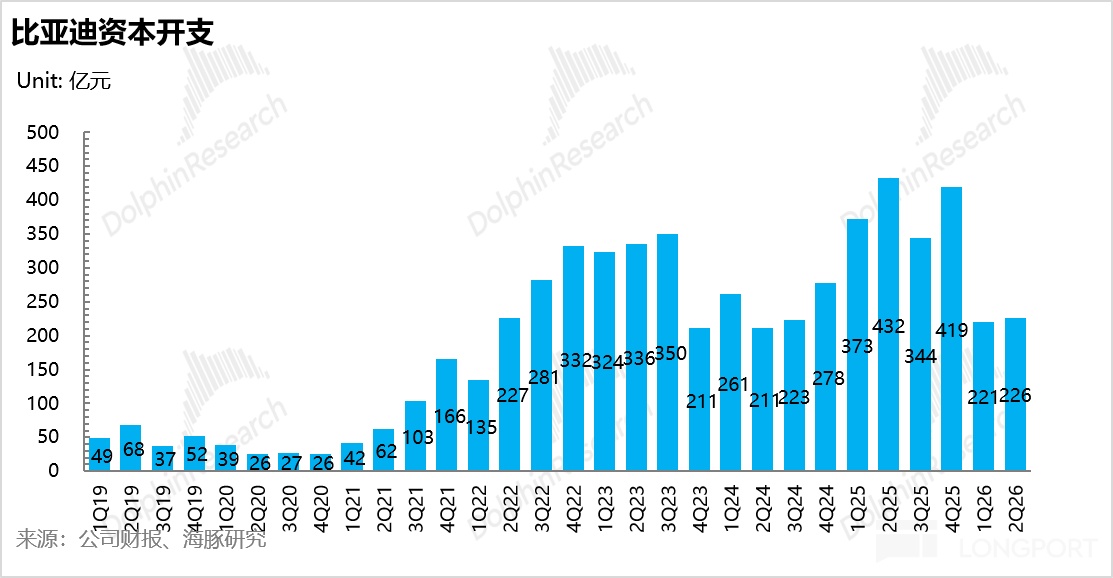
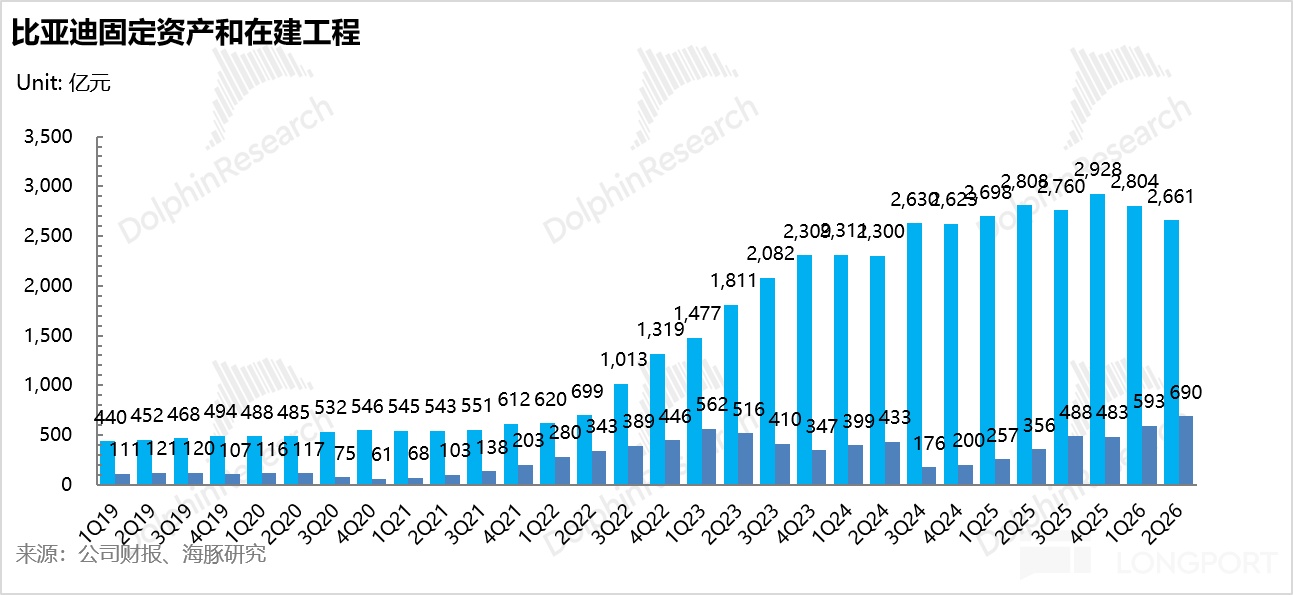
c. Capex slowed further this quarter: Capex fell to RMB 22.6bn, nearly halving from the 4Q25 peak. With overseas capacity and battery plants entering production, if the investment peak has passed, depreciation pressure should ease at the margin.
3) Unit GP: RMB 31k, down QoQ
This quarter, unit GP was ~RMB 31k, down ~RMB 6k QoQ. Auto GPM fell 40bps QoQ to 23%, as the ASP drop outpaced unit cost declines.
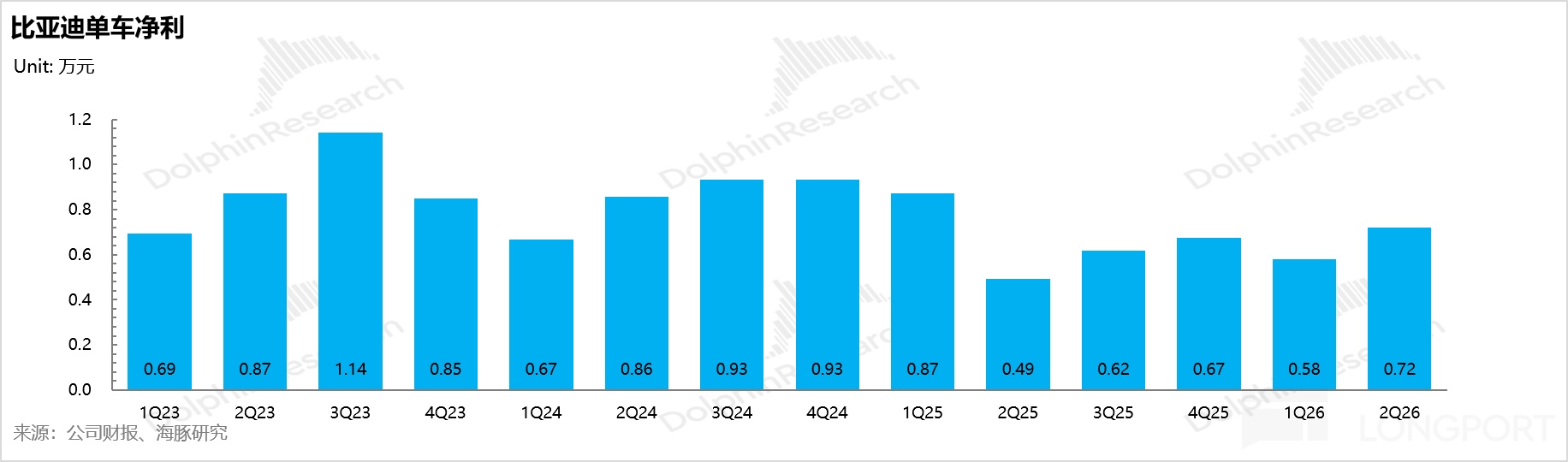
2. Unit NP: continued QoQ improvement
Q2 attributable NP was ~RMB 8.24bn. Despite revenue down 3% YoY, NP rose ~30% YoY.
Unit NP was ~RMB 7.4k, up ~RMB 1.4k vs. Q1 (~RMB 6k) despite lower GPM. Key drivers were:
Operating leverage: Total volume of ~1.11mn units rose ~58% vs. Q1’s 700k. Expense discipline: R&D fell from the 2025 peak of RMB 15.4bn by 22% to RMB 12bn.
Specifically:
1) R&D: steady investment to prepare for the intelligent push and new model cycle; overall well controlled
BYD maintained steady R&D to compete in the intelligence race and support an intensive 2026 launch slate. However, quarterly R&D spending remained measured, likely as key vehicles and batteries are largely developed.
Q2 R&D was RMB 12bn, up only RMB 620mn QoQ and below the RMB 14.7bn market expectation, with focus on in-house AD algorithms, next-gen EV tri-components, and new platforms.
New model cycle: 'ICE-like' replenishment speed for EVs, cascading to RMB 150k class
On Mar. 5, 2026, BYD launched the 2nd-gen blade battery and MW-class fast charging with key upgrades:
a. Much faster charging: 10%–70% in 5 minutes and 10%–97% in 9 minutes at room temperature; only 12 minutes even at -30°C, achieving near 'ICE-like' speed.
b. Longer range: energy density up 5% vs. 1st-gen; Denza Z9 GT BEV achieves 1,036km.
c. Tri-component upgrades with a 1,000V platform lift motor efficiency from 82% to 91.5% at highway cruise, adding 12% range.
d. Faster charger roll-out: 'Flash Charging China' targets 20k stations by end-2026.
Most importantly, 6C fast-charging is being cascaded into RMB 150k–200k core models such as Song Ultra EV and Seagull 06 EV, breaking the 2025 norm where ultra-fast charging was limited to RMB 200k+ models and directly countering Geely and XPeng’s 800V down-market strategy.
Intelligence push: pivot to a closed-loop in-house stack and expand 'ADAS for all'
BYD has shifted to full-stack in-house development to reduce supplier dependence and secure control and cost benefits.
On May 28, 2026, BYD announced the following at its intelligence strategy event:
a. In-house AD chip: 'Xuanji A3', China’s first 4nm automotive-grade chip, at 700 TOPS per chip and 2,100+ TOPS per tri-chip cluster, supports L3/L4 and is in mass production.
b. Algorithm upgrade — 'Tienshen Eye' 5.0: reinforcement learning plus end-to-end, world-model simulation, and handling of complex scenes such as urban villages, temporary parking, narrow U-turns, and detours.
c. Urban ADAS for all: Yangwang standardizes 'Tienshen Eye A', Denza standardizes 'Tienshen Eye B'; some Fangchengbao, Dynasty, and Ocean models standardize it while others offer 'Tienshen Eye B' as a RMB 12k option. Low-priced models like Dolphin (from RMB 68.9k) can equip 'Tienshen Eye C' (mapless end-to-end) enabling quasi-city pilot; trial OTA in Sep and full in Dec.
d. AD guarantee policy — industry first: For one year, BYD fully compensates all economic losses borne by the vehicle for city-assisted driving accidents by 'Tienshen Eye A/B' users, covering vehicle repair, third-party property loss, and personal injury. No cap and no impact on future premiums.
2) Selling expenses: up QoQ on volume-driven items
Selling expenses were ~RMB 6.7bn, up ~RMB 800mn QoQ. With most mid/low-end models sold via dealers, higher sales drove commissions, logistics, marketing, and aftersales costs higher.
3) G&A: up ~RMB 200mn QoQ to RMB 5.28bn
Management expenses reached ~RMB 5.28bn, up ~RMB 200mn QoQ, with ratios stable.
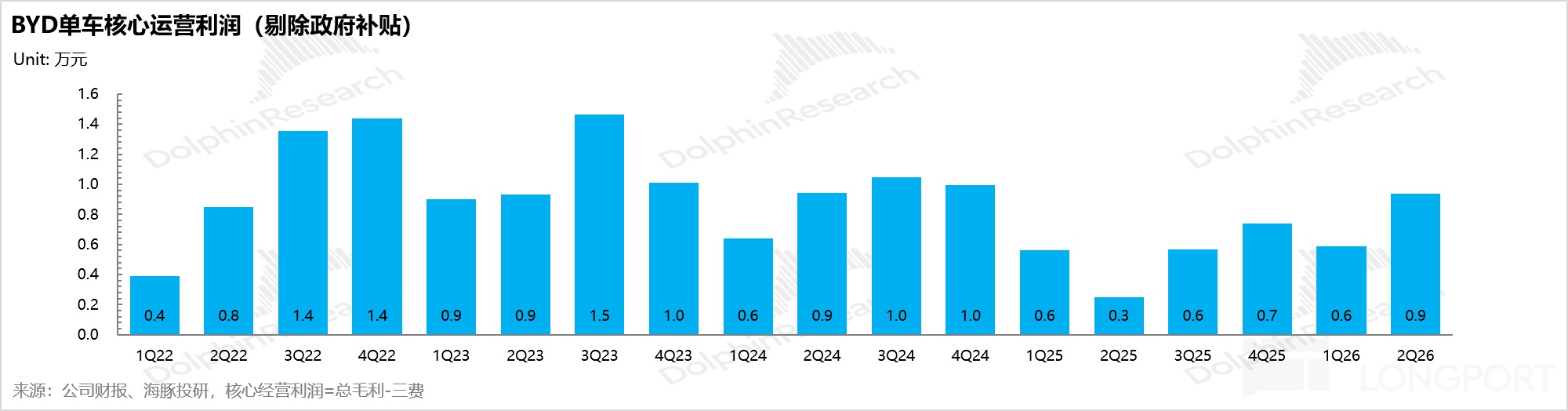
Excluding FX and other noise, core unit OP (GP minus taxes and opex) shows:
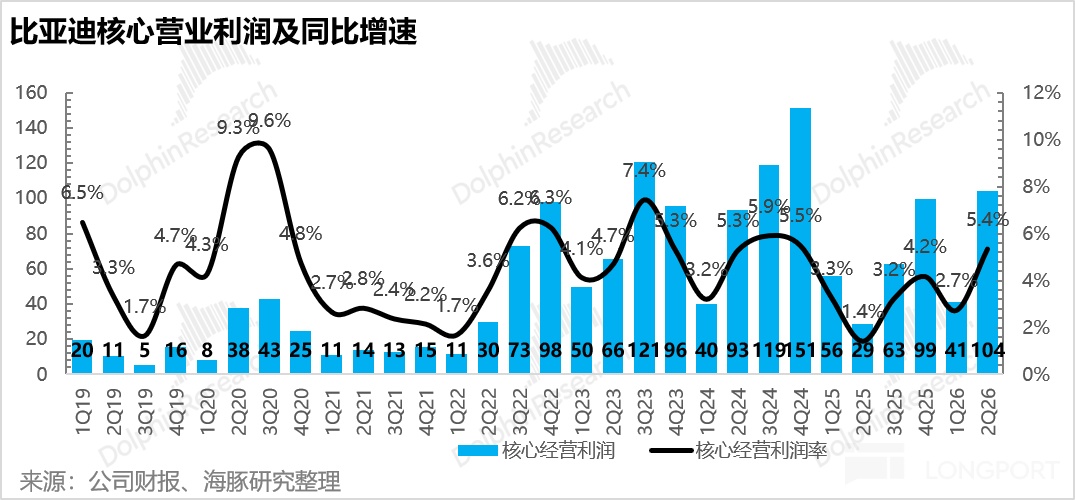
Q2 2026 core unit OP was ~RMB 9k, well above ~RMB 3k last year. Core OP reached ~RMB 10.4bn, aided by a low base in Q2 last year when upgraded AD models and price cuts pressured unit profits, volumes missed expectations, and auto GPM hit a low of 18.7%, while R&D stayed high at RMB 15.4bn.
This quarter, volume leverage (+58% QoQ to ~1.11mn units) and disciplined expenses unlocked profit elasticity.
3. BYD stabilizes share via 'overseas expansion + tech upgrades'
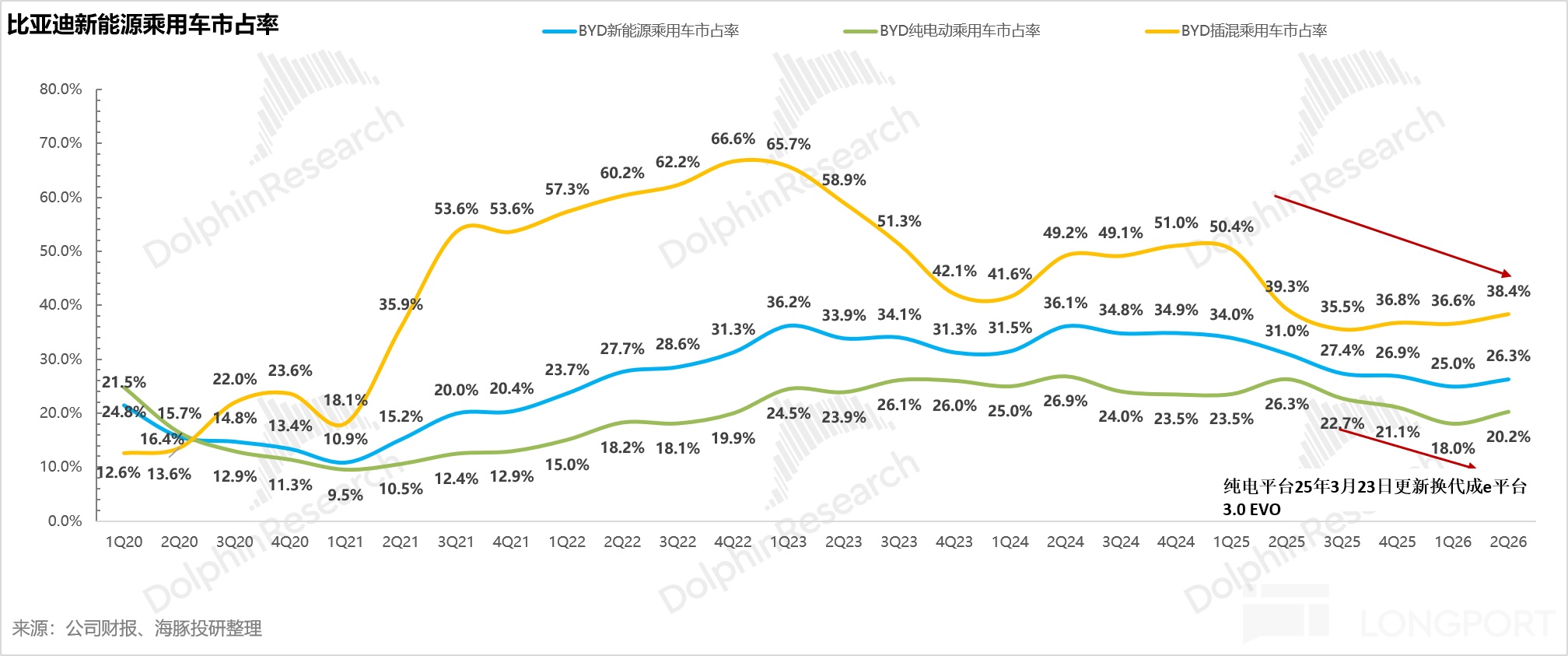
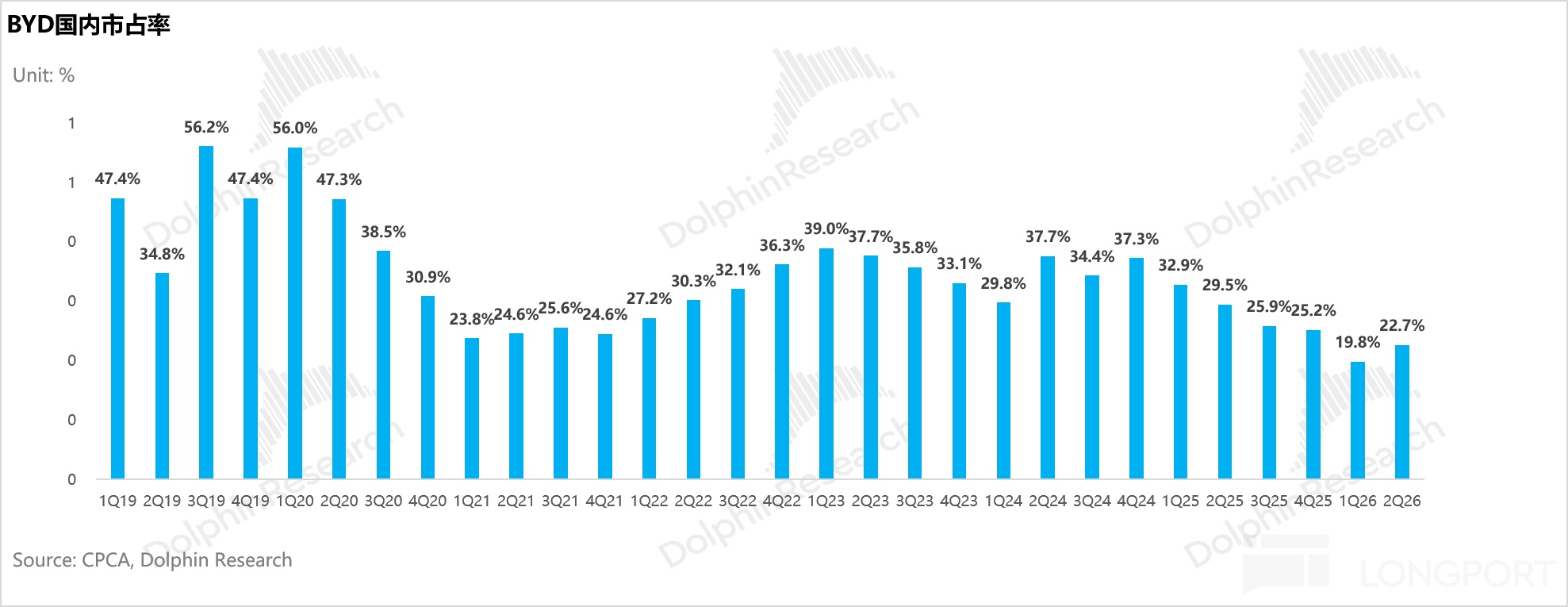
Since peaking at 36% in Q2 2024, BYD’s domestic share trended down. In Q2 2026, the launch of fast-charging models and rapid overseas growth lifted total share by 1.3ppt QoQ to 26.3%. Domestic share also rebounded from 19.8% in Q1 to 22.7% in Q2.
1) PHEV tech gap narrowed, but BYD’s share stabilized and rose
PHEV share rose ~1.8ppt QoQ to ~38.4%. While peers like Geely (Thor) and Chery (C-DM) have caught up on core metrics such as efficiency and power, narrowing BYD’s early DM 5.0 edge, export mix helped.
The share of PHEVs in exports continued to rise (40.6% of NEV exports in May, +6.7ppt YoY). Stronger demand in overseas markets, especially developing countries, offset domestic PHEV softness.
2) BEV share gain driven by fast-charging breakthroughs
BEV share rose ~2.2ppt QoQ to ~20.3% on the back of 2nd-gen blade battery and fast charging. Charging from 10% to 70% takes 5 minutes at room temperature, and 10% to 97% takes 9 minutes, keeping BYD ahead on tech. To arrest domestic share loss, BYD’s 2026 plan emphasizes 'tech for all' and faster refreshes, cascading core tech like 2nd-gen blade and MW-class fast charging across models priced above RMB 120k.
In parallel, a 'self-build + partnerships' charging network is targeted for large-scale rollout in 2026, with 20k stations including 2k along highways. This aims to alleviate charging pain points and repair domestic share.
Overseas remains the top strategic priority in 2026:
4. Overseas: from growth engine to profit pillar, monetizing higher profitability faster
Overseas momentum accelerated in Q2 2026, with 470k units shipped and a 43.3% mix, providing strong structural support to GPM. Higher overseas ASPs and unit profits turn overseas from mere volume growth into a 'profit ballast'.
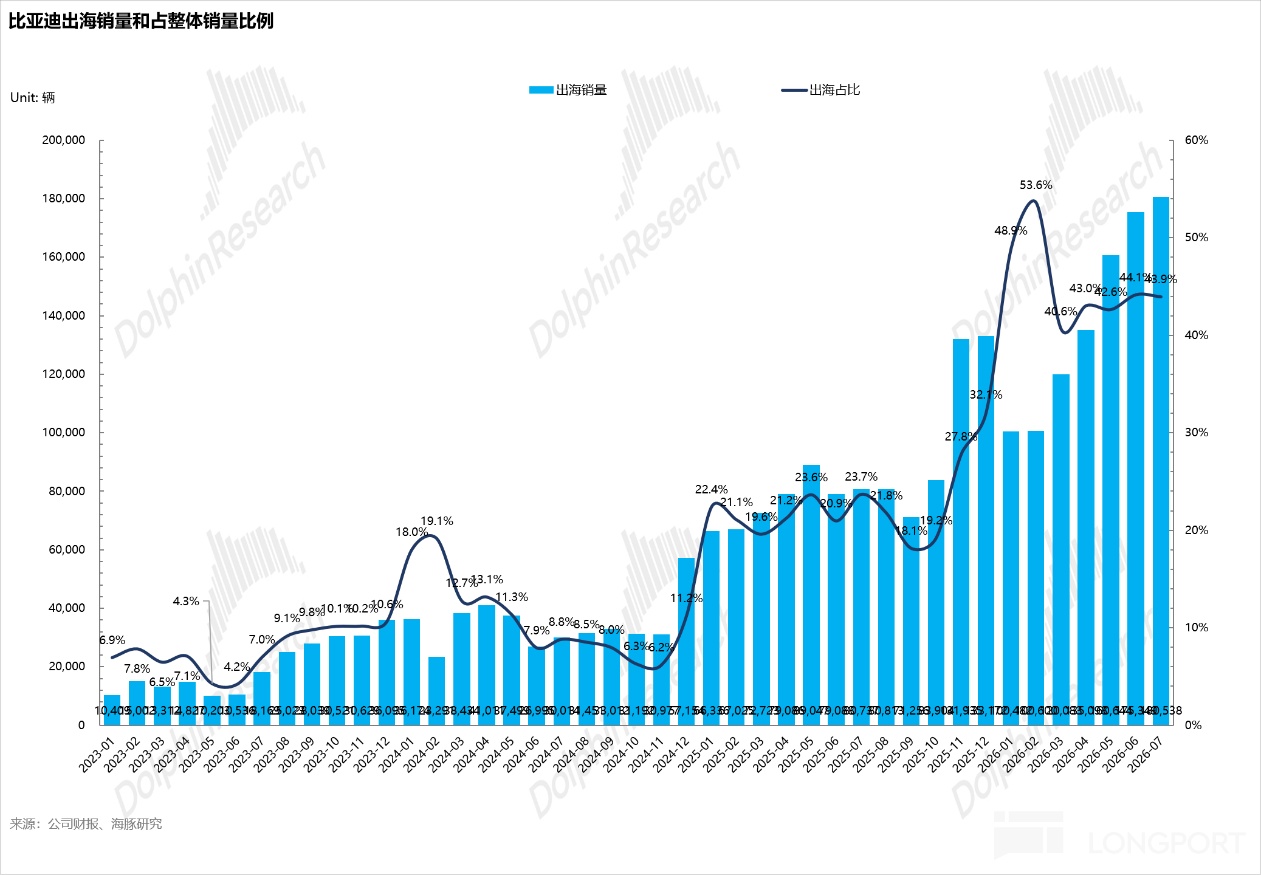
To counter fierce domestic competition and tighter NEV purchase tax incentives, BYD has made 'overseas expansion' a core 2026 strategy. The export target was lifted again from 1.5mn to 1.7–1.8mn units, with a stretch to 1.9mn likely. From Jan–Jul 2026, exports reached 970k, making the target highly achievable.
BYD’s export strategy centers on localized capacity and aggressive network build-out:
a. Accelerate localized capacity to avoid tariff barriers
To mitigate trade risks and improve regional delivery efficiency, BYD is building a global manufacturing network.
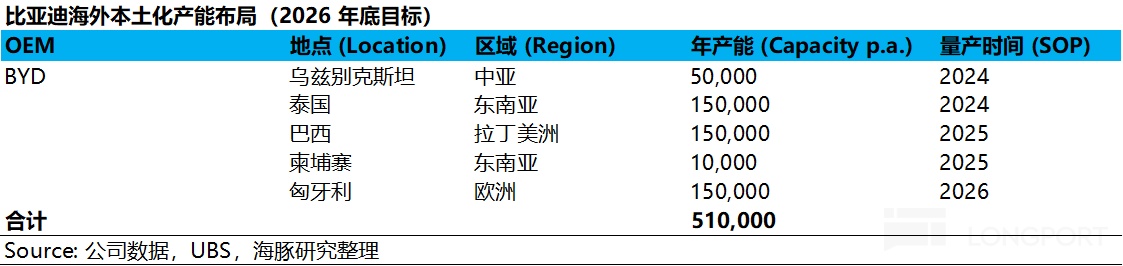
Two cores in the Americas and Europe: Brazil is online with 150k units of Phase I capacity and room for expansion; Hungary is slated for 2H26 start with 150k planned capacity.
Multiple new nodes in emerging markets: capacity projects in Indonesia and Turkey are progressing. By end-2026, localized overseas capacity should exceed 700k units with an 'eight countries, eight plants' footprint. Together with widespread KD facilities, BYD aims to shorten supply chains and respond efficiently to regional demand.
b. Rapid dealership expansion to strengthen channel reach
In Europe, BYD plans to double sales points from ~1,000 at end-2025 to 2,000 in 2026. Deeper partnerships with large local dealer groups will enhance brand reach and localization.
<End here>
Dolphin Research archive:
Earnings season
Aug. 30, 2025 review 'BYD: The Price-War King Under Siege — Has the 'Magic Sword' Become a Double-Edged Blade?'
Hot topics
Oct. 14, 2025 'Auto Tax Cut Thresholds Reset — Another Hit to BYD?'
Jun. 4, 2025 'BYD: Will It Become the Next Evergrande?'
Jun. 12, 2025 'BYD, Geely, Great Wall, NIO: Whose 60-Day Payables Are a Life-or-Death Test?'
Jul. 12, 2022 'Did Buffett Dump BYD? Case Closed'
Deep dives
Feb. 26, 2025 'Can 'ADAS for All' Recreate Another BYD?'
Feb. 19, 2025 'Up 30%! What’s in BYD’s 'ADAS for All' Playbook?'
Risk disclosure and disclaimer: Dolphin Research Disclaimer and General Disclosure




The copyright of this article belongs to the original author/organization.
The views expressed herein are solely those of the author and do not reflect the stance of the platform. The content is intended for investment reference purposes only and shall not be considered as investment advice. Please contact us if you have any questions or suggestions regarding the content services provided by the platform.